
33 And when the sixth hour had come, there was darkness over the whole land until the ninth hour.
34 And at the ninth hour Jesus cried with a loud voice, “Eloi, Eloi, lema sabachthani?” which means, “My God, my God, why have you forsaken me?”
35 And some of the bystanders hearing it said, “Behold, he is calling Elijah.”
36 And someone ran and filled a sponge with sour wine, put it on a reed and gave it to him to drink, saying, “Wait, let us see whether Elijah will come to take him down.”
37 And Jesus uttered a loud cry and breathed his last.
38 And the curtain of the temple was torn in two, from top to bottom.
39 And when the centurion, who stood facing him, saw that in this way he breathed his last, he said, “Truly this man was the Son of God!”
40 There were also women looking on from a distance, among whom were Mary Magdalene, and Mary the mother of James the younger and of Joses, and Salome.
41 When he was in Galilee, they followed him and ministered to him, and there were also many other women who came up with him to Jerusalem.
42 And when evening had come, since it was the day of Preparation, that is, the day before the Sabbath,
43 Joseph of Arimathea, a respected member of the council, who was also himself looking for the kingdom of God, took courage and went to Pilate and asked for the body of Jesus.
44 Pilate was surprised to hear that he should have already died.
45 And when he learned from the centurion that he was dead, he granted the corpse to Joseph.
46 And Joseph bought a linen shroud, and taking him down, wrapped him in the linen shroud and laid him in a tomb that had been cut out of the rock. And he rolled a stone against the entrance of the tomb.
47 Mary Magdalene and Mary the mother of Joses saw where he was laid.
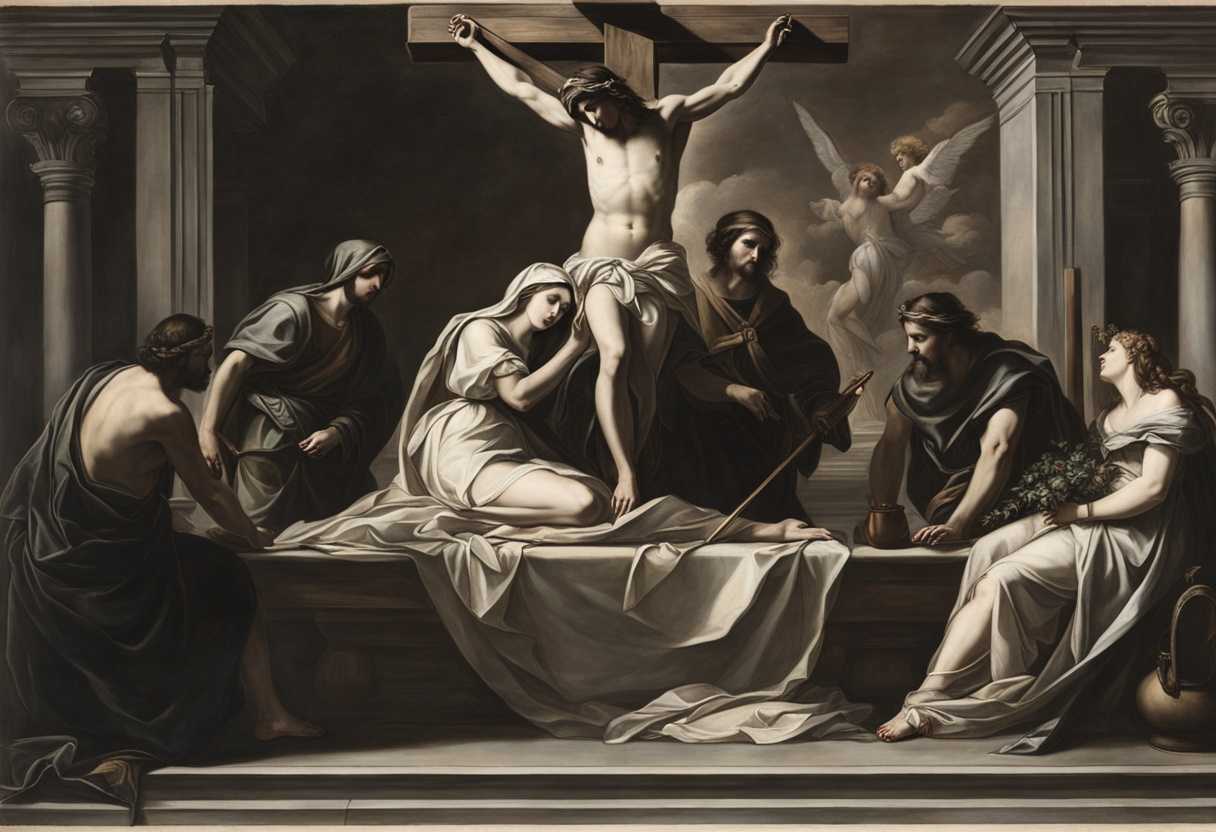
Setting the Scene for Mark 15:33-47
The scene in Mark chapter 15:33-47 takes place at Golgotha, the place of the Skull, where Jesus was crucified. The sky darkens in the middle of the day as Jesus hangs on the cross, enduring immense suffering. Roman soldiers, along with a crowd of onlookers, including religious leaders and passersby, gather around the site. Among them are Mary Magdalene, Mary the mother of James and Joseph, and Salome, who had followed Jesus from Galilee to care for Him.
The soldiers cast lots for Jesus’ clothing, and the religious leaders mock Him, challenging Him to save Himself if He truly is the Son of God. Despite the agony, Jesus remains steadfast in His mission, bearing the weight of the sins of the world. The scene is filled with a mix of emotions – from the soldiers carrying out their duty to the women who had faithfully followed Jesus, witnessing the culmination of His earthly ministry. The atmosphere is heavy with the weight of the momentous event unfolding before them, as Jesus willingly sacrifices Himself for the redemption of humanity.
What is Mark 15:33-47 about?
This verse encapsulates a pivotal moment in Christian theology – the death of Jesus Christ on the cross. The darkness that descends upon the land symbolizes the weight and significance of this momentous event. It signifies a cosmic shift, a moment of intense sorrow and mourning for believers. The tearing of the temple curtain is symbolic of the breaking down of barriers between humanity and the divine, as Jesus’ sacrifice opens up a new way for people to connect with God.
Picture this scene – a man willingly sacrificing himself, surrounded by darkness, yet his actions bring about a profound transformation. Joseph’s act of burying Jesus underscores the human response to this divine sacrifice, showing love, reverence, and the beginning of a journey of faith. Reflect on the depth of these events – the darkness, the tearing of the curtain, the burial – and consider the immense impact they have on believers’ understanding of salvation and redemption. Let these powerful images inspire you to contemplate the sacrificial love of Jesus and the profound implications it has for our lives.
Understanding what Mark 15:33-47 really means
An incredibly profound and deeply-moving passage vividly describes the crucifixion of Jesus Christ, His death, and the immediate response of those around Him in Mark 15:33-47. This section of Scripture is not only a cornerstone of Christian theology but also a powerful narrative that features themes of sacrifice, darkness, and faith.
The passage begins with a period of darkness enveloping the land, a physical manifestation of the somber event unfolding. This darkness, lasting from noon until three in the afternoon, symbolizes the grave weight of the moment—the Son of God bearing the sins of the world. Darkness often signifies judgment or divine intervention in biblical contexts. Think of the plagues in Egypt or the darkness at Mount Sinai; how do you see this aligning with those events?
Following this, Jesus utters a poignant cry, “Eloi, Eloi, lema sabachthani?” which means “My God, my God, why have you forsaken me?” Echoing Psalm 22, this phrase highlights the depth of Jesus’ suffering and His sense of abandonment at this crucial moment. This should make us, as readers, reflect on the times we have felt abandoned or alone. How does knowing Jesus endured such depths of despair impact your understanding of suffering?
The narrative progresses to the moment of Jesus’ death and the immediate events that follow, such as the tearing of the temple curtain. This act symbolizes the removal of the barrier between God and humanity, signifying direct access to the divine presence through the sacrifice of Jesus. How does this change your view of your relationship with God?
Furthermore, the reaction of the centurion, who states, “Truly this man was the Son of God!” after witnessing the events surrounding Jesus’ death, is pivotal. It showcases a Gentile’s recognition of Jesus’ divine nature and marks a significant moment of understanding and revelation. This serves as a reminder to us about the universal impact of Jesus’ life and death—how might this influence our interactions with those who do not share our faith?
Finally, the passage concludes with the devoted actions of Joseph of Arimathea and the women who followed Jesus. Their courage and dedication in the face of danger and despair provide a practical model of faithfulness and loyalty. Their example challenges us to ask ourselves in today’s world, where fear often dictates action: how can we display similar courage and commitment in our lives?
This passage, rich with theological and practical implications, invites us to contemplate darkness, sacrifice, and faithfulness. It encourages us not only to reflect on the narrative itself but also to apply its lessons in our lives, fostering a deeper and more active faith.
Why did Jesus feel forsaken on the cross?
Jesus felt forsaken on the cross because in that moment, He took on the sins of the world, bearing the weight of humanity’s wrongdoing. He, as a sinless and perfect sacrifice, felt the full separation from God that sin brings. This separation was not due to any fault of His own but was necessary for Him to complete the work of redemption and reconciliation between God and humanity. Jesus cried out in a loud voice in his moment of anguish, expressing the deep sense of abandonment and isolation he experienced on the cross. This intense feeling of abandonment underscores the tremendous sacrifice Jesus made for humanity, willingly enduring suffering and separation from God in order to bring salvation to all who believe in Him. Through this act, Jesus demonstrated the depth of His love and the extent to which He was willing to go to bring about the forgiveness of sins and offer eternal life to those who trust in Him.
Application
Imagine yourself as a worker in the vast marketplace of life where your actions are your currency. Now, think of Jesus’ sacrifice as the ultimate startup capital granted to you out of sheer love and immeasurable generosity. This profound gift has cleared your debts and funded your future endeavor—living a life guided by faith, humility, and gratitude. Every word you speak, every choice you make, can now be an investment back into this gift. How will you manage this incredible capital? Will you invest in actions that multiply this gift of grace or let it sit idle? Now, ask yourself, what will your spiritual portfolio look like at the end of your days?

Reverend Michael Johnson is an experienced Church Minister with a profound expertise in spirituality and guidance. With a serene presence and a compassionate heart, he has faithfully served his congregation for over 20 years, leading them on a spiritual journey towards inner peace and enlightenment. Reverend Johnson’s extensive knowledge of religious philosophies and profound understanding of human nature have made him a trusted confidant and mentor to many, as he seamlessly weaves his profound wisdom into life teachings. Reverend Johnson’s calming demeanor and empathetic nature continue to uplift and heal souls, nurturing a sense of unity and tranquility within his community.