
Mark 2:1-22 is about Jesus’ authority to forgive sins and perform miracles, demonstrating his divinity and challenging the religious leaders’ understanding of the Law.
2 And when he returned to Capernaum after some days, it was reported that he was at home.
2 And many were gathered together, so that there was no more room, not even at the door. And he was preaching the word to them.
3 And they came, bringing to him a paralytic carried by four men.
4 And when they could not get near him because of the crowd, they removed the roof above him, and when they had made an opening, they let down the bed on which the paralytic lay.
5 And when Jesus saw their faith, he said to the paralytic, “Son, your sins are forgiven.”
6 But some of the scribes were sitting there, questioning in their hearts,
7 “Why does this man speak like that? He is blaspheming! Who can forgive sins but God alone?”
8 And immediately Jesus, perceiving in his spirit that they thus questioned within themselves, said to them, “Why do you question these things in your hearts?
9 Which is easier, to say to the paralytic, ‘Your sins are forgiven,’ or to say, ‘Rise, take up your bed and walk’?
10 But that you may know that the Son of Man has authority on earth to forgive sins”—he said to the paralytic—
11 “I say to you, rise, pick up your bed, and go home.”
12 And he rose and immediately picked up his bed and went out before them all, so that they were all amazed and glorified God, saying, “We never saw anything like this!”
13 He went out again beside the sea, and all the crowd was coming to him, and he was teaching them.
14 And as he passed by, he saw Levi the son of Alphaeus sitting at the tax booth, and he said to him, “Follow me.” And he rose and followed him.
15 And as he reclined at table in his house, many tax collectors and sinners were reclining with Jesus and his disciples, for there were many who followed him.
16 And the scribes of the Pharisees, when they saw that he was eating with sinners and tax collectors, said to his disciples, “Why does he eat with tax collectors and sinners?”
17 And when Jesus heard it, he said to them, “Those who are well have no need of a physician, but those who are sick. I came not to call the righteous, but sinners.”
18 Now John’s disciples and the Pharisees were fasting. And people came and said to him, “Why do John’s disciples and the disciples of the Pharisees fast, but your disciples do not fast?”
19 And Jesus said to them, “Can the wedding guests fast while the bridegroom is with them? As long as they have the bridegroom with them, they cannot fast.
20 The days will come when the bridegroom is taken away from them, and then they will fast in that day.
21 No one sews a piece of unshrunk cloth on an old garment. If he does, the patch tears away from it, the new from the old, and a worse tear is made.
22 And no one puts new wine into old wineskins. If he does, the wine will burst the skins—and the wine is destroyed, and so are the skins. But new wine is for fresh wineskins.”
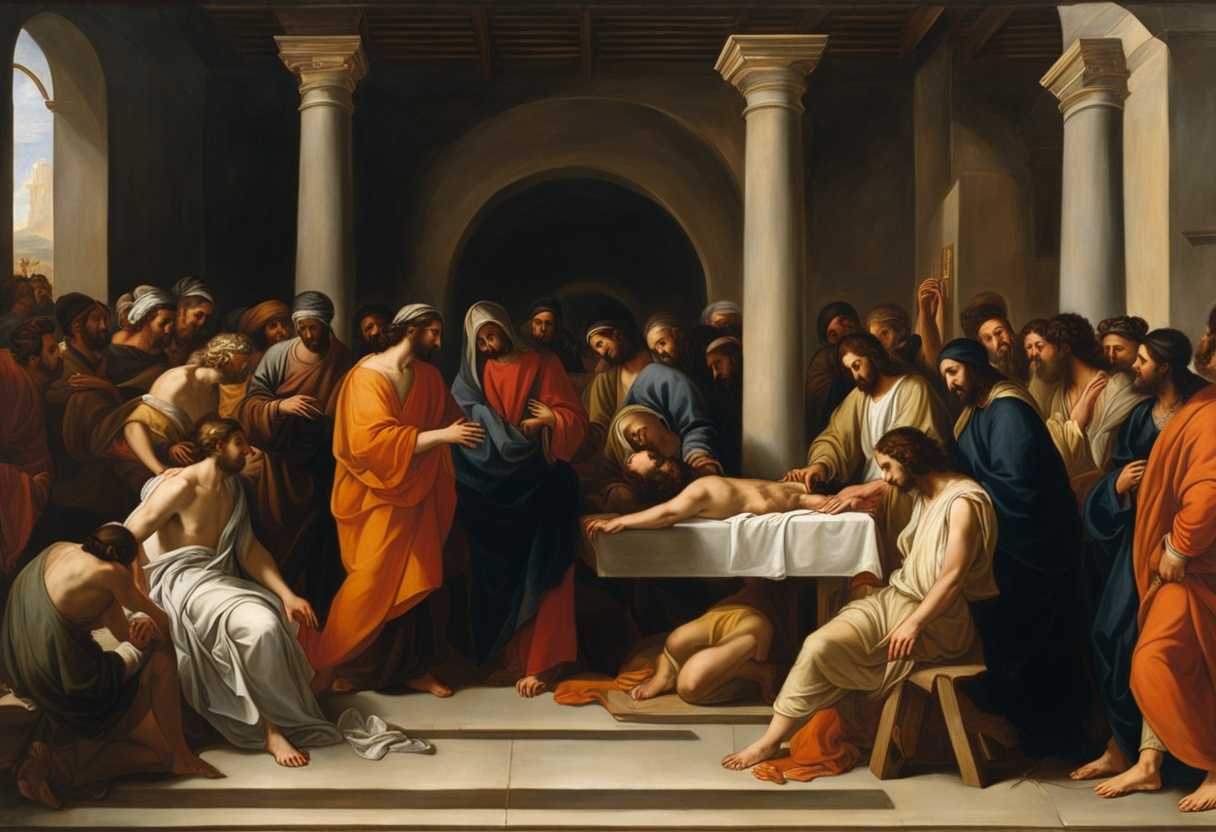
Setting the Scene for Mark 2:1-22
In Mark chapter 2, we find Jesus teaching in a house in Capernaum, a bustling fishing town on the northern shore of the Sea of Galilee. The news of Jesus’ miraculous healings and powerful teachings had spread far and wide, drawing crowds wherever He went. On this particular day, the house where Jesus was teaching quickly became packed with people eager to hear His words.
Among the crowd were the Pharisees and teachers of the law, who had come from nearby towns to observe Jesus and scrutinize His actions. They were seated near the front, watching Jesus closely for any signs of blasphemy or wrongdoing. Also present were Jesus’ disciples, including Peter, Andrew, James, and John, who had left their fishing nets to follow Him.
As Jesus spoke, a group of friends arrived carrying a paralyzed man on a mat. Unable to get through the crowded house, they climbed onto the roof, made an opening, and lowered the man down in front of Jesus. This act of faith and determination caught Jesus’ attention, and He not only forgave the man’s sins but also healed him, causing amazement and awe among the onlookers. This scene in Capernaum captures the essence of Jesus’ ministry – compassion, healing, forgiveness, and the challenge to traditional religious authorities.
What is Mark 2:1-22 about?
Jesus not only forgives sins but also heals the sick in this verse. This act showcases not only his compassion but also his authority as the Son of God. Jesus reveals his divine power to bring about spiritual healing and reconciliation with God by forgiving sins. Through physical healing, he demonstrates his ability to restore and renew our physical bodies, touching the lives of those who are suffering.
Have you ever stopped to ponder the significance of Jesus’ actions in this verse? It’s not just about the physical healing or the forgiveness of sins; it’s about Jesus showing us his ultimate authority over all aspects of our lives. Through his actions, Christ presents himself as the ultimate source of healing and restoration, offering us a pathway to redemption and renewal. Reflecting on the profound impact of this verse can deepen our understanding of Jesus’ divine nature and his boundless love for all of us.
Understanding what Mark 2:1-22 really means
In Mark 2:1-22, we witness a series of events that showcase the power and compassion of Jesus Christ. As Jesus returns to Capernaum, a large crowd gathers around Him, eager to witness His miracles and hear His teachings. The passage unfolds with the healing of a paralytic, the calling of Levi, and Jesus’ response to questions about fasting.
The healing of the paralytic in verses 1-12 is a profound demonstration of Jesus’ authority and compassion. When Jesus declares, “Son, your sins are forgiven,” He prioritizes spiritual healing over physical restoration. This act emphasizes the importance of inner healing and reconciliation with God. The cross-reference to Psalm 103:3 further underscores the connection between forgiveness of sins and healing. It prompts us to reflect on the significance of spiritual well-being in our lives today and how finding peace through forgiveness can bring about profound transformation.
Moreover, when Jesus instructs the paralytic to “Take up your mat and walk,” He showcases His power over physical ailments. This moment not only highlights Jesus’ ability to perform miracles but also encourages faith in His capacity to heal both body and soul. The cross-reference to Isaiah 35:6 paints a vivid picture of restoration and renewal, inspiring us to trust in Jesus’ transformative power. Consider how a modern-day miracle story of faith leading to physical healing can strengthen our belief in the miraculous works of Christ.
In verses 13-17, we witness the calling of Levi, a tax collector considered a sinner by society. Jesus’ simple yet powerful command, “Follow me,” demonstrates His inclusivity and willingness to call sinners to Himself. This act challenges societal norms and emphasizes the universal call to discipleship, regardless of one’s past. Drawing from the cross-reference in Matthew 9:13, we are reminded that Jesus came to save the lost, offering hope and redemption to all who seek Him. Reflect on how individuals, like a former addict finding purpose in following Jesus, can experience radical transformation through discipleship.
Furthermore, Jesus’ response to questions about fasting in verses 18-22 sheds light on His identity as the bridegroom and the ushering in of a time of joy. By referring to Himself as the bridegroom, Jesus invites us to partake in a season of celebration and rejoicing in His presence. The cross-reference to John 3:29 deepens our understanding of the intimate relationship between Christ and His followers, encouraging us to find joy and renewal in our faith community. Consider how a community’s shared celebration of faith can foster unity and spiritual growth.
Lastly, the metaphor of new wine into new wineskins symbolizes the new covenant and the necessity of embracing fresh perspectives and approaches to spirituality. Just as 2 Corinthians 5:17 speaks of becoming a new creation in Christ, this analogy challenges us to remain open to new spiritual insights and practices. Reflect on how a church’s willingness to adapt and innovate in worship and outreach can lead to growth and revitalization, ushering in a season of renewal and transformation.
In conclusion, the passage in Mark 2:1-22 illuminates Jesus’ authority to forgive sins, His call to sinners, and the joy found in His presence. As we meditate on these events, let us seek spiritual healing, embrace our calling as disciples, and find joy in our relationship with Jesus. Consider how the teachings and actions of Jesus in this passage can profoundly impact and transform your life today.
How can we have faith in God’s power?
We can have faith in God’s power by witnessing the evidence of this power through the miracles He performs. Jesus demonstrates His authority over sickness by healing a paralyzed man in the mentioned verses. This miracle reminds us of God’s limitless power to heal and restore. Seeing such miraculous displays of power can strengthen our faith in God’s ability to work in our own lives and circumstances.
Furthermore, the accounts in the mentioned verses also highlight the importance of belief and faith in accessing God’s power. The paralyzed man’s friends had faith that Jesus could heal him, which ultimately led to the miraculous healing taking place. This serves as a reminder for us to have unwavering faith in God’s power, believing that He is capable of doing the impossible when we align our trust with His will. We ultimately need to trust in God’s sovereignty and acknowledge that He is the ultimate source of all power and authority to have faith in His power. We can nurture a stronger faith that relies on His power to work wonders in our lives by meditating on the miracles in these verses and recognizing God’s ability to overcome obstacles.
Application
Embrace the faith that can conquer mountains and defy societal boundaries. Bring your loved ones to the Savior for spiritual healing and salvation – just like the friends who never gave up and lowered the paralytic through the roof. Let’s not be deterred by obstacles but show courage in seeking God’s transformative touch. Will you answer the call to step out in faith and lead others to Jesus for a new beginning?

Reverend Michael Johnson is an experienced Church Minister with a profound expertise in spirituality and guidance. With a serene presence and a compassionate heart, he has faithfully served his congregation for over 20 years, leading them on a spiritual journey towards inner peace and enlightenment. Reverend Johnson’s extensive knowledge of religious philosophies and profound understanding of human nature have made him a trusted confidant and mentor to many, as he seamlessly weaves his profound wisdom into life teachings. Reverend Johnson’s calming demeanor and empathetic nature continue to uplift and heal souls, nurturing a sense of unity and tranquility within his community.