
Mark 6:41 is about Jesus miraculously multiplying five loaves and two fish to feed a large crowd, demonstrating his compassion, power, and ability to provide for the needs of his followers beyond what was thought possible.
41 And taking the five loaves and the two fish, he looked up to heaven and said a blessing and broke the loaves and gave them to the disciples to set before the people. And he divided the two fish among them all.
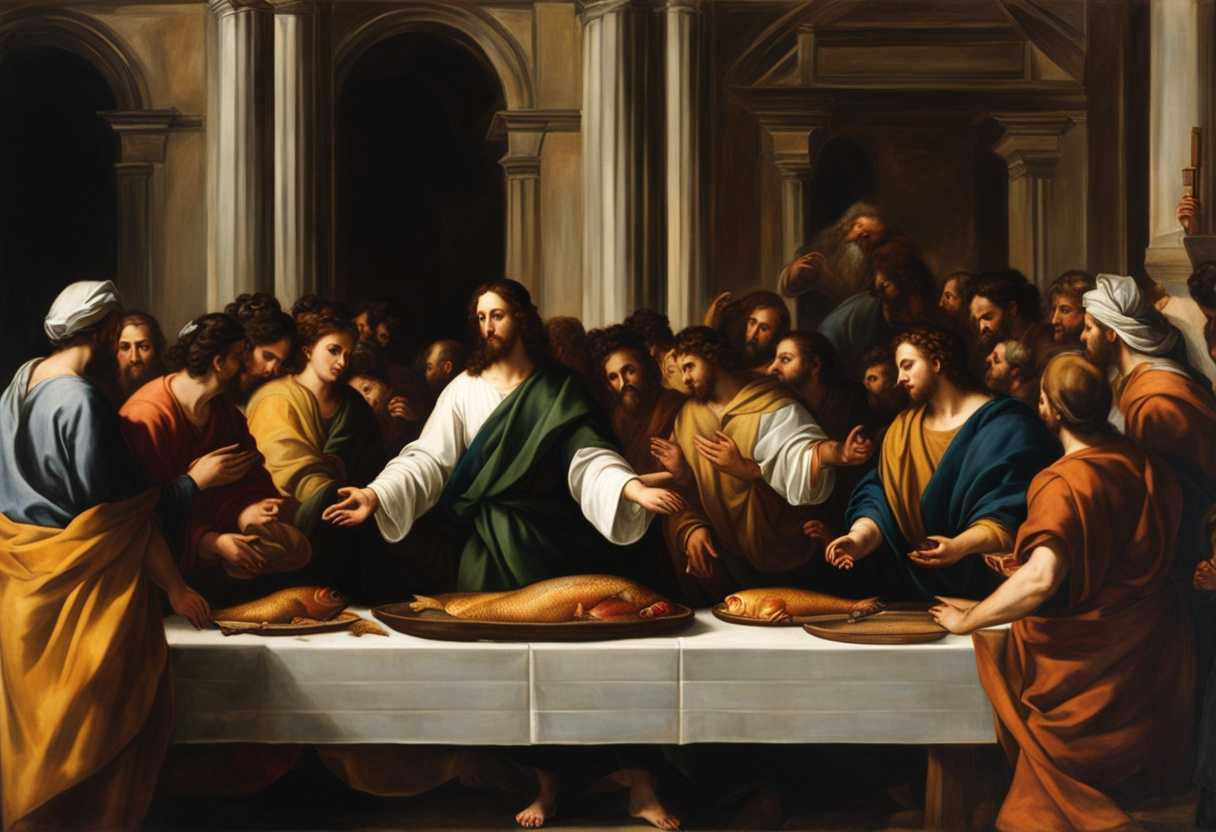
Setting the Scene for Mark 6:41
In Mark chapter 6, we find Jesus and his disciples in a remote place near the Sea of Galilee. A large crowd had been following Jesus, eager to hear his teachings and witness his miracles. As the day wore on, the disciples grew concerned about the people’s hunger and suggested to Jesus that he send them away to nearby villages to buy food for themselves.
However, Jesus had compassion on the crowd and instructed his disciples to gather what little food they had – five loaves of bread and two fish. He then directed the people to sit down on the grass in groups of hundreds and fifties. The scene is one of anticipation and wonder as Jesus took the loaves and fish, looked up to heaven, blessed the food, and began breaking it to distribute among the people. The disciples watched in amazement as the food multiplied, feeding the entire crowd with plenty left over.
The setting is serene, with the Sea of Galilee glistening in the background and the gentle breeze rustling through the grassy meadow. The disciples, including Peter, James, John, and Andrew, are bustling about, organizing the crowd and distributing the miraculous meal. The crowd is a mix of men, women, and children, their faces filled with awe and gratitude as they witness this incredible display of Jesus’ power and provision.
What is Mark 6:41 about?
Isn’t it incredible how through this miracle, Jesus teaches us about the abundance that comes from faith and generosity? Jesus reveals his divine power and compassion in this powerful event as he turns a seemingly inadequate amount of food into an overflow of sustenance for thousands. This miracle shows us that with faith in God, even the most unlikely resources can be multiplied beyond our wildest imagination.
Furthermore, this miracle of the multiplication of the loaves and fish serves as a metaphor for the Eucharist, where Jesus continues to nourish us spiritually with his body and blood. Jesus continues to provide for us in ways that surpass our limited understanding, just as he physically fed the five thousand. This event invites us to reflect on the importance of sharing what we have, trusting in God’s provision, and recognizing the blessings that come from acts of generosity. Like the disciples who distributed the food in abundance, we are called to be instruments of God’s love and provision in the world.
Understanding what Mark 6:41 really means
In the Gospel of Mark, we encounter a profound moment in the ministry of Jesus, where He feeds the 5,000 with just five loaves and two fish. This miraculous event is not just a display of Jesus’ power but also a lesson in faith and provision. As Jesus faced a large crowd hungry for both physical and spiritual nourishment, the disciples suggested sending them away. However, Jesus, in His compassion and divine wisdom, chose to perform a miracle that would resonate through the ages.
The key phrases in Mark 6:41 offer us insights into the significance of this miracle. “Taking the five loaves and the two fish” emphasizes the starting point of the miracle – a meager offering that, through faith and divine intervention, became abundant provision. It teaches us that God can work wonders with what may seem insufficient in our eyes. When Jesus “looked up to heaven and gave thanks,” He demonstrated a posture of gratitude and reliance on God’s sovereignty. This act reminds us of the importance of acknowledging God’s provision in our lives and approaching Him with thankfulness.
The action of Jesus breaking the loaves symbolizes not only the physical act of sharing food but also the spiritual significance of His sacrifice. By breaking the loaves, Jesus foreshadows the breaking of His body for the salvation of humanity. This act of sharing and sacrifice is a profound metaphor for the selflessness and love that underpin Jesus’ ministry and teachings.
In connecting Mark 6:41 to other passages in the Bible, we see a consistent theme of God’s provision and care for His people. Jesus declaring, “I am the bread of life” in John 6:35 links the physical feeding of the 5,000 to the spiritual nourishment that He offers. Philippians 4:19 reassures us that God will meet all our needs according to His riches, echoing the message of abundance and provision. Psalm 23:1 further emphasizes the idea that the Lord is our shepherd, and we lack nothing under His care.
The relevance of this passage to our lives today is profound. In a world where scarcity and need are prevalent, Mark 6:41 reminds us of God’s ability to provide abundantly from the most modest of resources. It encourages us to cultivate a spirit of gratitude for what we have and to trust in God’s ability to multiply our efforts and resources beyond our expectations.
Consider a modern-day example like a community garden project. Initially, resources may be limited, but through faith, collaboration, and hard work, the garden flourishes, providing sustenance for many. This anecdote mirrors the miracle of the loaves and fishes, illustrating how God can multiply our efforts when we trust in Him and work together towards a common goal.
In conclusion, Mark 6:41 teaches us valuable lessons about gratitude, faith, and God’s miraculous provision. It challenges us to look beyond our limitations, trust in God’s infinite resources, and participate in His work of abundance and blessing in the world.
What limits do I place on God’s provision?
Jesus multiplied the loaves and fishes to feed a large crowd in this verse. The act of feeding the multitude with so little reveals God’s ability to provide abundantly beyond our human limitations. It shows that God’s provision is not constrained by the size or scarcity of our resources. Jesus demonstrates that there are no limits to God’s ability to provide for our needs by performing this miracle.
When we limit God’s provision, we are essentially placing restrictions on His power and sovereignty. We may doubt His ability to provide for us in times of need or underestimate the ways in which He can work miracles in our lives. By acknowledging and trusting in God’s unlimited provision, we open ourselves up to experiencing His abundant blessings and grace in ways that surpass our understanding.
Therefore, instead of imposing our own limitations on God’s provision, we should have faith in His ability to meet all our needs according to His riches and glory. We should approach every situation with a mindset of expectancy, knowing that God’s provision knows no bounds and He is able to do exceedingly abundantly above all that we can ask or think.
Application
Think of your family gatherings and work meetings. When Jesus took a small amount of food, blessed it and fed thousands, he trusted and acted. Can you trust that your own small actions can lead to great impact too? In your daily hustle, can you extend generosity, even when your resources appear limited? What if sharing just a little more could multiply blessings beyond your imagination?

Reverend Michael Johnson is an experienced Church Minister with a profound expertise in spirituality and guidance. With a serene presence and a compassionate heart, he has faithfully served his congregation for over 20 years, leading them on a spiritual journey towards inner peace and enlightenment. Reverend Johnson’s extensive knowledge of religious philosophies and profound understanding of human nature have made him a trusted confidant and mentor to many, as he seamlessly weaves his profound wisdom into life teachings. Reverend Johnson’s calming demeanor and empathetic nature continue to uplift and heal souls, nurturing a sense of unity and tranquility within his community.