
Mark 8:1-9 is about Jesus demonstrating his compassion and ability to provide abundance by miraculously feeding a multitude of people with limited resources, promoting faith in divine provision and pointing to his role as the sustainer of both physical and spiritual nourishment.
In those days, when again a great crowd had gathered, and they had nothing to eat, he called his disciples to him and said to them,
2 “I have compassion on the crowd, because they have been with me now three days and have nothing to eat.”
3 And if I send them away hungry to their homes, they will faint on the way. And some of them have come from far away.”
4 And his disciples answered him, “How can one feed these people with bread here in this desolate place?”
5 And he asked them, “How many loaves do you have?” They said, “Seven.”
6 And he directed the crowd to sit down on the ground. And he took the seven loaves, and having given thanks, he broke them and gave them to his disciples to set before the people; and they set them before the crowd.
7 And they had a few small fish.
8 And they ate and were satisfied. And they took up the broken pieces left over, seven baskets full.
9 And they ate and were satisfied. And they took up the broken pieces left over, seven baskets full.
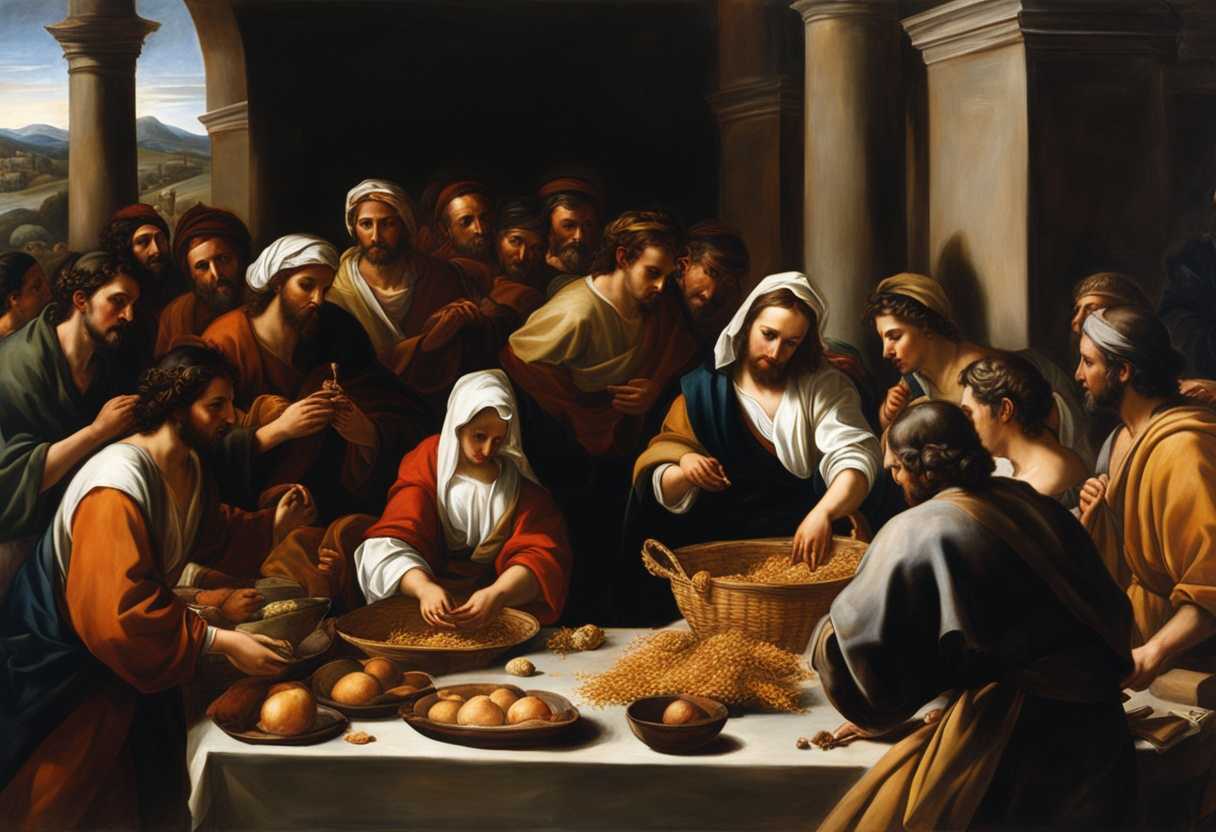
Setting the Scene for Mark 8:1-9
In Mark chapter 8, we find Jesus surrounded by a large crowd of people who have been following Him for days, eager to hear His teachings and witness His miracles. The scene is set on a grassy hillside near the Sea of Galilee, with the sun beginning to set in the distance, casting a warm golden glow over the gathering.
Among the crowd are the twelve disciples, who have been traveling with Jesus and learning from Him. They are tired and hungry, having journeyed far from the nearby villages to be with their beloved teacher. As the evening approaches, Jesus looks out at the multitude before Him with compassion, knowing that they too are in need of nourishment.
With only a few loaves of bread and fish provided by a young boy, Jesus performs a miraculous feeding, multiplying the food to satisfy the hunger of the thousands gathered. The disciples are amazed as they distribute the food, witnessing firsthand the power and compassion of their Lord. This event serves as a powerful demonstration of Jesus’ divinity and care for His people, leaving a lasting impact on all who were present on that hillside that day.
What is Mark 8:1-9 about?
Imagine witnessing such a miraculous event – Jesus turning a small amount of food into enough to feed thousands. This powerful act of compassion and abundance emphasizes the divine nature of Jesus and his ability to provide for all in times of need. Despite the limited resources available, Jesus demonstrates that with faith and trust, even the seemingly impossible can be achieved.
This verse teaches us about the limitless generosity and compassion of Jesus, showing us that no matter how scarce our resources may seem, there is always enough in the hands of the divine. It prompts us to reflect on our own lives and consider where we may be limiting ourselves out of fear or doubt, rather than trusting in the abundance of the universe. This miraculous feeding ultimately serves as a reminder of the boundless love and provision available to us when we have faith and believe in the power of divine grace.
Understanding what Mark 8:1-9 really means
In Mark 8:1-9, we witness a profound display of Jesus’ compassion and miraculous provision as He feeds a crowd of 4,000 with just seven loaves of bread and a few small fish. The setting is a remote area where people have gathered to hear Jesus teach, and after three days without food, Jesus expresses deep empathy for their physical and spiritual well-being, ensuring they do not leave hungry.
Jesus’ words, “I have compassion for these people,” reveal His heart of love and concern for those in need, emphasizing the significance of compassion in the Christian life. The statement, “They have already been with me three days and have nothing to eat,” underscores both the crowd’s dedication to Jesus’ teachings and their pressing physical need, setting the stage for the forthcoming miracle.
When Jesus asks, “How many loaves do you have?” He initiates the miracle by highlighting the importance of utilizing available resources, no matter how meager, to achieve great things through faith. The act of giving thanks and breaking the loaves before distributing them underscores the value of gratitude and acknowledging God’s provision in all circumstances.
This passage resonates with other biblical accounts, such as the feeding of the 5,000 in Matthew 14:13-21, showcasing Jesus’ compassion and ability to provide abundantly. In John 6:35, Jesus declares, “I am the bread of life,” connecting the physical nourishment of the crowd to the spiritual sustenance He offers. Psalm 23:1 echoes the theme of God’s provision, stating, “The Lord is my shepherd, I lack nothing.”
Today, this passage remains relevant as it prompts us to embody compassion and empathy towards those in need, urging us to take tangible actions to help others. It encourages believers to have faith in God’s provision, even when resources appear scarce, and teaches us the importance of gratitude, trusting that God can multiply our efforts.
Consider a scenario where a community center with dwindling food supplies experiences a surge of donations after the volunteers pray and give thanks, mirroring the miracle of the loaves and fishes. This modern-day anecdote illustrates how faith and gratitude can lead to abundance, echoing the timeless message of Mark 8:1-9.
In conclusion, Mark 8:1-9 serves as a poignant reminder of Jesus’ compassion, the significance of faith, and the miraculous ways in which God provides for our needs. It calls us to embody compassion, trust in God’s provision, and cultivate a spirit of gratitude in all circumstances, echoing the timeless truths that continue to resonate with believers today.
How does Jesus show compassion for those in need?
Jesus shows great compassion towards the crowd who had been following Him for three days and were in need of food in Mark 8:1-9. Despite the remote location and limited resources, Jesus did not send them away hungry, but instead, He miraculously multiplied the loaves and fish to feed the entire crowd of about four thousand people. This act of compassion and provision demonstrated Jesus’ care for the physical needs of those who followed Him.
Additionally, Jesus also showed compassion for the people by considering their spiritual needs. Before feeding them, He took time to teach and minister to them, showing that He cared not only for their physical hunger but also for their spiritual well-being. Jesus exemplified true compassion and care for those in need by fulfilling their immediate need for food and addressing their deeper spiritual needs, displaying His love and concern for all aspects of their lives.
Application
Imagine juggling work and family, with everyone depending on you. Just like Jesus feeding the four thousand, His compassion and provision were limitless. Think of this when you’re feeling overwhelmed; God’s faithfulness and grace are there for you too. Trust in His ability to meet your needs, and let that drive you to be a source of compassion for others. How will you answer the call to believe and act on this today?

Reverend Michael Johnson is an experienced Church Minister with a profound expertise in spirituality and guidance. With a serene presence and a compassionate heart, he has faithfully served his congregation for over 20 years, leading them on a spiritual journey towards inner peace and enlightenment. Reverend Johnson’s extensive knowledge of religious philosophies and profound understanding of human nature have made him a trusted confidant and mentor to many, as he seamlessly weaves his profound wisdom into life teachings. Reverend Johnson’s calming demeanor and empathetic nature continue to uplift and heal souls, nurturing a sense of unity and tranquility within his community.