
1 At that time Jesus went through the grainfields on the Sabbath. His disciples were hungry, and they began to pluck heads of grain and to eat.
2 But when the Pharisees saw it, they said to him, “Look, your disciples are doing what is not lawful to do on the Sabbath.”
3 He said to them, “Have you not read what David did when he was hungry, and those who were with him:
4 how he entered the house of God and ate the bread of the Presence, which it was not lawful for him to eat nor for those who were with him, but only for the priests?
5 Or have you not read in the Law how on the Sabbath the priests in the temple profane the Sabbath and are guiltless?
6 I tell you, something greater than the temple is here.
7 And if you had known what this means, ‘I desire mercy, and not sacrifice,’ you would not have condemned the guiltless.
8 For the Son of Man is lord of the Sabbath.”
9 He went on from there and entered their synagogue.
10 And a man was there with a withered hand.
11 He said to them, “Which one of you who has a sheep, if it falls into a pit on the Sabbath, will not take hold of it and lift it out?
12 Of how much more value is a man than a sheep! So it is lawful to do good on the Sabbath.”
13 Then he said to the man, “Stretch out your hand.” And the man stretched it out, and it was restored, healthy like the other.
14 But the Pharisees went out and conspired against him, how to destroy him.
15 Jesus, aware of this, withdrew from there. And many followed him, and he healed them all.
16 and ordered them not to make him known.
17 This was to fulfill what was spoken by the prophet Isaiah:
18 “Behold, my servant whom I have chosen, my beloved with whom my soul is well pleased. I will put my Spirit upon him, and he will proclaim justice to the Gentiles.”
19 He will not quarrel or cry aloud, nor will anyone hear his voice in the streets;
20 a bruised reed he will not break, and a smoldering wick he will not quench, until he brings justice to victory;
21 and in his name the Gentiles will hope.”
22 Then a demon-oppressed man who was blind and mute was brought to him, and he healed him, so that the man spoke and saw.
23 And all the people were amazed, and said, “Can this be the Son of David?”
24 But when the Pharisees heard it, they said, “It is only by Beelzebul, the prince of demons, that this man casts out demons.”
25 Knowing their thoughts, he said to them, “Every kingdom divided against itself is laid waste, and no city or house divided against itself will stand.
26 And if Satan casts out Satan, he is divided against himself. How then will his kingdom stand?
27 And if I cast out demons by Beelzebul, by whom do your sons cast them out? Therefore they will be your judges.
28 But if it is by the Spirit of God that I cast out demons, then the kingdom of God has come upon you.
29 Or how can someone enter a strong man’s house and plunder his goods, unless he first binds the strong man? Then indeed he may plunder his house.
30 Whoever is not with me is against me, and whoever does not gather with me scatters.
31 Therefore I tell you, every sin and blasphemy will be forgiven people, but the blasphemy against the Spirit will not be forgiven.
32 And whoever speaks a word against the Son of Man will be forgiven, but whoever speaks against the Holy Spirit will not be forgiven, either in this age or in the age to come.
33 “Either make the tree good and its fruit good, or make the tree bad and its fruit bad, for the tree is known by its fruit.
34 You brood of vipers! How can you speak good, when you are evil? For out of the abundance of the heart the mouth speaks.
35 The good person out of his good treasure brings forth good, and the evil person out of his evil treasure brings forth evil.
36 I tell you, on the day of judgment people will give account for every careless word they speak.
37 For by your words you will be justified, and by your words you will be condemned.
38 Then some of the scribes and Pharisees answered him, saying, “Teacher, we wish to see a sign from you.”
39 But he answered them, “An evil and adulterous generation seeks for a sign, but no sign will be given to it except the sign of the prophet Jonah.
40 For just as Jonah was three days and three nights in the belly of the great fish, so will the Son of Man be three days and three nights in the heart of the earth.
41 The men of Nineveh will rise up at the judgment with this generation and condemn it, for they repented at the preaching of Jonah, and behold, something greater than Jonah is here.
42 The queen of the South will rise up at the judgment with this generation and condemn it, for she came from the ends of the earth to hear the wisdom of Solomon, and behold, something greater than Solomon is here.
43 “When the unclean spirit has gone out of a person, it passes through waterless places seeking rest, but finds none.
44 Then it says, ‘I will return to my house from which I came.’ And when it comes, it finds the house empty, swept, and put in order.
45 Then it goes and brings with it seven other spirits more evil than itself, and they enter and dwell there, and the last state of that person is worse than the first. So also will it be with this evil generation.
46 While he was still speaking to the people, behold, his mother and his brothers stood outside, asking to speak to him.
47 Someone told him, “Your mother and your brothers are standing outside, asking to speak to you.”
48 But he replied to the man who told him, “Who is my mother, and who are my brothers?”
49 And stretching out his hand toward his disciples, he said, “Here are my mother and my brothers!
50 For whoever does the will of my Father in heaven is my brother and sister and mother.”
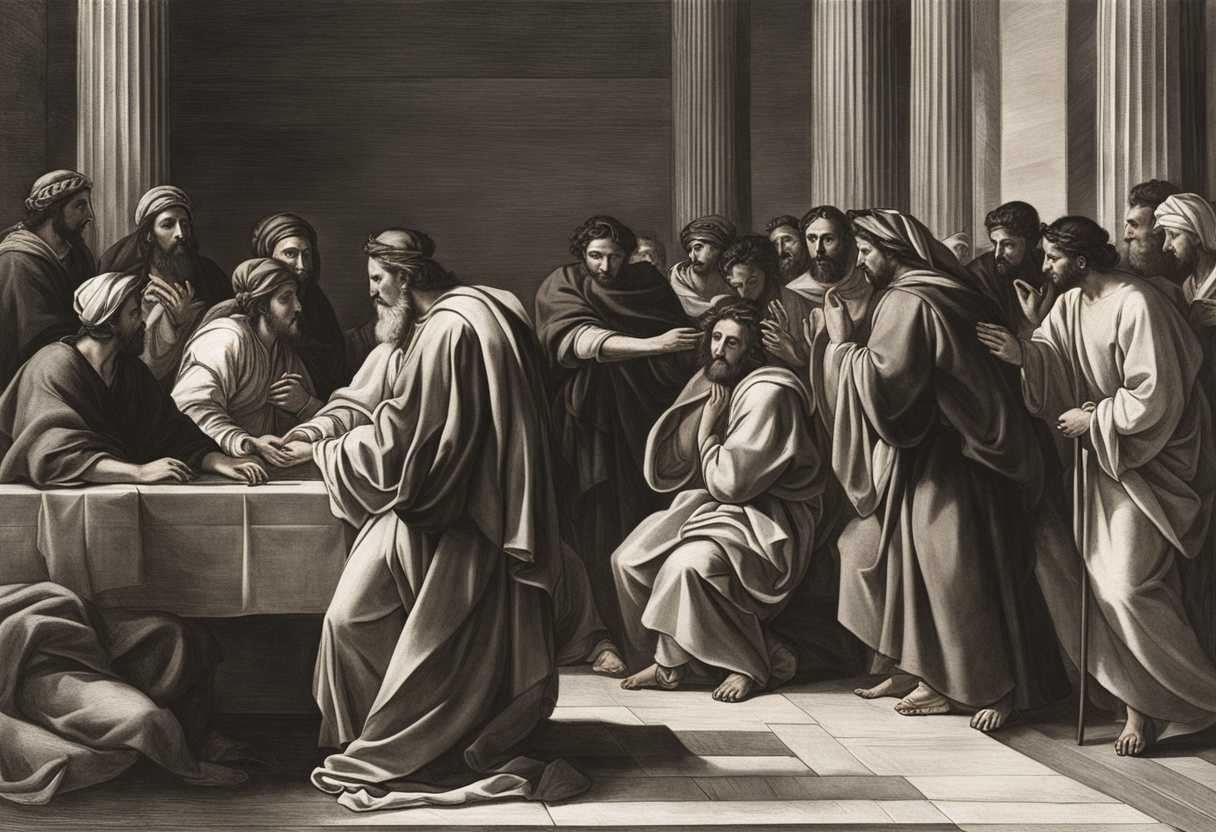
The True Meaning of Matthew 12
The Gospel of Matthew was written by the apostle Matthew, also known as Levi, who was one of the twelve disciples of Jesus. Matthew, a former tax collector, had a unique perspective on the life and teachings of Christ. Jesus and the Pharisees, the religious leaders of the time, engage in a series of confrontations in this chapter. These encounters shed light on the growing tension between Jesus’ message of grace and the Pharisees’ strict adherence to the law. We’ll see how Jesus challenges their rigid interpretations and offers a new understanding of the Sabbath and the nature of true righteousness.
The chapter also includes the famous “Parable of the Sower,” where Jesus uses an agricultural metaphor to illustrate the different responses people have to the message of the Kingdom of God. This parable echoes the teachings found in the Gospels of Mark and Luke, highlighting the consistent themes that run throughout the Synoptic Gospels. As we delve into this chapter, we’ll gain a deeper appreciation for Jesus’ unwavering commitment to his mission, even in the face of mounting opposition from the religious establishment. His actions and words will challenge us to re-examine our own understanding of faith and the true nature of righteousness.
Matthew 12:1-8
Several key sections in Matthew 12:1-8 are important to break down for a comprehensive understanding.
- Verse 1: “At that time Jesus went through the grainfields on the Sabbath. His disciples were hungry and began to pick some heads of grain and eat them.”
-
This verse sets the stage for the following events. Jesus, along with his disciples, is seen walking through the grainfields on the Sabbath. The fact that they were hungry and began to eat the heads of grain is significant because it leads to a confrontation over Sabbath observance.
-
Verses 2-4: “When the Pharisees saw this, they said to him, ‘Look! Your disciples are doing what is unlawful on the Sabbath.’ He answered, ‘Haven’t you read what David did when he and his companions were hungry? He entered the house of God, and he and his companions ate the consecrated bread—which was not lawful for them to do, but only for the priests.”
-
Here, the Pharisees accuse Jesus’ disciples of breaking the Sabbath by harvesting grain on that day. Jesus responds by referring to an incident from the Old Testament (1 Samuel 21:1-6) involving David when he and his men ate the consecrated bread that was normally reserved for the priests. Jesus is highlighting the principle of mercy and compassion over strict legalism by referencing this event. He is challenging the Pharisees’ interpretation of the Sabbath law and emphasizing the importance of understanding the spirit of the law rather than just the letter.
-
Verses 5-8: “Or haven’t you read in the Law that the priests on Sabbath duty in the temple desecrate the Sabbath and yet are innocent? I tell you that something greater than the temple is here. If you had known what these words mean, ‘I desire mercy, not sacrifice,’ you would not have condemned the innocent.”
- Jesus further reinforces his point by pointing out that the priests in the temple, despite working on the Sabbath, are considered blameless. He then asserts his authority by stating that something greater than the temple (referring to Himself) is present. This statement draws attention to his divinity and unique role in fulfilling the law. Jesus concludes by quoting from the prophet Hosea (Hosea 6:6), emphasizing that God values mercy and compassion over rigid adherence to rituals and sacrifices. This challenges the Pharisees to reexamine their priorities and understand the heart of God’s desires. Jesus challenges the traditional interpretation and application of the Sabbath law by the Pharisees in these verses. He highlights the importance of mercy, compassion, and understanding the spirit of God’s laws over legalistic adherence to rules. Jesus demonstrates that there are exceptions to the law when the greater principles of love and mercy are at stake by referring to the actions of David and the practices of the priests in the temple. This passage serves as a reminder for believers to prioritize love, compassion, and understanding in their interactions with others, rather than getting caught up in legalistic rules that may miss the heart of God’s intentions.
Matthew 12:9-14
Jesus heals a man with a withered hand on the Sabbath in Matthew 12:9-14. This event is significant because it reveals Jesus’ compassion for the suffering and his willingness to challenge the legalistic interpretations of the Sabbath laws held by the religious leaders of the time. Jesus entered the synagogue in the first section, and there was a man with a withered hand. The man’s condition symbolizes brokenness and helplessness, reflecting the spiritual state of many people who are in need of healing and restoration. Jesus is demonstrating that acts of compassion and mercy override strict adherence to legalistic rules by choosing to heal the man on the Sabbath. This challenges the Pharisees’ narrow understanding of the Sabbath and shows that love and compassion should always take precedence.
When Jesus asks the Pharisees if it is lawful to heal on the Sabbath, they remain silent. Their silence reveals their hypocrisy and their lack of understanding of the true purpose of the Sabbath. The Sabbath was intended as a day of rest and reflection, a time to honor God and remember His goodness. Jesus, by healing on the Sabbath, is showing that the Sabbath is a day to do good and to bring healing and restoration to others.
Jesus then goes on to say that it is lawful to do good on the Sabbath. This statement challenges the Pharisees’ legalistic interpretation of the Sabbath laws and emphasizes the importance of doing good deeds and showing compassion to others at all times, not just on the Sabbath. It underscores the message of love and mercy that Jesus consistently taught throughout his ministry.
Finally, Jesus heals the man’s withered hand, and it is restored to full health. This miracle not only showcases Jesus’ divine power and authority but also highlights his compassion for those who are suffering. Jesus is not only restoring physical health but also offering spiritual healing and redemption by healing the man’s hand. This event serves as a powerful example of Jesus’ mission to bring healing, restoration, and salvation to all who come to him in faith. The passage of Matthew 12:9-14 serves as a powerful reminder of the importance of showing compassion, love, and mercy to others, even in the face of rigid religious traditions and legalistic interpretations. It challenges us to prioritize acts of kindness and goodness, just as Jesus did, and to always seek to bring healing and restoration to those in need. It reminds us that true observance of faith involves not just following rules but also embodying the spirit of love and mercy that Jesus exemplified throughout his life and ministry.
Matthew 12:15-21
Several key sections in Matthew 12:15-21 are important to explore and understand. Let’s break down the verse into these parts for a more in-depth commentary:
-
“Aware of this, Jesus withdrew from that place. A large crowd followed him, and he healed all who were ill. Jesus’ awareness of the Pharisees’ plotting against him prompts him to withdraw to a safer place in this part of the verse. Despite this, a large crowd follows Jesus, seeking healing, which he graciously provides. This demonstrates Jesus’ compassion and willingness to help those in need, regardless of the dangers he faced from his adversaries.
-
“He warned them not to tell others about him.”
Jesus’ instruction for the healed individuals not to publicize their miraculous healings is an interesting aspect of this passage. This could be seen as part of Jesus’ humility and desire to avoid unnecessary attention or sensationalism around his miracles. It also aligns with his focus on the spiritual significance of his ministry rather than just on performing physical miracles for fame or spectacle. -
“This was to fulfill what was spoken through the prophet Isaiah: ‘Here is my servant whom I have chosen, the one I love, in whom I delight; I will put my spirit on him, and he will proclaim justice to the nations.’”
This section of the verse references the prophecy from Isaiah 42:1-4, where the prophet foretells the coming of a servant who will bring justice to the nations. Jesus fulfills the prophecy in Matthew 12 as the promised servant of God. It highlights Jesus’ role as the chosen one who brings not only physical healing but also spiritual redemption and justice to all people. -
“He will not quarrel or cry out; no one will hear his voice in the streets. A bruised reed he will not break, and a smoldering wick he will not snuff out, till he has brought justice through to victory. The nations will put their hope in his name.”
These verses from Isaiah emphasize the gentle and compassionate nature of the servant of God, which perfectly aligns with the character and mission of Jesus as portrayed in the Gospels. Jesus is depicted as a bringer of hope and restoration, who does not resort to violence or force but instead offers mercy and grace to those who are broken and in need of healing. The passage in Matthew 12:15-21 presents a rich tapestry of themes including Jesus’ compassion, humility, fulfillment of prophecy, and role as the promised servant of God. It serves to remind believers of the depth of Jesus’ mission on earth and his ultimate goal of bringing justice and salvation to all nations. It also highlights the importance of understanding Jesus not just as a miracle worker, but as the embodiment of God’s love and mercy for all humanity, in line with the prophecies from the Old Testament.
Matthew 12:22-32
A man possessed by a demon, who was blind and mute, was brought to Jesus for healing in Matthew 12:22-32. Jesus compassionately heals the man, and he is able to see and speak. This miracle by Jesus reveals his divine power and authority over evil forces. It also showcases Jesus’ continuous ministry of healing and delivering those who are oppressed by demons, demonstrating his love and compassion for the broken and burdened.
The Pharisees, upon witnessing this miraculous event, do not acknowledge Jesus’s power but instead accuse him of casting out demons by Beelzebul, the prince of demons. They are essentially attributing Jesus’s supernatural acts to the power of Satan. Jesus responds with the famous statement, “Every kingdom divided against itself is brought to desolation, and every city or house divided against itself will not stand” (Matthew 12:25). Here, Jesus refutes the Pharisees’ claim with simple logic, highlighting the inconsistency of their argument. He goes on to explain that it is by the Spirit of God that he drives out demons, and this is a sign of the arrival of the kingdom of God.
The passage then delves into a grave warning about blaspheming against the Holy Spirit, which Jesus describes as an unforgivable sin. He states that speaking a word against the Son of Man can be forgiven, but whoever speaks against the Holy Spirit will not be forgiven, neither in this age nor in the age to come. This severe warning emphasizes the importance of recognizing and honoring the work of the Holy Spirit, who testifies to the truth of Jesus Christ. To reject the conviction and testimony of the Holy Spirit is to reject the very source of forgiveness and redemption.
The concept of blasphemy against the Holy Spirit has been a topic of debate and concern for many believers throughout history. The overarching message in this passage is the significance of acknowledging the work of the Holy Spirit in revealing the truth of Jesus and the importance of accepting and not rejecting His testimony. It is a reminder for believers to remain vigilant in recognizing the divine presence and to guard against hardening their hearts to the promptings and guidance of the Holy Spirit. The consequences of denying the Spirit’s work are grave, as it severs the opportunity for repentance and forgiveness.
This passage in Matthew 12 serves as a powerful reminder of the interconnectedness of the Trinity – Father, Son, and Holy Spirit – in the work of salvation. It underscores the unity and harmony within God’s kingdom and the significance of aligning ourselves with the will of God through the Holy Spirit. We, as believers, are called to discern the work of the Spirit, honor His guidance, and not resist His leading in our lives. The unforgivable sin mentioned here is a solemn warning to take seriously the role of the Holy Spirit in convicting hearts and drawing people to Christ, reminding us to always be open to His prompting and to never harden our hearts towards Him.
Matthew 12:33-37
A few key sections in Matthew 12:33-37 can be analyzed to understand the spiritual significance of the passage. The first section, “Make a tree good, and its fruit will be good; or make a tree bad, and its fruit will be bad, for a tree is recognized by its fruit,” emphasizes the importance of the inward condition of a person’s heart and how it manifests in their actions or behavior. Just like a healthy tree bears good fruit and a diseased tree bears bad fruit, a person’s true nature is reflected in their words and deeds. This concept is echoed in Luke 6:45, where it is said, “The good person out of the good treasure of his heart produces good, and the evil person out of his evil treasure produces evil, for out of the abundance of the heart his mouth speaks.”
The following section, “You brood of vipers, how can you who are evil say anything good? For the mouth speaks what the heart is full of,” is a direct rebuke from Jesus to the Pharisees and teachers of the law who were hypocritical in their outward displays of righteousness but harbored evil intentions in their hearts. Jesus often clashed with these religious leaders throughout the Gospels because they focused on external rituals and appearances rather than true spiritual transformation and righteousness. This confrontation with the religious authorities serves as a powerful reminder that God is concerned with the authenticity of our faith and not just superficial displays of piety.
Lastly, the passage concludes with a warning about the impact of our words, stating that “everyone will have to give account on the day of judgment for every empty word they have spoken. For by your words you will be acquitted, and by your words you will be condemned.” This underscores the importance of exercising caution and wisdom in our speech, as our words have the power to either justify or condemn us. Proverbs 18:21 reinforces this idea by stating, “Death and life are in the power of the tongue, and those who love it will eat its fruits. Matthew 12:33-37 conveys the timeless message of the importance of genuine faith reflected in our actions, the danger of hypocrisy, and the accountability we have for our words and deeds before God. It serves as a call to examine our hearts, words, and intentions to ensure they align with God’s will and reflect the transformation that comes from a relationship with Him.
Matthew 12:38-42
Some of the scribes and Pharisees approach Jesus in Matthew 12:38-42 and ask for a sign to prove His authority. This request is clearly made to test Him, as they had already witnessed His many miracles and teachings. Jesus responds by calling them an evil and adulterous generation, emphasizing that the only sign that will be given to them is the sign of Jonah.
This reference to Jonah is significant on multiple levels. Just as Jonah spent three days and nights in the belly of the great fish before being spit out alive, Jesus foretells His own death, burial, and resurrection after three days. This foreshadowing of His own impending crucifixion and triumph over death serves as the ultimate sign of His divine authority and power. Jesus points to this Old Testament story, drawing connections between His own ministry and the prophetic narratives of the past, reinforcing the continuity of God’s plan throughout history. The comparison to the people of Nineveh who repented at the preaching of Jonah highlights the contrast between their response and the hardened hearts of the scribes and Pharisees. Jesus uses this example to condemn the unbelief and spiritual blindness of His contemporaries, warning them that even the pagan city of Nineveh, known for its wickedness, responded to the message of repentance while they, who had witnessed His miracles firsthand, remained obstinate in their unbelief. This serves as a sobering reminder of the importance of genuine repentance and faith in response to God’s call. This passage prompts readers to reflect on their own receptivity to divine truths and the urgency of responding with faith and repentance by delving into the significance of the sign of Jonah and contrasting the responses of different individuals to God’s message. It underscores the timeless theme of God’s faithfulness and the consequences of rejecting His messengers, pointing to the need for humility, faith, and a willingness to heed His call. This encounter with the scribes and Pharisees ultimately reveals the hardened condition of their hearts and serves as a cautionary tale for all who encounter the message of Jesus but fail to truly embrace it.
Matthew 12:43-45
Jesus tells a parable about an unclean spirit in these verses from Matthew 12:43-45. The passage goes as follows: “When an impure spirit comes out of a person, it goes through arid places seeking rest and does not find it. Then it says, ‘I will return to the house I left.’ When it arrives, it finds the house unoccupied, swept clean and put in order. Then it goes and takes with it seven other spirits more wicked than itself, and they go in and live there. And the final condition of that person is worse than the first. That is how it will be with this wicked generation.”
This parable spoken by Jesus serves as a warning to the Pharisees and the people of Israel about spiritual emptiness and the consequences of not filling oneself with God’s presence. The unclean spirit represents evil and sin, and the “house” it leaves and returns to is symbolic of a person’s heart and soul. When the house is left unoccupied and clean, it represents a person who may have rid themselves of one sin but has not filled their life with goodness and the Holy Spirit, leaving them vulnerable to a return of even greater evil.
Jesus uses this parable to illustrate the importance of continually seeking God’s presence and righteousness after we have repented and turned away from sin. It is not enough to simply stop doing wrong; we must actively pursue a relationship with God and fill our lives with His Word and Spirit to prevent a relapse into sin. This message is timeless and applies to all believers, emphasizing the need for spiritual vigilance and growth in our faith.
This passage also highlights the spiritual state of the people of Jesus’ time, referring to them as a “wicked generation.” Throughout the Gospels, we see Jesus constantly confronting the religious leaders and people of Israel for their hypocrisy, unbelief, and rejection of Him as the Messiah. Despite witnessing His miracles and hearing His teachings, many continued to harden their hearts and reject Him, leading to their spiritual downfall. Jesus in Matthew 12:38-42 also speaks about the “sign of Jonah,” referencing how Jonah’s preaching led the people of Nineveh to repentance, in contrast to the people of Jesus’ time who refused to repent despite greater signs and miracles. This juxtaposition serves to emphasize the importance of recognizing God’s truth and responding to His call for repentance and faith. This passage in Matthew 12 serves as a powerful reminder of the spiritual dangers of complacency and the need for continual growth, repentance, and faith in God to safeguard our hearts from the forces of evil. It urges believers to remain steadfast in their commitment to Christ and to actively fill their lives with His presence to avoid spiritual emptiness and vulnerability to sin.
Matthew 12:46-50
Jesus is teaching a crowd in Matthew 12:46-50, and his mother and brothers are standing outside, wanting to speak with him. This passage begins with Jesus pointing to his disciples and saying, “Here are my mother and my brothers! For whoever does the will of my Father in heaven is my brother and sister and mother.”
This section is significant because it emphasizes the spiritual bond that believers have with Jesus. While Jesus’ biological family was important, he is highlighting that a deeper, eternal connection is found in obeying and following God. This message challenges traditional notions of family and expands the concept to include all those who are united in faith. It underscores the idea that spiritual relationships are not limited by blood ties but are based on shared faith and obedience to God.
This passage also reflects themes of loyalty and obedience throughout the Bible. It echoes Jesus’ earlier teachings about the importance of following God’s will above all else. Jesus says in Matthew 7:21, “Not everyone who says to me, ‘Lord, Lord,’ will enter the kingdom of heaven, but only the one who does the will of my Father who is in heaven.”” This idea is reinforced in this interaction with his family, where Jesus emphasizes that true kinship with him is achieved through obedience to God.
Furthermore, Jesus’ own family dynamic is interesting to consider in this context. Throughout the Gospels, we see various interactions between Jesus and his family members. Initially, there were moments of misunderstanding and skepticism from his own siblings (John 7:5), but eventually, some of them, like James, became believers and played significant roles in the early church (Galatians 1:19). This transformation within his family serves as a powerful testament to the impact of Jesus’ ministry and the truth of his teachings. The passage in Matthew 12:46-50 highlights the spiritual unity found in Christ and emphasizes the importance of obedience and faith as the foundation of our relationship with Him. It challenges us to broaden our understanding of family to include all those who share in the same faith and values, rather than limiting it to biological ties alone.
After Matthew 12
Jesus healed a man with a withered hand on the Sabbath, which angered the Pharisees in this chapter. Jesus used this opportunity to teach about the true meaning of the Sabbath and to show that mercy is more important than religious rules. He also warned about the consequences of speaking against the Holy Spirit. Jesus emphasized the importance of our words reflecting the true condition of our hearts. Let us reflect on the teachings of Jesus in this chapter, remembering the power of mercy and the significance of our words. Let us strive to show compassion to others and speak words of love and kindness. Jesus will continue to challenge the religious leaders of the time and teach important lessons about faith and obedience in the next chapter. Let us prepare our hearts to receive these teachings and apply them in our own lives.

Reverend Michael Johnson is an experienced Church Minister with a profound expertise in spirituality and guidance. With a serene presence and a compassionate heart, he has faithfully served his congregation for over 20 years, leading them on a spiritual journey towards inner peace and enlightenment. Reverend Johnson’s extensive knowledge of religious philosophies and profound understanding of human nature have made him a trusted confidant and mentor to many, as he seamlessly weaves his profound wisdom into life teachings. Reverend Johnson’s calming demeanor and empathetic nature continue to uplift and heal souls, nurturing a sense of unity and tranquility within his community.