
Matthew 13:1-52 is about Jesus teaching the crowds through parables about the Kingdom of Heaven, conveying profound truths that challenge listeners to understand and respond to the message in order to inherit eternal life.
1 That same day Jesus went out of the house and sat beside the sea.
2 And great crowds gathered about him, so that he got into a boat and sat down. And the whole crowd stood on the beach.
3 And he told them many things in parables, saying: “A sower went out to sow.
4 And as he sowed, some seeds fell along the path, and the birds came and devoured them.
5 Other seeds fell on rocky ground, where they did not have much soil, and immediately they sprang up, since they had no depth of soil,
6 But when the sun rose, they were scorched, and since they had no root, they withered away.
7 Other seeds fell among thorns, and the thorns grew up and choked them.
8 Other seeds fell on good soil and produced grain, some a hundredfold, some sixty, some thirty.
9 He who has ears, let him hear.
10 Then the disciples came and said to him, “Why do you speak to them in parables?”
11 And he answered them, “To you it has been given to know the secrets of the kingdom of heaven, but to them it has not been given.
12 For to the one who has, more will be given, and he will have an abundance, but from the one who has not, even what he has will be taken away.
13 This is why I speak to them in parables, because seeing they do not see, and hearing they do not hear, nor do they understand.
14 Indeed, in their case the prophecy of Isaiah is fulfilled that says: “You will indeed hear but never understand, and you will indeed see but never perceive.”
15 For this people’s heart has grown dull, and with their ears they can barely hear, and their eyes they have closed, lest they should see with their eyes and hear with their ears and understand with their heart and turn, and I would heal them.’
16 But blessed are your eyes, for they see, and your ears, for they hear.
17 For truly, I say to you, many prophets and righteous people longed to see what you see, and did not see it, and to hear what you hear, and did not hear it.
18 “Hear then the parable of the sower:
19 When anyone hears the word of the kingdom and does not understand it, the evil one comes and snatches away what has been sown in his heart. This is what was sown along the path.
20 As for what was sown on rocky ground, this is the one who hears the word and immediately receives it with joy,
21 Yet he has no root in himself, but endures for a while, and when tribulation or persecution arises on account of the word, immediately he falls away.
22 As for what was sown among thorns, this is the one who hears the word, but the cares of the world and the deceitfulness of riches choke the word, and it proves unfruitful.
23 As for what was sown on good soil, this is the one who hears the word and understands it. He indeed bears fruit and yields, in one case a hundredfold, in another sixty, and in another thirty.
24 He put another parable before them, saying, “The kingdom of heaven may be compared to a man who sowed good seed in his field,
25 but while his men were sleeping, his enemy came and sowed weeds among the wheat and went away.
26 But when the plants sprouted and bore grain, then the weeds appeared also.
27 And the servants of the master of the house came and said to him, ‘Master, did you not sow good seed in your field? How then does it have weeds?’
28 He said to them, ‘An enemy has done this.’ So the servants said to him, ‘Then do you want us to go and gather them?’
29 But he said, ‘No, lest in gathering the weeds you root up the wheat along with them.
30 Let both grow together until the harvest, and at harvest time I will tell the reapers, “Gather the weeds first and bind them in bundles to be burned, but gather the wheat into my barn.”
31 He put another parable before them, saying, “The kingdom of heaven is like a grain of mustard seed that a man took and sowed in his field.
32 It is the smallest of all seeds, but when it has grown it is larger than all the garden plants and becomes a tree, so that the birds of the air come and make nests in its branches.
33 He told them another parable. “The kingdom of heaven is like leaven that a woman took and hid in three measures of flour, till it was all leavened.”
34 All these things Jesus said to the crowds in parables; indeed, he said nothing to them without a parable.
35 This was to fulfill what was spoken by the prophet: “I will open my mouth in parables; I will utter what has been hidden since the foundation of the world.”
36 Then he left the crowds and went into the house.
37 He answered, “The one who sows the good seed is the Son of Man.
38 The field is the world, and the good seed is the sons of the kingdom. The weeds are the sons of the evil one,
39 and the enemy who sowed them is the devil. The harvest is the end of the age, and the reapers are angels.
40 Just as the weeds are gathered and burned with fire, so will it be at the end of the age.
41 The Son of Man will send his angels, and they will gather out of his kingdom all causes of sin and all law-breakers,
42 and throw them into the fiery furnace. In that place there will be weeping and gnashing of teeth.
43 Then the righteous will shine like the sun in the kingdom of their Father. He who has ears, let him hear.
44 “The kingdom of heaven is like treasure hidden in a field, which a man found and covered up. Then in his joy he goes and sells all that he has and buys that field.”
45 “Again, the kingdom of heaven is like a merchant in search of fine pearls,”
46 He found one pearl of great value, went and sold all that he had and bought it.
47 “Again, the kingdom of heaven is like a net that was thrown into the sea and gathered fish of every kind.”
48 When it was full, men drew it ashore and sat down and sorted the good into containers but threw away the bad.
49 So it will be at the close of the age. The angels will come out and separate the evil from the righteous.
50 and throw them into the fiery furnace. In that place there will be weeping and gnashing of teeth.
51 “Have you understood all these things?” They said to him, “Yes.”
52 And he said to them, “Therefore every scribe who has been trained for the kingdom of heaven is like a master of a house, who brings out of his treasure what is new and what is old.”
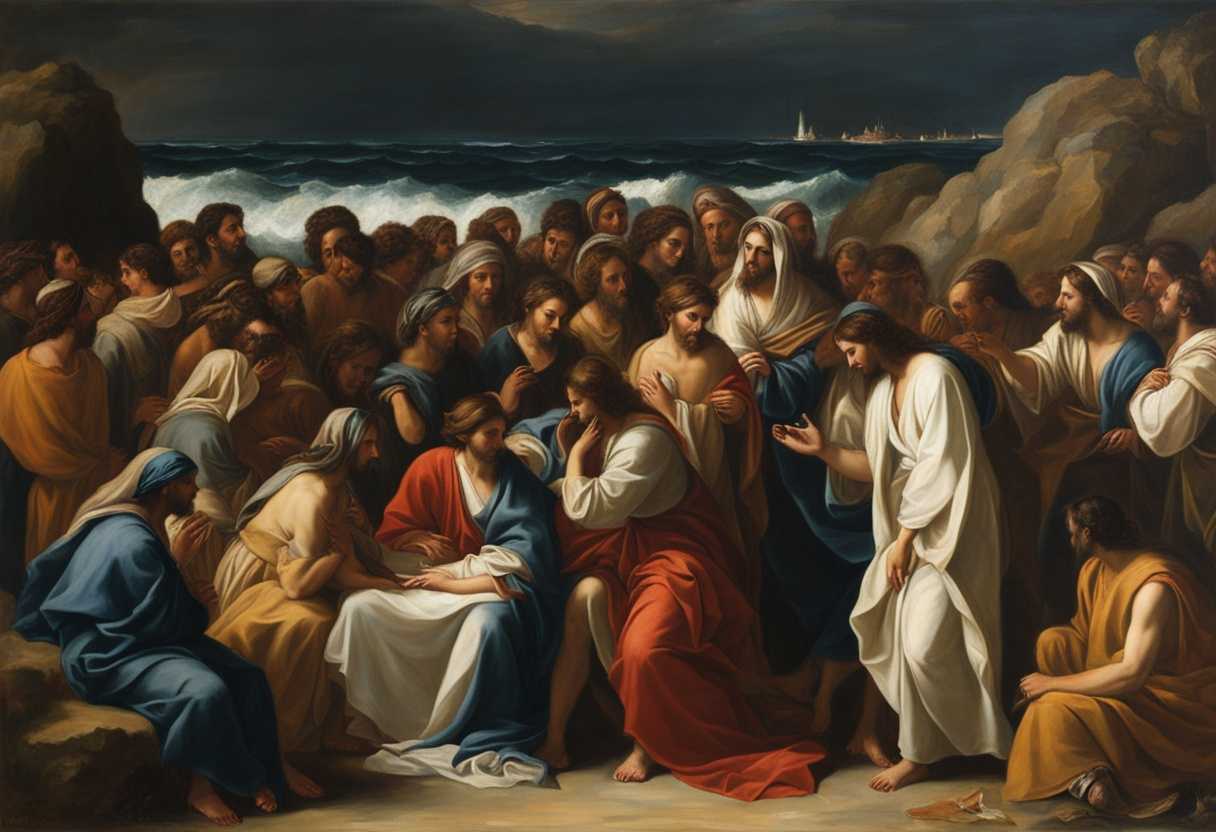
Setting the Scene for Matthew 13:1-52
The scene in Matthew 13:1-52 takes place by the Sea of Galilee, where a large crowd has gathered to listen to Jesus teach. The crowd is a mix of people from different walks of life – fishermen, farmers, merchants, and others who have come to hear the words of this renowned teacher. Jesus, sitting in a boat just off the shore, begins to speak to the crowd in parables, using everyday examples to convey deeper spiritual truths.
Among the crowd are Jesus’ disciples, who have been following him and learning from his teachings. They are eager to understand the meaning behind the parables and often seek clarification from Jesus. As the day goes on, Jesus shares several parables, including the parable of the sower, the parable of the weeds, the parable of the mustard seed, and the parable of the yeast, each one offering insights into the kingdom of heaven and the nature of faith.
The setting is peaceful and serene, with the gentle lapping of the waves providing a soothing backdrop to Jesus’ words. The sun is shining brightly, casting a warm glow over the scene as Jesus imparts his wisdom to the eager crowd. The atmosphere is one of anticipation and wonder as the listeners hang on every word, seeking to understand the mysteries of the kingdom that Jesus is revealing to them.
What is Matthew 13:1-52 about?
Let’s delve into the depths of these parables together. Imagine the Kingdom of Heaven as a vast garden, where seeds are sown; some fall on good soil and flourish, while others are choked by weeds. This parable reminds us that in life, we must nurture the seeds of goodness within us and be mindful of the negative influences that can hinder our growth.
Now, picture a tiny mustard seed, seemingly insignificant, growing into a large tree. This parable teaches us about the power of faith and how even the smallest acts of kindness and faith can have a profound impact. Similarly, the parable of yeast shows us how small beginnings can lead to great transformations, highlighting the importance of perseverance and patience in our spiritual journey. We reflect on the parables of the hidden treasure, pearl, and fishing net, reminding us of the preciousness of the Kingdom of Heaven and the lengths we should go to attain it. Just like the merchant who sold everything to buy the pearl of great value, we are called to prioritize our spiritual growth above all else. The fishing net illustrates the final judgment, where the righteous will be separated from the wicked. These parables challenge us to continuously seek and prioritize the Kingdom of Heaven in our lives.
Understanding what Matthew 13:1-52 really means
Jesus often used parables to convey deep spiritual truths in a way that was relatable and easy to remember. These parables, earthly stories with heavenly meanings, were crafted to unveil the mysteries of the Kingdom of Heaven to those willing to listen and understand.
In the Parable of the Sower, Jesus paints a vivid picture of a sower scattering seeds on different types of soil. Each type of soil represents a different response to the Word of God, highlighting the importance of the condition of our hearts in receiving and nurturing God’s message. Just as a gardener prepares the soil for seeds to grow, we must prepare our hearts to receive and bear fruit from God’s Word.
The Parable of the Weeds illustrates the coexistence of good and evil in the world, emphasizing God’s patience and ultimate justice. Like a farmer who waits until harvest to separate the wheat from the weeds, God allows time for repentance before the final judgment. This parable challenges us to trust in God’s sovereignty and justice, even in the midst of a world filled with both good and evil.
Through the Parable of the Mustard Seed and the Yeast, Jesus teaches about the small beginnings and transformative power of God’s Kingdom. Just as a mustard seed grows into a large tree and yeast leavens the whole batch of dough, our small acts of faith and kindness can have a significant impact on the world around us. These parables encourage us to have faith in the growth and influence of God’s Kingdom, no matter how insignificant our efforts may seem.
In the Parable of the Hidden Treasure and the Pearl, Jesus highlights the incomparable value of God’s Kingdom and the importance of prioritizing it above all else. Like a treasure hidden in a field or a merchant seeking fine pearls, we should be willing to give up everything for the sake of knowing and possessing the truth of God’s Kingdom. These parables remind us of the priceless nature of our relationship with God and the need to treasure it above earthly possessions.
Lastly, the Parable of the Net portrays the gathering of all people for final judgment, emphasizing the separation of the righteous from the wicked. Just as the fishermen collected the good fish in baskets and discarded the bad, there will come a time when God will separate the righteous from the wicked. This parable serves as a sobering reminder of the importance of living a life aligned with God’s will and the reality of the final judgment that awaits all humanity.
How can we cultivate good soil for God’s word?
We can cultivate good soil for God’s word by preparing our hearts to receive it. This involves having a humble and teachable attitude, being open to understanding and applying the message of the Bible in our lives. Just like good soil is receptive to receiving and nurturing seeds for growth, our hearts need to be receptive and willing to allow the word of God to take root and bear fruit in our lives.
Another way to cultivate good soil for God’s word is by meditating on it regularly. This involves spending time reading and studying the Bible, reflecting on its meaning, and allowing it to penetrate deep into our hearts and minds. Consistently engaging with God’s word nourishes the soil of our hearts and creates an environment where the seeds of truth can take root and grow.
Furthermore, cultivating good soil for God’s word involves living out its teachings in our daily lives. We demonstrate our faith and obedience to God’s word as we apply the principles and values of the Bible in our actions and decisions. This not only deepens our understanding of the scriptures but also enables us to bear fruits of righteousness and godliness, reflecting the transformative power of the word of God in our lives.
Application
Unlock the insightful messages in the parables like unlocking treasures in the workplace or nurturing relationships at home. Let these teachings shape your actions each day, leading you to become a better follower of Christ. Will you sow the seeds of wisdom in your heart and reap the fruits of righteousness in your life?

Reverend Michael Johnson is an experienced Church Minister with a profound expertise in spirituality and guidance. With a serene presence and a compassionate heart, he has faithfully served his congregation for over 20 years, leading them on a spiritual journey towards inner peace and enlightenment. Reverend Johnson’s extensive knowledge of religious philosophies and profound understanding of human nature have made him a trusted confidant and mentor to many, as he seamlessly weaves his profound wisdom into life teachings. Reverend Johnson’s calming demeanor and empathetic nature continue to uplift and heal souls, nurturing a sense of unity and tranquility within his community.