
Matthew 19:10-14 is about Jesus teaching his disciples about the value of children and the importance of humility and innocence in entering the kingdom of heaven.
10 The disciples said to him, “If such is the case of a man with his wife, it is better not to marry.”
11 But he said to them, “Not everyone can receive this saying, but only those to whom it is given.
12 For there are eunuchs who have been so from birth, and there are eunuchs who have been made eunuchs by men, and there are eunuchs who have made themselves eunuchs for the sake of the kingdom of heaven. Let the one who is able to receive this receive it.”
13 Then children were brought to him that he might lay his hands on them and pray. The disciples rebuked the people,
14 but Jesus said, “Let the little children come to me and do not hinder them, for to such belongs the kingdom of heaven.”
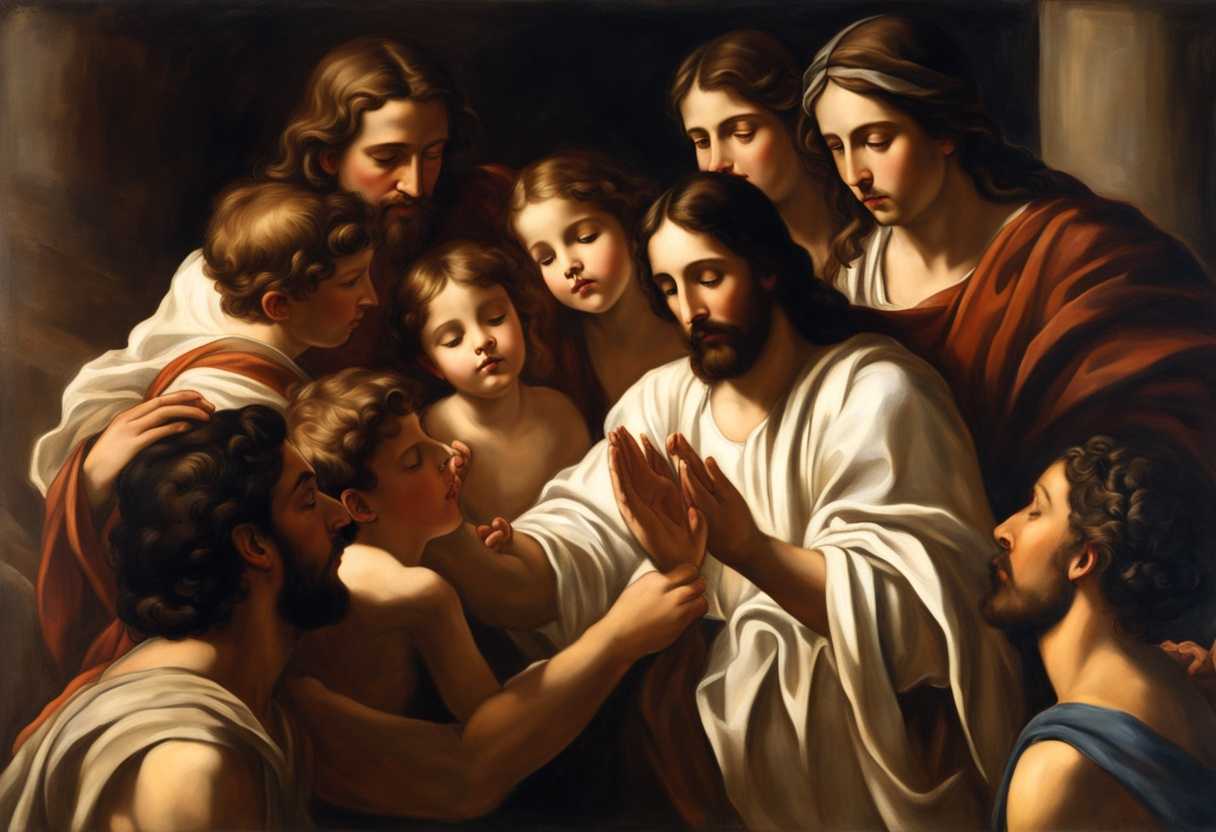
Setting the Scene for Matthew 19:10-14
In Matthew chapter 19, we find Jesus teaching a large crowd of people who have gathered to hear His words. The scene is set in the countryside, with the sun shining down on the grassy fields where the people have gathered. The crowd is a mix of men, women, and children, all eager to listen to the teachings of Jesus.
Among the crowd are also the disciples of Jesus, who have been traveling with Him and learning from Him. They are seated close to Jesus, hanging on His every word and ready to assist Him in any way they can. As Jesus speaks about marriage and divorce, the disciples listen intently, trying to understand the deeper meaning behind His words.
As the teaching continues, some parents in the crowd bring their children to Jesus, hoping that He will bless them. The disciples, perhaps thinking the children are a distraction, try to shoo them away. However, Jesus stops them and warmly welcomes the children, saying, “Let the little children come to me, and do not hinder them, for the kingdom of heaven belongs to such as these.” This moment of tenderness and compassion from Jesus towards the children serves as a powerful reminder of the inclusive and loving nature of His ministry.
What is Matthew 19:10-14 about?
Jesus is highlighting the significance of childlike qualities such as faith and humility in the context of marriage and relationships in this verse. Jesus is urging us to embody the qualities of trust, wonder, and openness in our interactions with others, especially within the sacred union of marriage, just as children do. He is emphasizing the pure and genuine spirit that children possess, encouraging us to approach our relationships with a similar level of trust, humility, and openness.
Think about the innocence and vulnerability of children – they trust without reservations and hold onto a sense of wonder and curiosity about the world. Jesus is inviting us to emulate these qualities in our relationships, reminding us that a humble and sincere heart can lead to deeper connections and a harmonious union with our partners. We can cultivate a sense of trust, honesty, and vulnerability in our relationships by embracing childlike faith and humility. We can incorporate these childlike qualities into our own lives and relationships, fostering a sense of trust, openness, and genuine connection with others.
Understanding what Matthew 19:10-14 really means
In Matthew 19:10-14, we find Jesus engaging in a profound dialogue with His disciples about marriage, divorce, and the kingdom of heaven. The disciples’ reaction to Jesus’ teachings on marriage reflects their astonishment at the high standards set by Jesus. They express concern about the challenges of adhering to such strict guidelines, highlighting the tension between societal norms and spiritual ideals.
Jesus responds to their concerns by acknowledging that His teachings are not easily accepted by everyone. He emphasizes that only those to whom it has been given can truly grasp the depth of His words. This recognition underscores the individualized nature of spiritual understanding and the varying capacities people have for embracing divine truths.
Furthermore, Jesus delves into the concept of different states of life, including celibacy, by mentioning eunuchs who were born as such, those who were made eunuchs by others, and those who choose to live like eunuchs for the sake of the kingdom of heaven. This discussion underscores the diversity of paths individuals may choose in their spiritual journey, highlighting the importance of discerning one’s unique calling and vocation.
The passage culminates in Jesus’ poignant statement, “Let the little children come to me, and do not hinder them, for the kingdom of heaven belongs to such as these.” Here, Jesus emphasizes the significance of childlike faith and openness to the kingdom of heaven. He extols the virtues of innocence, trust, and humility that characterize a child’s approach to God, inviting His followers to embody these qualities in their spiritual walk.
In contemporary society, where the sanctity of marriage is often challenged and diverse life choices are increasingly respected, Jesus’ teachings in this passage remain relevant. They prompt us to reflect on the seriousness of commitments, the value of different callings, and the essence of childlike faith. By contemplating these principles, we can deepen our understanding of our spiritual journey, honor the diverse paths chosen by individuals, and nurture a profound trust in God’s guidance and provision.
Consider a scenario where a young couple grappling with the weight of societal expectations and spiritual ideals seeks guidance from their pastor. The pastor, drawing from the wisdom of Matthew 19:10-14, encourages them to approach their impending marriage with grace, mutual support, and a deep sense of calling. By sharing stories of individuals who have embraced celibacy or other paths for spiritual reasons, the pastor illustrates the beauty and challenges inherent in different vocations. Ultimately, he urges the couple to embrace their faith with the simplicity and trust of a child, reminding them that the kingdom of heaven is accessible to all who approach it with humility and unwavering faith.
Can we truly accept the Kingdom of God?
Jesus in this passage is teaching about the kingdom of God and the requirements for entering it. He emphasizes the importance of having a childlike faith and humility in order to accept the kingdom of God. Children are used as models of purity, trust, and dependence, qualities that are essential for embracing the teachings and values of the kingdom.
Jesus is calling His followers to let go of their preconceived notions, self-sufficiency, and pride, and instead approach God with a sense of wonder, trust, and openness. The kingdom of God is not something that can be earned or achieved through human efforts, but it is received with a humble and receptive heart. Therefore, to truly accept the kingdom of God, we must set aside our worldly wisdom and self-righteousness and approach God with the simplicity and sincerity of a child.
Application
Think of yourself juggling work deadlines and family obligations every day. Matthew 19:10-14 is your call to pause and remember how Jesus welcomed children with open arms. Can you find the humility and innocence amidst your busy life? Just as you balance tasks at home and work, embrace childlike simplicity in your faith and interactions. Will you let this message inspire you to approach life with a pure heart and open arms?

Reverend Michael Johnson is an experienced Church Minister with a profound expertise in spirituality and guidance. With a serene presence and a compassionate heart, he has faithfully served his congregation for over 20 years, leading them on a spiritual journey towards inner peace and enlightenment. Reverend Johnson’s extensive knowledge of religious philosophies and profound understanding of human nature have made him a trusted confidant and mentor to many, as he seamlessly weaves his profound wisdom into life teachings. Reverend Johnson’s calming demeanor and empathetic nature continue to uplift and heal souls, nurturing a sense of unity and tranquility within his community.