
Matthew 1:18-22 is about the miraculous conception of Jesus by the Holy Spirit, fulfilling the prophecy that a virgin would give birth to a son called Immanuel, meaning “God with us,” indicating that Jesus is the long-awaited Messiah.
18 Now the birth of Jesus Christ took place in this way. When his mother Mary had been betrothed to Joseph, before they came together she was found to be with child from the Holy Spirit.
19 And her husband Joseph, being a just man and unwilling to put her to shame, resolved to divorce her quietly.
20 But as he considered these things, behold, an angel of the Lord appeared to him in a dream, saying, “Joseph, son of David, do not fear to take Mary as your wife, for that which is conceived in her is from the Holy Spirit.
21 She will bear a son, and you shall call his name Jesus, for he will save his people from their sins.
22 All this took place to fulfill what the Lord had spoken by the prophet:
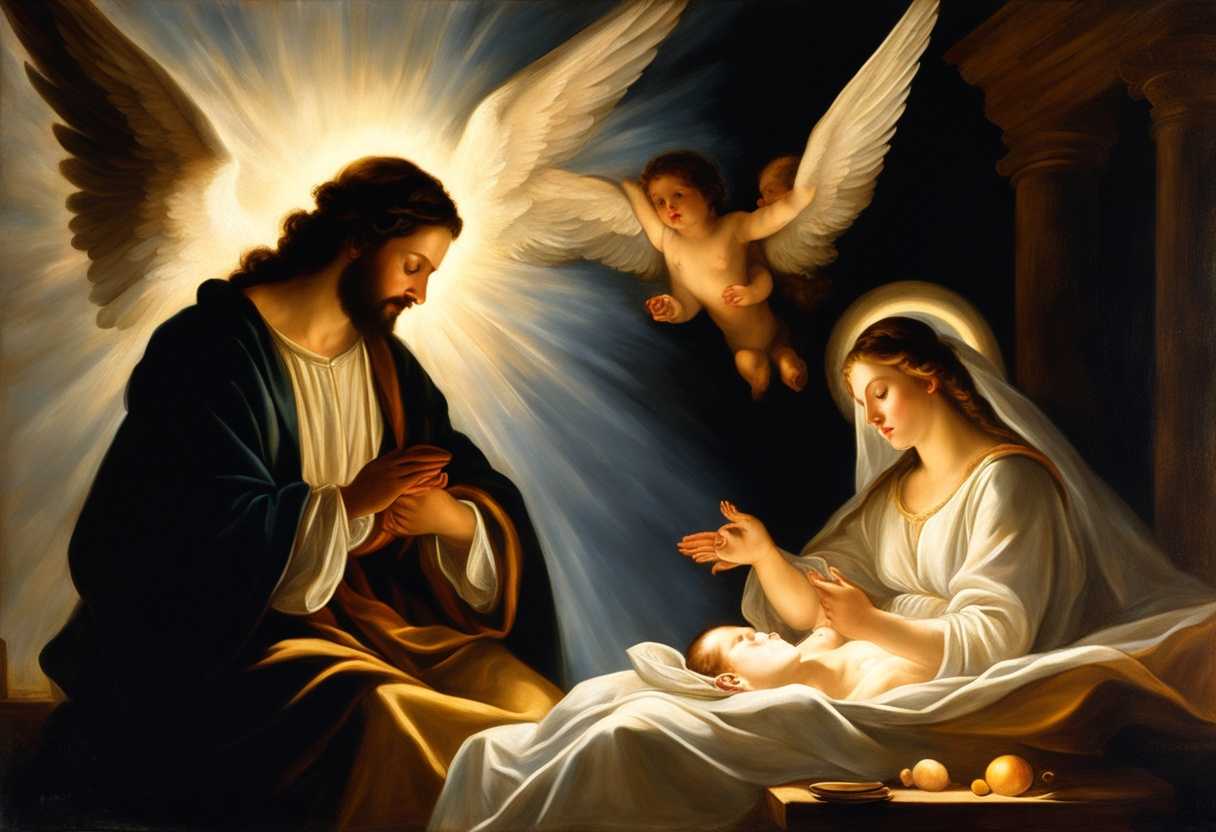
Setting the Scene for Matthew 1:18-22
In the scene described in Matthew 1:18-22, we find Joseph, a righteous and kind-hearted carpenter from Nazareth, deeply troubled and perplexed. He is engaged to Mary, a young and devout woman known for her purity and faith. The couple had been betrothed according to Jewish customs, awaiting the time when they would come together as husband and wife. However, before they had consummated their marriage, Mary was found to be with child, a situation that left Joseph in a state of inner turmoil.
The setting is a modest home in Nazareth, a small town in Galilee. The room is dimly lit by the flickering flame of an oil lamp, casting shadows on the worried face of Joseph as he paces back and forth, grappling with the news of Mary’s unexpected pregnancy. The air is heavy with tension and uncertainty, as Joseph wrestles with his emotions, torn between his love for Mary and the societal expectations that weigh heavily upon him. It is in this moment of inner conflict that an angel of the Lord appears to Joseph in a dream, delivering a message that will change the course of their lives forever.
What is Matthew 1:18-22 about?
We witness a pivotal moment in the story of Joseph and Mary in this verse. Joseph discovers that Mary, his betrothed, is pregnant. However, what sets this situation apart is that Mary’s pregnancy is not a result of a sinful act, but rather a miraculous conception by the Holy Spirit. This revelation fulfills the prophecy of Immanuel, meaning “God with us.” It symbolizes the divine presence and intervention in the affairs of humanity, demonstrating God’s plan unfolding in a profound and unexpected way. God chose a young couple to play a crucial role in the salvation of humanity, a revelation of great magnitude. Reflect on Joseph’s initial shock and confusion, yet his ultimate acceptance and obedience to God’s will. Delve into the layers of symbolism and faith at play here, as Joseph and Mary embrace their roles in the divine plan despite the social stigma and challenges they faced. This verse invites us to ponder the mystery of God’s ways, the power of faith, and the profound impact of obedience and trust in His plan.
Understanding what Matthew 1:18-22 really means
The passage in Matthew 1:18-22 delves into the extraordinary circumstances surrounding the birth of Jesus Christ, shedding light on the divine intervention and the fulfillment of ancient prophecies. It unveils the pivotal roles of Mary and Joseph in this miraculous event, emphasizing the profound nature of Jesus’ conception. Mary, pledged to be married to Joseph, signifies a deep commitment in Jewish tradition, surpassing mere modern engagements. The revelation that she was pregnant through the Holy Spirit underscores the supernatural origin of Jesus, portraying it as a divine act beyond human comprehension.
Joseph, described as a righteous man faithful to the law, initially contemplates divorcing Mary quietly to avoid public shame. However, an angel of the Lord appears to him in a dream, guiding him to embrace Mary as his wife. This divine intervention not only reassures Joseph but also underscores God’s direct involvement in orchestrating these events. The passage emphasizes that these occurrences fulfill ancient prophecies, particularly referencing Isaiah 7:14, which foretold the birth of a son through a virgin, named Immanuel, affirming Jesus as the promised Messiah.
Drawing parallels with other biblical passages like Luke 1:26-38 and Genesis 22:18, the narrative intertwines with broader themes of divine blessings and the fulfillment of God’s redemptive plan. It resonates with contemporary audiences by highlighting the significance of faith, obedience, and recognizing God’s sovereign purpose. In a world rife with uncertainties and doubts, this story serves as a beacon of hope, reminding us of God’s unwavering control and purpose in our lives.
Imagine a modern-day couple facing unexpected challenges, akin to Joseph and Mary’s predicament. Despite initial fear and uncertainty, their faith and reliance on God’s plan can lead them to peace and guidance, mirroring Joseph’s decision to heed the angel’s message. This passage encapsulates God’s faithfulness and the realization of His promises, urging us to place our trust in His divine orchestration, even amidst perplexing circumstances. Reflecting on Mary and Joseph’s unwavering faith can inspire us to confront our own trials with fortitude and a firm belief in God’s overarching design.
How can we trust in God’s unexpected plans?
We can trust in God’s unexpected plans by understanding that He works in ways that may surprise us, but ultimately, His plans are for our good. Even when things don’t go as we expect or desire, we can have faith that God is in control and has a purpose for everything that happens. We can trust that God’s plans are always better than our own, just as Joseph faced unexpected circumstances in the passage. We open ourselves up to experiencing His faithfulness and guidance in ways we may not have imagined by letting go of our own need for control and surrendering to God’s will. God’s plans often involve stepping out in faith and trusting Him even when we cannot see the entire picture. This passage reminds us to have faith in God’s sovereignty and trust that His plans, though unexpected to us, are perfect and purposeful.
Application
Just as Joseph trusted in God’s plan, let us also have faith in the path laid out for us. Even when faced with uncertainties, let us remain obedient to His calling. It’s time to take that leap of faith, knowing that God is walking alongside us in this journey. Will you trust in His plan and take that step forward today?

Reverend Michael Johnson is an experienced Church Minister with a profound expertise in spirituality and guidance. With a serene presence and a compassionate heart, he has faithfully served his congregation for over 20 years, leading them on a spiritual journey towards inner peace and enlightenment. Reverend Johnson’s extensive knowledge of religious philosophies and profound understanding of human nature have made him a trusted confidant and mentor to many, as he seamlessly weaves his profound wisdom into life teachings. Reverend Johnson’s calming demeanor and empathetic nature continue to uplift and heal souls, nurturing a sense of unity and tranquility within his community.