
Matthew 1:18-2:12 is about the miraculous birth of Jesus Christ, the fulfillment of Old Testament prophecies, the visit of the Magi from the East, and the divine guidance and protection of the holy family.
18 Now the birth of Jesus Christ took place in this way. When his mother Mary had been betrothed to Joseph, before they came together she was found to be with child from the Holy Spirit.
19 And her husband Joseph, being a just man and unwilling to put her to shame, resolved to divorce her quietly.
20 But as he considered these things, behold, an angel of the Lord appeared to him in a dream, saying, “Joseph, son of David, do not fear to take Mary as your wife, for that which is conceived in her is from the Holy Spirit.
21 She will bear a son, and you shall call his name Jesus, for he will save his people from their sins.
22 All this took place to fulfill what the Lord had spoken by the prophet:
23 “Behold, the virgin shall conceive and bear a son, and they shall call his name Immanuel” (which means, God with us).
24 When Joseph woke from sleep, he did as the angel of the Lord commanded him: he took his wife,
25 but knew her not until she had given birth to a son. And he called his name Jesus.
Now after Jesus was born in Bethlehem of Judea in the days of Herod the king, behold, wise men from the east came to Jerusalem,
2 saying, “Where is he who has been born king of the Jews? For we saw his star when it rose and have come to worship him.”
3 When Herod the king heard this, he was troubled, and all Jerusalem with him;
4 and assembling all the chief priests and scribes of the people, he inquired of them where the Christ was to be born.
5 They told him, “In Bethlehem of Judea, for so it is written by the prophet:
6 “‘And you, O Bethlehem, in the land of Judah,
are by no means least among the rulers of Judah;
for from you shall come a ruler
who will shepherd my people Israel.’”
7 Then Herod summoned the wise men secretly and ascertained from them what time the star had appeared.
8 And he sent them to Bethlehem, saying, “Go and search diligently for the child, and when you have found him, bring me word, that I too may come and worship him.”
9 After listening to the king, they went on their way. And behold, the star that they had seen when it rose went before them until it came to rest over the place where the child was.
10 When they saw the star, they rejoiced exceedingly with great joy.
11 And going into the house, they saw the child with Mary his mother, and they fell down and worshiped him. Then, opening their treasures, they offered him gifts, gold and frankincense and myrrh.
12 And being warned in a dream not to return to Herod, they departed to their own country by another way.
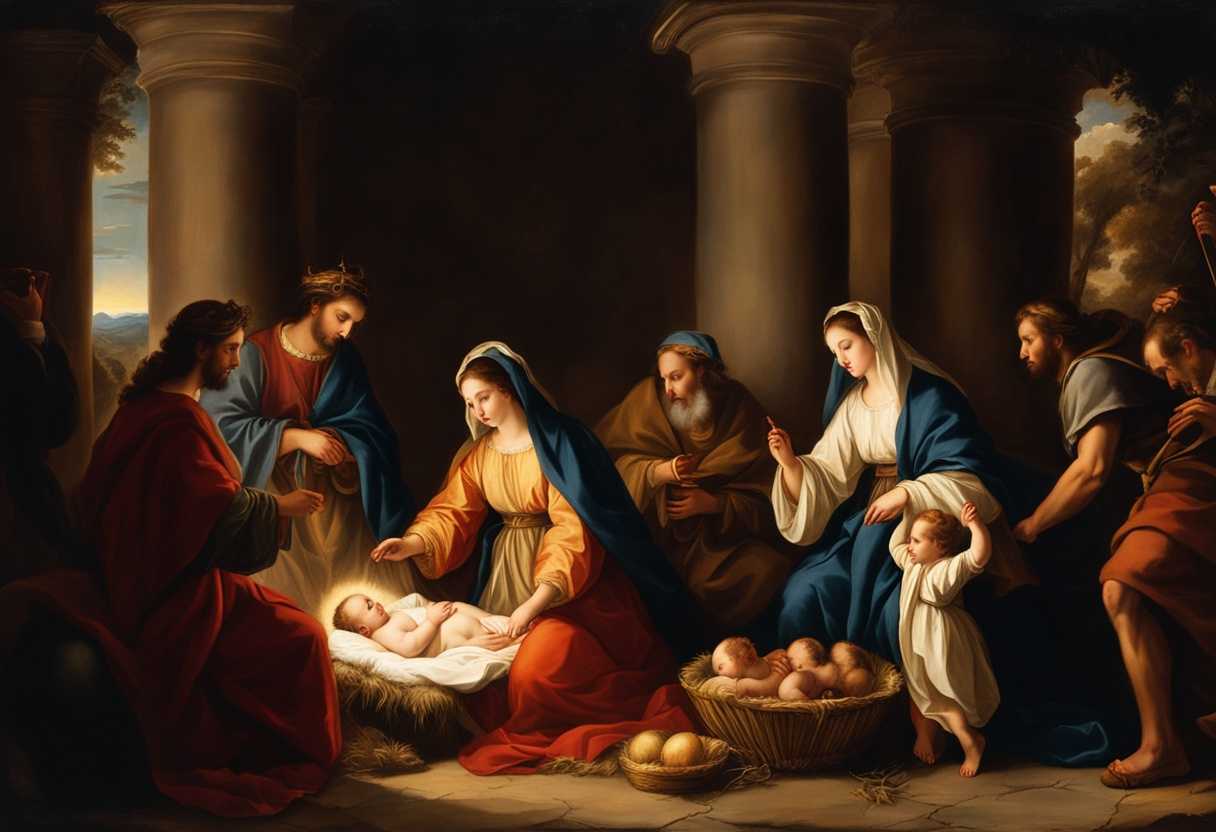
Setting the Scene for Matthew 1:18-2:12
The scene described in Matthew 1:18-2:12 takes place in the town of Bethlehem during the time of King Herod’s reign. Mary, a young virgin from Nazareth, is engaged to Joseph, a righteous man. One day, Mary receives a visit from the angel Gabriel who tells her that she will conceive a child by the Holy Spirit and that the child will be the Son of God. Joseph, initially troubled by Mary’s pregnancy, is visited by an angel in a dream who reassures him of the divine nature of Mary’s child.
As the time for Mary to give birth approaches, a decree is issued by Caesar Augustus that a census should be taken, requiring Joseph to travel with Mary to Bethlehem, the city of David, to register. The couple arrives in Bethlehem, but there is no room for them in the inn, so they find shelter in a humble stable where Mary gives birth to Jesus. Nearby, shepherds in the fields are visited by a host of angels who announce the birth of the Savior, prompting them to go and see the newborn baby.
Meanwhile, in a distant land, wise men from the East observe a star that signifies the birth of a great king. They follow the star to Jerusalem, where they meet King Herod and inquire about the newborn king of the Jews. Herod, feeling threatened by the news, consults with the chief priests and scribes who inform him that the Messiah is to be born in Bethlehem. Herod deceitfully asks the wise men to find the child and report back to him under the guise of wanting to worship the newborn king. The wise men continue their journey and are led by the star to the house where Jesus and his family are staying. They present gifts of gold, frankincense, and myrrh to the child, honoring him as the long-awaited Messiah.
What is Matthew 1:18-2:12 about?
This verse speaks to the significant event of the birth of Jesus Christ and the reverence shown to him by the wise men bearing gifts. It embodies the idea of divine intervention and the recognition of Jesus as a special and important figure. The visit of the wise men with their symbolic gifts is a powerful representation of the recognition and celebration of Jesus’s birth by people from different backgrounds and beliefs.
Have you ever pondered on the significance of this moment in history? The wise men’s journey to see Jesus draws attention to the universal appeal of his birth and the message of love and hope that he brings. Their act of presenting gifts symbolizes not just material offerings, but also an acknowledgment of Jesus’s importance and their willingness to honor and respect him. This verse serves as a reminder of the enduring impact of Jesus’s birth and the unity it can bring among people, regardless of their differences and backgrounds.
Understanding what Matthew 1:18-2:12 really means
In the Gospel of Matthew, we are presented with a profound narrative that encompasses the birth of Jesus Christ, the pivotal roles of Mary and Joseph, and the significant visit of the Magi. This passage holds immense importance in the context of the New Testament as it fulfills Old Testament prophecies, demonstrating the continuity and fulfillment of God’s plan throughout history.
One of the key phrases in this passage is “Mary was found to be with child through the Holy Spirit,” underscoring the divine nature of Jesus’ conception. This miraculous event aligns with the prophecy in Isaiah 7:14 and is further explained in Luke 1:35, emphasizing the supernatural origin of Jesus’ birth. Joseph’s initial reaction, intending to divorce Mary quietly, highlights his righteousness and adherence to the law, as seen in Matthew 1:19-20 and echoing the wisdom of Proverbs 3:5-6 in trusting in the Lord.
The declaration that Jesus would be called Immanuel, meaning “God with us,” encapsulates the essence of Jesus’ role as God incarnate dwelling among humanity. This concept is echoed in John 1:14 and Isaiah 9:6, emphasizing the intimate connection between God and humanity through Jesus. The arrival of the Magi from the east signifies the recognition of Jesus’ kingship by Gentiles, symbolizing the universal nature of Christ’s mission as foretold in Psalm 72:10-11 and Isaiah 60:3.
Today, this passage resonates with themes of faith, obedience, and divine intervention. Joseph’s response to the angel’s message teaches us about trusting in God’s plan even when it surpasses human understanding. The miraculous birth of Jesus serves as a reminder that God can intervene in our lives in unexpected ways, offering hope and reassurance in times of uncertainty. The visit of the Magi underscores the universal salvation brought by Jesus, extending His grace to all people regardless of their background or nationality.
In a modern context, we can draw parallels between the experiences of Mary, Joseph, and the Magi with contemporary individuals or families who have faced uncertainty and had to trust in God’s plan. For instance, a couple navigating an unexpected pregnancy may find strength and guidance through their faith, mirroring the resilience and obedience displayed by Mary and Joseph in the face of adversity.
In conclusion, the passage from Matthew 1:18-2:12 invites us to reflect on essential lessons: trusting in God’s plan, recognizing the divine nature of Jesus, and embracing the inclusivity of His mission. As we ponder these truths, let us consider how we can apply them in our own lives, especially during moments of uncertainty or when confronted with unexpected challenges. May we find inspiration and courage in the example set by Mary, Joseph, and the Magi, as we journey in faith and obedience towards the light of Christ’s love and salvation.
Are we willing to follow God’s guidance faithfully?
The passage in Matthew 1:18-2:12 talks about following God’s guidance faithfully, even when it may not make sense to us. Joseph obeyed the angel’s instructions to take Mary as his wife, despite the unconventional circumstances surrounding her pregnancy. Joseph’s obedience, even in the face of potential shame and societal judgment, shows a deep trust in God’s plan and purpose.
Similarly, the wise men in this passage follow the star to find and worship Jesus, displaying their faith and willingness to seek and obey God’s guidance even in a foreign land. Their journey may have been long and arduous, but they persevered because they were committed to following God’s leading no matter the cost.
This passage serves as a reminder for us to trust in God’s wisdom and guidance, even when it may lead us down unfamiliar or challenging paths. We too are called to follow God faithfully, trusting that His plans are always for our good and His glory, even if we may not fully understand them in the moment, just as Joseph and the wise men demonstrated unwavering faith and obedience.
Application
Let’s be like Joseph and the wise men, embracing faith and obedience in our own lives. Trust in the path laid out before you, even when it feels daunting. Allow yourself to follow the guiding stars, leading you towards your purpose. Today, let’s take that leap of faith and walk in alignment with God’s plan. Will you also answer the call with unwavering faith and obedience?

Reverend Michael Johnson is an experienced Church Minister with a profound expertise in spirituality and guidance. With a serene presence and a compassionate heart, he has faithfully served his congregation for over 20 years, leading them on a spiritual journey towards inner peace and enlightenment. Reverend Johnson’s extensive knowledge of religious philosophies and profound understanding of human nature have made him a trusted confidant and mentor to many, as he seamlessly weaves his profound wisdom into life teachings. Reverend Johnson’s calming demeanor and empathetic nature continue to uplift and heal souls, nurturing a sense of unity and tranquility within his community.