
Matthew 1:18-2:23 is about the miraculous birth of Jesus Christ, the fulfillment of Old Testament prophecies foretelling the Messiah’s coming, and the threats faced by the Holy Family from King Herod, emphasizing the divine protection and guidance provided to them.
18 Now the birth of Jesus Christ took place in this way. When his mother Mary had been betrothed to Joseph, before they came together she was found to be with child from the Holy Spirit.
19 And her husband Joseph, being a just man and unwilling to put her to shame, resolved to divorce her quietly.
20 But as he considered these things, behold, an angel of the Lord appeared to him in a dream, saying, “Joseph, son of David, do not fear to take Mary as your wife, for that which is conceived in her is from the Holy Spirit.
21 She will bear a son, and you shall call his name Jesus, for he will save his people from their sins.
22 All this took place to fulfill what the Lord had spoken by the prophet:
23 “Behold, the virgin shall conceive and bear a son, and they shall call his name Immanuel” (which means, God with us).
24 When Joseph woke from sleep, he did as the angel of the Lord commanded him: he took his wife,
25 but knew her not until she had given birth to a son. And he called his name Jesus.
Now after Jesus was born in Bethlehem of Judea in the days of Herod the king, behold, wise men from the east came to Jerusalem,
2 saying, “Where is he who has been born king of the Jews? For we saw his star when it rose and have come to worship him.”
3 When Herod the king heard this, he was troubled, and all Jerusalem with him;
4 and assembling all the chief priests and scribes of the people, he inquired of them where the Christ was to be born.
5 They told him, “In Bethlehem of Judea, for so it is written by the prophet:
6 “‘And you, O Bethlehem, in the land of Judah,
are by no means least among the rulers of Judah;
for from you shall come a ruler
who will shepherd my people Israel.’”
7 Then Herod summoned the wise men secretly and ascertained from them what time the star had appeared.
8 And he sent them to Bethlehem, saying, “Go and search diligently for the child, and when you have found him, bring me word, that I too may come and worship him.”
9 After listening to the king, they went on their way. And behold, the star that they had seen when it rose went before them until it came to rest over the place where the child was.
10 When they saw the star, they rejoiced exceedingly with great joy.
11 And going into the house, they saw the child with Mary his mother, and they fell down and worshiped him. Then, opening their treasures, they offered him gifts, gold and frankincense and myrrh.
12 And being warned in a dream not to return to Herod, they departed to their own country by another way.
13 Now when they had departed, behold, an angel of the Lord appeared to Joseph in a dream and said, “Rise, take the child and his mother, and flee to Egypt, and remain there until I tell you, for Herod is about to search for the child, to destroy him.”
14 And he rose and took the child and his mother by night and departed to Egypt.
15 and remained there until the death of Herod. This was to fulfill what the Lord had spoken by the prophet, “Out of Egypt I called my son.”
16 Then Herod, when he saw that he had been tricked by the wise men, became furious, and he sent and killed all the male children in Bethlehem and in all that region who were two years old or under, according to the time that he had ascertained from the wise men.
17 Then was fulfilled what was spoken by the prophet Jeremiah:
18 “A voice was heard in Ramah,
weeping and loud lamentation,
Rachel weeping for her children;
she refused to be comforted,
because they are no more.”
19 But when Herod died, behold, an angel of the Lord appeared in a dream to Joseph in Egypt,
20 saying, “Rise, take the child and his mother and go to the land of Israel, for those who sought the child’s life are dead.”
21 And he rose and took the child and his mother and went to the land of Israel.
22 But when he heard that Archelaus was reigning over Judea in place of his father Herod, he was afraid to go there, and being warned in a dream he withdrew to the district of Galilee.
23 And he went and lived in a city called Nazareth, so that what was spoken by the prophets might be fulfilled, that he would be called a Nazarene.
Setting the Scene for Matthew 1:18-2:23
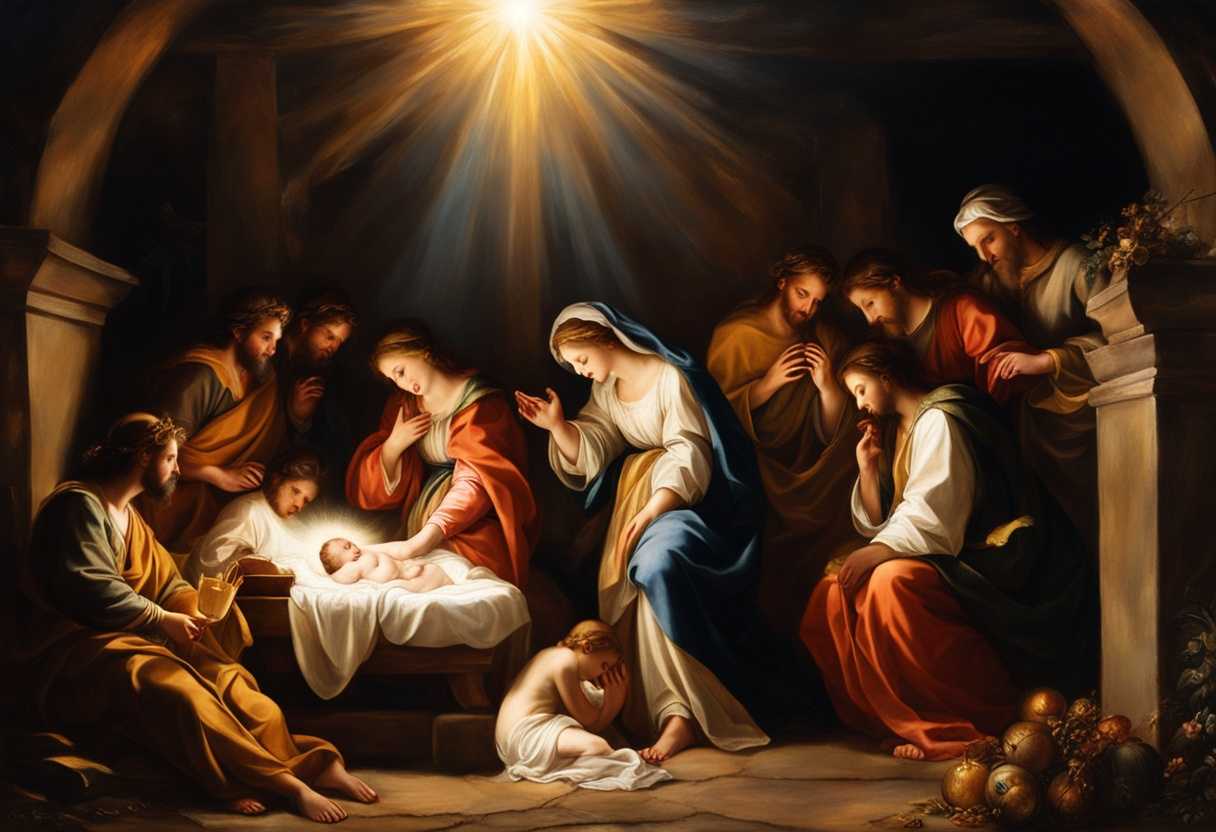
The scene described in Matthew 1:18-2:23 takes place in the town of Bethlehem, a small village in Judea. Mary, a young woman from Nazareth, is engaged to Joseph, a carpenter. One day, Mary receives a visit from the angel Gabriel, who tells her that she will conceive a child by the Holy Spirit and that she is to name him Jesus. Joseph, initially troubled by Mary’s pregnancy, is visited by an angel in a dream who reassures him that the child is from God.
As the time for Mary to give birth approaches, a decree from Caesar Augustus requires Joseph and Mary to travel to Bethlehem for a census. The couple arrives in Bethlehem and finds no room at the inn, so they take shelter in a humble stable where Jesus is born. Nearby, shepherds in the fields receive a visit from a host of angels proclaiming the birth of the Savior. They hurry to see the newborn baby, fulfilling the prophecy.
Meanwhile, in a distant land, wise men from the East observe a star that signifies the birth of a great king. They journey to Bethlehem, following the star, and present gifts of gold, frankincense, and myrrh to the infant Jesus. The scene is filled with a sense of wonder, awe, and divine intervention as people from different walks of life come together to witness the birth of the Messiah.
What is Matthew 1:18-2:23 about?
This verse speaks to the fulfillment of Old Testament prophecies through the birth and early life of Jesus. The Old Testament is a collection of sacred texts in the Bible that laid the foundation for the coming of the Messiah, Jesus Christ. The birth of Jesus in Bethlehem, as prophesied in the book of Micah, and his upbringing in Nazareth, as foretold in the book of Isaiah, demonstrate the divine orchestration of events to fulfill these prophecies. This verse showcases the alignment of Jesus’ life with the Old Testament scriptures, establishing his significance and divine purpose in the narrative of salvation.
Have you ever marveled at how the intricate details of Jesus’ birth and upbringing were meticulously foretold centuries before they came to pass? The fulfillment of these prophecies not only serves as a validation of Jesus’ identity as the long-awaited Messiah but also emphasizes the continuity and consistency of God’s plan throughout history. The powerful connection between the Old and New Testaments reveals God’s faithfulness in bringing to fruition His promises through the life of Jesus as we reflect on this verse. The birth and early life of Jesus exemplify the intricate tapestry of God’s redemptive plan, inviting us to contemplate the significance and fulfillment found in the scriptures.
Understanding what Matthew 1:18-2:23 really means
In the passage from Matthew 1:18 to 2:23, we delve into the extraordinary events surrounding the birth and early life of Jesus Christ. This narrative holds a pivotal place in the New Testament as it sets the stage for the arrival of the long-awaited Messiah. The account begins with the miraculous conception of Jesus, as Mary is found to be with child through the Holy Spirit. This virgin birth is not only a profound sign of God’s power and sovereignty but also fulfills the prophecy in Isaiah 7:14, emphasizing the divine nature of Jesus’ origin.
Joseph, referred to as “son of David,” plays a crucial role in the unfolding of God’s plan. His lineage traces back to King David, aligning with the prophecy that the Messiah would come from David’s line (2 Samuel 7:12-16). This connection highlights the meticulous fulfillment of Old Testament promises through the birth of Jesus. The name “Immanuel,” meaning “God with us,” encapsulates the theological significance of the Incarnation, where God takes on human form to dwell among His people. This concept echoes John 1:14, underscoring the profound mystery of God’s presence in human flesh.
The reference to Hosea 11:1, “Out of Egypt I called my son,” further underscores the intricate tapestry of prophecy and fulfillment woven throughout Jesus’ life. Just as the Israelites were led out of Egypt by Moses, Jesus emerges from Egypt, symbolizing His role as the new Moses who leads His people to spiritual liberation. These key themes and phrases interweave to paint a vivid picture of Jesus as the fulfillment of ancient prophecies and the embodiment of God’s redemptive plan.
Drawing connections to related biblical passages such as Isaiah 7:14, Micah 5:2, and Hosea 11:1 reinforces the continuity of God’s promises across generations. These prophecies find their culmination in the life of Jesus, affirming His identity as the long-awaited Messiah. Moreover, the relevance of these events to people today lies in the reminder of God’s faithfulness and His active involvement in human history for the purpose of salvation. Just as Joseph trusted in God’s plan despite the uncertainties, we are called to place our faith in God’s promises and seek His guidance in all circumstances.
In a world filled with uncertainties and challenges, the story of Jesus’ birth serves as a beacon of hope and a testament to God’s enduring faithfulness. Like the family who found peace and direction through prayer amidst crisis, we are encouraged to trust in God’s providence and remain steadfast in our faith. As we reflect on the significance of Jesus’ birth and the divine orchestration of events in His early life, may we be inspired to deepen our trust in God’s promises and actively seek His guidance in our journey of faith.
What does it mean to truly trust God’s guidance?
Truly trusting God’s guidance, as demonstrated in the verse referenced, involves surrendering our own plans and desires to God’s will. It means having faith that God’s timing and His ways are perfect, even if they may not align with our own understanding or expectations. Trusting God’s guidance requires letting go of our need for control and instead, placing our full confidence in His wisdom and provision. It involves stepping out in faith, obeying His leading even when it may be difficult or doesn’t make sense at the time.
Throughout the verses in Matthew 1:18-2:23, we see how Joseph and Mary demonstrated radical trust in God’s guidance. Despite the confusion and societal norms that surrounded their situation, they chose to believe the angel’s message and follow God’s plan for their lives, even if it meant facing criticism or uncertainty. We too are called to seek God’s will above our own, trusting that His ways are higher and His purposes will ultimately bring about good, just as Joseph and Mary surrendered to God’s direction.
Trusting God’s guidance means seeking His wisdom through prayer, aligning our hearts with His Word, and stepping out in faith even when the path ahead seems unclear. It involves relying on His promises, knowing that He is always faithful and will never lead us astray. We can experience the peace and hope that comes from resting in God’s perfect guidance for our lives by embodying the trust exemplified in the passage.
Application
Reflect on the unwavering faith and obedience of Joseph and Mary in the face of uncertainty and challenges. Let their example inspire you to trust in God’s perfect timing and his faithfulness in your own life. Will you respond to God’s call with the same courage and obedience as this devoted couple did so many years ago?

Reverend Michael Johnson is an experienced Church Minister with a profound expertise in spirituality and guidance. With a serene presence and a compassionate heart, he has faithfully served his congregation for over 20 years, leading them on a spiritual journey towards inner peace and enlightenment. Reverend Johnson’s extensive knowledge of religious philosophies and profound understanding of human nature have made him a trusted confidant and mentor to many, as he seamlessly weaves his profound wisdom into life teachings. Reverend Johnson’s calming demeanor and empathetic nature continue to uplift and heal souls, nurturing a sense of unity and tranquility within his community.