
Matthew 20:17-28 is about Jesus foretelling his death and resurrection, and teaching his disciples about the true nature of leadership through serving others selflessly.
17 And as Jesus was going up to Jerusalem, he took the twelve disciples aside, and on the way he said to them,
18 “See, we are going up to Jerusalem. And the Son of Man will be delivered over to the chief priests and scribes, and they will condemn him to death.
19 and deliver him over to the Gentiles to be mocked and flogged and crucified, and he will be raised on the third day.”
20 Then the mother of the sons of Zebedee came up to him with her sons, and kneeling before him she asked him for something.
21 And he said to her, “What do you want?” She said to him, “Say that these two sons of mine are to sit, one at your right hand and one at your left, in your kingdom.”
22 Jesus answered, “You do not know what you are asking. Are you able to drink the cup that I am to drink?” They said to him, “We are able.”
23 He said to them, “You will drink my cup, but to sit at my right hand and at my left is not mine to grant, but it is for those for whom it has been prepared by my Father.”
24 And when the ten heard it, they were indignant at the two brothers.
25 But Jesus called them to him and said, “You know that the rulers of the Gentiles lord it over them, and their great ones exercise authority over them.
26 It shall not be so among you. But whoever would be great among you must be your servant,
27 and whoever would be first among you must be your slave—
28 even as the Son of Man came not to be served but to serve, and to give his life as a ransom for many.”
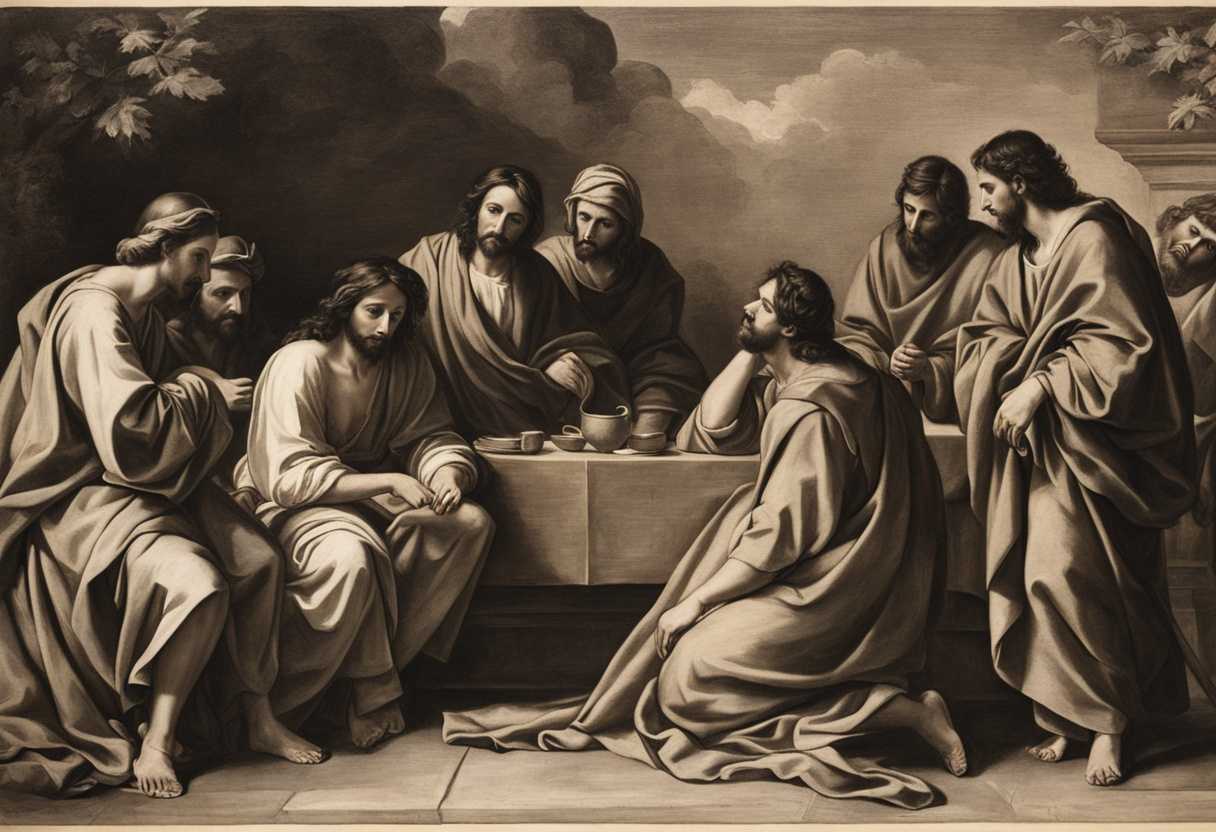
Setting the Scene for Matthew 20:17-28
As the sun began to set over the dusty roads of Judea, Jesus and his twelve disciples made their way towards Jerusalem. The group had been traveling for days, teaching and healing the sick along the way. Tension hung in the air as Jesus spoke to his disciples about the events that were to come. They walked in silence, the weight of his words heavy on their hearts.
Among the disciples, James and John, the sons of Zebedee, walked closely beside Jesus, their faces etched with concern. They had just approached Jesus with a bold request, asking to sit at his right and left hand in his kingdom. The other disciples overheard this conversation and were filled with jealousy and indignation. Jesus, sensing the discord among his followers, called them all together to teach them about true greatness and servanthood.
Surrounded by the rugged terrain of the Judean countryside, Jesus knelt down and washed the feet of his disciples, demonstrating humility and servitude. In this poignant moment, he explained that greatness in the kingdom of heaven comes from serving others, not seeking positions of power or prestige. The disciples listened intently, their hearts stirred by his words as they continued their journey towards Jerusalem.
What is Matthew 20:17-28 about?
Jesus in this verse is setting an example of humility and servant leadership for his disciples. He is teaching them that true greatness comes not from power or authority, but from serving others with love and humility by predicting his own death. He is showing them that sacrificial love is the greatest form of leadership, and that being willing to lay down one’s own life for the sake of others is the highest calling. Reflect on the importance of servant leadership and humility in your own life as a teacher. How can you emulate Jesus in your role as an educator, serving your students with love and humility? You can set an example for your students to follow, teaching them the value of selfless service and the power of humility in leadership. Let this verse inspire you to lead by example, just as Jesus did, showing love and compassion to all those around you.
Understanding what Matthew 20:17-28 really means
In Matthew 20:17-28, we find Jesus on His way to Jerusalem, fully aware of the suffering that awaits Him. This journey serves as a backdrop for His teachings on sacrifice, servanthood, leadership, and humility. Jesus predicts His death, emphasizing His role as the suffering servant who will be betrayed, suffer, and rise again. This foreknowledge showcases His deep love and commitment to fulfilling God’s plan for salvation, as seen in Isaiah 53:3-5.
Moving forward, we encounter the request of James and John’s mother, who seeks positions of honor for her sons in Jesus’ kingdom. However, Jesus challenges their understanding of greatness by highlighting the true cost of discipleship. He uses the metaphor of drinking the cup of suffering to illustrate the sacrificial nature of following Him. This passage underscores the importance of humility and selflessness in the pursuit of true greatness, as exemplified by Christ in His obedience and humility (Philippians 2:5-8).
Jesus further teaches about servanthood, contrasting worldly leadership with kingdom leadership. He redefines greatness as servanthood, emphasizing that true greatness is found in serving others. By stating that He came not to be served but to serve, Jesus sets the ultimate example of servant leadership. This counter-cultural message challenges societal norms that equate greatness with power and status, calling believers to embrace humility and selfless service.
The relevance of these teachings in today’s society is profound, where success is often equated with material wealth and influence. Jesus’ message stands as a radical call to redefine greatness through service and humility. Consider the story of a business leader who found greater fulfillment in serving others than in pursuing personal gain, embodying the principles of servanthood in a tangible way.
Reflect on how you can apply these principles of servanthood and humility in your own life. Where can you serve others in your community, workplace, or family? Jesus’ words challenge us to reevaluate our understanding of greatness and leadership, urging us to follow His example of selfless service and sacrificial love. As we seek to live out these principles, may we embody the heart of a servant and reflect the humility of our Savior in all that we do.
How can we serve others selflessly as Jesus did?
We can serve others selflessly as Jesus did by following His example of humility and sacrificial love. Jesus demonstrated this by willingly taking on the role of a servant and putting others’ needs above His own. He taught that true greatness comes from serving others, not seeking recognition or status. We can emulate Jesus by showing compassion, kindness, and a willingness to help others without expecting anything in return in our interactions.
To serve others selflessly as Jesus did also means to have a heart of compassion and empathy. Jesus showed love and compassion to all, regardless of their background or circumstances. This kind of selfless service involves putting ourselves in the shoes of others, understanding their struggles, and reaching out to help in practical ways. We can reflect the love of Christ and be a source of hope and encouragement to those in need by doing so.
Finally, serving others selflessly as Jesus did requires a willingness to make sacrifices for the benefit of others. We can make sacrifices in our own lives to help those around us, just as Jesus sacrificed His own life for the salvation of humanity. This may involve giving up our time, resources, or comfort to meet the needs of others. Through these selfless acts of service, we can follow in the footsteps of Jesus and spread His love to those around us.
Application
Think of your daily grind at work or the hustle at home. Jesus teaches us to put others first, just like the best leaders do. Can you imagine a world where you serve your colleagues and family with humility? It’s not just about faith; it’s about practical, impactful action. Are you ready to make that change and follow His example?

Reverend Michael Johnson is an experienced Church Minister with a profound expertise in spirituality and guidance. With a serene presence and a compassionate heart, he has faithfully served his congregation for over 20 years, leading them on a spiritual journey towards inner peace and enlightenment. Reverend Johnson’s extensive knowledge of religious philosophies and profound understanding of human nature have made him a trusted confidant and mentor to many, as he seamlessly weaves his profound wisdom into life teachings. Reverend Johnson’s calming demeanor and empathetic nature continue to uplift and heal souls, nurturing a sense of unity and tranquility within his community.