
Matthew 22:23-46 is about Jesus responding to questions from the Pharisees and Sadducees, showcasing his wisdom, authority, and mastery of the scriptures while emphasizing the greatest commandments of loving God and loving others.
23 The same day Sadducees came to him, who say that there is no resurrection, and they asked him a question,
24 “Teacher, Moses said, ‘If a man dies having no children, his brother must marry the widow and raise up offspring for his brother.’”
25 Now there were seven brothers among us. The first married and died, and having no children left his wife to his brother.
26 So too the second and the third, down to the seventh.
27 Last of all, the woman also died.
28 In the resurrection, therefore, of the seven, whose wife will she be? For they all had her.”
29 But Jesus answered them, “You are wrong, because you know neither the Scriptures nor the power of God.
30 For in the resurrection they neither marry nor are given in marriage, but are like angels in heaven.
31 And as for the resurrection of the dead, have you not read what was said to you by God:
32 ‘I am the God of Abraham, and the God of Isaac, and the God of Jacob’? He is not God of the dead, but of the living.”
22 And when the crowd heard it, they were astonished at his teaching.
34 But when the Pharisees heard that he had silenced the Sadducees, they gathered together.
35 And one of them, a lawyer, asked him a question to test him.
36 “Teacher, which is the great commandment in the Law?”
37 And he said to him, “You shall love the Lord your God with all your heart and with all your soul and with all your mind.”
38 This is the great and first commandment.
39 And a second is like it: You shall love your neighbor as yourself.
40 On these two commandments depend all the Law and the Prophets.
41 Now while the Pharisees were gathered together, Jesus asked them a question,
42 saying, “What do you think about the Christ? Whose son is he?” They said to him, “The son of David.”
He said to them, “How is it then that David, in the Spirit, calls him Lord, saying,
44 ‘The Lord said to my Lord,
“Sit at my right hand,
until I put your enemies under your feet”’?
45 If then David calls him Lord, how is he his son?”
46 No one was able to answer him a word, nor from that day did anyone dare to ask him any more questions.
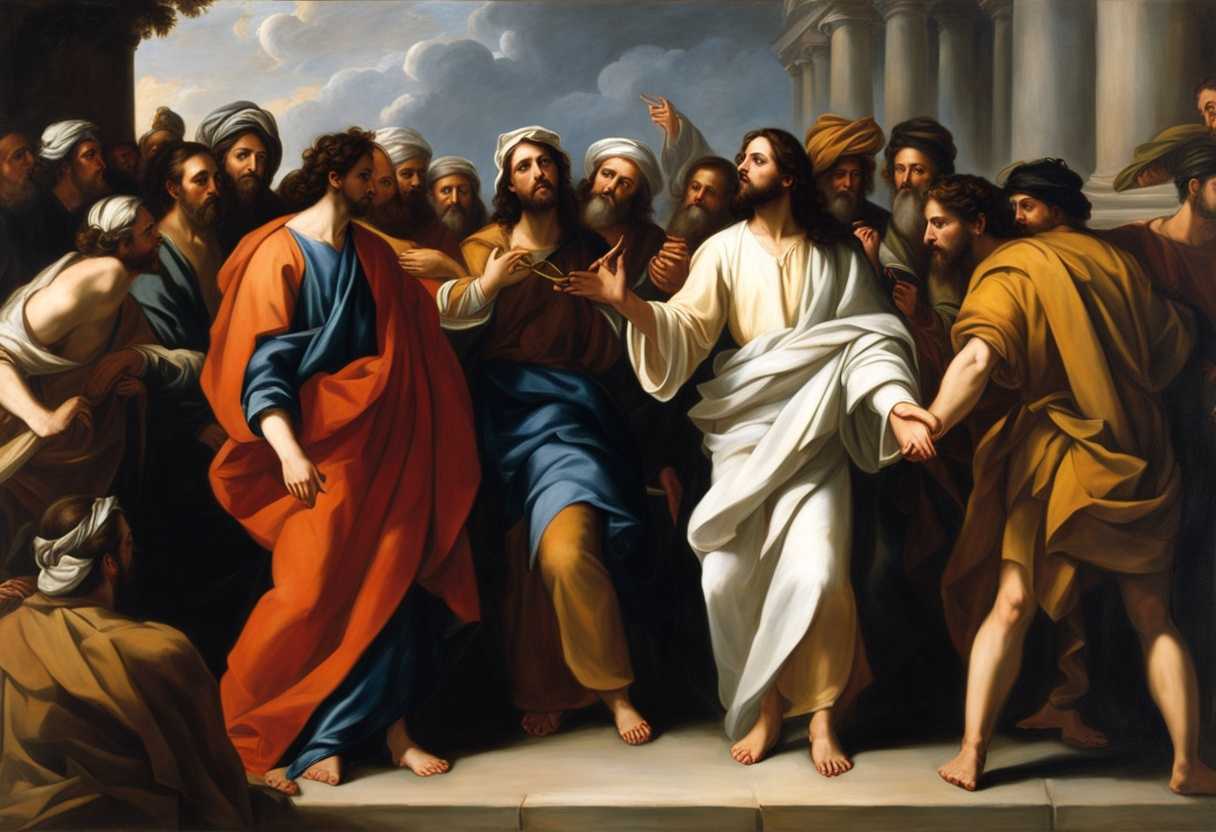
Setting the Scene for Matthew 22:23-46
In Matthew chapter 22, we find Jesus engaged in a series of debates with the religious leaders of his time in the temple in Jerusalem. The scene is tense as the Pharisees, Sadducees, and scribes are all present, each group trying to trap Jesus with their questions. The Pharisees, known for their strict adherence to the law, are trying to test Jesus by asking about paying taxes to Caesar. The Sadducees, who do not believe in the resurrection, pose a hypothetical question about marriage in the afterlife. The scribes, experts in the law, are also present, observing the interactions.
The setting is the temple courtyard, bustling with activity as people come to worship and offer sacrifices. The air is filled with the sounds of prayers, animal sacrifices, and discussions about religious matters. Jesus, calm and composed, navigates through the tricky questions with wisdom and authority, silencing his opponents and leaving the crowd in awe of his teachings. The scene is charged with tension as the religious leaders try to discredit Jesus, but he emerges victorious, demonstrating his deep understanding of the scriptures and his divine authority.
What is Matthew 22:23-46 about?
Jesus imparts two essential teachings in this verse. First, he speaks about the concept of resurrection, emphasizing the significance of life after death and the eternal nature of our souls. Jesus offers hope and reassurance to his followers by discussing resurrection, reminding them of the ultimate promise of salvation and the continuity of life beyond physical death.
Additionally, Jesus highlights the importance of love and relationship in our spiritual journey by emphasizing the greatest commandment – to love God with all our heart, soul, and mind, and to love our neighbors as ourselves. This teaching underscores the central role of love in Christian faith and practice, emphasizing the interconnectedness of loving God and loving others. It challenges us to reflect on the depth and sincerity of our love for both God and our fellow human beings. We are invited to contemplate the eternal nature of our souls and the transformative power of love in our lives as we ponder on these teachings of Jesus. How does the promise of resurrection shape our understanding of the present moment? How does our capacity to love reflect our relationship with God and others? These teachings guide us towards a deeper spiritual understanding and a more profound connection with our faith and community.
Understanding what Matthew 22:23-46 really means
In the midst of contentious interactions with religious leaders, Jesus navigates a series of probing questions with wisdom and clarity. The Sadducees, known for their disbelief in the resurrection, attempt to ensnare Jesus with a query about marriage in the afterlife. Jesus, undeterred, elucidates the nature of the resurrection, asserting that in that realm, earthly institutions like marriage will not hold the same significance. His response not only addresses their immediate challenge but also delves into profound truths about the eternal state of believers.
“You are in error because you do not know the Scriptures or the power of God,” Jesus rebukes, highlighting the essentiality of comprehending both Scripture and the omnipotence of God. This admonition underscores the importance of grounding our beliefs in a deep understanding of God’s Word and His sovereignty. Furthermore, Jesus proclaims that in the resurrection, individuals will transcend earthly relationships, resembling the angels in heaven. This declaration points to a transformed existence beyond our current comprehension, where the focus shifts from earthly ties to a heavenly state of being.
Amidst these exchanges, Jesus encapsulates the essence of divine commandments, emphasizing the paramount importance of loving God wholeheartedly and loving others as oneself. These timeless principles, reiterated from the Old Testament, serve as foundational pillars for ethical conduct and moral living. The call to love God with every fiber of our being and to extend that love to our neighbors resonates across time, guiding believers towards a life marked by compassion and justice.
The relevance of these teachings reverberates through the ages, offering hope and direction to individuals navigating the complexities of life. Understanding the nature of the resurrection provides a perspective that transcends temporal concerns, urging believers to live with an eternal mindset. The commandments to love God and love others stand as beacons of light in a world often shrouded in division, calling for unity, empathy, and selfless love that can transform communities and relationships.
Consider a community where the principles of loving one’s neighbor are lived out authentically. In a town ravaged by a natural disaster, diverse individuals rallied together, offering aid, shelter, and emotional support without reservation. This tangible display of selfless love mirrors the transformative power of Jesus’ teachings, illustrating how embodying these commandments can create a glimpse of God’s kingdom on earth. As we internalize these profound truths and put them into practice, we not only align ourselves with God’s will but also contribute to the realization of a more compassionate and loving world.
What does it mean to love God completely?
To love God completely means to give Him our whole heart, soul, and mind. This includes dedicating our thoughts, actions, and emotions to Him, putting Him above all else in our lives. It means prioritizing our relationship with God above everything else and seeking to align our will with His.
To love God completely is to have a deep and intimate connection with Him, to trust in His providence, and to surrender ourselves fully to His divine will. It involves seeking to know Him more deeply through prayer, meditation on His word, and seeking to live according to His commandments.
Loving God completely means recognizing His supreme authority and sovereignty in our lives, acknowledging His greatness, and committing to follow Him wholeheartedly. It is a continuous journey of growth and transformation, where we strive to become more like Christ in all aspects of our lives.
Application
Dive into the scriptures like you’re unraveling a work project or nurturing a family bond. Engage with them, dissect them, and let them shape your worldview. Let the words of Matthew 22:23-46 be your guide in navigating your spiritual journey. Are you ready to take on the challenge of delving deeper into the teachings of Jesus and transforming your life in the process?

Reverend Michael Johnson is an experienced Church Minister with a profound expertise in spirituality and guidance. With a serene presence and a compassionate heart, he has faithfully served his congregation for over 20 years, leading them on a spiritual journey towards inner peace and enlightenment. Reverend Johnson’s extensive knowledge of religious philosophies and profound understanding of human nature have made him a trusted confidant and mentor to many, as he seamlessly weaves his profound wisdom into life teachings. Reverend Johnson’s calming demeanor and empathetic nature continue to uplift and heal souls, nurturing a sense of unity and tranquility within his community.