
Matthew 23:1-6 is about Jesus criticizing the Pharisees for their hypocritical behavior and lack of true righteousness despite their outward displays of religious devotion.
1 Then Jesus said to the crowds and to his disciples,
2 “The scribes and the Pharisees sit on Moses’ seat,
3 so do and observe whatever they tell you, but not the works they do. For they preach, but do not practice.
4 They tie up heavy burdens, hard to bear, and lay them on people’s shoulders, but they themselves are not willing to move them with their finger.
5 They do all their deeds to be seen by others. For they make their phylacteries broad and their fringes long,
6 and they love the place of honor at feasts and the best seats in the synagogues,
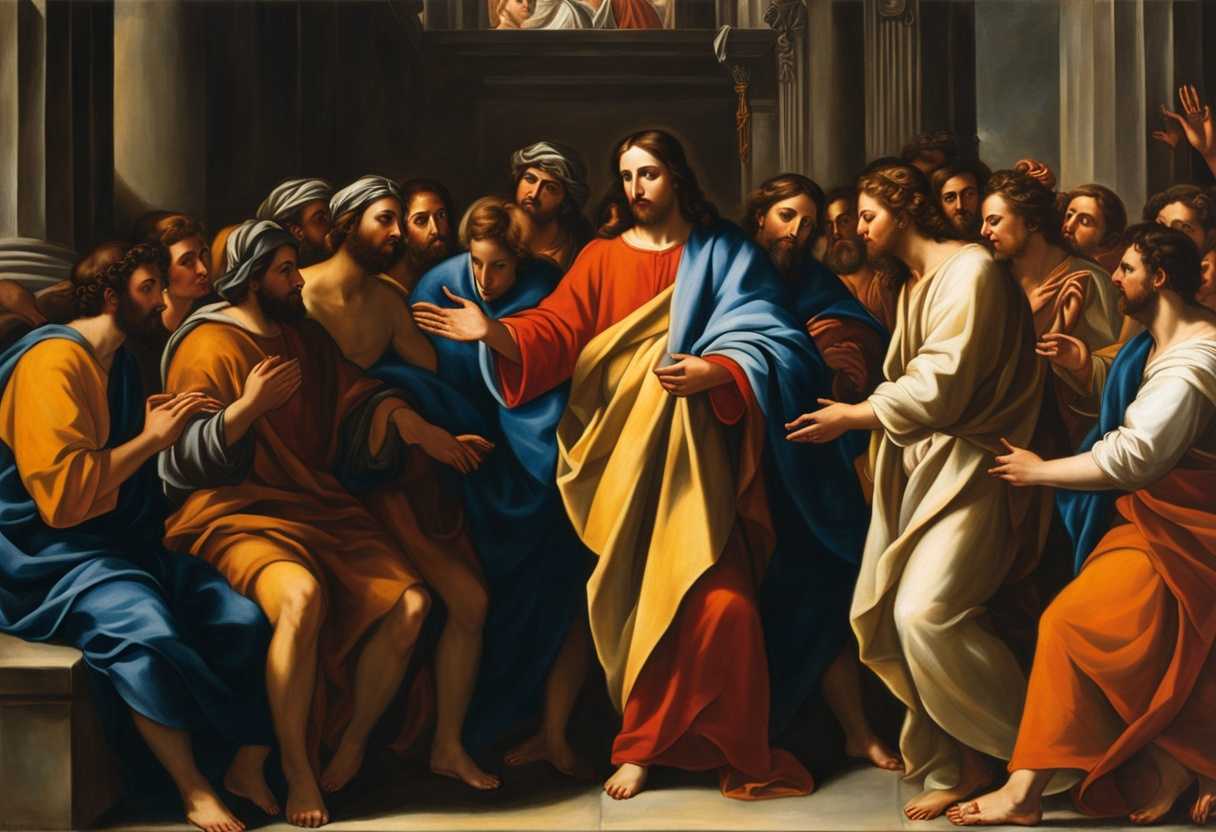
Setting the Scene for Matthew 23:1-6
In Matthew chapter 23, we find Jesus teaching a large crowd in the temple in Jerusalem. The scene is bustling with people from all walks of life – Pharisees, scribes, disciples, and ordinary citizens have gathered to listen to Jesus speak. The temple courtyard is filled with the sounds of conversation, the smell of incense, and the sight of people coming and going.
As Jesus begins to address the crowd, the Pharisees and scribes, known for their strict adherence to religious laws, are also present. They are listening intently, eager to hear what Jesus has to say. The disciples, who have been following Jesus and learning from him, are standing nearby, absorbing his every word.
Jesus, in his teaching, is warning the people about the hypocrisy of the religious leaders. He criticizes the Pharisees and scribes for their outward show of piety while neglecting justice, mercy, and faithfulness. The tension in the air is palpable as Jesus confronts the religious elite, challenging their authority and calling them out on their hypocrisy. The scene is charged with emotion as Jesus delivers his powerful message with authority and conviction.
What is Matthew 23:1-6 about?
Jesus in this verse is cautioning against the dangers of hypocrisy and pride, specifically in the context of religious leadership. Through this warning, he emphasizes the importance of sincerity and humility in one’s faith and actions. Hypocrisy refers to the act of pretending to have beliefs, virtues, or qualities that one does not actually possess, while pride involves an excessive belief in one’s own abilities or accomplishments. Jesus encourages individuals to address these negative traits, act in accordance with their true beliefs, and remain humble in their behavior. Let us consider this verse as we reflect on our own lives and actions. Are we being true to ourselves and our beliefs, or are we putting on a facade for others? Do we approach our faith with sincerity and authenticity, or are we motivated by pride and the desire for recognition? We can strive to embody the qualities of honesty and humility that Jesus exemplifies in his teachings by examining our motivations and behavior. Let us remember the importance of living genuinely and modestly, especially in our roles as leaders and examples to others.
Understanding what Matthew 23:1-6 really means
In Matthew 23:1-6, Jesus addresses the crowds and His disciples, cautioning them about the conduct of the scribes and Pharisees. These religious leaders held positions of authority, symbolized by sitting on Moses’ seat, signifying their role in teaching the Law. However, Jesus points out a crucial flaw in their behavior – while they preach the Law, they do not practice it themselves. This discrepancy between their teachings and actions highlights the hypocrisy that Jesus condemns. He emphasizes the importance of not just hearing and teaching the word but also living it out in one’s daily life.
The key phrases in this passage shed light on the underlying message Jesus conveys. When He instructs the people to follow the teachings of the scribes and Pharisees but not their actions, He underscores the significance of integrity and authenticity in faith. The religious leaders’ focus on outward displays of righteousness, seeking the approval of others rather than God, reveals their misguided priorities. Their deeds are performed not out of genuine devotion but to garner praise from people, exposing their lack of true faith.
Drawing parallels from other biblical passages, such as James 1:22 and Matthew 6:1, reinforces the idea that faith without corresponding actions is empty. James exhorts believers to be doers of the word, not merely listeners, while Matthew warns against practicing righteousness for the sake of human recognition. These verses echo Jesus’ admonition against hypocritical behavior and emphasize the importance of aligning one’s beliefs with their conduct. Additionally, 1 Samuel 16:7 reminds us that God values the sincerity of the heart over external appearances, urging us to cultivate inner righteousness rather than seeking validation from others.
The relevance of this message transcends time, resonating with contemporary society’s inclination towards superficiality and the pursuit of social approval. In an era dominated by social media, where individuals often craft idealized personas for public consumption, Jesus’ words serve as a poignant reminder to prioritize authenticity and moral consistency. The anecdotal scenarios of a respected community leader and a social media influencer illustrate the dangers of prioritizing outward image over inner character. Such discrepancies between public persona and private conduct can erode trust and lead to a shallow sense of self-worth rooted in external validation.
In conclusion, Matthew 23:1-6 challenges us to reflect on our actions and motivations, urging us to align our behavior with our professed beliefs. It prompts introspection and calls for a shift in focus from seeking human approval to seeking God’s affirmation. By embodying genuine faith and humility, we can cultivate a life characterized by integrity and authenticity, transcending the superficial trappings of external validation.
Are my actions aligned with my beliefs and values?
I must reflect on whether I am practicing what I preach in evaluating whether my actions are aligned with my beliefs and values. It’s essential for me to truly live out my principles rather than just giving lip service to them. If there is a disparity between what I claim to believe and how I behave, I am not truly embodying my values.
It is crucial for me to remain humble and genuine in my actions, especially when it comes to matters of faith and ethics. Extending the same values that I uphold to my actions is a reflection of integrity and sincerity. I can cultivate a more authentic and meaningful connection between my beliefs and my behavior by ensuring that my deeds and words are harmonious.
Application
Reflect on your actions honestly and with purity, just like the call in Matthew 23:1-6. Are you truly embodying your faith, or are you just wearing a mask for the world to see? Align your heart with God’s purpose, serving with humility instead of seeking vain praise. Embrace this verse as a guiding light to assess your intentions and nurture a sincere relationship with the Divine. How will you show the world the true essence of your beliefs through your everyday choices?

Reverend Michael Johnson is an experienced Church Minister with a profound expertise in spirituality and guidance. With a serene presence and a compassionate heart, he has faithfully served his congregation for over 20 years, leading them on a spiritual journey towards inner peace and enlightenment. Reverend Johnson’s extensive knowledge of religious philosophies and profound understanding of human nature have made him a trusted confidant and mentor to many, as he seamlessly weaves his profound wisdom into life teachings. Reverend Johnson’s calming demeanor and empathetic nature continue to uplift and heal souls, nurturing a sense of unity and tranquility within his community.