
Matthew 26:17-35 is about Jesus preparing for the Last Supper with his disciples, where he foretells his betrayal by Judas and Peter’s denial, emphasizing the themes of sacrifice, loyalty, and the initiation of the new covenant through his body and blood.
17 Now on the first day of Unleavened Bread the disciples came to Jesus, saying, “Where will you have us prepare for you to eat the Passover?”
18 He said, “Go into the city to a certain man and say to him, ‘The Teacher says, My time is at hand. I will keep the Passover at your house with my disciples.’”
19 So the disciples did as Jesus had directed them, and they prepared the Passover.
20 When it was evening, he reclined at table with the twelve.
21 And as they were eating, he said, “Truly, I say to you, one of you will betray me.”
22 And they were very sorrowful and began to say to him one after another, “Is it I, Lord?”
23 He answered, “He who has dipped his hand in the dish with me will betray me.
24 The Son of Man goes as it is written of him, but woe to that man by whom the Son of Man is betrayed! It would have been better for that man if he had not been born.
25 Judas, who would betray him, answered, “Is it I, Rabbi?” He said to him, “You have said so.”
26 Now as they were eating, Jesus took bread, and after blessing it broke it and gave it to the disciples, and said, “Take, eat; this is my body.”
27 And he took a cup, and when he had given thanks he gave it to them, saying, “Drink of it, all of you,
28 for this is my blood of the covenant, which is poured out for many for the forgiveness of sins.
29 I tell you I will not drink again of this fruit of the vine until that day when I drink it new with you in my Father’s kingdom.”
30 And when they had sung a hymn, they went out to the Mount of Olives.
31 Then Jesus said to them, “You will all fall away because of me this night. For it is written, ‘I will strike the shepherd, and the sheep of the flock will be scattered.’
32 But after I am raised up, I will go before you to Galilee.
33 Peter answered him, “Though they all fall away because of you, I will never fall away.”
34 Jesus said to him, “Truly, I tell you, this very night, before the rooster crows, you will deny me three times.”
35 Peter said to him, “Even if I must die with you, I will not deny you.” And all the disciples said the same.
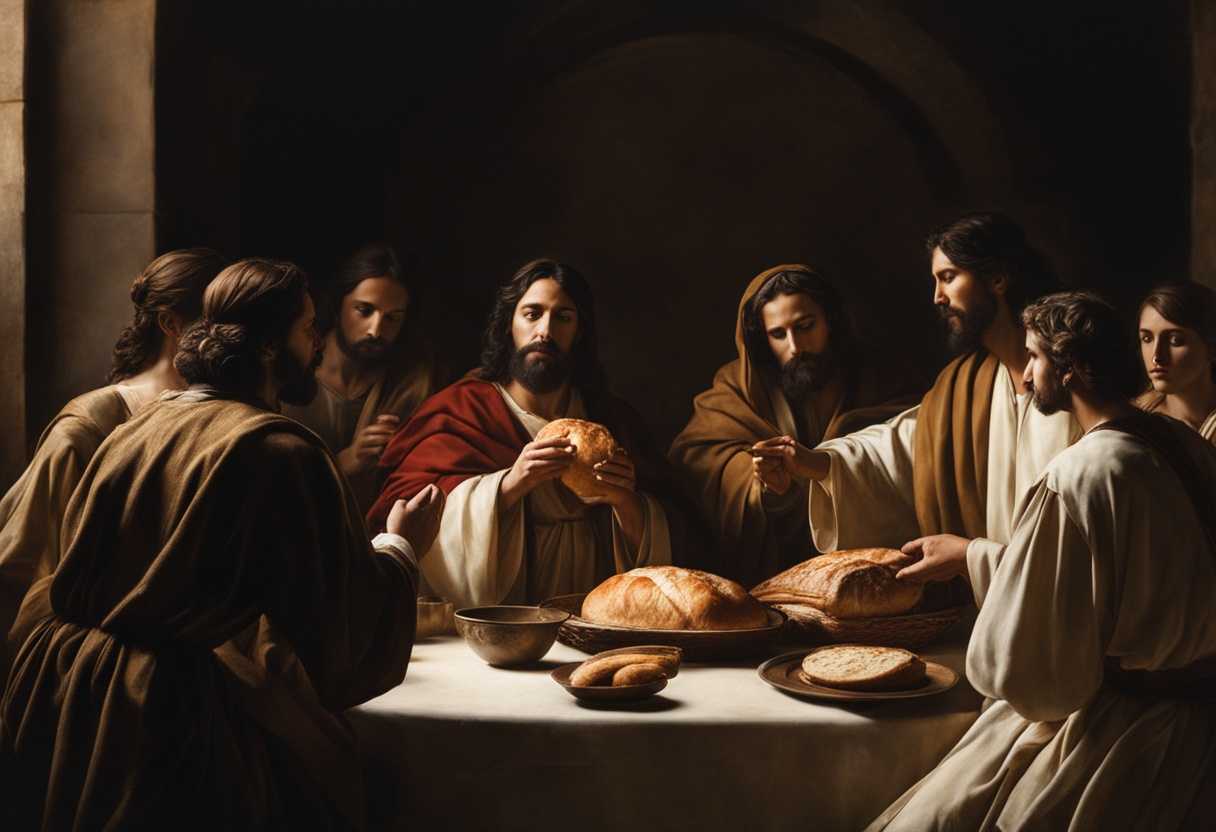
Setting the Scene for Matthew 26:17-35
In Matthew chapter 26, we find Jesus and his disciples preparing to celebrate the Passover meal in Jerusalem. The scene is set in an upper room, a large and dimly lit space with a long table adorned with traditional Passover foods such as unleavened bread, bitter herbs, and wine. The disciples, including Peter, James, John, and the others, are gathered around Jesus, eagerly anticipating the meal.
As they recline at the table, Jesus begins to speak somberly about the betrayal that is to come. Judas Iscariot, one of the twelve disciples, is present in the room, though his heart is already filled with treachery. The atmosphere is tense as Jesus reveals that one of them will betray him. The disciples are shocked and saddened by this revelation, each questioning if it could be them.
Amidst the heavy atmosphere, Jesus takes the bread, blesses it, and breaks it, symbolizing his body that will be broken for them. He then takes the cup, blesses it, and shares it with them, symbolizing his blood that will be shed for the forgiveness of sins. This poignant moment marks the institution of the Lord’s Supper, a sacred tradition that Christians around the world continue to observe in remembrance of Jesus’ sacrifice.
What is Matthew 26:17-35 about?
Jesus institutes the Lord’s Supper in this verse as a powerful moment for Christians to remember His sacrifice. He shows His followers how to partake in this sacred meal as a way to remember and honor His upcoming sacrifice for their sins. This act of communion is meant to strengthen the bond between believers and Jesus, reminding them of His love and the ultimate sacrifice He made for them.
Furthermore, Jesus also predicts Peter’s denial and his disciples’ desertion. This serves as a reminder of the humanity and imperfections present even among Jesus’ closest followers. It shows that even those who are deeply devoted to Him can falter in their faith and commit mistakes. Despite these shortcomings, Jesus’ love and grace are always present, offering forgiveness and redemption to those who seek it. This verse urges us to reflect on our own actions and faith, reminding us that even in our weakest moments, Jesus is there to guide and support us.
Understanding what Matthew 26:17-35 really means
During the Last Supper, a significant event in Jesus’ life, He prepares His disciples for the upcoming crucifixion, marking the beginning of the Passion narrative. Jesus, aware of His impending death, mentions, “My time is near,” indicating His readiness to fulfill His mission. The revelation that “One of you will betray me” foreshadows Judas’ betrayal, highlighting the theme of human frailty and disloyalty. By saying, “Take, eat; this is my body,” Jesus institutes the Eucharist, symbolizing His sacrifice and the establishment of a new covenant. He further emphasizes the sacrificial nature of His death by stating, “This is my blood of the covenant, which is poured out for many for the forgiveness of sins.”
In Exodus 12:1-14, the institution of the Passover parallels the Last Supper, portraying Jesus as the ultimate Passover Lamb. Paul’s account in 1 Corinthians 11:23-26 reinforces the significance of the Eucharist in Christian practice. John 13:21-30 provides another perspective on Jesus predicting His betrayal, adding depth to the emotional and spiritual weight of the moment. The passage resonates with people today through themes of betrayal, forgiveness, sacrifice, and love. It speaks to the universal experience of betrayal and the potential for redemption through forgiveness.
Jesus’ willingness to sacrifice Himself out of love for humanity exemplifies selfless love and unwavering commitment. The institution of the Eucharist underscores the importance of community and shared faith in the Christian tradition. Consider a scenario where a close group of friends faces betrayal, mirroring Jesus and His disciples. Despite the pain caused, the leader chooses love, forgiveness, and sacrifice to restore unity, offering a profound lesson in compassion and reconciliation. This passage challenges readers to reflect on betrayal, sacrifice, and redemption, prompting us to embody the love and forgiveness demonstrated by Jesus, even in times of suffering and disloyalty.
How can we show unwavering faith like Peter?
To show unwavering faith like Peter, we must trust in the power and faithfulness of God even in the face of difficult circumstances. Peter’s unwavering faith was evident when he boldly proclaimed his loyalty to Jesus, even when others doubted. Similarly, we can demonstrate unwavering faith by standing firm in our beliefs and commitments to God, regardless of the challenges or uncertainties we may face.
Additionally, unwavering faith requires us to take action based on our belief in God’s promises. Peter demonstrated his faith not just through words, but through his actions by stepping out of the boat to walk on water towards Jesus. We can show unwavering faith by actively seeking God’s will and obeying His commands, even when it requires us to step into the unknown or face difficult circumstances. Trusting in God’s plan and sovereignty means having unwavering faith, knowing that He is in control even when things seem out of our control. Like Peter, we can demonstrate unwavering faith by surrendering our fears and doubts to God, and placing our trust fully in Him to guide us through life’s challenges and uncertainties.
Application
Join in the sacred act of communion, just as Jesus did with his disciples, reinforcing the bond between us and our faith. Partake in this tradition with earnest respect and thankfulness, acknowledging the profound love that guides us through the modern tumult of our daily lives. Will you accept the invitation to commune, keeping alive the enduring message of hope and salvation?

Reverend Michael Johnson is an experienced Church Minister with a profound expertise in spirituality and guidance. With a serene presence and a compassionate heart, he has faithfully served his congregation for over 20 years, leading them on a spiritual journey towards inner peace and enlightenment. Reverend Johnson’s extensive knowledge of religious philosophies and profound understanding of human nature have made him a trusted confidant and mentor to many, as he seamlessly weaves his profound wisdom into life teachings. Reverend Johnson’s calming demeanor and empathetic nature continue to uplift and heal souls, nurturing a sense of unity and tranquility within his community.