
Matthew 26:36-56 is about Jesus preparing for his arrest and crucifixion, demonstrating obedience to God’s will, despite facing emotional turmoil and betrayal from his closest disciples.
36 Then Jesus went with them to a place called Gethsemane, and he said to his disciples, “Sit here, while I go over there and pray.”
37 And taking with him Peter and the two sons of Zebedee, he began to be sorrowful and troubled.
38 Then he said to them, “My soul is very sorrowful, even to death; remain here, and watch with me.”
39 And going a little farther he fell on his face and prayed, saying, “My Father, if it be possible, let this cup pass from me; nevertheless, not as I will, but as you will.”
40 And he came to the disciples and found them sleeping. And he said to Peter, “So, could you not watch with me one hour?
41 Watch and pray that you may not enter into temptation. The spirit indeed is willing, but the flesh is weak.
42 Again, for the second time, he went away and prayed, “My Father, if this cannot pass unless I drink it, your will be done.”
43 And again he came and found them sleeping, for their eyes were heavy.
44 So, leaving them again, he went away and prayed for the third time, saying the same words again.
45 Then he came to the disciples and said to them, “Sleep and take your rest later on. See, the hour is at hand, and the Son of Man is betrayed into the hands of sinners.
46 Rise, let us be going; see, my betrayer is at hand.
47 While he was still speaking, Judas came, one of the twelve, and with him a great crowd with swords and clubs, from the chief priests and the elders of the people.
48 Now the betrayer had given them a sign, saying, “The one I will kiss is the man; seize him.”
49 And he came up to Jesus at once and said, “Greetings, Rabbi!” And he kissed him.
50 Jesus said to him, “Friend, do what you came to do.” Then they came up and laid hands on Jesus and seized him.
51 And behold, one of those who were with Jesus stretched out his hand and drew his sword and struck the servant of the high priest and cut off his ear.
52 Then Jesus said to him, “Put your sword back into its place. For all who take the sword will perish by the sword.
53 Do you think that I cannot appeal to my Father, and he will at once send me more than twelve legions of angels?
54 But how then should the Scriptures be fulfilled, that it must be so?”
55 At that hour Jesus said to the crowds, “Have you come out as against a robber, with swords and clubs to capture me? Day after day I sat in the temple teaching, and you did not seize me.
56 But all this has taken place that the Scriptures of the prophets might be fulfilled.” Then all the disciples left him and fled.
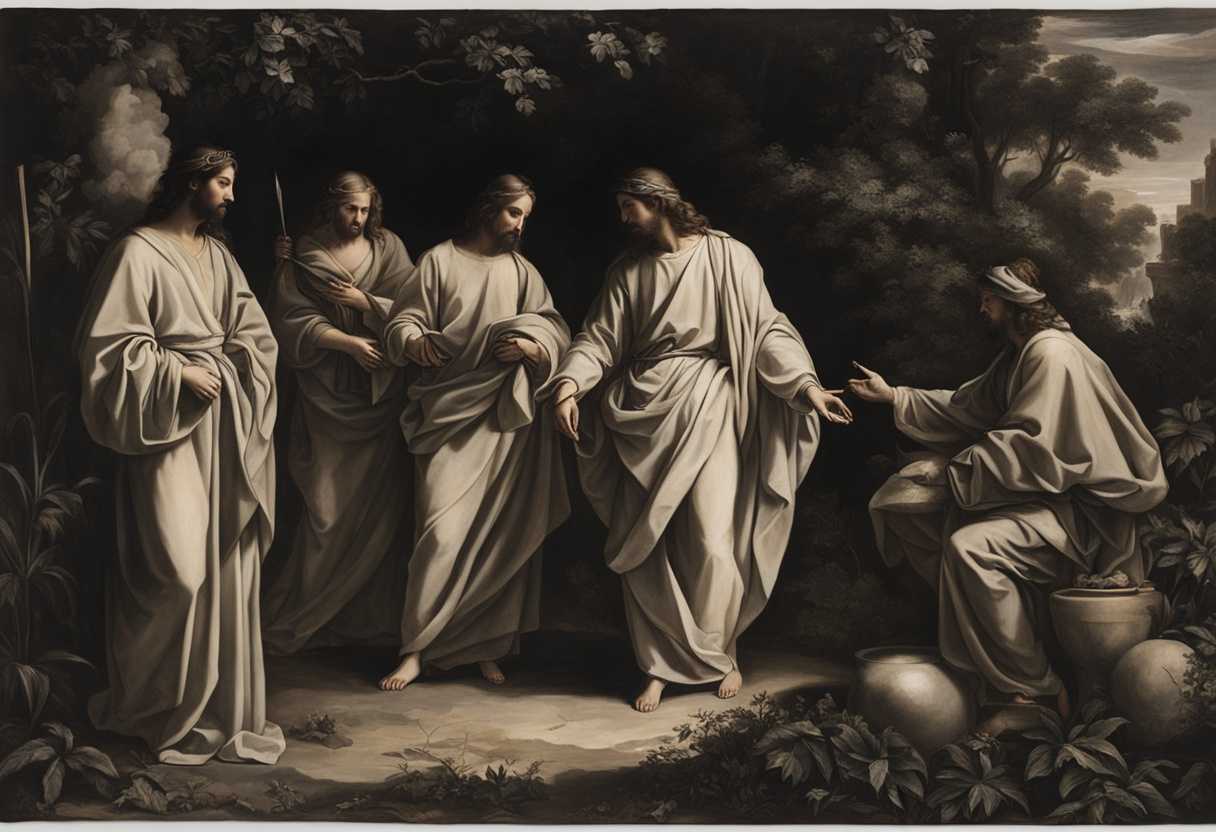
Setting the Scene for Matthew 26:36-56
In Matthew chapter 26, we find Jesus in the Garden of Gethsemane with his disciples. After the Last Supper, Jesus takes Peter, James, and John with him to a secluded spot within the garden to pray. The atmosphere is heavy with anticipation and sorrow as Jesus knows what is about to unfold – his betrayal, arrest, and crucifixion. The garden is filled with olive trees, their branches casting long shadows in the moonlight.
As Jesus prays, he becomes overwhelmed with anguish and sorrow, knowing the weight of the sins of the world that he is about to bear. His disciples, Peter, James, and John, are nearby, but they keep falling asleep, unable to fully grasp the gravity of the situation. Jesus, in his humanity, asks God to let the cup of suffering pass from him if it is His will, but ultimately surrenders to God’s plan for salvation.
Suddenly, the tranquility of the garden is shattered by the arrival of Judas Iscariot, leading a crowd armed with swords and clubs to arrest Jesus. Despite Peter’s attempt to defend Jesus, he is taken into custody, fulfilling the prophecies of the Old Testament. The scene in the Garden of Gethsemane captures the pivotal moment in Jesus’ journey towards the cross, where he willingly lays down his life for the redemption of humanity.
What is Matthew 26:36-56 about?
We witness a powerful and pivotal moment in Jesus’ life in this verse. It shows the profound human emotions and struggles Jesus faced in his final hours before his crucifixion. From fervently praying in Gethsemane, feeling the weight of what was to come, to being betrayed by one of his own disciples, Judas, and ultimately being arrested while his closest companions fled. This verse captures the emotional turmoil, betrayal, and abandonment faced by Jesus in the face of his impending sacrifice for humanity.
Have you ever felt overwhelmed by challenges or betrayed by someone you trusted? This verse serves as a reminder that even in our darkest moments, we can find solace in knowing that Jesus himself experienced similar struggles. It reflects the depth of Jesus’ sacrifice and the human experience of facing adversity with courage and faith. Despite the betrayal and abandonment, Jesus continued on his path of love and redemption, showing us the ultimate example of forgiveness and resilience in the face of adversity. Let this verse inspire you to find strength in your own struggles and remember that you are never alone in facing life’s challenges.
Understanding what Matthew 26:36-56 really means
The passage in Matthew 26:36-56 takes us to the poignant scene of Jesus in the Garden of Gethsemane, a moment of profound significance before His crucifixion. Here, we witness the intersection of Jesus’ human vulnerability and divine obedience, as He grapples with the weight of what is to come. His words, “My soul is overwhelmed with sorrow to the point of death,” resonate with deep emotional and spiritual anguish, laying bare His humanity for all to see. In this moment, Jesus exemplifies the essence of surrender and trust in God’s will, uttering the powerful words, “Not as I will, but as you will,” a testament to His unwavering obedience.
As we delve into the key phrases of this passage, we encounter the timeless struggle encapsulated in the words, “The spirit is willing, but the flesh is weak.” This dichotomy between spiritual resolve and human frailty is a universal theme that resonates with the challenges we face in our own lives. Jesus’ unwavering commitment in the face of betrayal, as He declares, “Rise, let us go! Here comes my betrayer!” showcases His courage and steadfastness in fulfilling His divine purpose.
Drawing parallels with other biblical passages such as Luke 22:42, Hebrews 5:7-8, and Philippians 2:8, we gain a deeper understanding of Jesus’ submission to God’s will, His fervent prayers, and His ultimate humility in obedience unto death. These scriptures reinforce the profound sacrifice and obedience displayed by Jesus, setting a powerful example for us to follow in our own lives.
The relevance of this passage to contemporary audiences is striking. In a world filled with personal struggles and uncertainties, Jesus’ example in Gethsemane serves as a beacon of hope and guidance. His unwavering trust in God’s plan encourages us to seek divine wisdom and strength in the midst of our own trials. By acknowledging our human frailty and leaning on God for support, we can navigate life’s challenges with faith and resilience.
Consider a scenario where an individual is faced with a daunting life decision, much like Jesus in Gethsemane. Through prayer and seeking God’s guidance, they find solace and direction, mirroring Jesus’ reliance on the Father’s will. This anecdote illustrates the timeless relevance of Jesus’ experience and underscores the importance of seeking God’s wisdom in our own journeys.
In conclusion, the passage from Matthew 26:36-56 offers a profound insight into Jesus’ humanity, obedience, and trust in God. It serves as a poignant reminder for us to embrace our struggles with faith, submit to God’s will, and draw strength from His unwavering love. By reflecting on Jesus’ profound experience in Gethsemane, we are invited to emulate His example of surrender and find solace in the assurance that God’s plan is always for our ultimate good.
What does it mean to submit to God’s will?
Submitting to God’s will means humbly accepting and obeying His plans for us, even if they may be difficult or different from what we initially desire. It involves surrendering our own desires and preferences to trust in God’s wisdom and guidance. Jesus in the garden of Gethsemane prayed to God, expressing His human emotions and fears, but ultimately submitted to God’s will by saying, “not as I will, but as You will.”” This act of submission allowed Jesus to fulfill His purpose and ultimately bring about salvation for all.
Submitting to God’s will also involves putting our faith and trust in Him, knowing that He works all things for our good. It requires us to let go of our need for control and to have a posture of surrender, acknowledging that God’s plans are always greater and better than our own. We align ourselves with God’s purpose for our lives and open ourselves up to experiencing His peace and blessings, even in the midst of challenges and uncertainties by submitting to His will. Submitting to God’s will ultimately stems from a deep trust in His love and sovereignty, requiring an act of surrender and obedience. It is a recognition that God knows what is best for us and that His plans will always lead to our ultimate good and His glory. We learn to trust in God’s perfect will and embrace His guidance in every aspect of our lives by following Jesus’ example of submission in the garden of Gethsemane.
Application
Think about Jesus in the Garden of Gethsemane, battling His toughest moments just like you juggle your own work and family pressures. He turned to prayer – His direct line to strength and peace. Can you imagine finding that same source of power during your trials? Make prayer your go-to, your anchor in the storm. Will you take the step to build a constant prayer life, drawing closer to God for the solace and guidance you need?

Reverend Michael Johnson is an experienced Church Minister with a profound expertise in spirituality and guidance. With a serene presence and a compassionate heart, he has faithfully served his congregation for over 20 years, leading them on a spiritual journey towards inner peace and enlightenment. Reverend Johnson’s extensive knowledge of religious philosophies and profound understanding of human nature have made him a trusted confidant and mentor to many, as he seamlessly weaves his profound wisdom into life teachings. Reverend Johnson’s calming demeanor and empathetic nature continue to uplift and heal souls, nurturing a sense of unity and tranquility within his community.