
Matthew 26:47-56 is about the betrayal and arrest of Jesus in the Garden of Gethsemane, illustrating the fulfillment of scripture, Jesus’ submission to God’s will, and his disciples’ failure to stay with him in his hour of need.
47 While he was still speaking, Judas came, one of the twelve, and with him a great crowd with swords and clubs, from the chief priests and the elders of the people.
48 Now the betrayer had given them a sign, saying, “The one I will kiss is the man; seize him.”
49 And he came up to Jesus at once and said, “Greetings, Rabbi!” And he kissed him.
50 Jesus said to him, “Friend, do what you came to do.” Then they came up and laid hands on Jesus and seized him.
51 And behold, one of those who were with Jesus stretched out his hand and drew his sword and struck the servant of the high priest and cut off his ear.
52 Then Jesus said to him, “Put your sword back into its place. For all who take the sword will perish by the sword.
53 Do you think that I cannot appeal to my Father, and he will at once send me more than twelve legions of angels?
54 But how then should the Scriptures be fulfilled, that it must be so?”
55 At that hour Jesus said to the crowds, “Have you come out as against a robber, with swords and clubs to capture me? Day after day I sat in the temple teaching, and you did not seize me.
56 But all this has taken place that the Scriptures of the prophets might be fulfilled.” Then all the disciples left him and fled.
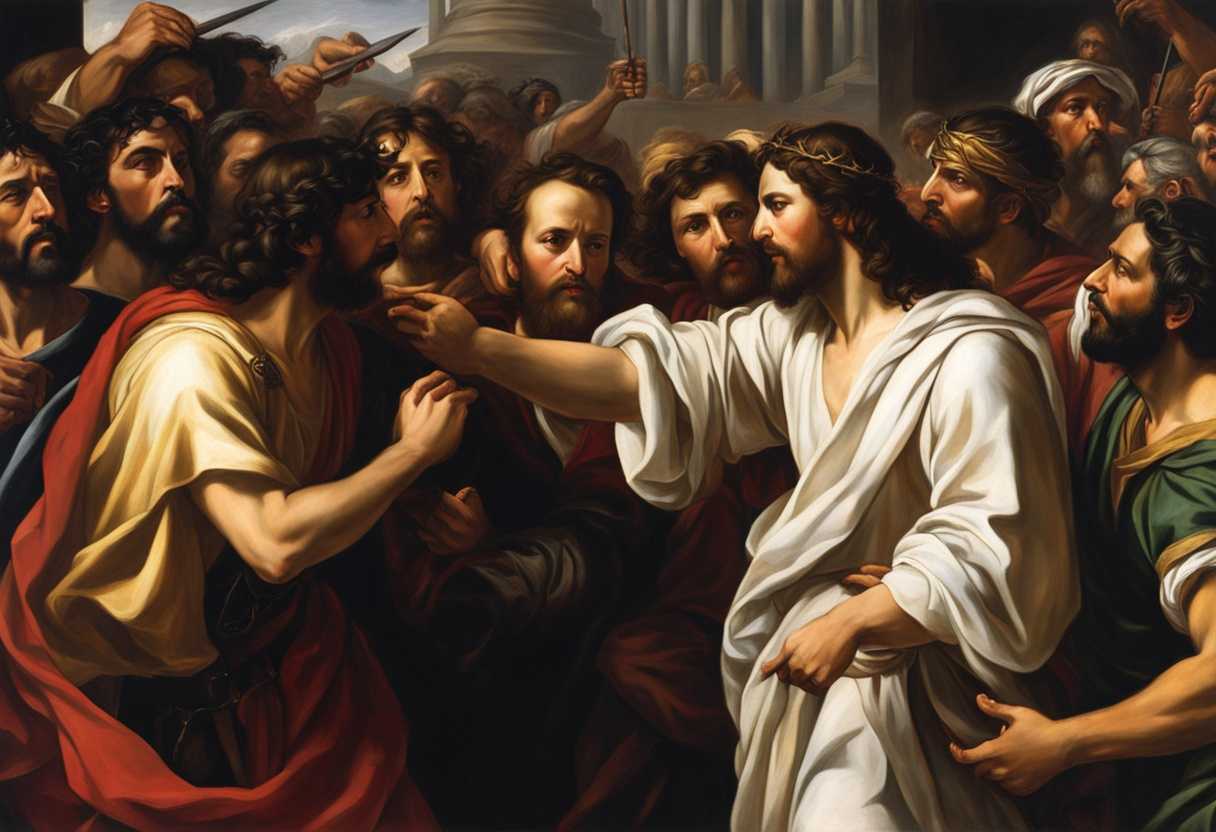
Setting the Scene for Matthew 26:47-56
The scene described in Matthew 26:47-56 takes place in the Garden of Gethsemane, a peaceful olive grove located at the foot of the Mount of Olives, just outside Jerusalem. Jesus, accompanied by his disciples Peter, James, and John, had gone to the garden to pray, knowing that his arrest was imminent.
As they were in the garden, a large crowd armed with swords and clubs, sent by the chief priests and elders, approached them. Leading the group was Judas Iscariot, one of Jesus’ disciples who had betrayed him by identifying him with a kiss. Judas had arranged a signal with the crowd to identify Jesus, and as he approached, he said, “Greetings, Rabbi!” and kissed him.
In the confusion that followed, Peter impulsively drew his sword and cut off the ear of one of the high priest’s servants. Jesus, demonstrating his unwavering commitment to his mission, rebuked Peter, healed the servant’s ear, and willingly surrendered himself to be taken into custody. This pivotal moment marked the beginning of Jesus’ journey to the cross, as he fulfilled the prophecies and willingly laid down his life for the salvation of humanity.
What is Matthew 26:47-56 about?
This verse captures a pivotal moment in the life of Jesus Christ as he nears the culmination of his earthly ministry. It recounts the heartbreaking betrayal of Jesus by one of his own disciples, Judas Iscariot, leading to his arrest in the garden of Gethsemane. Jesus is faced with the ultimate act of treachery by someone he had walked alongside for so long in this moment of intense vulnerability and humanity. The disciples, overwhelmed by fear and confusion, scatter and flee, leaving Jesus to face his fate alone.
The events described in this verse also highlight the profound irony and complexity of the situation. While the betrayal, arrest, and abandonment seem like moments of defeat and despair, they are also essential steps in the fulfillment of ancient prophecies foretelling the coming of the Messiah. Jesus, in his willingness to endure betrayal and suffering, is fulfilling a greater purpose that transcends human understanding. God invites us to ponder the depths of human frailty and the unfathomable grace and wisdom as we reflect on this verse, weaving even the darkest moments of betrayal into the tapestry of salvation. What lessons can we draw from the actions of Judas, the disciples, and Jesus in this crucial moment? How does this narrative challenge us to grapple with the complexities of faith, loyalty, and divine providence in our own lives?
Understanding what Matthew 26:47-56 really means
In the somber setting of the Garden of Gethsemane, a pivotal moment unfolds as Jesus is betrayed by one of His own. Judas, a trusted disciple, arrives with a crowd armed with swords and clubs, symbolizing the forces of opposition aligned against Jesus. The kiss of betrayal from Judas serves as a stark reminder of the duplicity that can exist within close relationships, prompting us to consider the complexities of trust and loyalty.
As Judas approaches Jesus with feigned affection, addressing Him as “Rabbi,” we witness Jesus’ composed response, acknowledging the unfolding events with a sense of divine purpose. His words, “Friend, do what you came for,” reveal a profound acceptance of the path ahead, embodying a remarkable display of calmness in the face of betrayal and impending suffering.
Amidst the chaos, Peter’s impulsive act of drawing a sword is swiftly rebuked by Jesus, who emphasizes the principle of non-violence and the futility of responding to aggression with further violence. This teaching echoes through the ages, challenging us to seek peaceful resolutions in the midst of conflict and to embody the spirit of reconciliation rather than retaliation.
Jesus’ reference to the availability of heavenly legions underscores His divine authority and the voluntary nature of His sacrifice, highlighting the alignment of His actions with the fulfillment of prophetic Scriptures. His unwavering commitment to God’s plan, even in the face of betrayal and imminent suffering, serves as a powerful example of obedience and trust in the Father’s will.
In a world marked by broken trust and escalating conflicts, the timeless lessons from this passage resonate deeply. The themes of betrayal, non-violence, and divine purpose compel us to reflect on our own responses to adversity, urging us to emulate Jesus’ grace and resilience in the face of trials. As we navigate the complexities of human relationships and the challenges of living out our faith, may we find inspiration in Jesus’ unwavering commitment to God’s plan and His enduring message of love and forgiveness.
Do we betray Jesus in our actions?
Our actions may unintentionally betray Jesus in our daily lives. For example, when we prioritize material possessions, selfish desires, or worldly pursuits over the teachings of Jesus, we are failing to live out His message of love, compassion, and service to others. This betrayal can occur when we allow greed, envy, or hatred to guide our behaviors instead of kindness, forgiveness, and empathy.
Furthermore, when we remain silent in the face of injustice, discrimination, or wrongdoing, we are complicit in betraying Jesus. We may also back away from standing up for our faith when it is inconvenient or challenging, just as Peter denied knowing Jesus three times out of fear. We may unknowingly betray Jesus and His teachings by aligning ourselves with the values of the world rather than the values of the Kingdom of God.
To avoid betraying Jesus in our actions, we must strive to live according to His example and teachings. This means practicing love, forgiveness, and humility in all aspects of our lives, and speaking out against injustice and oppression. We can ensure that our actions reflect our commitment to following Jesus wholeheartedly by embracing the values of the Gospel and extending grace and mercy to others.
Application
Reflecting on Matthew 26:47-56, we see Jesus’ steadfast love and sacrifice. This is our call to check our own dedication, just like balancing work and family. Let’s not just read these words; let’s live them. Stand firm in your faith, even when it’s tough. Are you ready to step up and follow Jesus’ teachings with boldness and unwavering commitment?

Reverend Michael Johnson is an experienced Church Minister with a profound expertise in spirituality and guidance. With a serene presence and a compassionate heart, he has faithfully served his congregation for over 20 years, leading them on a spiritual journey towards inner peace and enlightenment. Reverend Johnson’s extensive knowledge of religious philosophies and profound understanding of human nature have made him a trusted confidant and mentor to many, as he seamlessly weaves his profound wisdom into life teachings. Reverend Johnson’s calming demeanor and empathetic nature continue to uplift and heal souls, nurturing a sense of unity and tranquility within his community.