
Matthew 27:15-26 is about Pontius Pilate attempting to release Jesus, the innocent man, by offering the choice between Him and the guilty Barabbas to the crowd, symbolizing the human tendency to choose the wrong path even when presented with the opportunity for redemption and salvation.
15 Now at the feast the governor was accustomed to release for the crowd any one prisoner whom they wanted.
16 And they had then a notorious prisoner called Barabbas.
17 So when they had gathered, Pilate said to them, “Whom do you want me to release for you: Barabbas, or Jesus who is called Christ?”
18 For he knew that it was out of envy that they had delivered him up.
19 Besides, while he was sitting on the judgment seat, his wife sent word to him, “Have nothing to do with that righteous man, for I have suffered much because of him today in a dream.”
20 Now the chief priests and the elders persuaded the crowd to ask for Barabbas and destroy Jesus.
21 The governor again said to them, “Which of the two do you want me to release for you?” And they said, “Barabbas.”
22 Pilate said to them, “Then what shall I do with Jesus who is called Christ?” They all said, “Let him be crucified!”
23 And he said, “Why? What evil has he done?” But they shouted all the more, “Let him be crucified!”
24 So when Pilate saw that he was gaining nothing, but rather that a riot was beginning, he took water and washed his hands before the crowd, saying, “I am innocent of this man’s blood; see to it yourselves.”
25 And all the people answered, “His blood be on us and on our children!”
26 Then he released for them Barabbas, and having scourged Jesus, delivered him to be crucified.
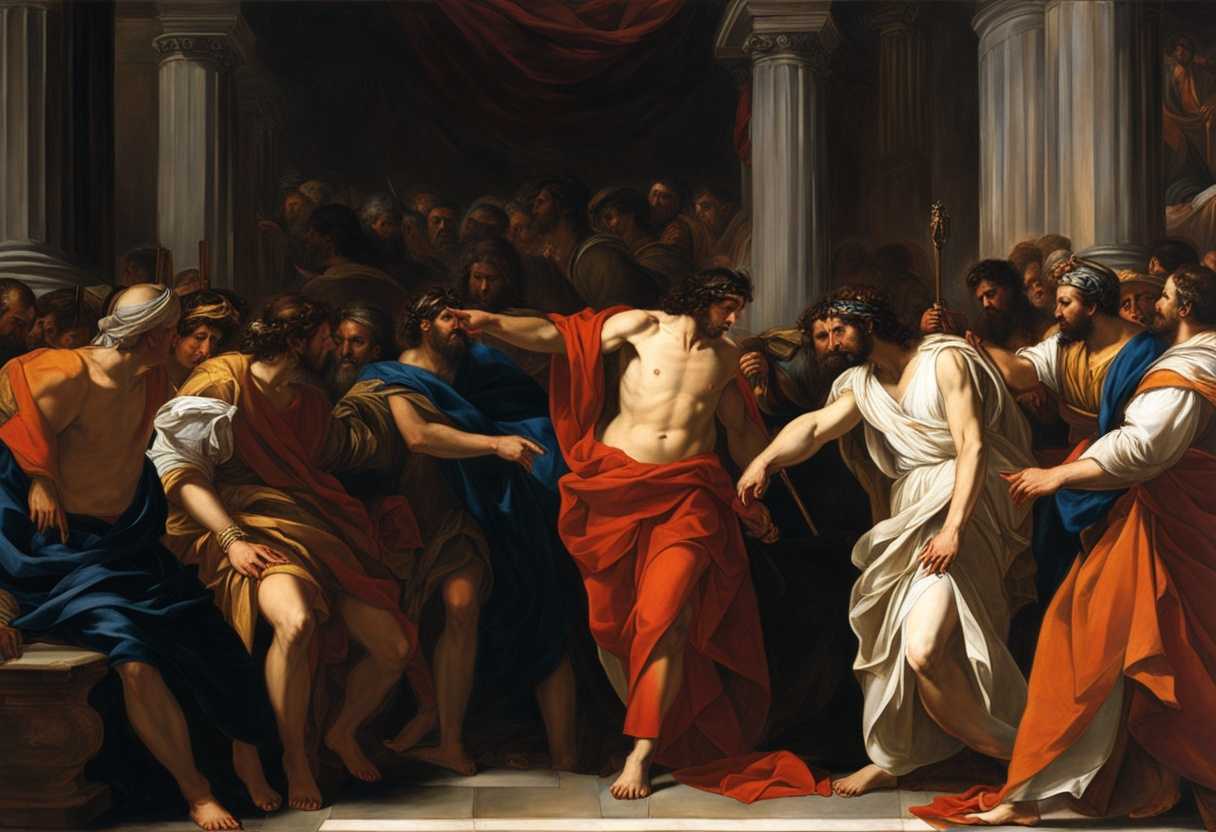
Setting the Scene for Matthew 27:15-26
The scene described in Matthew 27:15-26 takes place in Jerusalem during the time of the Roman governor Pontius Pilate. The main characters in this scene are Pontius Pilate, the Roman governor, and the crowd that has gathered outside his residence. The crowd has been incited by the chief priests and elders to demand the release of a prisoner, as was the custom during the Passover festival.
Pontius Pilate, a representative of Roman authority, finds himself in a difficult position as he tries to navigate the demands of the crowd and uphold Roman law. Inside his residence, the atmosphere is tense as Pilate questions Jesus, who has been brought before him by the religious leaders. The crowd outside grows restless, influenced by the religious leaders who have stirred them up against Jesus.
The setting is likely a courtyard within Pilate’s residence, with Roman guards present to maintain order. The crowd outside is a mix of curious onlookers, supporters of Jesus, and those who have been swayed by the religious leaders’ manipulation. The tension is palpable as Pilate seeks a way to appease the crowd without compromising his authority or principles.
What is Matthew 27:15-26 about?
We witness a heart-wrenching moment in Jesus’ journey towards his crucifixion in this powerful verse. The choice presented between Jesus, the embodiment of love, truth, and compassion, and Barabbas, a criminal, symbolizes the struggle between good and evil, light and darkness. Pilate’s offer to release one of them forces the crowd to confront their own beliefs, values, and morals. Challenging questions confront us as we reflect upon this verse. Why did the crowd choose Barabbas over Jesus? What does their decision say about human nature, society, and the influence of external pressures? What role does fear, confusion, and manipulation play in our own decision-making processes? This moment serves as a poignant reminder of the complexities of the human condition and the capacity for both great acts of love and profound depths of betrayal. Let us consider the implications of this verse for our own lives as we meditate on it. Are we willing to stand up for what is right, even in the face of opposition? How can we ensure that we do not succumb to the pressures of the crowd, but instead, hold fast to our beliefs and values? Jesus’ unwavering commitment to his divine purpose can inspire us to draw strength, even in the face of imminent suffering and sacrifice. May this verse inspire us to live with courage, integrity, and unwavering faith, even in the darkest moments of our lives.
Understanding what Matthew 27:15-26 really means
The trial of Jesus before Pontius Pilate, as depicted in Matthew 27:15-26, offers a profound insight into the moral and spiritual dilemmas faced by individuals in the face of societal pressure and personal conviction. Pilate’s question to the crowd, “Whom do you want me to release to you? Barabbas, or Jesus who is called Christ?” starkly contrasts the innocence of Jesus with the guilt of Barabbas, symbolizing the eternal choice between good and evil, righteousness and sin. The crowd’s chilling response, “Let him be crucified!” not only reflects the depths of human sin and rejection of divine grace but also fulfills the prophecy of the suffering servant in Isaiah 53.
The biblical passages related to this event, such as Isaiah 53:3-5, John 1:11, and Acts 3:14, further emphasize the rejection of Jesus by those He came to save and the gravity of choosing worldly desires over spiritual truth. This narrative challenges us to reflect on our own daily choices, urging us to consider the consequences of prioritizing personal gain over righteousness. It serves as a poignant reminder of the enduring struggle between standing up for justice and succumbing to societal pressures, resonating with the timeless call to uphold truth and righteousness even in the face of adversity.
To illustrate the relevance of this passage in contemporary settings, consider a workplace scenario where an employee must decide whether to support a colleague facing injustice or conform to the majority to avoid conflict. This modern-day dilemma echoes the choice between Jesus and Barabbas, highlighting the courage required to uphold moral principles despite potential personal costs. In a personal anecdote, a friend’s decision to report unethical behavior at work instead of remaining silent to safeguard their job reflects the courage and integrity demanded in choosing righteousness over convenience.
In conclusion, the trial of Jesus before Pilate serves as a poignant reminder of the weight of our choices and their enduring impact on our lives and the lives of those around us. It beckons us to introspect, align our actions with the teachings of Christ, and embrace truth and justice even when it challenges societal norms or personal comfort. As we navigate the complexities of our world, may we draw inspiration from this biblical account to stand firm in our convictions and choose the path of righteousness, echoing the unwavering commitment of Jesus to the will of God.
What does it mean to stand for truth?
To stand for truth means to uphold and defend what is right and honest, even in the face of adversity or opposition. It requires a commitment to honesty, integrity, and righteousness, regardless of the consequences. The verse demonstrates the importance of standing firm in the truth, even when others may try to persuade or manipulate for their own gain.
Pilate’s dilemma in the verse exemplifies the struggle between prioritizing truth and giving in to societal or political pressures. When faced with a decision that goes against his conscience, standing for truth means choosing the path that aligns with what is right rather than succumbing to the demands of the crowd. It emphasizes the significance of holding steadfast in one’s beliefs and principles, even when it may be challenging or unpopular. Standing for truth ultimately requires courage, conviction, and a deep sense of integrity. It involves speaking out against injustice, defending what is morally upright, and being unwavering in one’s commitment to honesty and righteousness. Standing for truth in a world where falsehoods and deceit may abound serves as a beacon of light and a testament to one’s unwavering commitment to what is right.
Application
Reflect on the choices made by Pilate in Matthew 27:15-26. Like Pilate, have you been swayed by others, leading to decisions with lasting impact? Let this story be a reminder to stand resolute in your beliefs, despite challenges. Examine your choices – are they led by faith or the pressures around you? Will you choose conviction over conformity in your own life today?

Reverend Michael Johnson is an experienced Church Minister with a profound expertise in spirituality and guidance. With a serene presence and a compassionate heart, he has faithfully served his congregation for over 20 years, leading them on a spiritual journey towards inner peace and enlightenment. Reverend Johnson’s extensive knowledge of religious philosophies and profound understanding of human nature have made him a trusted confidant and mentor to many, as he seamlessly weaves his profound wisdom into life teachings. Reverend Johnson’s calming demeanor and empathetic nature continue to uplift and heal souls, nurturing a sense of unity and tranquility within his community.