
Matthew 27:32-54 is about the crucifixion of Jesus Christ, depicting his journey to Golgotha, his crucifixion between two criminals, the mocking by bystanders, and his ultimate death on the cross, illustrating the sacrificial love and redemption offered by Jesus to humanity.
32 As they went out, they found a man of Cyrene, Simon by name. They compelled this man to carry his cross.
33 And when they came to a place called Golgotha (which means Place of a Skull),
34 they offered him wine to drink, mixed with gall, but when he tasted it, he would not drink it.
35 And when they had crucified him, they divided his garments among them by casting lots.
36 Then sitting down, they kept watch over him there.
37 And over his head they put the charge against him, which read, “This is Jesus, the King of the Jews.”
38 Then two robbers were crucified with him, one on the right and one on the left.
39 And those who passed by derided him, wagging their heads
40 and saying, “You who would destroy the temple and rebuild it in three days, save yourself! If you are the Son of God, come down from the cross.”
41 So also the chief priests, with the scribes and elders, mocked him, saying,
42 “He saved others; he cannot save himself. He is the King of Israel; let him come down now from the cross, and we will believe in him.”
43 He trusts in God; let God deliver him now, if he desires him. For he said, ‘I am the Son of God.’”
44 And the robbers who were crucified with him also reviled him in the same way.
46 And about the ninth hour Jesus cried out with a loud voice, saying, “Eli, Eli, lema sabachthani?” that is, “My God, my God, why have you forsaken me?”
46 And about the ninth hour Jesus cried out with a loud voice, saying, “Eli, Eli, lema sabachthani?” that is, “My God, my God, why have you forsaken me?”
47 And some of the bystanders, hearing it, said, “This man is calling Elijah.”
48 And one of them at once ran and took a sponge, filled it with sour wine, and put it on a reed and gave it to him to drink.
49 And the rest said, “Let us see whether Elijah will come to save him.”
50 And Jesus cried out again with a loud voice and yielded up his spirit.
51 And behold, the curtain of the temple was torn in two, from top to bottom. And the earth shook, and the rocks were split.
52 The tombs also were opened. And many bodies of the saints who had fallen asleep were raised,
53 They came out of the tombs after his resurrection and went into the holy city and appeared to many.
54 When the centurion and those who were with him, keeping watch over Jesus, saw the earthquake and what took place, they were filled with awe and said, “Truly this was the Son of God!”
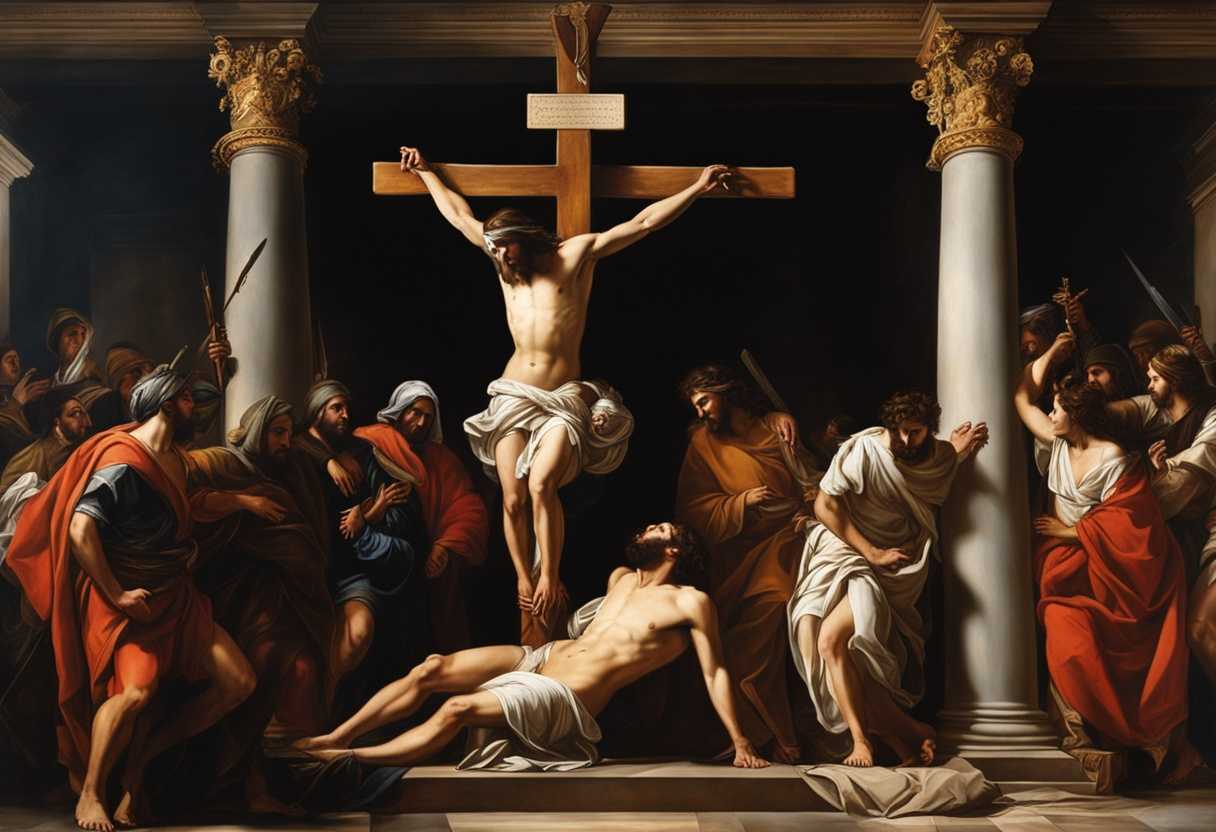
Setting the Scene for Matthew 27:32-54
The scene described in Matthew 27:32-54 takes place on a hill called Golgotha, just outside the city walls of Jerusalem. The hill is barren and rocky, with three wooden crosses erected at the top. The sky is dark and ominous, as if the world itself is mourning.
In the scene, we see a crowd gathered around the crosses, consisting of Roman soldiers, religious leaders, onlookers, and the two criminals who were crucified alongside Jesus. Among the crowd are also Mary, the mother of Jesus, Mary Magdalene, and a few of Jesus’ disciples, including John. They are standing at a distance, watching in sorrow as Jesus hangs on the central cross, crucified between the two criminals.
The soldiers are busy carrying out their duties, casting lots for Jesus’ clothing and mocking him as he hangs in agony. The religious leaders are sneering and taunting Jesus, challenging him to save himself if he truly is the Son of God. Despite the chaos and cruelty surrounding him, Jesus remains calm and composed, even asking God to forgive his tormentors. The atmosphere is heavy with tension and emotion as the pivotal moment of Jesus’ crucifixion unfolds before the eyes of those present.
What is Matthew 27:32-54 about?
We witness a pivotal moment in Christian theology and the life of Jesus Christ in this profound verse. The crucifixion of Jesus, the darkness covering the land, and his ultimate death all symbolize the sacrificial act that embodies his divine purpose. Jesus demonstrates his unwavering commitment to his mission of salvation for humanity by willingly undergoing the excruciating crucifixion.
The darkness that descends upon the land serves as a powerful metaphor for the weight of sin and suffering that Jesus bears on behalf of mankind. Through his death, Jesus not only reveals his divine nature but also offers a pathway to redemption and eternal life for all who believe in him. This verse challenges us to reflect on the depth of Jesus’s love and sacrifice, prompting us to consider the profound implications of his crucifixion for our own lives. We contemplate this verse, pondering the significance of Jesus’s selfless act and the transformative power of his sacrifice. It prompts us to examine our own faith and relationship with Jesus, inviting us to embrace the profound implications of his death and resurrection. This verse ultimately serves as a poignant reminder of the immense love and grace that Jesus offers to all who seek him, compelling us to respond with gratitude, humility, and a renewed commitment to following in his footsteps.
Understanding what Matthew 27:32-54 really means
The passage in Matthew 27:32-54 vividly portrays the crucifixion of Jesus Christ, a pivotal event in Christian theology. This moment is not merely a historical event but holds profound significance for believers, representing the ultimate sacrifice made for the redemption of humanity’s sins. As we delve into the key phrases within this passage, we uncover layers of meaning that deepen our understanding of Jesus’ sacrifice. When Jesus was forced to carry the cross, it symbolized the weight of sin that He willingly bore on behalf of all humanity, showcasing His selfless love.
The poignant cry of Jesus, “My God, my God, why have you forsaken me?” echoes the depths of His human suffering and fulfills the prophecy of Psalm 22:1. This cry reveals Jesus’ profound sense of abandonment, a relatable experience for many who have felt isolated or forsaken in their own lives. The tearing of the temple curtain holds immense symbolism, signifying the removal of the barrier between God and humanity. Through Jesus, all people now have direct access to God, emphasizing the personal and intimate nature of faith.
Related biblical passages such as Isaiah 53:5, John 3:16, and Hebrews 10:19-20 further illuminate the purpose and significance of Jesus’ sacrifice on the cross. These verses underscore the love, redemption, and access to God made possible through Christ’s death. Today, amidst a world often consumed by self-interest, the concept of sacrifice exemplified by Jesus serves as a powerful reminder of love in its purest form. His sacrifice challenges us to consider the depth of our own sacrificial love for others and for God.
In a modern context, many individuals grapple with feelings of abandonment or burdens that seem too heavy to bear. By reflecting on Jesus’ cry from the cross and His ultimate sacrifice, we find solace in knowing that even in His darkest moment, He was fulfilling a greater plan of redemption. The story of Jesus’ crucifixion offers hope and healing to those who feel overwhelmed by life’s challenges, reminding them that they are never truly alone in their struggles.
As we contemplate the profound act of love displayed on the cross, we are invited to reflect on its implications for our lives. Jesus’ crucifixion not only fulfills prophecies but also provides a way for each person to connect directly with God. In times of suffering and hardship, we can find comfort in the knowledge that Jesus understands our pain and offers a path to redemption and healing. Let us ponder the depth of Jesus’ sacrifice and allow it to transform our hearts, inspiring us to live lives marked by love, sacrifice, and faith.
Why did Jesus have to die on the cross?
Jesus had to die on the cross to fulfill the Scriptures and God’s divine plan for salvation. His sacrificial death was necessary to pay the price for the sins of humanity. Through His death on the cross, Jesus provided a way for people to be reconciled with God by taking on the punishment they deserved, offering forgiveness, and restoring the relationship between God and humanity.
The crucifixion of Jesus also demonstrated the depth of God’s love for humanity. Jesus willingly suffered and died on the cross out of love, showing the ultimate act of selflessness and obedience to God. His death served as a powerful demonstration of God’s grace and mercy, offering forgiveness and salvation to all who believe in Him. Those who put their faith in Jesus ultimately saw the cross as a symbol of hope, redemption, and eternal life.
Application
Contemplate the poignant depiction of Jesus’ sacrifice on the cross in Matthew 27:32-54. Let it ignite a profound sense of thankfulness and wonder. Allow His selfless act to inspire you to embody love and grace in your own life. Take this opportunity to assess your intentions and deeds, and seek ways to mirror His sacrificial spirit. Will you choose to reflect His boundless love by showing kindness and compassion to others?

Reverend Michael Johnson is an experienced Church Minister with a profound expertise in spirituality and guidance. With a serene presence and a compassionate heart, he has faithfully served his congregation for over 20 years, leading them on a spiritual journey towards inner peace and enlightenment. Reverend Johnson’s extensive knowledge of religious philosophies and profound understanding of human nature have made him a trusted confidant and mentor to many, as he seamlessly weaves his profound wisdom into life teachings. Reverend Johnson’s calming demeanor and empathetic nature continue to uplift and heal souls, nurturing a sense of unity and tranquility within his community.