
Matthew 28:13 is about the religious leaders spreading lies and covering up the truth of Jesus’s resurrection to maintain their authority and control over the people.
13 and said, “Tell people, ‘His disciples came by night and stole him away while we were asleep.’
Setting the Scene for Matthew 28:13
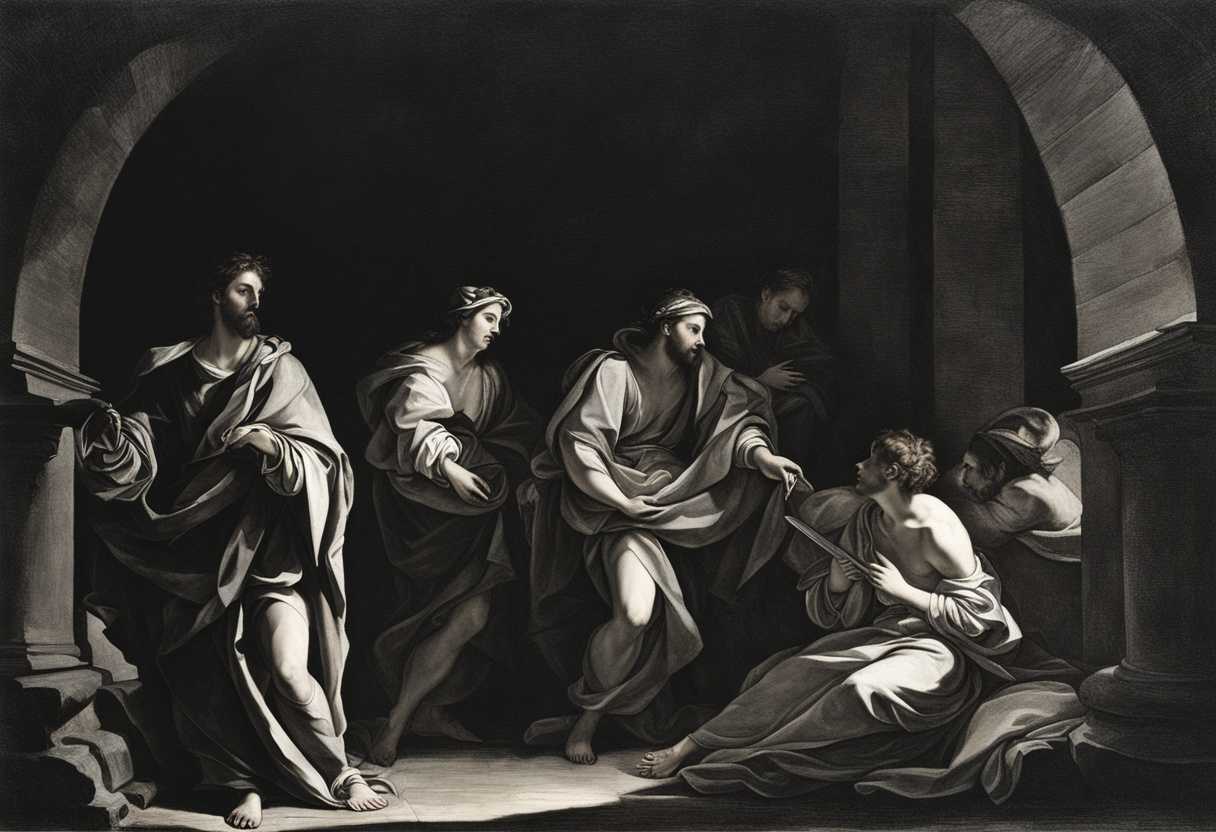
In Matthew chapter 28, we find ourselves at the scene where the guards who were stationed at Jesus’ tomb are reporting back to the chief priests and elders. The guards had been placed there by the religious leaders out of fear that Jesus’ disciples would come and steal His body to claim that He had risen from the dead, as He had prophesied. The guards were likely feeling a mix of confusion, fear, and awe after witnessing the angel descending from heaven, rolling back the stone, and sitting on it.
The chief priests and elders, on the other hand, were filled with disbelief and desperation as the guards recounted the miraculous events they had witnessed. The religious leaders were now faced with a dilemma as the news of Jesus’ resurrection began to spread. They had to come up with a plan to counter this unexpected turn of events and maintain their authority and control over the people. The tension in the room would have been palpable as they tried to make sense of the situation and decide on their next course of action.
The setting is likely a dimly lit room in the temple, with the guards standing before the chief priests and elders, recounting the events that had transpired at the tomb. The atmosphere is charged with a mix of disbelief, fear, and uncertainty as the reality of Jesus’ resurrection begins to sink in for all those present. The stage is set for a clash between the religious authorities and the truth of Jesus’ victory over death.
What is Matthew 28:13 about?
This verse highlights the extent to which some individuals went to discredit Jesus and his followers. The chief priests, who were threatened by Jesus’ teachings and the growing following he had, resorted to deceit and manipulation by bribing the soldiers to spread a false story about Jesus’ body being stolen in this context. This false narrative aimed to undermine the truth of Jesus’ resurrection and to sow seeds of doubt among the people.
It’s crucial to reflect on the power dynamics at play here. The chief priests, representing the religious authorities of the time, misused their influence and resources to suppress the message of Jesus. They dishonored the truth and betrayed the values they were supposed to uphold by resorting to bribery and spreading lies. This verse serves as a reminder of the ethical challenges that arise when individuals prioritize their own agendas over integrity and justice. As we delve into this verse, the pursuit of power and control can lead to moral compromises and the distortion of reality.
Understanding what Matthew 28:13 really means
In the aftermath of Jesus’ resurrection, a pivotal moment unfolds in Matthew 28:13. The religious leaders, threatened by the truth of Christ’s victory over death, resort to deception. They concoct a narrative claiming that Jesus’ disciples stole His body, attempting to discredit the miraculous event that had taken place. This deceitful scheme exposes the depths to which individuals may sink to suppress the truth that challenges their beliefs and authority.
The context surrounding this verse is essential for grasping its significance. It emerges in the wake of the discovery of the empty tomb by the women and the angelic proclamation of Jesus’ resurrection. The contrast between the divine truth revealed to the faithful and the human deceit propagated by the religious elite is stark. It prompts reflection on the enduring struggle between truth and falsehood, a conflict that resonates throughout history and into contemporary society.
The narrative in Matthew 28:13 is intertwined with broader themes found in related passages. From the bold proclamation of the apostles in Acts to the intimate encounter of Mary Magdalene with the risen Christ in John, the resurrection stands as an unshakable foundation of the Christian faith. These accounts reinforce the enduring power of truth and the unwavering commitment required to uphold it in the face of opposition and deception.
In a world inundated with misinformation and distorted narratives, the message of Matthew 28:13 reverberates with relevance. It serves as a poignant reminder of the imperative to discern truth from falsehood and to stand firm in the face of deception. Just as the disciples faced the challenge of defending the reality of the resurrection amidst lies, believers today are called to uphold the truth of the Gospel with unwavering conviction.
Consider a scenario where integrity is tested, akin to the disciples’ ordeal. Picture a student falsely accused of cheating, surrounded by a web of lies and doubt. In such moments, the courage to stand by the truth, despite adversity, mirrors the disciples’ unwavering commitment to the reality of Christ’s resurrection. This parallel underscores the timeless struggle between truth and deception, urging individuals to emulate the disciples’ steadfastness in upholding what is right and true.
The deliberate fabrication in Matthew 28:13, claiming the disciples stole Jesus’ body, underscores the lengths to which individuals may go to suppress inconvenient truths. It exposes the insecurities and fears that drive individuals to distort reality rather than confront uncomfortable truths. This manipulation serves as a cautionary tale, prompting introspection on the dangers of succumbing to falsehoods and the necessity of upholding integrity and honesty in all circumstances.
As believers reflect on the implications of Matthew 28:13, they are challenged to embody the virtues of integrity, honesty, and unwavering faith. The verse serves as a clarion call to stand as witnesses to the truth of the resurrection, even in the face of opposition and skepticism. By internalizing the lessons embedded in this narrative, individuals are inspired to live out their faith with courage, integrity, and a steadfast commitment to upholding the truth in a world often clouded by deception.
What prevents us from recognizing Jesus in our midst?
The passage speaks about how the guards who witnessed the resurrection of Jesus were bribed to spread a false story about what happened. This points to the idea that sometimes material or personal gain can lead individuals to deny or overlook the truth that is right in front of them. Distractions, selfish desires, or external influences can hinder us from recognizing the presence of Jesus in our midst in our own lives.
Additionally, preconceived notions or expectations about how Jesus should appear or act may cloud our ability to see Him when He is right in front of us. Our own biases or misconceptions can prevent us from seeing the true identity of Jesus in the people and situations we encounter, just as the guards’ greed blinded them to the truth. It is vital to approach each moment with an open heart and mind, ready to witness the presence of Jesus in unexpected ways.
Application
Reflect on Matthew 28:13; let it ignite a spark urging you to share the gospel far and wide. Imagine your work and family; could they thrive if kept in darkness? Your heart knows the truth—God’s love and grace are needed everywhere. Will you rise and act, taking the light where it’s needed most? Will you fulfill the Great Commission placed in your hands by our Savior?

Reverend Michael Johnson is an experienced Church Minister with a profound expertise in spirituality and guidance. With a serene presence and a compassionate heart, he has faithfully served his congregation for over 20 years, leading them on a spiritual journey towards inner peace and enlightenment. Reverend Johnson’s extensive knowledge of religious philosophies and profound understanding of human nature have made him a trusted confidant and mentor to many, as he seamlessly weaves his profound wisdom into life teachings. Reverend Johnson’s calming demeanor and empathetic nature continue to uplift and heal souls, nurturing a sense of unity and tranquility within his community.