
Numbers 14:1-35 is about the consequences of the Israelites’ lack of faith and disobedience in not trusting God to enter the Promised Land, resulting in their wandering in the wilderness for forty years as a punishment.
1 Then all the congregation raised a loud cry, and the people wept that night.
2 And all the people of Israel grumbled against Moses and Aaron. The whole congregation said to them, “Would that we had died in the land of Egypt! Or would that we had died in this wilderness!
3 Why is the Lord bringing us into this land, to fall by the sword? Our wives and our little ones will become a prey. Would it not be better for us to go back to Egypt?”
4 And they said to one another, “Let us choose a leader and go back to Egypt.”
5 Then Moses and Aaron fell on their faces before all the assembly of the congregation of the people of Israel.
6 And Joshua the son of Nun and Caleb the son of Jephunneh, who were among those who had spied out the land, tore their clothes
7 and said to all the congregation of the people of Israel, “The land, which we passed through to spy it out, is an exceedingly good land.
8 If the Lord delights in us, he will bring us into this land and give it to us, a land that flows with milk and honey.
9 Only do not rebel against the Lord. And do not fear the people of the land, for they are bread for us. Their protection is removed from them, and the Lord is with us; do not fear them.”
14 Then all the congregation said to stone them with stones. But the glory of the Lord appeared at the tent of meeting to all the people of Israel.
11 And the Lord said to Moses, “How long will this people despise me? And how long will they not believe in me, in spite of all the signs that I have done among them?
12 I will strike them with the pestilence and disinherit them, and I will make of you a nation greater and mightier than they.”
14 But Moses said to the Lord, “Then the Egyptians will hear of it, for you brought up this people in your might from among them,
14 And they will tell the inhabitants of this land. They have heard that you, O Lord, are in the midst of this people. For you, O Lord, are seen face to face, and your cloud stands over them and you go before them, in a pillar of cloud by day and in a pillar of fire by night.
15 Now if you kill this people as one man, then the nations who have heard your fame will say,
16 ‘Because the Lord was not able to bring this people into the land that he swore to give to them, he has killed them in the wilderness.’
17 And now, please let the power of the Lord be great as you have promised, saying,
18 ‘The Lord is slow to anger and abounding in steadfast love, forgiving iniquity and transgression, but he will by no means clear the guilty, visiting the iniquity of the fathers on the children, to the third and the fourth generation.’
19 Please pardon the iniquity of this people, according to the greatness of your steadfast love, just as you have forgiven this people, from Egypt until now.”
21 But truly, as I live, and as all the earth shall be filled with the glory of the Lord,
21 But truly, as I live, and as all the earth shall be filled with the glory of the Lord,
22 none of the men who have seen my glory and my signs that I did in Egypt and in the wilderness, and yet have put me to the test these ten times and have not obeyed my voice,
23 shall see the land that I swore to give to their fathers. And none of those who despised me shall see it.
24 But my servant Caleb, because he has a different spirit and has followed me fully, I will bring into the land into which he went, and his descendants shall possess it.
25 Now, since the Amalekites and the Canaanites dwell in the valleys, turn tomorrow and set out for the wilderness by the way to the Red Sea.”
26 And the Lord spoke to Moses and to Aaron, saying,
27 “How long shall this wicked congregation grumble against me? I have heard the grumblings of the people of Israel, which they grumble against me.”
28 Say to them, ‘As I live, declares the Lord, what you have said in my hearing I will do to you:
29 In this wilderness your dead bodies shall fall, and all your number, listed in the census from twenty years old and upward, who have grumbled against me.
30 not one shall come into the land where I swore that I would make you dwell, except Caleb the son of Jephunneh and Joshua the son of Nun.
31 But your little ones, who you said would become a prey, I will bring in, and they shall know the land that you have rejected.
32 But as for you, your dead bodies shall fall in this wilderness.
33 And your children shall be shepherds in the wilderness forty years and shall suffer for your faithlessness, until the last of your dead bodies lies in the wilderness.
34 According to the number of the days in which you spied out the land, forty days, a year for each day, you shall bear your iniquity forty years, and you shall know my displeasure.’
35 I, the Lord, have spoken. Surely this will I do to all this wicked congregation who are gathered together against me: in this wilderness they shall come to a full end, and there they shall die.”
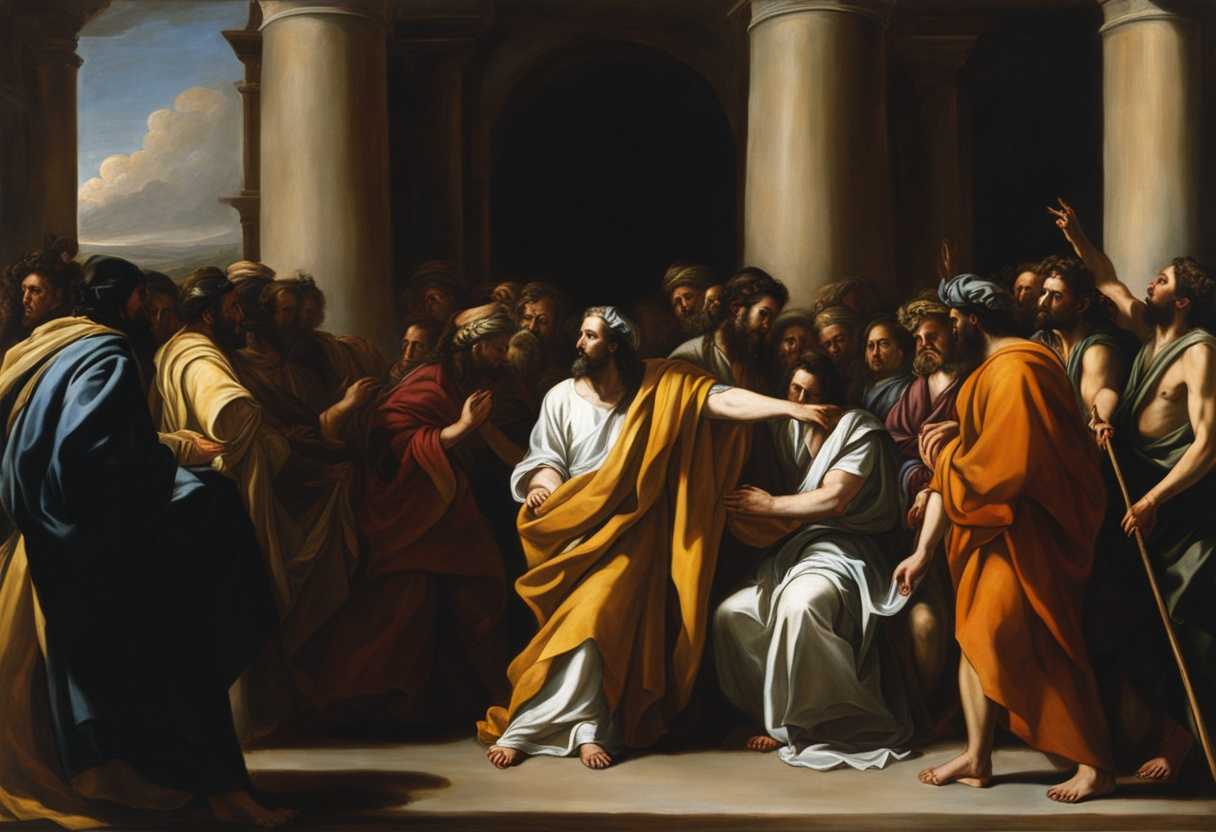
Setting the Scene for Numbers 14:1-35
The scene in Numbers 14:1-35 takes place in the wilderness of Paran, where the Israelites had been wandering after their exodus from Egypt. The Israelites had just received a negative report from the spies they had sent to scout out the land of Canaan. The majority of the spies had brought back a discouraging report, causing the people to fear and doubt God’s promise to give them the land.
In this scene, Moses and Aaron are present, along with Joshua and Caleb, who were the only two spies who had faith in God’s ability to deliver the land of Canaan into their hands. The Israelites, however, were overcome with fear and began to grumble against Moses and Aaron, even suggesting that they should choose a new leader and return to Egypt. This lack of faith and disobedience angered God, who declared that none of the adults who had left Egypt would enter the promised land except for Joshua and Caleb.
The surroundings are likely dusty and barren, typical of a wilderness setting. The Israelites are encamped, their tents scattered across the landscape as they await Moses’ leadership. The tension is palpable as emotions run high, with fear and doubt clouding the people’s judgment. Despite the miraculous deliverance from Egypt and the numerous signs and wonders they had witnessed, the Israelites allowed their fear to overshadow their faith, leading to dire consequences for their journey to the promised land.
What is Numbers 14:1-35 about?
This verse conveys a powerful message about the consequences of grumbling and lack of faith. The Israelites’ constant complaining and discontentment despite witnessing God’s miracles led to them being prohibited from entering the promised land. Only Joshua and Caleb, who remained faithful and trusted in God’s plan, were allowed to enter and inherit the land. This story serves as a reminder of the importance of having faith and gratitude even in difficult circumstances.
Have you ever found yourself complaining or feeling dissatisfied when things don’t go your way? This verse challenges us to reflect on our own attitudes and actions in times of struggle. It encourages us to trust in God’s plan and remain steadfast in our faith, even when faced with challenges. We can overcome obstacles and ultimately enter into our own “promised land” of blessings and fulfillment by showing gratitude and having faith in God’s promises. Let’s strive to be like Joshua and Caleb, embodying faith and trust in God’s goodness even in the face of adversity.
Understanding what Numbers 14:1-35 really means
In Numbers 14:1-35, we witness a pivotal moment in the journey of the Israelites towards the Promised Land. The context is crucial here; the spies’ report from Canaan has sparked fear and rebellion among the people. As a result, the congregation collectively cries out in despair, longing to return to Egypt, displaying a profound lack of faith in God’s promises. This reaction reveals a troubling pattern of ingratitude and forgetfulness of God’s past faithfulness, a theme that resonates throughout the Bible.
God’s response to the Israelites’ rebellion is swift and severe. The glory of the Lord appears in the tabernacle, underscoring His immediate presence and intervention in the face of disobedience. God expresses His frustration with the people’s continuous provocation, highlighting the consequences of their lack of faith. The initial judgment of pestilence and disinheritance serves as a stark reminder of the seriousness of their sin and the repercussions of turning away from God.
This passage is not just a historical account but holds timeless truths that are relevant to people today. It serves as a cautionary tale about the dangers of rebellion and the importance of faith and trust in God. Just as the Israelites struggled to trust God despite His past faithfulness, we too may find ourselves grappling with similar challenges in our journey of faith. The story reminds us of the consequences of turning away from God’s guidance and the balance between His patience and justice.
Reflecting on this narrative, we can draw parallels to our own lives. Like a child learning to ride a bike, we may face daunting challenges that test our faith. Despite God’s constant presence and past faithfulness, we may still waver in our trust, much like the Israelites. The story prompts us to examine our own responses to uncertainty and fear, urging us to lean on God’s promises even when the path ahead seems unclear.
In dissecting the key phrases of this passage, we uncover deeper insights into the human condition and God’s character. The Israelites’ cries and desires to return to Egypt reveal the irrationality of fear and the allure of familiarity, even if it means embracing past suffering. God’s response showcases His immediate presence and responsiveness to our actions, emphasizing His sovereignty and justice. Ultimately, despite human failure, God’s glory will prevail, offering hope and assurance of His unwavering purpose in the midst of our doubts and struggles.
How can we trust God’s promises in times of uncertainty?
We can trust God’s promises in times of uncertainty by remembering His past faithfulness and provision. We too may encounter challenges that cause us to question God’s promises, just as the Israelites faced uncertainty and doubt when they were on the brink of entering the Promised Land. However, by reflecting on how God has never failed to fulfill His promises in the past, we can have confidence that He will continue to do so in the present and future.
Furthermore, trusting in God’s promises requires a steadfast faith that surpasses momentary circumstances. It means believing in His power, faithfulness, and goodness even when everything around us seems uncertain. We are also called to have unwavering faith in His promises, knowing that He is in control and will bring about what He has spoken, just as the Israelites were called to trust in God’s plan despite the intimidating giants in the land. We can find reassurance in the unchanging nature of God’s character in times of doubt and uncertainty. He is faithful, trustworthy, and true to His word. We can navigate through seasons of uncertainty with peace and confidence by holding on to this truth and grounding ourselves in His promises, knowing that God’s plans for us are good, regardless of the challenges we may face.
Application
Embrace the lesson from Numbers 14:1-35, to trust in God’s promises through life’s storms. Let faith be your compass in the face of doubts and fears. Let us brave the trials ahead with unwavering belief in God’s plans for us. Are you ready to stand firm in faith and stride ahead with confidence today?

Reverend Michael Johnson is an experienced Church Minister with a profound expertise in spirituality and guidance. With a serene presence and a compassionate heart, he has faithfully served his congregation for over 20 years, leading them on a spiritual journey towards inner peace and enlightenment. Reverend Johnson’s extensive knowledge of religious philosophies and profound understanding of human nature have made him a trusted confidant and mentor to many, as he seamlessly weaves his profound wisdom into life teachings. Reverend Johnson’s calming demeanor and empathetic nature continue to uplift and heal souls, nurturing a sense of unity and tranquility within his community.