
Numbers 35:1-8 is about the establishment of cities of refuge for individuals who commit unintentional manslaughter, emphasizing the importance of justice, mercy, and protection within the community by providing a legal mechanism to safeguard the lives of both the accused and the victims’ families.
1 The Lord spoke to Moses in the plains of Moab by the Jordan at Jericho, saying:
2 “Command the people of Israel to give to the Levites some of the inheritance of their possession as cities for them to dwell in. And you shall give to the Levites pasturelands around the cities.
3 And the cities shall be for you a refuge from the avenger, that the manslayer may not die until he stands before the congregation for judgment.
4 “The pasturelands of the cities, which you shall give to the Levites, shall reach from the wall of the city outward a thousand cubits around.”
5 And you shall measure, outside the city, on the east side two thousand cubits, and on the south side two thousand cubits, and on the west side two thousand cubits, and on the north side two thousand cubits, the city being in the middle. This shall belong to them as pastureland for their cities.
6 “The cities that you give to the Levites shall be the six cities of refuge, where you shall permit the manslayer to flee, and in addition to them you shall give forty-two cities.”
7 So all the cities that you give to the Levites shall be forty-eight cities with their pasturelands.
8 And as for the cities that you shall give from the possession of the people of Israel, from the larger tribes you shall take many, and from the smaller tribes you shall take few; each, in proportion to the inheritance that it inherits, shall give of its cities to the Levites.”
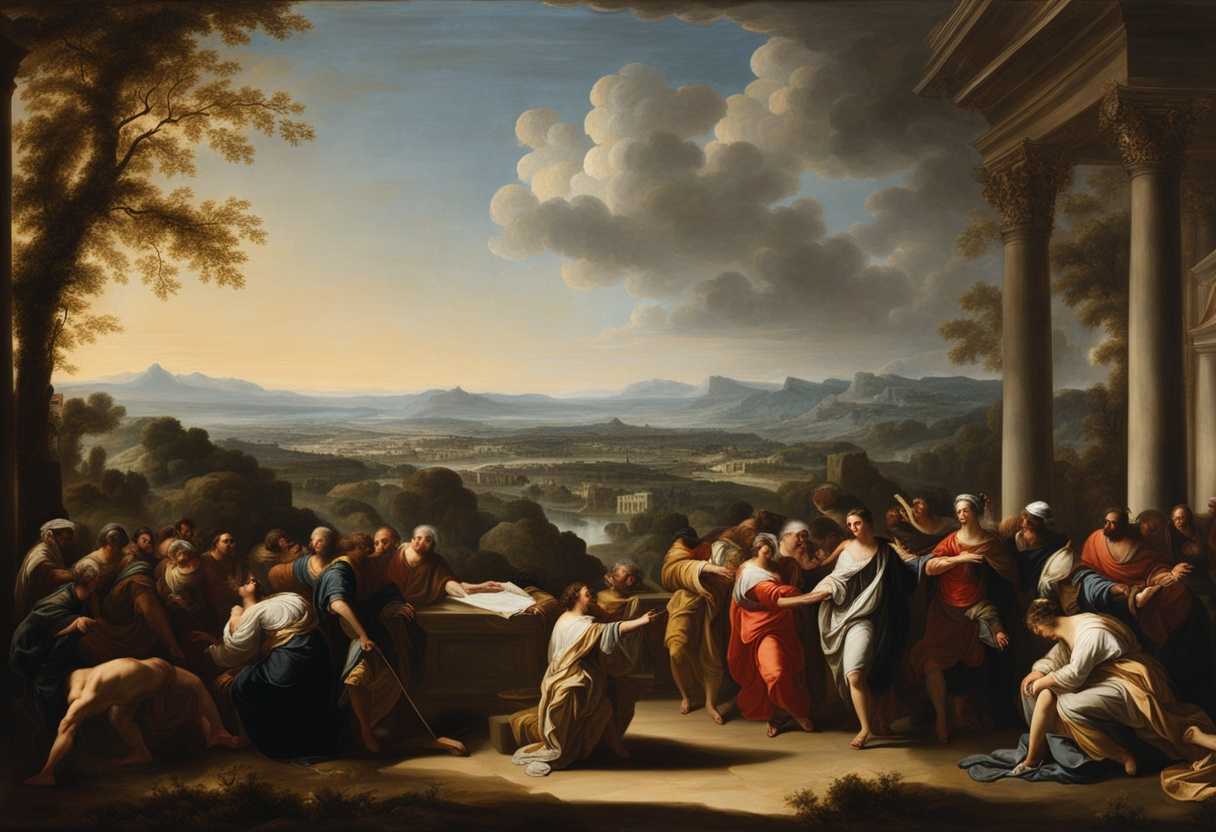
Setting the Scene for Numbers 35:1-8
In the arid wilderness of the Sinai Peninsula, the Israelites are encamped, their tents forming a sprawling community under the vast, open sky. The sun hangs high, casting a warm glow over the landscape, while the distant mountains stand as silent witnesses to the journey of this nomadic people. Among them, Moses, the revered leader, stands at the forefront, his face weathered by years of guiding his people through trials and tribulations. He has just received instructions from God regarding the allocation of cities for the Levites, the priestly tribe, and the establishment of cities of refuge for those who have unintentionally caused harm.
As Moses gathers the leaders of the tribes, the air is thick with anticipation and curiosity. The Levites, who have dedicated their lives to the service of God, are present, their garments reflecting their sacred calling. They listen intently, knowing that their future and the safety of their community hinge on the decisions made in this moment. The leaders of the other tribes, including figures like Aaron, Moses’ brother, and Eleazar, the high priest, are also present, their expressions a mix of reverence and concern. They understand the importance of these cities, which will serve as sanctuaries for those who have committed unintentional acts of violence, allowing them to seek refuge and protection from the avenger of blood.
The surrounding landscape is dotted with rugged terrain and sparse vegetation, a reminder of the harshness of their journey. In the distance, the shimmering waters of the Jordan River can be seen, a symbol of the promise that lies ahead. As Moses speaks, the sound of his voice carries over the murmurs of the crowd, emphasizing the significance of justice and mercy in their community. The Levites will be given specific cities, and the concept of refuge will be woven into the fabric of their society, ensuring that even in a world filled with uncertainty, there is a place for grace and redemption. The scene is one of solemnity and hope, as the Israelites prepare to establish a new order in their midst, guided by divine instruction.
What is Numbers 35:1-8 about?
God’s instruction to Israel regarding the establishment of cities of refuge highlights a profound understanding of justice interwoven with mercy in this verse. Imagine living in a time when accidental harm could lead to severe consequences, where the lines between guilt and innocence could be blurred. The cities of refuge serve as physical and spiritual sanctuaries for individuals who have caused unintentional harm, allowing them a place where they could seek protection from the avenger while awaiting a fair trial. Isn’t it incredible to think about how this directive reflects a compassionate legal system that values human life, even in the midst of tragedy?
Furthermore, consider the broader implications of this instruction. These cities not only function as a means of safeguarding the rights of the accused but also illustrate a societal commitment to grace and second chances. How often do we see a lack of understanding regarding the complexities of human actions? God is offering a chance for healing and restoration rather than punishment alone by providing refuge. It prompts us to reflect: how can we embody this balance of justice and mercy in our own communities? Are we quick to judge and condemn, or do we strive to offer understanding and support to those who have made mistakes? The cities of refuge remind us of the importance of creating environments that promote healing and restoration, ensuring that our responses to human error are rooted in love and compassion.
Understanding what Numbers 35:1-8 really means
In Numbers 35:1-8, we encounter a profound aspect of God’s justice system for the Israelites: the establishment of cities of refuge. These cities were designed for individuals who accidentally caused the death of another, reflecting God’s deep concern for both justice and mercy. This passage invites us to consider the balance between accountability and compassion, a theme that resonates throughout Scripture and remains relevant in our lives today.
The term “cities of refuge” is particularly significant. It represents not just physical safety but also a divine provision for mercy amidst the law. By allowing those who committed unintentional manslaughter to seek refuge, God emphasizes that not all acts of death carry the same moral weight. This distinction is crucial, as it acknowledges human fallibility while still upholding the seriousness of life and death situations. How often do we find ourselves in situations where intentions are misunderstood? This passage encourages us to look beyond the surface and consider the heart behind actions.
The role of “the avenger of blood” further illustrates the cultural context of ancient Israel. This family member was tasked with seeking justice for the slain, highlighting the importance of family honor and the gravity of bloodshed. Yet, the cities of refuge provided a counterbalance to this instinct for retribution. They offered a legal framework that allowed for fair trials and the possibility of redemption. In our modern context, how do we navigate the tension between seeking justice and extending grace? This passage challenges us to reflect on our responses to wrongdoing, both in our lives and in society.
The number of cities—six—also carries meaning. It signifies God’s generous provision for mercy, indicating that He desires to offer multiple opportunities for redemption. This is echoed in related passages, such as Deuteronomy 19:1-13, which elaborates on the operational aspects of these cities. Moreover, Hebrews 6:18 draws a parallel between these physical cities and the spiritual refuge found in Christ, reminding us that God’s promise is a sanctuary for believers. How can we find comfort in knowing that we have a refuge in our faith, especially during times of distress?
In today’s world, where justice can often feel harsh and unforgiving, the concept of a refuge resonates deeply. Many individuals grapple with feelings of judgment and condemnation for their mistakes. The cities of refuge serve as a powerful metaphor for hope and healing. They remind us that there is a place for restoration, even in the aftermath of grave errors. Can we create environments in our communities that reflect this spirit of refuge, offering support and understanding to those who have stumbled?
Consider the story of a young man who, in a moment of anger, caused a tragic accident. Instead of facing immediate retribution, he found a community willing to support him and help him make amends. This mirrors the essence of the cities of refuge, where individuals could seek safety and a path toward redemption rather than being consumed by guilt and fear. Such stories remind us of the transformative power of grace and the importance of fostering environments where healing can occur.
In conclusion, the principles of justice and mercy found in Numbers 35:1-8 are timeless and essential. They remind us that while we must uphold justice, we must also extend grace and compassion. As we navigate our own lives, may we strive to be places of refuge for others, embodying the love and mercy that God has shown us. How can we actively seek to create spaces of safety and healing in our communities? Let us reflect on this as we move forward, inspired by the divine balance of justice and mercy.
How can I seek justice and mercy in my life?
To seek justice in your life, it’s essential to understand the importance of fairness and accountability. This involves standing up for what is right, whether it relates to personal relationships, workplace dynamics, or community interactions. Establishing boundaries and advocating for equitable treatment can foster an environment where justice prevails. It’s crucial to evaluate situations objectively and ensure that your actions align with principles that uphold integrity and fairness for everyone involved.
On the other hand, seeking mercy entails exercising compassion and understanding, particularly when dealing with conflict or mistakes. This means recognizing the humanity in others, acknowledging that everyone is capable of error, and being willing to forgive when appropriate. Practicing empathy allows you to create more harmonious relationships and encourages others to extend the same grace to you. Striking a balance between justice and mercy means being fair while also being understanding, ultimately fostering a sense of community and cooperation.
Combining justice and mercy can lead to transformative experiences, both personally and within your community. Encourage conversations that promote understanding, and advocate for fair solutions that also consider the broader impact of your decisions on others. You can contribute to a more just world that values compassion by embodying both aspects, ultimately enriching your own life and the lives of those around you.
Application
Just like a workplace that thrives on collaboration and a family that supports each other, you have the power to create safe spaces for those who are struggling. Think about your community—are you building a haven for those who feel lost or overlooked? Your compassion can be the light that guides someone through their darkness. Take action today: reach out to a neighbor, lend a helping hand, or simply listen. Remember, every little gesture counts. Will you be the refuge someone desperately needs right now?

Reverend Michael Johnson is an experienced Church Minister with a profound expertise in spirituality and guidance. With a serene presence and a compassionate heart, he has faithfully served his congregation for over 20 years, leading them on a spiritual journey towards inner peace and enlightenment. Reverend Johnson’s extensive knowledge of religious philosophies and profound understanding of human nature have made him a trusted confidant and mentor to many, as he seamlessly weaves his profound wisdom into life teachings. Reverend Johnson’s calming demeanor and empathetic nature continue to uplift and heal souls, nurturing a sense of unity and tranquility within his community.