
11 And the Lord spoke to Moses, saying:
12 “Speak to the people of Israel, If any man’s wife goes astray and breaks faith with him,
13 and a man lies with her carnally, and it is hidden from the eyes of her husband, and she is undetected though she has defiled herself, and there is no witness against her, since she was not taken in the act.
14 and if the spirit of jealousy comes over him and he is jealous of his wife who has defiled herself, or if the spirit of jealousy comes over him and he is jealous of his wife, though she has not defiled herself,
15 then the man shall bring his wife to the priest and bring the offering required of her, a tenth of an ephah of barley flour. He shall pour no oil on it and put no frankincense on it, for it is a grain offering of jealousy, a grain offering of remembrance, bringing iniquity to remembrance.
16 “And the priest shall bring her near and set her before the Lord.
17 Then the priest shall take holy water in an earthenware vessel and take some of the dust that is on the floor of the tabernacle and put it into the water.
18 And the priest shall set the woman before the Lord and unbind the hair of the woman’s head and place in her hands the grain offering of remembrance, which is the grain offering of jealousy. And in his hand the priest shall have the water of bitterness that brings the curse.
19 Then the priest shall make her take an oath, saying, ‘If no man has lain with you, and if you have not turned aside to uncleanness while you were under your husband’s authority, be free from this water of bitterness that brings the curse.
20 “But if you have gone astray, though you are under your husband’s authority, and if you have defiled yourself, and some man other than your husband has lain with you,”
21 then the priest shall make the woman take the oath of the curse, and he shall say to the woman, “the Lord make you a curse and an oath among your people, when the Lord makes your thigh fall away and your body swell.
22 May this water that brings a curse pass into your bowels and make your womb swell and your thigh fall away.’ And the woman shall say, ‘Amen, Amen.’
23 “Then the priest shall write these curses in a book and wash them off into the water of bitterness.”
24 And he shall make the woman drink the bitter water that brings a curse, and the water that brings the curse shall enter into her and cause bitter pain.
25 And the priest shall take the grain offering of jealousy out of the woman’s hand and shall wave the grain offering before the Lord and bring it to the altar.
26 And the priest shall take a handful of the offering, as its memorial portion, and burn it on the altar, and afterward shall make the woman drink the water.
27 And when he has made her drink the water, then, if she has defiled herself and has broken faith with her husband, the water that brings the curse shall enter into her and cause bitter pain, and her womb shall swell, and her thigh shall fall away, and the woman shall become a curse among her people.
28 But if the woman has not defiled herself and is clean, then she shall be free and shall conceive children.
29 This is the law in cases of jealousy, when a wife, though under her husband’s authority, goes astray and defiles herself,
30 or when the spirit of jealousy comes over a man and he is jealous of his wife.
31 The man shall be free from iniquity, but the woman shall bear her iniquity.
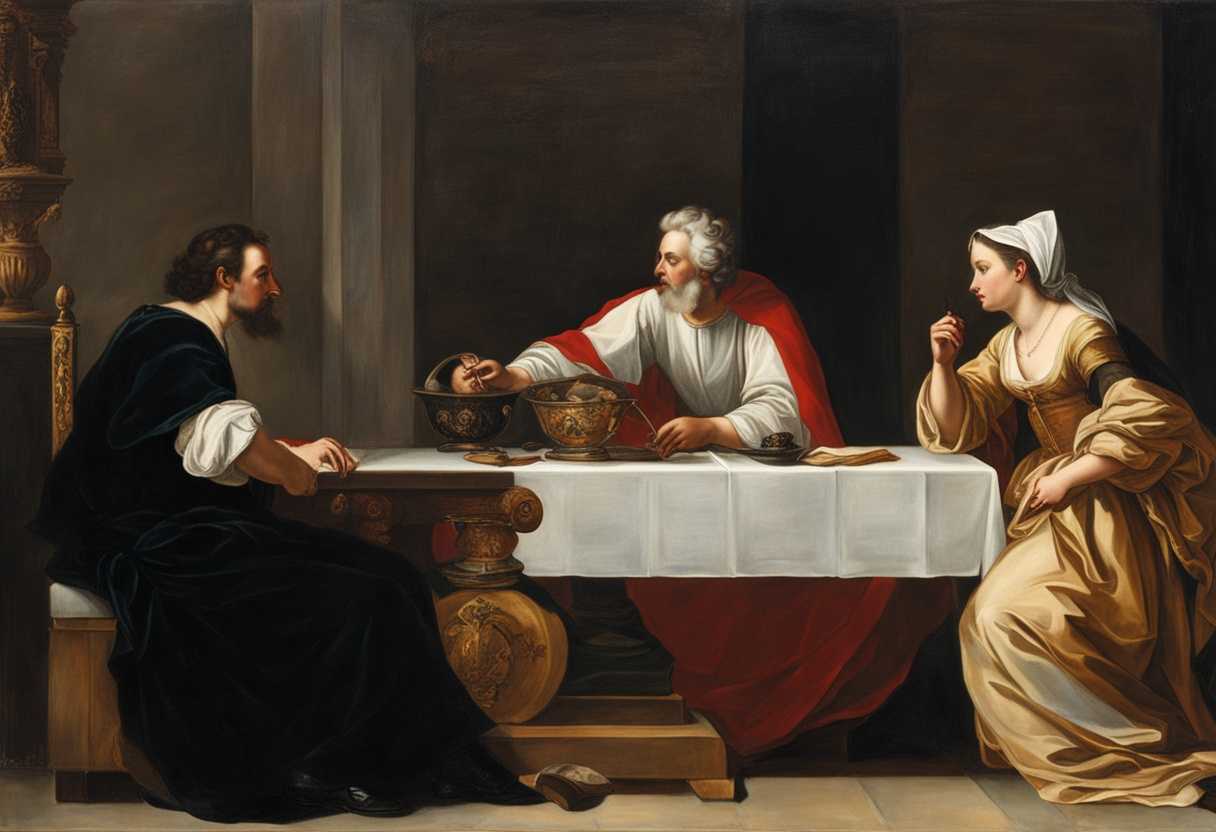
Setting the Scene for Numbers 5:11-31
In Numbers chapter 5, we find the Israelites encamped at the foot of Mount Sinai, following their exodus from Egypt. The scene is set in the midst of the Israelite camp, with the tabernacle at the center, surrounded by the tents of the twelve tribes. The camp is organized according to the instructions given by God to Moses, with each tribe positioned in a specific location around the tabernacle.
Moses, the leader of the Israelites, is present along with Aaron the high priest and the other Levites who assist in the duties of the tabernacle. The people of Israel have gathered to hear the laws and commandments that God has given to Moses for their guidance and instruction. In this particular scenario, the focus is on a law concerning a husband who suspects his wife of being unfaithful, leading to a trial by ordeal known as the bitter water test.
As Moses explains the procedure outlined in Numbers chapter 5, the people listen attentively, understanding the seriousness of maintaining purity and faithfulness within the community. The tense atmosphere is palpable as the consequences of the trial are revealed, highlighting the importance of trust and fidelity in marriage as well as the overarching theme of holiness and obedience to God’s laws.
What is Numbers 5:11-31 about?
A complex ritual to address suspected infidelity is found in this verse in the Book of Numbers in the Bible. The ritual involving bitter water and a curse was a way for the Israelites to deal with cases of suspected unfaithfulness in marriage. It was a method to bring hidden sins to light and to allow God to intervene and bring justice. The bitter water symbolizes the consequences of betrayal and the curse was a way to bring about a supernatural judgment for those guilty of deceit.
The ritual highlighted in this verse raises important questions about trust, accountability, and the consequences of betrayal. It prompts us to think about the importance of honesty and fidelity in relationships, and the need for a just resolution when trust is broken. It also speaks to the belief in divine justice and the idea that our actions, even those done in secret, have consequences that we may not escape. Examining this ritual reminds us of the complexities of human relationships and the importance of seeking truth and reconciliation even in moments of pain and betrayal.
Understanding what Numbers 5:11-31 really means
Structure for Commentary
- Introduction to the Passage
- Contextual Background
- Detailed Analysis of Key Phrases
- Connections to Other Biblical Passages
- Relevance to Modern Life
- Anecdotal Illustration
- Conclusion and Reflection
Commentary
Introduction to the Passage
The passage from Numbers 5:11-31 outlines a specific ritual known as the “Test for an Unfaithful Wife.” This text may seem obscure or even troubling to modern readers, but it provides a unique insight into the cultural and religious practices of ancient Israel. We can uncover deeper theological and ethical lessons applicable to our lives today by delving into this passage. The community in ancient Israel prioritized purity and fidelity. This passage describes a procedure designed to address suspicions of marital infidelity. It involves a priest, an offering, and a ritual designed to reveal the truth. The broader context of Numbers involves the Israelites’ journey through the wilderness and the establishment of laws to maintain social order and covenantal faithfulness. Understanding this context helps us appreciate the passage’s intent to protect communal harmony and justice.
Detailed Analysis of Key Phrases
Several phrases in this passage warrant closer examination. For instance, “if a man’s wife goes astray and is unfaithful to him” sets the stage for the ritual. This phrase reflects deep concerns about trust and integrity within marriage. Another significant phrase is “the priest shall bring her and have her stand before the Lord.” Here, the presence of the priest and the offering symbolizes bringing the matter before God, emphasizing that ultimate judgment belongs to Him. The “bitter water that brings a curse” is another critical element, symbolizing the gravity of the situation and the divine involvement in revealing the truth.
Connections to Other Biblical Passages
This passage can be linked to other scriptures that discuss fidelity and justice. For example, the story of the woman caught in adultery in John 8:1-11 highlights Jesus’ approach to sin and forgiveness, contrasting with the more punitive measures described in Numbers. Additionally, 1 Corinthians 7:2-5 emphasizes mutual faithfulness and respect in marriage, underscoring the importance of trust and love. These connections remind us that while procedures and cultural contexts may differ, the underlying principles of justice, truth, and fidelity remain constant.
Relevance to Modern Life
Despite its ancient origins, this passage holds relevance for us today. It underscores the importance of faithfulness in relationships and the need for transparent and just processes when addressing suspicions or conflicts. It invites us to consider how we handle issues of trust and integrity in our own lives in a broader sense. Are we quick to judge, or do we seek fair and compassionate resolutions? This passage challenges us to reflect on our attitudes and actions. Rumors and suspicions about an individual’s actions face a community in a modern scenario. Instead of jumping to conclusions, the community leaders decide to address the matter openly and fairly, involving all relevant parties and seeking truth and reconciliation. This approach not only resolves the issue but also strengthens the community’s bonds. Similarly, the ritual in Numbers aimed to restore trust and harmony within the community, highlighting the value of just and transparent processes. Numbers 5:11-31 may initially seem distant and harsh, but it offers profound lessons about justice, faithfulness, and community. By examining this passage in its historical and biblical context, we gain a deeper understanding of its significance and relevance. We should strive to cultivate trust, fairness, and integrity in our own lives and communities as we reflect on these themes, drawing inspiration from the timeless principles embedded in this ancient text. How can you apply these lessons to your own relationships and community interactions today?
Can we trust God to bring justice?
Yes, we can trust God to bring justice. God provided a way for justice to prevail in cases of suspected infidelity in Numbers 5:11-31. Through this process, the truth was revealed, and the guilty party faced consequences for their actions. This demonstrates God’s concern for justice and His willingness to intervene in human affairs to ensure fairness.
The passage serves as a reminder that God sees and knows all things, even what is hidden from human eyes. It assures us that ultimately, God’s truth will triumph, and justice will be served. Therefore, we can have confidence that God, who is righteous and just, will bring about justice in His perfect timing and according to His perfect wisdom. We can take comfort in the understanding that God is a God of justice in times when we may feel wronged or see injustices around us. We can trust Him to ultimately bring about justice in all situations, either in this life or in the next. It is our responsibility to seek justice, but we can find rest in knowing that God is ultimately the arbiter of true justice.
Application
Picture your life as a careful balancing act between work deadlines and family responsibilities. Just as an unfaithful spouse must face the truth, we too must confront any hidden wrongs in our hearts. Don’t let unspoken guilt weigh you down. Seek repentance and mend those relationships, both with God and those around you. Are you ready to free yourself and live with a clean conscience?

Reverend Michael Johnson is an experienced Church Minister with a profound expertise in spirituality and guidance. With a serene presence and a compassionate heart, he has faithfully served his congregation for over 20 years, leading them on a spiritual journey towards inner peace and enlightenment. Reverend Johnson’s extensive knowledge of religious philosophies and profound understanding of human nature have made him a trusted confidant and mentor to many, as he seamlessly weaves his profound wisdom into life teachings. Reverend Johnson’s calming demeanor and empathetic nature continue to uplift and heal souls, nurturing a sense of unity and tranquility within his community.