
Romans 11:1-36 is about the theological explanation of God’s plan for salvation, emphasizing the concepts of grace, faith, and the inclusion of both Jews and Gentiles in his redemptive work.
1 I ask, then, has God rejected his people? By no means! For I myself am an Israelite, a descendant of Abraham, a member of the tribe of Benjamin.
God has not rejected his people whom he foreknew.
3 “Lord, they have killed your prophets, they have demolished your altars, and I alone am left, and they seek my life.”
4 But what is God’s reply to him? “I have kept for myself seven thousand men who have not bowed the knee to Baal.”
5 So too at the present time there is a remnant, chosen by grace.
6 But if it is by grace, it is no longer on the basis of works; otherwise grace would no longer be grace.
7 What then? Israel failed to obtain what it was seeking. The elect obtained it, but the rest were hardened,
8 as it is written, “God gave them a spirit of stupor, eyes that would not see and ears that would not hear, down to this very day.”
10 Let their eyes be darkened so that they cannot see,
and bend their backs forever.”
10 Let their eyes be darkened so that they cannot see,
and bend their backs forever.”
11 So I ask, did they stumble in order that they might fall? By no means! But through their trespass salvation has come to the Gentiles, so as to make Israel jealous.
12 Now if their trespass means riches for the world, and if their failure means riches for the Gentiles, how much more will their full inclusion mean!
11 Now I am speaking to you Gentiles. Inasmuch then as I am an apostle to the Gentiles, I magnify my ministry.
11 in order somehow to make my fellow Jews jealous, and thus save some of them.
28 As regards the gospel, they are enemies for your sake. But as regards election, they are beloved for the sake of their forefathers.
16 If the dough offered as firstfruits is holy, so is the whole lump, and if the root is holy, so are the branches.
11 But if some of the branches were broken off, and you, although a wild olive shoot, were grafted in among the others and now share in the nourishing root of the olive tree,
18 do not be arrogant toward the branches. If you are, remember it is not you who support the root, but the root that supports you.
19 Then you will say, “Branches were broken off so that I might be grafted in.”
20 That is true. They were broken off because of their unbelief, but you stand fast through faith. So do not become proud, but fear.
21 For if God did not spare the natural branches, neither will he spare you.
22 Note then the kindness and the severity of God: severity toward those who have fallen, but God’s kindness to you, provided you continue in his kindness. Otherwise you too will be cut off.
11 And even they, if they do not continue in their unbelief, will be grafted in, for God has the power to graft them in again.
24 For if you were cut from what is by nature a wild olive tree, and grafted, contrary to nature, into a cultivated olive tree, how much more will these, the natural branches, be grafted back into their own olive tree.
25 Lest you be wise in your own sight, I do not want you to be unaware of this mystery, brothers: a partial hardening has come upon Israel, until the fullness of the Gentiles has come in.
26 And in this way all Israel will be saved, as it is written, “The Deliverer will come from Zion, he will banish ungodliness from Jacob”;
27 “and this will be my covenant with them when I take away their sins.”
28 As regards the gospel, they are enemies for your sake. But as regards election, they are beloved for the sake of their forefathers.
29 For the gifts and the calling of God are irrevocable.
30 For just as you were at one time disobedient to God but now have received mercy because of their disobedience,
31 so they too have now been disobedient in order that by the mercy shown to you they also may now receive mercy.
32 For God has consigned all to disobedience, that he may have mercy on all.
33 Oh, the depth of the riches and wisdom and knowledge of God! How unsearchable are his judgments and how inscrutable his ways!
34 “For who has known the mind of the Lord, or who has been his counselor?”
35 “Or who has given a gift to him
that he might be repaid?”
36 For from him and through him and to him are all things. To him be glory forever. Amen.
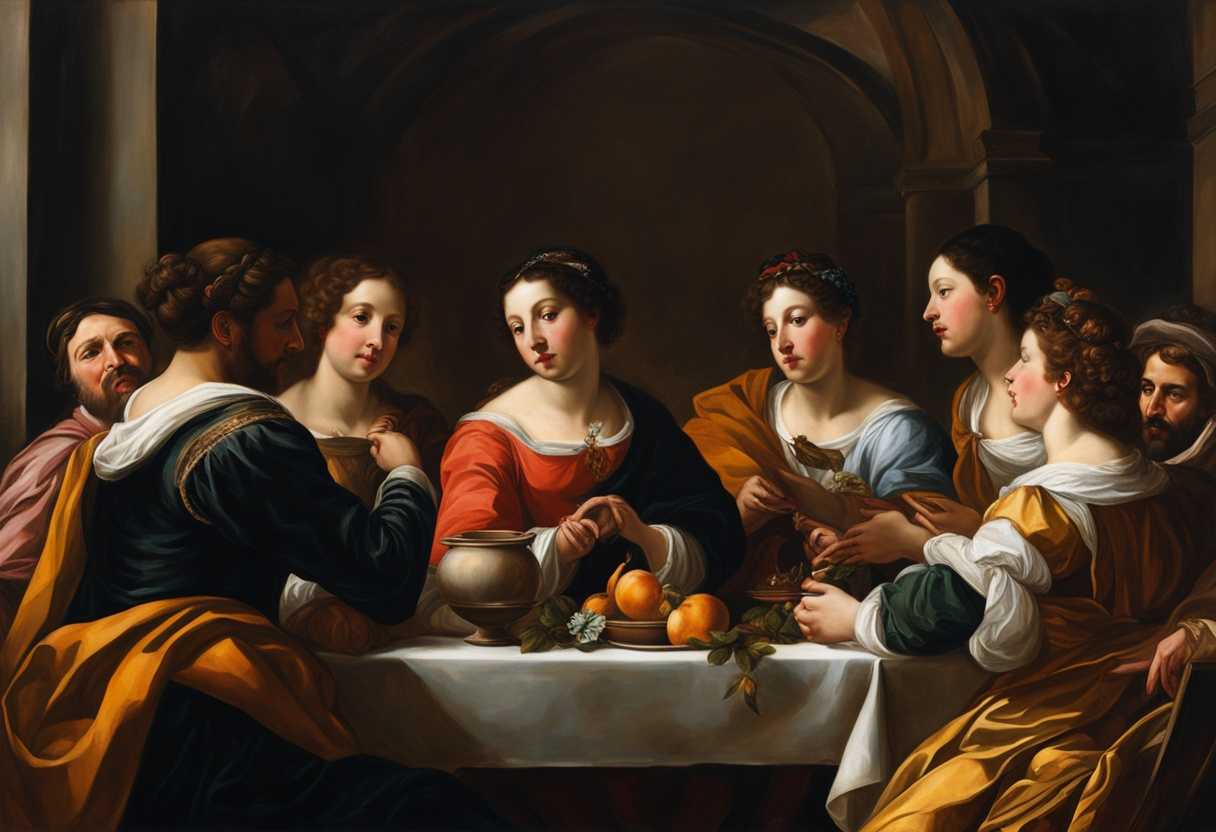
Setting the Scene for Romans 11:1-36
The scene in Romans chapter 11 takes place in a bustling marketplace in the ancient city of Rome. The apostle Paul, a prominent figure in the early Christian church, is surrounded by a diverse group of people from different backgrounds and cultures. Among them are Jewish believers, Gentile converts, and curious onlookers intrigued by Paul’s teachings.
Paul, a former persecutor of Christians turned passionate preacher, is passionately explaining the concept of God’s plan for both Jews and Gentiles to his audience. He uses vivid imagery and powerful language to convey the message of God’s mercy and grace towards all who believe. The marketplace is filled with the sounds of merchants haggling, children playing, and the occasional passerby stopping to listen to Paul’s words.
As Paul continues to speak, his audience is captivated by his words, some nodding in agreement while others furrow their brows in thought. The scene is a vibrant mix of cultures and beliefs, all coming together to listen to the message of salvation and redemption. Paul’s words resonate with his listeners, sparking discussions and debates that will continue long after the marketplace clears out for the day.
What is Romans 11:1-36 about?
The profound message of God’s faithfulness to both the Israelites and the Gentiles is seen in this verse. It communicates the idea that salvation is available to all who have faith in Christ, regardless of their background or history. This inclusivity is a powerful reminder of God’s love for all people and His desire for everyone to experience the gift of salvation.
Have you ever pondered the depth of God’s grace that extends to people from all walks of life? It’s a beautiful reminder that no one is beyond the reach of God’s love and forgiveness. This verse serves as a testament to the universal nature of salvation and the unending faithfulness of God to His people. It challenges us to reflect on our own beliefs and how we view others who may be different from us, prompting us to embrace diversity and unity in Christ.
Understanding what Romans 11:1-36 really means
Romans 11 is a profound chapter where the Apostle Paul delves into the intricate relationship between Israel and the Gentiles within God’s redemptive plan. Divided into three main sections, it navigates through God’s faithfulness to Israel, the inclusion of the Gentiles, and the ultimate salvation of Israel.
In the first section, Paul emphatically declares, “God has not rejected His people,” reassuring us of God’s unwavering commitment to His promises despite Israel’s unbelief. This affirmation echoes the sentiment in 1 Samuel 12:22, emphasizing God’s faithfulness even when human faith falters. In a world where promises are often broken, this serves as a beacon of hope, reminding us of the reliability of God’s word.
Moving on to the inclusion of the Gentiles, Paul highlights how Israel’s stumbling has paved the way for Gentiles to partake in salvation. This inclusive plan of God, as seen in Acts 13:46-47, underscores the universal nature of His love and the significance of unity amidst diversity. Analogously, just as love shown to one child in a family can inspire others to seek the same, God’s grace extended to the Gentiles can draw all nations closer to Him.
The revelation of the ultimate salvation of Israel unfolds in the subsequent verses, where Paul unveils the mystery of Israel’s partial hardening until the full number of Gentiles enters. Drawing from Isaiah 59:20-21, this prophecy underscores God’s comprehensive redemptive plan, ensuring that Israel will ultimately recognize their Messiah. This narrative offers a profound sense of hope, assuring us that God’s grace knows no bounds and that reconciliation is within reach for all.
As the chapter culminates in a doxology, Paul’s exclamation, “Oh, the depth of the riches of the wisdom and knowledge of God!” encapsulates the awe and reverence for God’s inscrutable ways. Referencing Job 11:7, this doxology humbles us, reminding us of the vastness and mystery of God’s plan. In times of uncertainty, it serves as a poignant reminder to trust in God’s wisdom and sovereignty, akin to admiring the intricate work of a master artist that leaves viewers in awe.
In applying the teachings of Romans 11 to our lives today, we are encouraged to embody faithfulness by trusting in God’s promises, embracing inclusivity by recognizing the diversity of God’s family, holding onto hope in the inclusivity of God’s redemptive plan, and approaching life with humility, acknowledging the depth of God’s wisdom beyond our full comprehension.
What does it mean to be grafted into God’s family?
To be grafted into God’s family means to be welcomed and adopted into His family through faith in Him. Paul uses the analogy of grafting branches onto a tree in Romans 11 to explain how Gentile believers are brought into relationship with God. Gentiles can be grafted into the family of God alongside Jewish believers, just as one can graft branches from a wild olive tree onto a cultivated olive tree.
Being grafted into God’s family signifies a new identity and connection with God. It represents a spiritual rebirth and a transformation that allows individuals to partake in the blessings and promises of God’s covenant. This grafting signifies unity and inclusion within God’s chosen people, where distinctions such as ethnicity or background no longer separate believers, but all are united in Christ through faith. God ultimately grafts us into His family as a profound act of grace and mercy, demonstrating His love for all and His desire for all to be a part of His family. It emphasizes the importance of faith, acceptance, and belonging in the Kingdom of God, where believers are nourished by the same root and bear fruit together for His glory.
Application
Dive into the ocean of God’s wisdom and soak in the endless love He offers. Stand in awe of His greatness and let it move you to spread His light like a beacon in the darkness. Allow His grace to fuel your actions in this world of deadlines and obligations. Will you let His love flow through you and touch the lives of those in your circle?

Reverend Michael Johnson is an experienced Church Minister with a profound expertise in spirituality and guidance. With a serene presence and a compassionate heart, he has faithfully served his congregation for over 20 years, leading them on a spiritual journey towards inner peace and enlightenment. Reverend Johnson’s extensive knowledge of religious philosophies and profound understanding of human nature have made him a trusted confidant and mentor to many, as he seamlessly weaves his profound wisdom into life teachings. Reverend Johnson’s calming demeanor and empathetic nature continue to uplift and heal souls, nurturing a sense of unity and tranquility within his community.