
Romans 11:11-36 is about the mysterious and sovereign plan of God to bring both Jews and Gentiles into salvation through faith in Jesus Christ, showcasing His wisdom, knowledge, and unsearchable ways.
11 So I ask, did they stumble in order that they might fall? By no means! But through their trespass salvation has come to the Gentiles, so as to make Israel jealous.
12 Now if their trespass means riches for the world, and if their failure means riches for the Gentiles, how much more will their full inclusion mean!
11 Now I am speaking to you Gentiles. Inasmuch then as I am an apostle to the Gentiles, I magnify my ministry.
11 in order somehow to make my fellow Jews jealous, and thus save some of them.
28 As regards the gospel, they are enemies for your sake. But as regards election, they are beloved for the sake of their forefathers.
16 If the dough offered as firstfruits is holy, so is the whole lump, and if the root is holy, so are the branches.
11 But if some of the branches were broken off, and you, although a wild olive shoot, were grafted in among the others and now share in the nourishing root of the olive tree,
18 do not be arrogant toward the branches. If you are, remember it is not you who support the root, but the root that supports you.
19 Then you will say, “Branches were broken off so that I might be grafted in.”
20 That is true. They were broken off because of their unbelief, but you stand fast through faith. So do not become proud, but fear.
21 For if God did not spare the natural branches, neither will he spare you.
22 Note then the kindness and the severity of God: severity toward those who have fallen, but God’s kindness to you, provided you continue in his kindness. Otherwise you too will be cut off.
11 And even they, if they do not continue in their unbelief, will be grafted in, for God has the power to graft them in again.
24 For if you were cut from what is by nature a wild olive tree, and grafted, contrary to nature, into a cultivated olive tree, how much more will these, the natural branches, be grafted back into their own olive tree.
25 Lest you be wise in your own sight, I do not want you to be unaware of this mystery, brothers: a partial hardening has come upon Israel, until the fullness of the Gentiles has come in.
26 And in this way all Israel will be saved, as it is written, “The Deliverer will come from Zion, he will banish ungodliness from Jacob”;
27 “and this will be my covenant with them when I take away their sins.”
28 As regards the gospel, they are enemies for your sake. But as regards election, they are beloved for the sake of their forefathers.
29 For the gifts and the calling of God are irrevocable.
30 For just as you were at one time disobedient to God but now have received mercy because of their disobedience,
31 so they too have now been disobedient in order that by the mercy shown to you they also may now receive mercy.
32 For God has consigned all to disobedience, that he may have mercy on all.
33 Oh, the depth of the riches and wisdom and knowledge of God! How unsearchable are his judgments and how inscrutable his ways!
34 “For who has known the mind of the Lord, or who has been his counselor?”
35 “Or who has given a gift to him
that he might be repaid?”
36 For from him and through him and to him are all things. To him be glory forever. Amen.
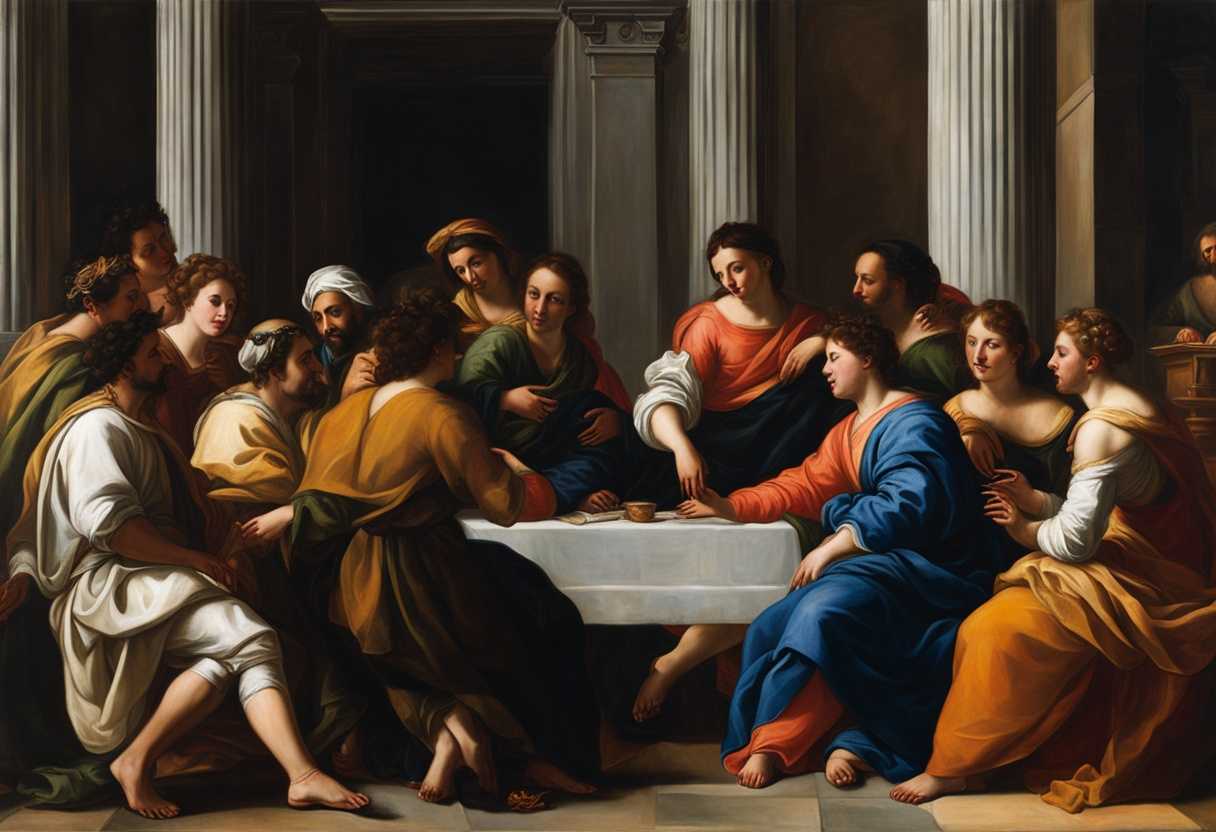
Setting the Scene for Romans 11:11-36
In Romans chapter 11, the apostle Paul is addressing the Gentile believers in Rome, explaining to them the relationship between the Jewish people and the Gentiles in God’s plan of salvation. As Paul speaks, the scene is set in a gathering of believers in a humble meeting place, perhaps a small house church in Rome. The room is filled with a diverse group of people, both Jews and Gentiles, who have come together to hear Paul’s teachings.
Among the attendees are Jewish believers who have accepted Jesus as the Messiah, as well as Gentile believers who have been grafted into the faith through their belief in Christ. The atmosphere is one of anticipation and curiosity as Paul delves into the deep theological truths about God’s mercy and plan for both Jews and Gentiles. The room is dimly lit by oil lamps, casting a warm glow on the faces of those listening intently to Paul’s words.
As Paul continues to expound on the mysteries of God’s ways, the believers are drawn into a deeper understanding of the richness of God’s wisdom and knowledge. The scene is one of unity and mutual respect, as both Jews and Gentiles come to see that they are all part of God’s redemptive plan. The room is filled with a sense of awe and reverence as Paul concludes his teaching, leaving the believers with a profound sense of gratitude for God’s unsearchable ways.
What is Romans 11:11-36 about?
This verse emphasizes that salvation is available to everyone, regardless of their background or ethnicity. Both Jews and Gentiles are included in God’s plan for salvation, and this plan is fulfilled through faith in Christ. The idea here is that faith in Jesus is the key to entering into a relationship with God and receiving the gift of salvation. It highlights the universal nature of God’s love and grace, which extends to all people, regardless of their cultural or religious background.
Have you ever thought about the inclusivity of God’s plan for salvation? It’s incredible to think that no one is excluded from receiving God’s gift of grace through faith in Jesus Christ. This verse serves as a powerful reminder that we are all equal in God’s eyes and that His love knows no boundaries. It challenges us to look beyond our differences and to recognize the common faith we share in Christ as the basis for our salvation. Let’s reflect on the significance of this verse and its implications for how we view and treat others in our lives.
Understanding what Romans 11:11-36 really means
Romans 11:11-36 delves into the intricate relationship between Israel and the Gentiles within the framework of God’s grand salvation design. The passage is a tapestry woven with threads of God’s mercy, the enigmatic nature of His plan, and the unifying bond among believers. One striking phrase, “Salvation has come to the Gentiles to make Israel envious,” illuminates God’s all-encompassing salvation scheme, reaching beyond Israel to embrace the Gentiles. It hints at the strategic inclusion of Gentiles as a means to draw Israel back to God, showcasing His inclusive love for all.
Another poignant phrase, “If their transgression means riches for the world,” underscores the purpose behind Israel’s stumbling in God’s plan, bringing forth blessings to the entire world. It underscores the profound truth that God can bring forth goodness even from human failures. The metaphor of being “grafted in among the others” paints a vivid picture of Gentiles being integrated into the spiritual lineage of Israel, emphasizing unity and the shared inheritance of God’s promises. This imagery highlights the interconnectedness and mutual blessings within the body of believers.
The proclamation that “All Israel will be saved” points towards a future hope and the fulfillment of God’s covenant promises to His chosen people. It serves as a testament to God’s unwavering faithfulness and the ultimate reconciliation of His people. Related passages such as Ephesians 2:11-22 and John 10:16 further emphasize the unity between Jews and Gentiles in Christ, breaking down barriers and fostering peace among believers. Isaiah 11:10 prophesies the inclusion of Gentiles in God’s redemptive plan, laying a foundational framework for the unity of all peoples under God’s banner.
In today’s fragmented world, Romans 11:11-36 resonates profoundly, calling for unity amidst diversity. It transcends societal divisions of race, nationality, and creed, urging believers to come together in Christ. The passage serves as a comforting reminder of God’s sovereignty over history and His boundless mercy towards His creation. It prompts us to trust in God’s mysterious yet perfect plan, even when circumstances seem perplexing or inscrutable.
Consider a family scenario where a child feels estranged until the parents adopt another child, not to replace but to enrich the family. Over time, the initial child witnesses the love and joy the new sibling brings, drawing them back into the familial embrace. This narrative mirrors how God uses the inclusion of Gentiles to beckon Israel back, showcasing His enduring love and mercy for all His children.
Romans 11:11-36 stands as a poignant testament to God’s inclusive and redemptive narrative, urging us to embody unity, lean on God’s sovereignty, and acknowledge His mercy in our lives. As we meditate on this passage, may we be spurred to embody these truths in our communities, fostering unity and extending God’s love to all.
What does it mean to be grafted into faith?
To be grafted into faith means to be joined or incorporated into a relationship with God through belief and acceptance of His grace. Paul uses the metaphor of grafting branches onto an olive tree in Romans 11:11-36 to illustrate how non-Jews (Gentiles) are able to partake in the blessings of God’s covenant with Israel by their faith in Jesus Christ. Through faith, Gentiles become part of God’s chosen people, sharing in the promises and inheritance that were originally given to the Israelites.
This imagery of grafting highlights the unity and interconnectedness of all believers, both Jews and Gentiles, in God’s redemptive plan. It signifies that faith is the common bond that unites believers into one family, regardless of their background or ethnicity. Individuals who are grafted into faith are connected to the eternal life-giving source of God’s love and mercy, growing and bearing fruit as they abide in Him. The universal invitation of salvation that is extended to all people through Jesus Christ ultimately reflects being grafted into faith. It emphasizes the transformative power of faith to reconcile and unify diverse individuals into a harmonious relationship with God, where all can experience the fullness of His grace, mercy, and blessings.
Application
Let’s dive into Romans 11:11-36 and soak in the mercy and wisdom of God. Let these words spark a flame within us to spread the good news like wildfire, where Jews and Gentiles unite as one family through Christ. Let’s shine brightly, radiating His grace to all we meet, illuminating the path for others. Will you stand with me, bridging gaps and sharing God’s love with every corner of the world, fulfilling our mission as His faithful messengers?

Reverend Michael Johnson is an experienced Church Minister with a profound expertise in spirituality and guidance. With a serene presence and a compassionate heart, he has faithfully served his congregation for over 20 years, leading them on a spiritual journey towards inner peace and enlightenment. Reverend Johnson’s extensive knowledge of religious philosophies and profound understanding of human nature have made him a trusted confidant and mentor to many, as he seamlessly weaves his profound wisdom into life teachings. Reverend Johnson’s calming demeanor and empathetic nature continue to uplift and heal souls, nurturing a sense of unity and tranquility within his community.