
Romans 4:24 is about how the resurrection of Jesus Christ serves as confirmation of God’s promise of justification through faith.
24 but for ours also. It will be counted to us who believe in him who raised from the dead Jesus our Lord,
Setting the Scene for Romans 4:24
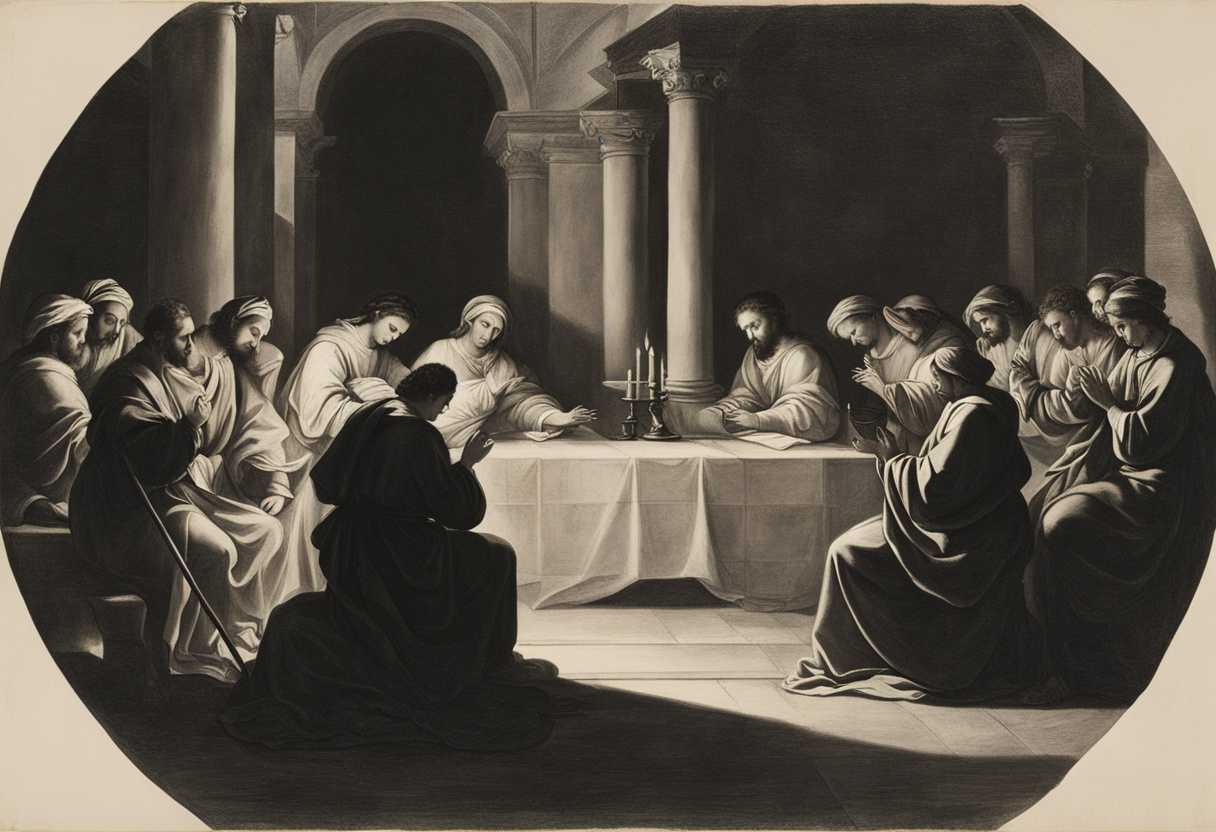
In Romans chapter 4, the apostle Paul is writing to the early Christian community in Rome, explaining the concept of justification by faith. The scene unfolds in a humble meeting room in Rome, where a diverse group of believers has gathered to study and discuss Paul’s teachings. Among them are Lydia, a wealthy merchant from Thyatira who had recently converted to Christianity, and Aquila and Priscilla, a couple who were tentmakers and close associates of Paul.
As they sit in a circle, the flickering light of oil lamps casting a warm glow on their faces, Paul passionately explains how Abraham’s faith was credited to him as righteousness. The group listens intently, their hearts stirred by the powerful message of God’s grace and the promise of salvation through faith. The room is filled with a sense of awe and wonder as they contemplate the depth of God’s love and the freedom that comes from being justified by faith.
In this intimate setting, surrounded by fellow believers who have become like family, the words of Romans 4:24 resonate deeply with each person present, reinforcing their faith and inspiring them to continue living out their beliefs with courage and conviction. The scene captures a moment of spiritual growth and unity, as the early Christians in Rome come together to study, learn, and encourage one another in their journey of faith.
What is Romans 4:24 about?
The apostle Paul in Romans 4:24 is referring to Abraham, the biblical figure known for his great faith. Paul is emphasizing the important principle of faith being credited as righteousness. Abraham, who believed in God’s promises, had his faith counted as righteousness. This verse highlights that this principle of faith leading to righteousness is not just for Abraham but also for all who believe in God.
When we reflect on this verse, we are reminded of the power of faith in our lives. It shows us that faith is not just a personal matter, but it has a profound impact on our relationship with God and our standing before Him. Believers are counted as righteous in God’s eyes by believing in Him and His promises. This verse encourages us to have faith in God, knowing that it is through this faith that we are credited as righteous and find favor in His sight. Let us consider how the depth of our own faith influences our relationship with God as we meditate on Romans 4:24. Are we steadfast in our belief in Him, like Abraham was? Do we trust in God’s promises, even when circumstances are challenging? This verse serves as a reminder that our faith has a significant impact not only on our lives but also on our eternal standing with God. We should strive to deepen our faith and trust in Him, knowing that through belief in Him, we are counted as righteous.
Understanding what Romans 4:24 really means
Romans 4:24, nestled within the profound teachings of the Apostle Paul in the Book of Romans, delves into the essence of faith and righteousness. Paul, in his discourse, draws upon the life of Abraham to illuminate the truth that righteousness is not attained through works or legalistic observances but through unwavering faith in God.
The phrase “For us also, to whom it shall be imputed” underscores the accessibility of the righteousness credited to Abraham through faith to each one of us. It signifies that the same faith that justified Abraham is available to us today, bridging the gap between ancient biblical narratives and our contemporary lives.
Furthermore, the mention of “If we believe on him that raised up Jesus our Lord from the dead” in Romans 4:24 underscores the foundational Christian belief in the resurrection of Jesus Christ. This pivotal event not only serves as the cornerstone of our faith but also as the bedrock of our justification before God.
Genesis 15:6, a pivotal Old Testament reference, lays the groundwork for Paul’s argument on faith and righteousness. It highlights Abraham’s belief in the Lord, which was counted to him as righteousness, echoing the central theme of faith as the pathway to righteousness.
Ephesians 2:8-9 reinforces the notion that salvation is a divine gift bestowed upon us through faith, not a reward earned through human endeavors. This passage emphasizes the unmerited nature of God’s grace, emphasizing that our salvation is rooted in faith rather than in our own works.
In a world where the pressure to earn approval and validation is pervasive, Romans 4:24 offers a liberating message. It reminds us that our standing before God is not contingent on our achievements or adherence to rules but on our faith in Jesus Christ. This truth brings solace and freedom, assuring us that we are accepted and loved by God based on our faith, not our performance.
Imagine someone burdened by the relentless pursuit of perfection in every sphere of life, only to discover the transformative message of faith and grace encapsulated in Romans 4:24. This newfound understanding liberates them from the shackles of self-imposed expectations, ushering in a profound sense of peace and acceptance in the realization that their worth is rooted in faith, not in flawless accomplishments.
In conclusion, Romans 4:24 stands as a poignant reminder that righteousness and a harmonious relationship with God are attained through faith in Jesus Christ. It beckons us to place our trust in God’s unmerited favor rather than in our own striving, offering a timeless message of hope and assurance that resonates as powerfully today as it did in the era of the early Christian church.
How can we believe in God’s promises wholeheartedly?
We can believe in God’s promises wholeheartedly by focusing on the character of God. Throughout the Bible, we see examples of God fulfilling His promises to His people. Therefore, when we meditate on His faithfulness and trustworthiness, our faith is strengthened. We can have confidence that God is able and willing to keep His promises by acknowledging His sovereignty and omnipotence.
Additionally, we can believe in God’s promises wholeheartedly by understanding that His promises are based on His love for us. God’s promises are not dependent on our actions or merit but on His grace and mercy. Knowing that God’s love is unconditional and unchanging can help us rely on His promises with unwavering faith. We can experience the peace and assurance that come from trusting in Him completely by embracing His love and accepting His promises with a humble heart.
Finally, we can believe in God’s promises wholeheartedly by walking in obedience and aligning our lives with His will. Drawing closer to God through prayer, studying His Word, and cultivating a relationship with Him helps us become more attuned to His voice and His promises. We demonstrate our faith in His promises and open ourselves up to receive the blessings He has in store for us by living a life that honors God and seeks His kingdom first.
Application
Let the words of Romans 4:24 ignite a fire within you to embrace unwavering faith like Abraham. Believe in the power of God’s promises just as he did. Walk your path with faith, knowing that every promise will be fulfilled at the right time. Will you rise to the challenge and trust in God’s promises like Abraham did?

Reverend Michael Johnson is an experienced Church Minister with a profound expertise in spirituality and guidance. With a serene presence and a compassionate heart, he has faithfully served his congregation for over 20 years, leading them on a spiritual journey towards inner peace and enlightenment. Reverend Johnson’s extensive knowledge of religious philosophies and profound understanding of human nature have made him a trusted confidant and mentor to many, as he seamlessly weaves his profound wisdom into life teachings. Reverend Johnson’s calming demeanor and empathetic nature continue to uplift and heal souls, nurturing a sense of unity and tranquility within his community.