
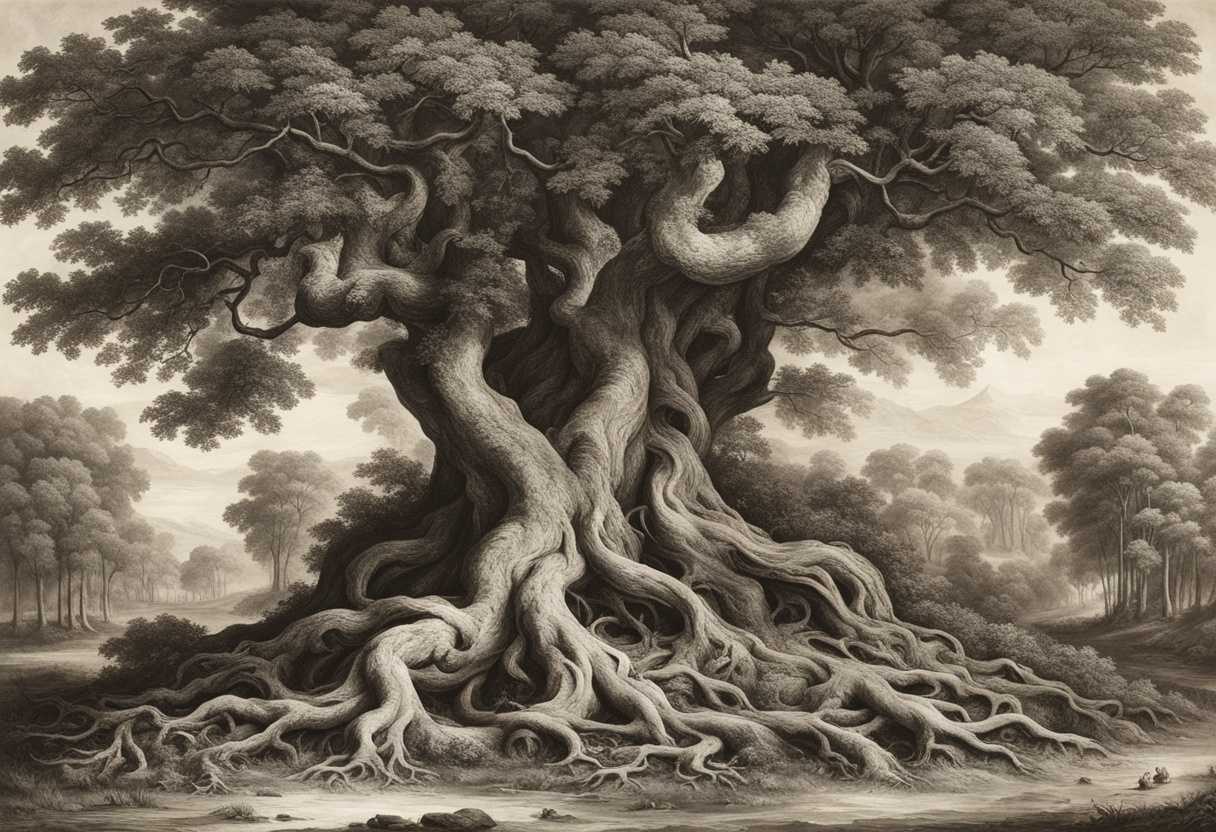
In the Bible, the “root of a tree” often symbolizes the source of strength and stability, representing God’s foundational support and the heritage of faith. It can also denote a connection to one’s ancestry or spiritual lineage, as seen in scriptures like Isaiah 11:1, which refers to the “root of Jesse,” symbolizing the lineage of David and the coming Messiah.
Scripture
1 There shall come forth a shoot from the stump of Jesse, and a branch from his roots shall bear fruit.
2 And the Spirit of the Lord shall rest upon him, the Spirit of wisdom and understanding, the Spirit of counsel and might, the Spirit of knowledge and the fear of the Lord.
3 And his delight shall be in the fear of the Lord. He shall not judge by what his eyes see, or decide disputes by what his ears hear,
4 but with righteousness he shall judge the poor, and decide with equity for the meek of the earth; and he shall strike the earth with the rod of his mouth, and with the breath of his lips he shall kill the wicked.
5 Righteousness shall be the belt of his waist,
and faithfulness the belt of his loins.
6 The wolf shall dwell with the lamb, and the leopard shall lie down with the young goat, and the calf and the lion and the fattened calf together; and a little child shall lead them.
7 The cow and the bear shall graze; their young shall lie down together; and the lion shall eat straw like the ox.
8 The nursing child shall play over the hole of the cobra, and the weaned child shall put his hand on the adder’s den.
9 They shall not hurt or destroy
in all my holy mountain;
for the earth shall be full of the knowledge of the Lord
as the waters cover the sea.
10 In that day the root of Jesse, who shall stand as a signal for the peoples—of him shall the nations inquire, and his resting place shall be glorious.
“Root of a Tree” in the Bible
The concept of the “root of a tree” in the Bible conveys deep meanings that extend beyond mere botanical imagery, often serving as a metaphor for strength, stability, and spiritual heritage. In Isaiah 11:1, where it discusses the “root of Jesse,” the verse highlights the promise of a future Messiah stemming from the lineage of King David, emphasizing the importance of spiritual ancestry and reaffirmation of God’s covenant with His people. This root signifies not only a royal lineage but also the hope that springs from faith in God’s promises, as the Messiah epitomizes the fulfillment of God’s redemptive plan.
Further expanding on this symbolism, Psalm 1:3 compares the righteous to a tree planted by streams of water, which bears fruit in its season and does not wither. This image of roots drawing sustenance from a reliable source prompts readers to reflect on their own spiritual foundations. Just as the roots of a tree anchor it and provide nourishment, believers are encouraged to deepen their roots in God’s Word and His promises. Additionally, in Romans 11:17-18, Paul uses the metaphor of roots in the context of divine mercy and inclusion, where Gentile believers are described as wild olive shoots grafted into the cultivated olive tree, signifying their connection to the spiritual heritage of Israel. Thus, the “root of a tree” serves as a multi-layered image; it illustrates one’s spiritual lineage, anchors believers in God’s promises, and reminds them of the importance of strong, steadfast faith that draws nourishment from God’s eternal word.
Continuing along the lines of the “root of a tree” for its rich biblical symbolism, the book of Proverbs also provides insight into the moral and ethical dimensions associated with this imagery. Proverbs 12:3 speaks of a righteous person as being rooted in a solid foundation, underscoring that uprightness leads to stability and prosperity. Here, the root becomes a symbol of moral integrity and strength, suggesting that those who live righteous lives are deeply anchored in wisdom and truth. This notion reinforces the idea that the roots of a person’s character significantly influence their outward actions and impact within the community, mirroring how deep roots support a tree during storms.
Moreover, in the context of prophetic literature, the metaphor of roots is often intertwined with themes of judgment and restoration. In the book of Ezekiel, for instance, the imagery of roots is used eloquently to describe the fate of nations. The assurance that God will restore His people highlights that even when a nation appears cut off or barren, there is hope for rejuvenation as new growth springs forth from what may seem like lifeless roots. This reflects a theological promise that God can revive any situation deemed hopeless, reestablishing a connection with His people. Consequently, the “root of a tree” encapsulates not only the ideas of nourishment and support but also the resilience of faith amid adversity, illustrating the profound spiritual truth that God remains at work even in the hardest of seasons.
Symbol of Stability and Nourishment
The “root of a tree” often symbolizes stability and nourishment in the biblical context. Just as roots anchor a tree and provide it with essential nutrients and water, they represent the foundational aspects of faith and spiritual growth. This imagery suggests that a strong relationship with God and adherence to His teachings are vital for sustaining one’s spiritual life. The roots serve as a reminder that believers must remain grounded in their faith to thrive and bear fruit in their lives.
Representation of Lineage and Heritage
In biblical literature, the roots of a tree can also signify lineage and heritage. Trees often symbolize families or nations, and their roots represent the ancestral connections that shape identity and purpose. This concept emphasizes the importance of understanding one’s spiritual heritage and the legacy of faith passed down through generations. It highlights how the roots of faith can influence the present and future, encouraging believers to honor their spiritual ancestry while cultivating their own relationship with God.
Metaphor for Judgment and Renewal
The “root of a tree” can serve as a metaphor for judgment and renewal in the biblical narrative. Just as a tree can be cut down to its roots, symbolizing destruction or judgment, it can also sprout anew, representing hope and restoration. This duality reflects the biblical themes of repentance and redemption, where God offers a chance for renewal even after judgment. The imagery of roots being preserved or renewed underscores the idea that, despite trials and tribulations, there is always the potential for new life and growth through divine grace.
How to Build a Stronger Foundation in Faith
Building a stronger foundation in faith is a deeply personal journey that requires intentionality and openness to God’s guidance. Start by immersing yourself in Scripture; the Bible is not just a book but a living testament that speaks to our hearts and minds. Set aside time each day for prayer, allowing it to be a two-way conversation where you not only speak but also listen for God’s voice. Surround yourself with a community of believers who can encourage and challenge you, as fellowship is vital in nurturing our faith. Don’t shy away from asking tough questions or expressing doubts; remember, faith is often strengthened in the wrestling. Lastly, put your faith into action through service and love, as living out your beliefs can deepen your understanding and connection to God. Embrace this journey with patience and grace, knowing that faith is a lifelong process of growth and discovery.
Bible References to “Root of a Tree”:
Jeremiah 17:7-8: 7 “Blessed is the man who trusts in the Lord,
whose trust is the Lord.
8 He is like a tree planted by water, that sends out its roots by the stream, and does not fear when heat comes, for its leaves remain green, and is not anxious in the year of drought, for it does not cease to bear fruit.
Job 14:7-9: 7 “For there is hope for a tree,
if it be cut down, that it will sprout again,
and that its shoots will not cease.
8 Though its root grow old in the earth,
and its stump die in the soil,
9 Yet at the scent of water it will bud
and put out branches like a young plant.
Romans 11:16-18: 16 If the dough offered as firstfruits is holy, so is the whole lump, and if the root is holy, so are the branches.
11 But if some of the branches were broken off, and you, although a wild olive shoot, were grafted in among the others and now share in the nourishing root of the olive tree,
18 do not be arrogant toward the branches. If you are, remember it is not you who support the root, but the root that supports you.
Matthew 3:10-12: 10 Even now the axe is laid to the root of the trees. Every tree therefore that does not bear good fruit is cut down and thrown into the fire.
11 “I baptize you with water for repentance, but he who is coming after me is mightier than I, whose sandals I am not worthy to carry. He will baptize you with the Holy Spirit and fire.”
12 His winnowing fork is in his hand, and he will clear his threshing floor and gather his wheat into the barn, but the chaff he will burn with unquenchable fire.
Luke 3:9-11: 9 Even now the axe is laid to the root of the trees. Every tree therefore that does not bear good fruit is cut down and thrown into the fire.
10 And the crowds asked him, “What then shall we do?”
11 And he answered them, “Whoever has two tunics is to share with him who has none, and whoever has food is to do likewise.”
Ezekiel 17:22-24: 22 Thus says the Lord God: “I myself will take a sprig from the lofty top of the cedar and will set it out. I will break off from the topmost of its young twigs a tender one, and I myself will plant it on a high and lofty mountain.”
23 On the mountain height of Israel will I plant it, that it may bear branches and produce fruit and become a noble cedar. And under it will dwell every kind of bird; in the shade of its branches birds of every sort will nest.
24 And all the trees of the field shall know that I am the Lord; I bring low the high tree, and make high the low tree, dry up the green tree, and make the dry tree flourish. I am the Lord; I have spoken, and I will do it.”
Daniel 4:10-15: 10 The visions of my head as I lay in bed were these: I saw, and behold, a tree in the midst of the earth, and its height was great.
11 The tree grew and became strong, and its top reached to heaven, and it was visible to the end of the whole earth.
12 Its leaves were beautiful and its fruit abundant, and in it was food for all. The beasts of the field found shade under it, and the birds of the heavens lived in its branches.
13 I saw in the visions of my head as I lay in bed, and behold, a watcher, a holy one, came down from heaven.
14 He proclaimed aloud and said thus: ‘Chop down the tree and lop off its branches, strip off its leaves and scatter its fruit. Let the beasts flee from under it and the birds from its branches.
15 But leave the stump of its roots in the earth, bound with a band of iron and bronze, amid the tender grass of the field. Let him be wet with the dew of heaven. Let his portion be with the beasts in the grass of the earth.
Hosea 14:5-7: 5 I will be like the dew to Israel;
he shall blossom like the lily;
he shall take root like the trees of Lebanon;
6 his shoots shall spread out;
his beauty shall be like the olive,
and his fragrance like Lebanon.
7 They shall return and dwell beneath my shadow;
they shall flourish like the grain;
they shall blossom like the vine;
their fame shall be like the wine of Lebanon.
Psalm 1:1-3: 1 Blessed is the man who walks not in the counsel of the wicked, nor stands in the way of sinners, nor sits in the seat of scoffers;
2 but his delight is in the law of the Lord, and on his law he meditates day and night.
3 He is like a tree
planted by streams of water
that yields its fruit in its season,
and its leaf does not wither.
In all that he does, he prospers.
Revelation 22:16-17: 16 “I, Jesus, have sent my angel to testify to you about these things for the churches. I am the root and the descendant of David, the bright morning star.”
17 The Spirit and the Bride say, “Come.” And let the one who hears say, “Come.” And let the one who is thirsty come; let the one who desires take the water of life without price.
Proverbs 12:3-4: 3 No one is established by wickedness,
but the root of the righteous will never be moved.
4 An excellent wife is the crown of her husband, but she who brings shame is like rottenness in his bones.
Isaiah 37:31-32: 31 And the surviving remnant of the house of Judah shall again take root downward and bear fruit upward.
32 For out of Jerusalem shall go a remnant, and out of Mount Zion a band of survivors. The zeal of the Lord of hosts will do this.

Reverend Michael Johnson is an experienced Church Minister with a profound expertise in spirituality and guidance. With a serene presence and a compassionate heart, he has faithfully served his congregation for over 20 years, leading them on a spiritual journey towards inner peace and enlightenment. Reverend Johnson’s extensive knowledge of religious philosophies and profound understanding of human nature have made him a trusted confidant and mentor to many, as he seamlessly weaves his profound wisdom into life teachings. Reverend Johnson’s calming demeanor and empathetic nature continue to uplift and heal souls, nurturing a sense of unity and tranquility within his community.