
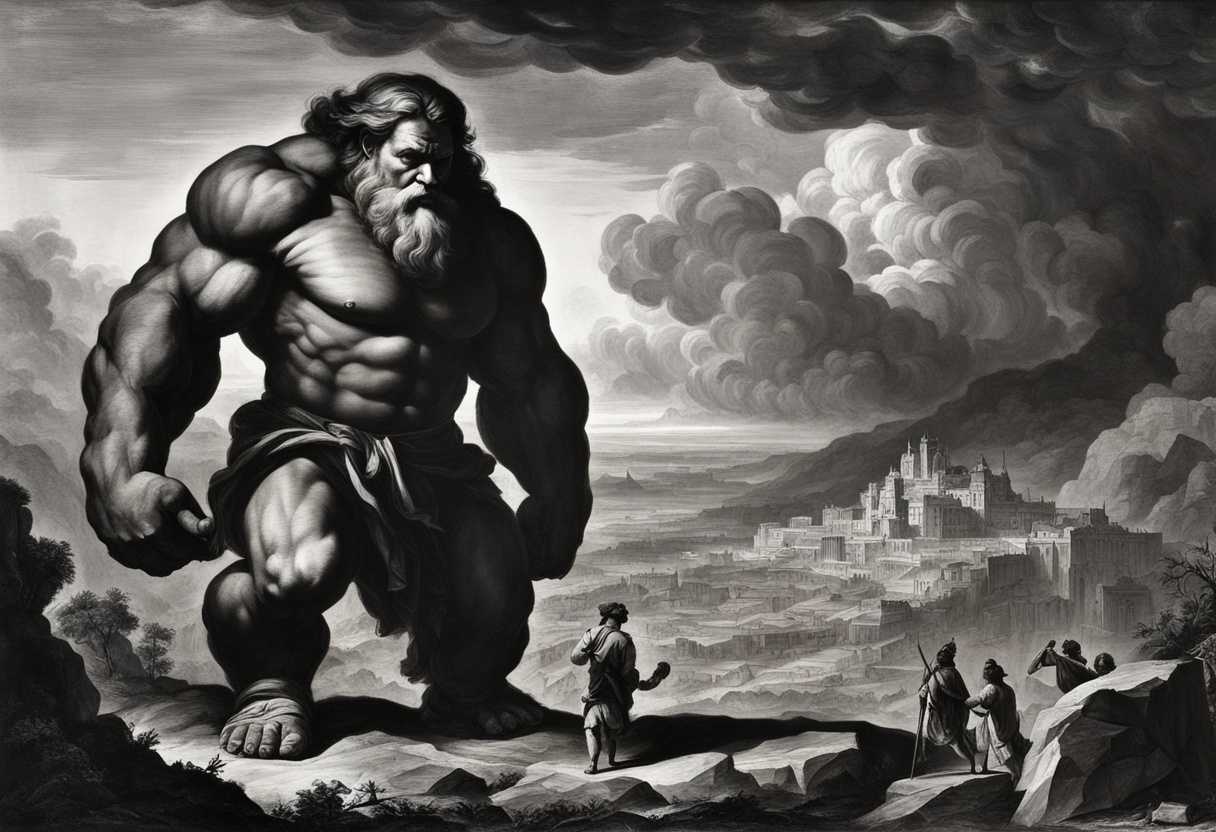
In the Bible, “giants” often refers to the Nephilim, mentioned in Genesis 6:4, who were described as mighty men and the offspring of the sons of God and the daughters of men. They are generally associated with great size and strength, symbolizing human wickedness and the consequences of straying from God’s ways.
Scripture
5 The Lord saw that the wickedness of man was great in the earth, and that every intention of the thoughts of his heart was only evil continually.
2 the sons of God saw that the daughters of man were attractive. And they took as their wives any they chose.
3 Then the Lord said, “My Spirit shall not abide in man forever, for he is flesh: his days shall be 120 years.”
4 There were giants in the earth in those days, and also after that, when the sons of God came in unto the daughters of men, and they bare children to them, the same became mighty men which were of old, men of renown.
Giants in the Bible: Definition and Significance
The concept of giants in the Bible, particularly encapsulated in the term “Nephilim,” holds profound theological and moral implications beyond their physical stature. As noted in Genesis 6:4, the Nephilim are portrayed as the offspring of “the sons of God” and “the daughters of men,” symbolizing a blend of the divine with the human, which raises questions about the nature of humanity and its relationship with the divine. This intermingling is often interpreted as a metaphor for rebellion against God’s design, embodying the height of human wickedness that precedes the flood. The presence of giants serves as a stark reminder of the consequences of turning away from God’s covenant and the sinfulness that led to divine judgment (Genesis 6:5-7).
In a broader sense, giants in biblical literature can also represent insurmountable challenges or formidable obstacles that believers must face. For instance, in the story of David and Goliath (1 Samuel 17), Goliath is depicted as a giant and a formidable adversary that seemed impossible to defeat. Yet, David’s victory over Goliath signifies the triumph of faith and reliance on God over brute strength and intimidation. This narrative serves as an enduring lesson about courage, faith, and the belief that with God, even the mightiest ‘giants’ in our lives can be overcome. The theme of giants consequently intertwines the notions of human frailty, moral failure, and the need for divine assistance, inviting readers to reflect on their own struggles and the power of faith amid adversity.
The notion of giants extends into other biblical narratives, forming a rich tapestry of meaning regarding divine judgment, the nature of evil, and the struggle for faith. In the Book of Numbers, the Israelite spies report seeing giants in the land of Canaan, describing themselves as grasshoppers in comparison to these colossal beings (Numbers 13:33). This episode reflects the fear and doubt that can hinder the faithful from pursuing God’s promises. The giants here symbolize the seemingly overwhelming fears and challenges that can appear insurmountable, leading many to disbelief and disobedience. The contrast between the spies’ timid assessment and God’s assurance illustrates a critical message: faith empowers individuals to confront their fears, regardless of how large those fears may loom.
The theme of giants can also encompass the idea of geopolitical power and oppression as demonstrated in the Hebrew Scriptures. The Philistines, often associated with Goliath, not only exemplify physical might but also represent the broader struggles that Israel faced against powerful adversaries throughout its history. The narrative of these giants serves as an allegory for spiritual battles, illustrating the pervasive presence of evil in the world. The portrayal of giants thus acts as a multifaceted symbol, addressing both historical realities and spiritual truths, urging believers to confront and rely on divine strength to overcome challenges that might otherwise overwhelm them. Ultimately, the recurring theme of giants throughout the biblical text invites deeper exploration into the intersections of faith, fear, and the human condition in the face of life’s adversities.
Symbol of Human Corruption
In the biblical narrative, giants often represent the culmination of human sin and moral decay. Their existence is seen as a direct consequence of humanity’s rebellion against God, illustrating the consequences of straying from divine principles. This portrayal serves as a warning about the dangers of unchecked ambition and the moral decline that can arise when individuals or societies turn away from righteousness.
Representation of Spiritual Warfare
Giants in the Bible can also symbolize the formidable challenges and adversities that believers face in their spiritual journeys. They embody the obstacles that seem insurmountable, representing the trials and tribulations that test faith. This interpretation encourages believers to confront their fears and adversities with courage and reliance on divine strength, emphasizing the importance of faith in overcoming life’s giants.
Metaphor for Oppression and Injustice
Additionally, giants can be viewed as metaphors for oppressive forces and systems that dominate and exploit the vulnerable. In this context, they represent the powerful entities that stand against justice and righteousness. The narrative surrounding giants serves to highlight the struggle against tyranny and the call for divine intervention, inspiring hope for liberation and the triumph of good over evil.
How to Strengthen Your Faith and Live Christ-like
Strengthening your faith and living a Christ-like life is a beautiful journey that requires intentionality and grace. Start by immersing yourself in the Word of God; daily reading and meditation on Scripture can transform your heart and mind, helping you to align your thoughts with Christ’s teachings. Prayer is another vital component—it’s not just about asking for things, but about building a relationship with God, sharing your struggles, and seeking His guidance. Surround yourself with a community of believers who can encourage and challenge you; fellowship is essential for growth. Additionally, look for opportunities to serve others, as Christ did, whether through volunteering, helping a neighbor, or simply offering a listening ear. Remember, it’s not about perfection but progress; embrace the journey, and trust that God is working in you to reflect His love and grace in the world.
Bible References to Giants in Scripture:
Numbers 13:32-33: 13 And there we saw the Nephilim (the sons of Anak, who come from the Nephilim), and we seemed to ourselves like grasshoppers, and so we seemed to them.”
33 And there we saw the Nephilim (the sons of Anak, who come from the Nephilim), and we seemed to ourselves like grasshoppers, and so we seemed to them.”
Deuteronomy 2:10-11: 10(The Emim formerly lived there, a people great and many, and tall as the Anakim.)
11 Like the Anakim they are also counted as Rephaim, but the Moabites call them Emim.
Deuteronomy 2:20-21: 20 (It is also counted as a land of Rephaim. Rephaim formerly lived there, but the Ammonites call them Zamzummim,).
21 a people great and many, and tall as the Anakim, but the Lord destroyed them before the Ammonites, and they dispossessed them and settled in their place,
Deuteronomy 3:11: 11 (For only Og the king of Bashan was left of the remnant of the Rephaim. Behold, his bed was a bed of iron. Is it not in Rabbah of the Ammonites? Nine cubits was its length, and four cubits its breadth, according to the common cubit.)
Deuteronomy 3:13: 13 the rest of Gilead, and all Bashan, the kingdom of Og, that is, all the region of Argob, I gave to the half-tribe of Manasseh. (All that portion of Bashan is called the land of Rephaim.)
Joshua 12:4: 4 and Og king of Bashan, one of the remnant of the Rephaim, who lived at Ashtaroth and at Edrei,
Joshua 13:12: 12 all the kingdom of Og in Bashan, who reigned in Ashtaroth and in Edrei (he alone was left of the remnant of the Rephaim); these Moses had struck and driven out.
1 Samuel 17:4-7: 4 And there came out from the camp of the Philistines a champion named Goliath of Gath, whose height was six cubits and a span.
5 He had a helmet of bronze on his head, and he was armed with a coat of mail, and the weight of the coat was five thousand shekels of bronze.
6 And he had bronze armor on his legs, and a javelin of bronze slung between his shoulders.
7 And the staff of his spear was like a weaver’s beam, and his spear’s head weighed six hundred shekels of iron. And his shield-bearer went before him.
2 Samuel 21:15-22: 15 There was war again between the Philistines and Israel, and David went down together with his servants, and they fought against the Philistines. And David grew weary.
16 And Ishbi-benob, one of the descendants of the giants, whose spear weighed three hundred shekels of bronze, and who was armed with a new sword, thought to kill David.
17 But Abishai the son of Zeruiah came to his aid and attacked the Philistine and killed him. Then David’s men swore to him, “You shall no longer go out with us to battle, lest you quench the lamp of Israel.”
18 And after this there was again war with the Philistines at Gob. Then Sibbecai the Hushathite struck down Saph, who was one of the descendants of the giants.
19 And there was again war with the Philistines at Gob, and Elhanan the son of Jaare-oregim, the Bethlehemite, struck down Goliath the Gittite, the shaft of whose spear was like a weaver’s beam.
20 And there was again war at Gath, where there was a man of great stature, who had six fingers on each hand and six toes on each foot, twenty-four in number, and he also was descended from the giants.
21 And when he defied Israel, Jonathan the son of Shimei, David’s brother, struck him down.
22 These four were descended from the giants in Gath, and they fell by the hand of David and by the hand of his servants.
1 Chronicles 20:4-8: 4 And after this there arose war with the Philistines at Gezer. Then Sibbecai the Hushathite struck down Sippai, who was one of the descendants of the giants, and the Philistines were subdued.
5 And there was war with the Philistines again, and Elhanan the son of Jair struck down Lahmi the brother of Goliath the Gittite, the shaft of whose spear was like a weaver’s beam.
6 And there was again war at Gath, where there was a man of great stature, who had six fingers on each hand and six toes on each foot, twenty-four in number, and he also was descended from the giants.
7 And when David arose in the morning, the word of the Lord came to the prophet Gad, David’s seer, saying,
8 In Gath, there was a man of great stature, who had six fingers on each hand and six toes on each foot, twenty-four in number, and he also was descended from the giants.

Reverend Michael Johnson is an experienced Church Minister with a profound expertise in spirituality and guidance. With a serene presence and a compassionate heart, he has faithfully served his congregation for over 20 years, leading them on a spiritual journey towards inner peace and enlightenment. Reverend Johnson’s extensive knowledge of religious philosophies and profound understanding of human nature have made him a trusted confidant and mentor to many, as he seamlessly weaves his profound wisdom into life teachings. Reverend Johnson’s calming demeanor and empathetic nature continue to uplift and heal souls, nurturing a sense of unity and tranquility within his community.