
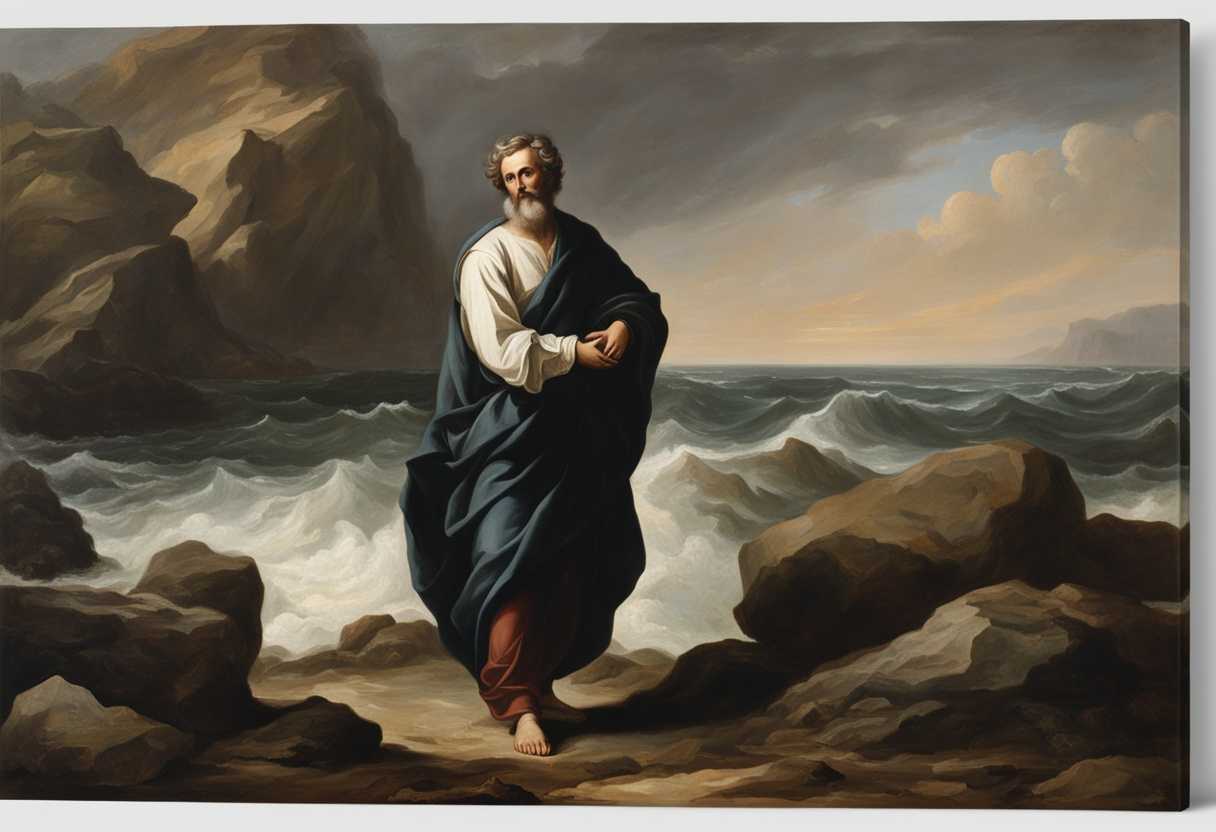
Cephas is an Aramaic name meaning “rock,” and it is used in the Bible as a reference to the Apostle Peter, who was given this name by Jesus to signify his role as a foundational leader in the early Church (John 1:42).
Scripture
40 One of the two who heard John speak and followed Jesus was Andrew, Simon Peter’s brother.
41 He first found his own brother Simon and said to him, “We have found the Messiah” (which means Christ).
42 He brought him to Jesus. Jesus looked at him and said, “You are Simon the son of John. You shall be called Cephas” (which means Peter).
Meaning of Cephas in the Bible
The name “Cephas,” which translates to “rock,” holds profound significance in the New Testament, particularly in the context of the Apostle Peter’s role in the Church. In John 1:42, when Jesus renames Simon as Cephas, He is not merely bestowing a name; He is establishing Peter’s identity and mission. This renaming symbolizes Peter’s anticipated strength and stability in the faith, suggesting that he would serve as a fundamental pillar for the burgeoning Christian community. Additionally, in Matthew 16:18, Jesus reaffirms this by stating, “And I tell you that you are Peter, and on this rock I will build my church,” highlighting Peter’s pivotal position in the spread of the Gospel and the Christian faith.
Beyond the immediate reference to Peter himself, the term “rock” embodies broader theological themes, representing steadfastness, faithfulness, and foundational truth. In 1 Corinthians 3:11, Paul emphasizes that no one can lay any foundation other than that which is already laid, which is Jesus Christ. This connects back to the concept of Cephas in that Peter, as the rock, embodies the unshakeable truth of Christ, serving as a model for believers to build their faith upon. Additionally, the idea of being a rock extends to the believer’s call to be steadfast and resolute in their faith, reinforcing the notion that the Church, built upon such figures, should similarly reflect the unwavering nature of Christ. Thus, Cephas symbolizes both a singular leadership role and the collective calling of all believers to embody the strength of their faith.
The term “Cephas” not only denotes an individual but also reflects the broader implications of leadership and foundation in the early Christian community. In the Acts of the Apostles, Peter, while still referred to as Cephas, emerges as a prominent figure guiding the fledgling Church through its earliest challenges. His ability to recite scriptural truths and make key proclamations laid the groundwork for the movement that would define Christianity. This underscores how Cephas represents not just a personal identity but a theological principle of truth and authority that believers were expected to emulate.
Moreover, the significance of Cephas can also be seen in Paul’s letters, where he addresses the divisions within the Church by invoking Cephas’s name alongside others. This highlights the importance of unity and the dangers of partisanship in a faith community built on the teachings of Christ. The reference to Cephas serves to remind followers that while individual leaders may arise, they are ultimately servants of the same gospel, called to uphold the tenets of faith that Jesus represented. This notion encourages the Church to focus on the shared mission of advancing the kingdom rather than allowing personal identities or allegiances to divide them, thus reiterating the enduring message of strength and reliability embodied in Cephas.
The Foundation of the Church
Cephas, which means “rock” in Aramaic, symbolizes stability and strength. In the context of the early Christian church, Cephas represents the foundational role that Peter played in establishing and leading the community of believers. His steadfastness in faith and leadership qualities contributed to the growth and spread of Christianity, making him a pivotal figure in the church’s history.
The Duality of Human Nature
Cephas also embodies the complexities of human nature, particularly in the context of faith and doubt. Peter’s journey reflects the struggles that many believers face, including moments of weakness and failure. His denial of Christ and subsequent restoration illustrate the themes of redemption and forgiveness, highlighting that even strong leaders can falter but can also be renewed and empowered for greater purposes.
The Call to Leadership and Service
The name Cephas signifies a call to leadership and service within the Christian community. Peter’s role as a leader emphasizes the importance of guiding others in faith and nurturing the spiritual growth of the church. This aspect of Cephas serves as a reminder that leadership in the faith community is not just about authority but also about humility, service, and the responsibility to care for others in their spiritual journeys.
How to Strengthen Your Faith Through Christ’s Teachings
Strengthening your faith through Christ’s teachings is a deeply personal journey that invites you to immerse yourself in His words and actions. Start by reading the Gospels—Matthew, Mark, Luke, and John—where you’ll find the essence of His message: love, compassion, and forgiveness. Reflect on His parables, as they offer profound insights into living a life aligned with God’s will. Consider keeping a journal to document your thoughts and prayers, allowing you to see how His teachings resonate in your daily life. Engage in community worship and discussions, as sharing your experiences with fellow believers can deepen your understanding and commitment. Most importantly, practice what you learn; let His teachings guide your decisions and interactions, and watch how your faith flourishes as you embody His love in the world around you. Remember, faith is not just a belief but a way of living, and with each step you take in Christ’s footsteps, you’ll find your connection to Him growing stronger.
Bible References to the Meaning of Cephas:
1 Corinthians 1:10-12: 10 I appeal to you, brothers, by the name of our Lord Jesus Christ, that all of you agree, and that there be no divisions among you, but that you be united in the same mind and the same judgment.
11 For it has been reported to me by Chloe’s people that there is quarreling among you, my brothers.
12 What I mean is that each one of you says, “I follow Paul,” or “I follow Apollos,” or “I follow Cephas,” or “I follow Christ.”
1 Corinthians 3:21-23: 21 So let no one boast in men. For all things are yours,
22 whether Paul or Apollos or Cephas or the world or life or death or the present or the future—all are yours,
23 and you are Christ’s, and Christ is God’s.
1 Corinthians 9:4-6: 4 Do we not have the right to eat and drink?
5 Do we not have the right to take along a believing wife, as do the other apostles and the brothers of the Lord and Cephas?
6 Or is it only Barnabas and I who have no right to refrain from working for a living?
1 Corinthians 15:3-5: 3 For I delivered to you as of first importance what I also received: that Christ died for our sins in accordance with the Scriptures,
4 that he was buried, that he was raised on the third day in accordance with the Scriptures,
5 and that he appeared to Cephas, then to the twelve.
Galatians 1:18-19: 18 Then after three years I went up to Jerusalem to visit Cephas and remained with him fifteen days.
19 But I saw none of the other apostles except James the Lord’s brother.
Galatians 2:7-9: 7 On the contrary, when they saw that I had been entrusted with the gospel to the uncircumcised, just as Peter had been entrusted with the gospel to the circumcised
8 (for he who worked through Peter for his apostolic ministry to the circumcised worked also through me for mine to the Gentiles),
9 and when James and Cephas and John, who seemed to be pillars, perceived the grace that was given to me, they gave the right hand of fellowship to Barnabas and me, that we should go to the Gentiles and they to the circumcised.
Galatians 2:11-14: 11 But when Cephas came to Antioch, I opposed him to his face, because he stood condemned.
12 For before certain men came from James, he was eating with the Gentiles; but when they came he drew back and separated himself, fearing the circumcision party.
13 And the rest of the Jews acted hypocritically along with him, so that even Barnabas was led astray by their hypocrisy.
14 But when I saw that their conduct was not in step with the truth of the gospel, I said to Cephas before them all, “If you, though a Jew, live like a Gentile and not like a Jew, how can you force the Gentiles to live like Jews?”

Reverend Michael Johnson is an experienced Church Minister with a profound expertise in spirituality and guidance. With a serene presence and a compassionate heart, he has faithfully served his congregation for over 20 years, leading them on a spiritual journey towards inner peace and enlightenment. Reverend Johnson’s extensive knowledge of religious philosophies and profound understanding of human nature have made him a trusted confidant and mentor to many, as he seamlessly weaves his profound wisdom into life teachings. Reverend Johnson’s calming demeanor and empathetic nature continue to uplift and heal souls, nurturing a sense of unity and tranquility within his community.