
The name Olivia does not have a direct Hebrew origin; it is derived from the Latin word “oliva,” meaning “olive.” In biblical symbolism, the olive tree represents peace, prosperity, and the blessing of God, as seen in various passages such as Psalm 52:8 and Romans 11:17-24.
Scripture
6 At the end of forty days Noah opened the window of the ark that he had made.
7 and sent out a raven. It went to and fro until the waters were dried up from the earth.
8 Then he sent forth a dove from him, to see if the waters had subsided from the face of the ground.
9 But the dove found no place to set her foot, and she returned to him to the ark, for the waters were still on the face of the whole earth. So he put out his hand and took her and brought her into the ark with him.
10 He waited another seven days, and again he sent forth the dove out of the ark.
11 And the dove came back to him in the evening, and behold, in her mouth was a freshly plucked olive leaf. So Noah knew that the waters had subsided from the earth.
12 And he waited yet another seven days and sent forth the dove, and she did not return to him anymore.
Meaning of Olivia in the Bible
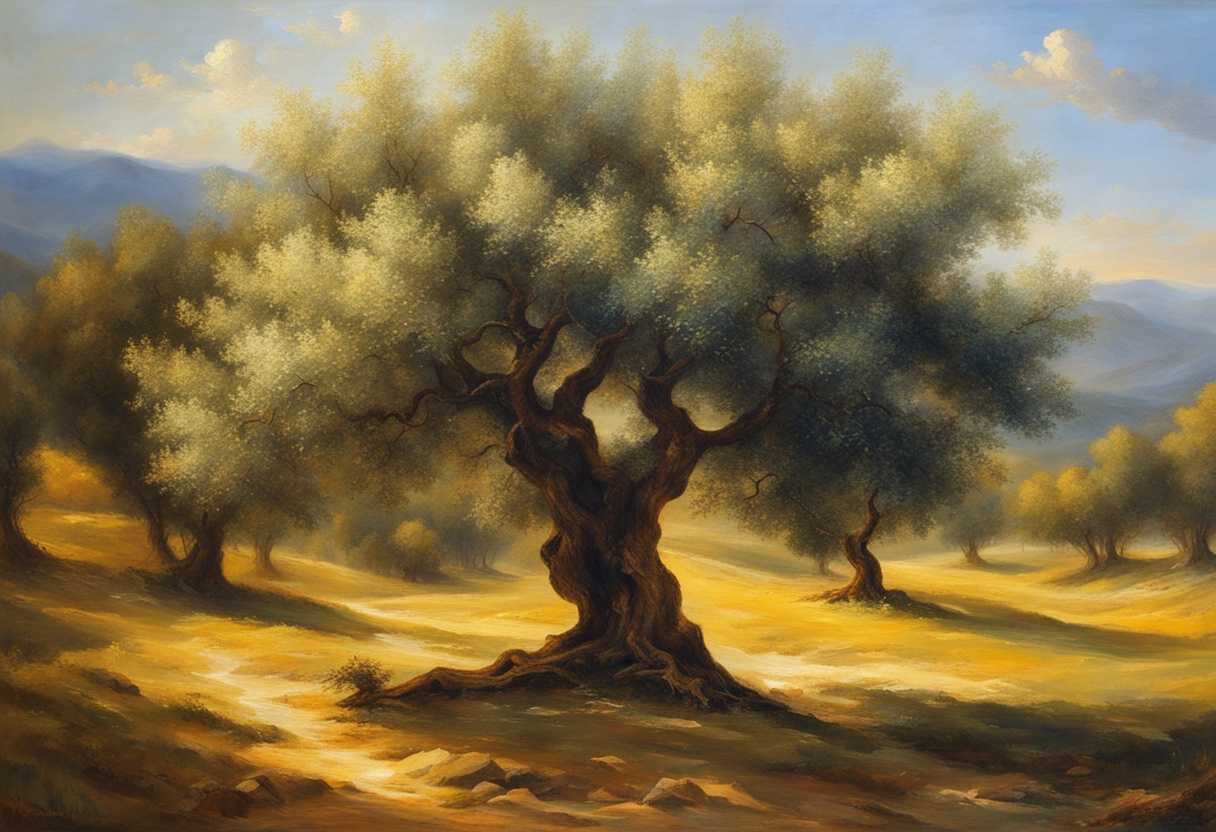
While the name Olivia itself does not originate from Hebrew, its Latin root “oliva,” which means “olive,” evokes profound biblical symbolism associated with the olive tree in scripture. The olive tree is often regarded as a powerful symbol of peace and reconciliation, drawing upon the narrative of Noah in Genesis 8:11, where a dove returns to the ark with an olive leaf, signaling God’s renewed promise to humanity. This imagery of the olive tree as a bearer of peace and hope resonates throughout the Bible, particularly in Psalm 52:8, where the psalmist declares, “But I am like an olive tree flourishing in the house of God; I trust in God’s unfailing love forever and ever.” This verse illustrates the idea that those who are rooted in faith can experience prosperity and assurance.
Furthermore, in Romans 11:17-24, the Apostle Paul uses the olive tree metaphorically to describe God’s covenant with Israel and the inclusion of Gentiles into His divine plan. He speaks of branches being broken off and others grafted in, highlighting the dynamic aspect of God’s relationship with His people. The olive tree symbolizes not only sustenance and prosperity but also community and the interconnectedness of believers. Thus, when considering the broader biblical implications of the name Olivia through its association with the olive tree, it embodies themes of divine blessing, peace, reconciliation, and the nurturing presence of God in the lives of His people.
While the name Olivia may not have direct Hebrew origins, it nonetheless resonates deeply within the context of biblical symbolism, particularly when viewed through the lens of the olive tree’s significance in both ancient cultures and scripture. In Hebrew, the word for olive is “זית” (zayit), a term that signifies not just the fruit itself, but also the tree that has long stood as a symbol of endurance and vitality. The olive tree’s resilience is echoed in the metaphor of a flourishing life, drawing parallels to the tenacity of faith amidst trials, a theme often articulated in the Psalms where the steadfastness of those who trust in God is emphasized.
Moreover, the olive tree’s association with anointing is particularly noteworthy. In ancient Israel, olive oil was used for anointing kings, priests, and sacred objects, marking them as holy and set apart for God’s purpose. This act of anointing reflects a deeper theological significance, emphasizing divine selection and empowerment found throughout scripture. For instance, the anointing of David, which established his kingship, symbolizes God’s approval and the impartation of the Holy Spirit for leadership. In this light, Olivia can be viewed as a name that encapsulates themes of sanctity, divine favor, and the empowerment to fulfill one’s purpose in alignment with God’s will, further enriching its connection to the rich tapestry of biblical tradition and meaning.
Symbol of Peace and Prosperity
In Hebrew, the name Olivia is often associated with the olive tree, which symbolizes peace and prosperity. The olive tree has deep roots in biblical tradition, representing abundance and the blessings of God. This connection highlights the importance of peace in human relationships and the divine favor that comes with living in harmony.
Connection to the Land
The olive tree is also emblematic of the land of Israel, where it has been cultivated for thousands of years. This connection signifies a deep relationship with the land, reflecting themes of heritage, identity, and the nurturing aspects of nature. In a broader sense, it represents the idea of being grounded and rooted in one’s faith and community.
Spiritual Resilience
Furthermore, the olive tree is known for its resilience and ability to thrive in harsh conditions. This aspect of Olivia can be interpreted as a symbol of spiritual strength and endurance. In biblical contexts, it serves as a reminder of the importance of perseverance in faith, even in the face of adversity, and the ability to bear fruit despite challenges.
How to Embrace Biblical Values for a Fulfilling Faith
Embracing biblical values is a transformative journey that can deeply enrich your faith and daily life. Start by immersing yourself in Scripture, allowing the teachings of Jesus and the wisdom of the Old Testament to guide your thoughts and actions. Reflect on the core values of love, compassion, humility, and forgiveness—these are not just ideals but practical ways to interact with the world around you. Consider how you can embody these values in your relationships, whether it’s through acts of kindness, offering a listening ear, or extending grace to those who may have wronged you. Remember, it’s not about perfection but progress; each small step you take towards living out these values brings you closer to a fulfilling faith. Surround yourself with a community that encourages you to grow, and don’t hesitate to seek guidance through prayer and fellowship. In doing so, you’ll find that embracing biblical values not only strengthens your relationship with God but also brings a profound sense of purpose and joy to your life.
Bible References to the Name Olivia:
Psalm 52:8-9: 8 But I am like a green olive tree in the house of God. I trust in the steadfast love of God forever and ever.
9 I will thank you forever, because you have done it. I will wait for your name, for it is good, in the presence of the godly.
Zechariah 4:1-14: 1 And the angel who talked with me came again and woke me, like a man who is awakened out of his sleep.
2 And he said to me, “What do you see?” I said, “I see, and behold, a lampstand all of gold, with a bowl on the top of it, and seven lamps on it, with seven lips on each of the lamps that are on the top of it.
3 And there are two olive trees by it, one on the right of the bowl and the other on its left.”
4 Then I said to the angel who talked with me, “What are these, my lord?”
5 Then the angel who talked with me answered and said to me, “Do you not know what these are?” And I said, “No, my lord.”
6 Then he said to me, “This is the word of the Lord to Zerubbabel: Not by might, nor by power, but by my Spirit, says the Lord of hosts.
7 Who are you, O great mountain? Before Zerubbabel you shall become a plain. And he shall bring forward the top stone amid shouts of ‘Grace, grace to it!’”
4 Then the word of the Lord came to me, saying:
9 “The hands of Zerubbabel have laid the foundation of this house; his hands shall also complete it. Then you will know that the Lord of hosts has sent me to you.”
10 For whoever has despised the day of small things shall rejoice, and shall see the plumb line in the hand of Zerubbabel.
4 Then I said to him, “What are these two olive trees on the right and the left of the lampstand?”
12 And I said to him, “What are these two olive branches that are beside the two golden pipes from which the golden oil is poured out?”
13 He said to me, “Do you not know what these are?” I said, “No, my lord.”
14 Then he said, “These are the two anointed ones who stand by the Lord of the whole earth.”
Romans 11:16-24: 16 If the dough offered as firstfruits is holy, so is the whole lump, and if the root is holy, so are the branches.
11 But if some of the branches were broken off, and you, although a wild olive shoot, were grafted in among the others and now share in the nourishing root of the olive tree,
18 do not be arrogant toward the branches. If you are, remember it is not you who support the root, but the root that supports you.
19 Then you will say, “Branches were broken off so that I might be grafted in.”
20 That is true. They were broken off because of their unbelief, but you stand fast through faith. So do not become proud, but fear.
21 For if God did not spare the natural branches, neither will he spare you.
22 Note then the kindness and the severity of God: severity toward those who have fallen, but God’s kindness to you, provided you continue in his kindness. Otherwise you too will be cut off.
11 And even they, if they do not continue in their unbelief, will be grafted in, for God has the power to graft them in again.
24 For if you were cut from what is by nature a wild olive tree, and grafted, contrary to nature, into a cultivated olive tree, how much more will these, the natural branches, be grafted back into their own olive tree.
John 15:1-8: 1 “I am the true vine, and my Father is the vinedresser.”
2 Every branch in me that does not bear fruit he takes away, and every branch that does bear fruit he prunes, that it may bear more fruit.
3 Already you are clean because of the word that I have spoken to you.
4 Abide in me, and I in you. As the branch cannot bear fruit by itself, unless it abides in the vine, neither can you, unless you abide in me.
5 I am the vine; you are the branches. Whoever abides in me and I in him, he it is that bears much fruit, for apart from me you can do nothing.
6 If anyone does not abide in me he is thrown away like a branch and withers; and the branches are gathered, thrown into the fire, and burned.
7 If you abide in me, and my words abide in you, ask whatever you wish, and it will be done for you.
8 By this my Father is glorified, that you bear much fruit and so prove to be my disciples.
Isaiah 24:13-15: 13 For thus it shall be in the midst of the earth among the nations, as when an olive tree is beaten, as at the gleaning when the grape harvest is done.
14 They lift up their voices, they sing for joy; over the majesty of the Lord they shout from the west.
15 Therefore in the east give glory to the Lord; in the coastlands of the sea, give glory to the name of the Lord, the God of Israel.
Jeremiah 11:16-17: 16 The Lord once called you ‘a green olive tree, beautiful with good fruit.’ But with the roar of a great tempest he will set fire to it, and its branches will be consumed.
17 The Lord of hosts, who planted you, has decreed disaster against you, because of the evil that the house of Israel and the house of Judah have done, provoking me to anger by making offerings to Baal.
Hosea 14:4-6: 4 I will heal their apostasy; I will love them freely, for my anger has turned from them.
5 I will be like the dew to Israel;
he shall blossom like the lily;
he shall take root like the trees of Lebanon;
6 his shoots shall spread out;
his beauty shall be like the olive,
and his fragrance like Lebanon.
Psalm 128:1-4: 1 Blessed is everyone who fears the Lord, who walks in his ways!
2 For you shall eat the fruit of the labor of your hands; you shall be blessed, and it shall be well with you.
3 Your wife will be like a fruitful vine within your house; your children will be like olive shoots around your table.
4 Behold, thus shall the man be blessed who fears the Lord.
1 Kings 6:23-28: 23 In the inner sanctuary he made two cherubim of olivewood, each ten cubits high.
24 And five cubits was the length of the wings of the cherubim.
25 The doors for the most holy place were made of olive wood; the lintel and the doorposts were five-sided.
26 The height of the one cherub was ten cubits, and so was that of the other cherub.
27 He put the cherubim in the innermost part of the house. And the wings of the cherubim were spread out so that a wing of one touched the one wall, and a wing of the other cherub touched the other wall; their other wings touched each other in the middle of the house.
28 And he overlaid the cherubim with gold.
Nehemiah 8:15-18: 15 and that they should proclaim it and publish it in all their towns and in Jerusalem, “Go out to the hills and bring branches of olive, wild olive, myrtle, palm, and other leafy trees to make booths, as it is written.”
16 So the people went out and brought them and made booths for themselves, each on his roof, and in their courts and in the courts of the house of God, and in the square at the Water Gate and in the square at the Gate of Ephraim.
17 And all the assembly of those who had returned from the captivity made booths and lived in the booths, for from the days of Jeshua the son of Nun to that day the people of Israel had not done so. And there was very great rejoicing.
18 And day by day, from the first day to the last day, he read from the Book of the Law of God. They kept the feast seven days, and on the eighth day there was a solemn assembly, according to the rule.
Judges 9:8-15: 8 The trees once went out to anoint a king over them, and they said to the olive tree, ‘Reign over us.’
9 But the olive tree said to them, ‘Shall I leave my abundance, by which gods and men are honored, and go hold sway over the trees?’
10 And the trees said to the fig tree, ‘You come and reign over us.’
11 But the fig tree said to them, ‘Shall I leave my sweetness and my good fruit and go hold sway over the trees?’
12 And the trees said to the vine, ‘You come and reign over us.’
13 “But the vine said to them, ‘Shall I leave my wine that cheers God and men and go hold sway over the trees?’”
14 Then all the trees said to the bramble, ‘You come and reign over us.’
15 And the bramble said to the trees, ‘If in good faith you are anointing me king over you, then come and take refuge in my shade, but if not, let fire come out of the bramble and devour the cedars of Lebanon.’

Reverend Michael Johnson is an experienced Church Minister with a profound expertise in spirituality and guidance. With a serene presence and a compassionate heart, he has faithfully served his congregation for over 20 years, leading them on a spiritual journey towards inner peace and enlightenment. Reverend Johnson’s extensive knowledge of religious philosophies and profound understanding of human nature have made him a trusted confidant and mentor to many, as he seamlessly weaves his profound wisdom into life teachings. Reverend Johnson’s calming demeanor and empathetic nature continue to uplift and heal souls, nurturing a sense of unity and tranquility within his community.