
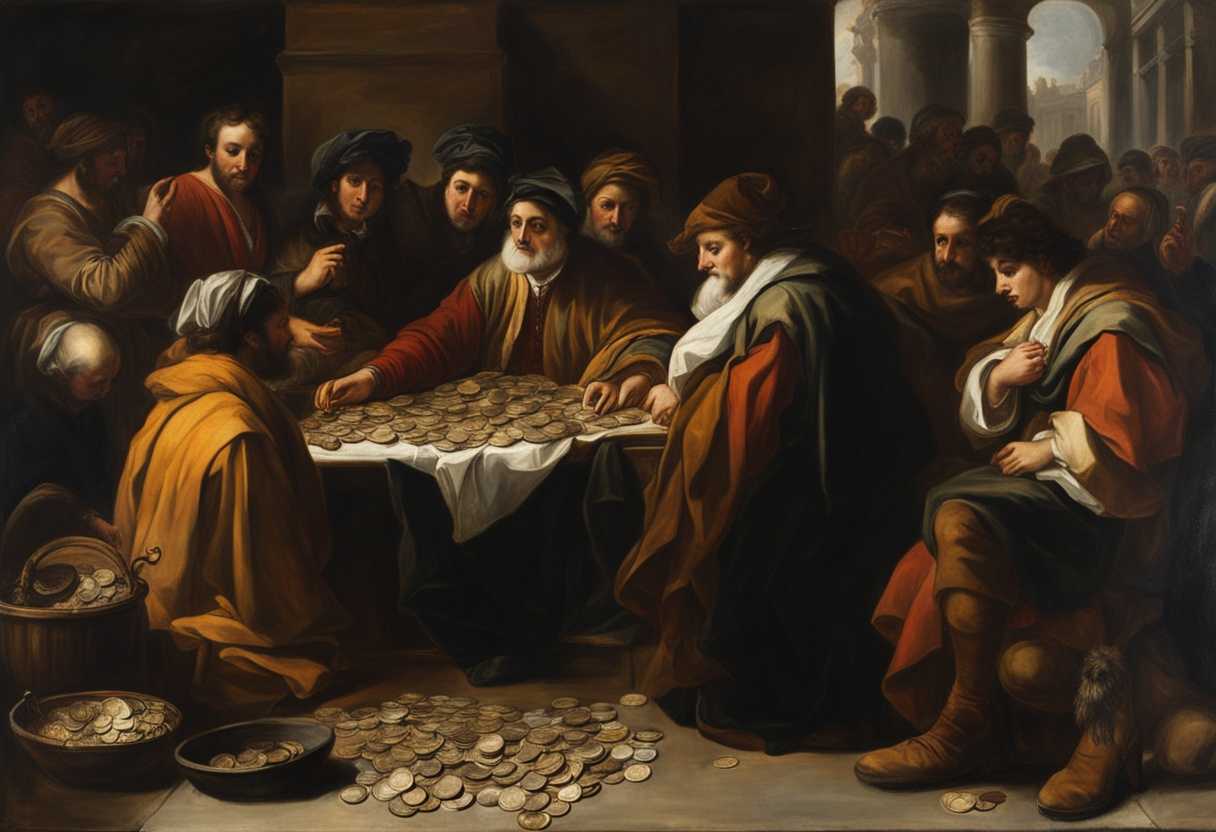
In the King James Version (KJV) Bible, a “publican” refers to a tax collector, often associated with dishonesty and extortion, as they collected taxes for the Roman authorities from the Jewish people (Luke 18:10-14). Publicans were typically viewed with contempt by the society of the time.
Scripture
9 As Jesus passed on from there, he saw a man called Matthew sitting at the tax booth, and he said to him, “Follow me.” And he rose and followed him.
10 And as Jesus reclined at table in the house, behold, many tax collectors and sinners came and were reclining with Jesus and his disciples.
11 And when the Pharisees saw this, they said to his disciples, “Why does your teacher eat with tax collectors and sinners?”
12 But when he heard it, he said, “Those who are well have no need of a physician, but those who are sick.
13 Go and learn what this means: ‘I desire mercy, and not sacrifice.’ For I came not to call the righteous, but sinners.”
Meaning of Publican in the KJV Bible
The concept of a publican in the KJV Bible extends beyond mere taxation; it epitomizes the social and spiritual marginalized of Jesus’ time. Publicans, such as Levi (Matthew) in Luke 5:27-29, were often Jews who collaborated with the Roman regime, making them objects of disdain among their fellow Jews. In Luke 18:10-14, Jesus tells the parable of the Pharisee and the publican, highlighting the stark contrast between the self-righteousness of the Pharisee and the humility of the publican, who repents and seeks mercy from God. This parable emphasizes that societal status does not dictate one’s relationship with God; rather, it is the heart’s posture that matters, underscoring themes of repentance and grace.
Furthermore, the portrayals of publicans emphasize Jesus’ mission to seek and save the lost. In Luke 19:1-10, we encounter Zacchaeus, a chief publican, whose encounter with Jesus leads to profound transformation and repentance. Jesus’ willingness to associate with publicans serves to illustrate the inclusive nature of God’s love and the radical grace available to all, regardless of their past actions or societal standing. Thus, the publican symbolizes not only societal rejection but also the hope of redemption and the transformative power of humility before God, as evidenced in the ultimate message of salvation that transcends earthly judgment.
In the KJV Bible, the term “publican” signifies more than just a tax collector; it reflects the moral and spiritual struggles of individuals who occupied a contentious space in their communities. Publicans were often viewed as traitors, exploiting their fellow Jews for personal gain, which placed them at the fringes of society. This estrangement is poignantly illustrated throughout the New Testament, where publicans are depicted as those who may be despised by the elite but are nonetheless capable of recognizing their need for redemption. Their representation in scripture highlights the broader theme of God’s grace extending to those labeled as outcasts and sinners.
The societal implications of being a publican also inform Jesus’ teaching approach; He often used their experiences to drive home critical lessons about humility and repentance. In contrast to the Pharisees, who were celebrated for their adherence to the Law, publicans illustrate the essentiality of acknowledging one’s faults and the need for divine mercy. Through interactions and parables involving publicans, Jesus challenges conventional wisdom and societal hierarchies, illustrating that true righteousness stems from an authentic relationship with God rather than mere adherence to rules. This radical inclusion offers profound insight into the nature of God’s kingdom, inviting all, irrespective of their past actions, to experience His transformative love and mercy.
The Role of Publicans in Society
Publicans in the KJV Bible were tax collectors, often viewed with disdain by the general populace. They were typically associated with the Roman authorities and were known for their corrupt practices, such as overcharging taxes and pocketing the excess. This role placed them in a position of moral ambiguity, as they were seen as traitors to their own people, collaborating with the occupying forces. The societal perception of publicans highlights themes of betrayal and the complexities of authority in biblical times.
Symbol of Redemption and Transformation
Despite their negative connotations, publicans also serve as powerful symbols of redemption in the biblical narrative. The stories of publicans illustrate that no one is beyond the reach of grace and forgiveness. Their encounters with Jesus demonstrate that even those who are marginalized and despised can experience transformation and acceptance. This broader meaning emphasizes the inclusive nature of Christ’s message and the potential for personal change, regardless of one’s past actions or societal status.
Contrast with Pharisees
Publicans are often contrasted with Pharisees in the biblical texts, representing two different approaches to faith and righteousness. While Pharisees adhered strictly to the law and were seen as pious, publicans embodied a more humble and repentant spirit. This contrast serves to challenge the notion of self-righteousness and highlights the importance of humility in one’s relationship with God. The depiction of publicans invites readers to reflect on their own spiritual journeys and the value of recognizing one’s shortcomings.
How to Embrace Grace and Compassion in Your Faith
Embracing grace and compassion in your faith journey is truly transformative, and it begins with recognizing that we are all imperfect beings in need of God’s love. Take a moment each day to reflect on the grace you’ve received—think of the times you’ve stumbled and yet found forgiveness, and let that inspire you to extend the same kindness to others. When you encounter someone in need, whether it’s a friend struggling with a burden or a stranger facing hardship, approach them with an open heart and a willingness to listen. Remember, compassion isn’t just about feeling sorry for someone; it’s about taking action to alleviate their suffering. As you practice grace and compassion, you’ll find that your faith deepens, and you become a living testament to the love of Christ in a world that desperately needs it. So, let’s commit to being vessels of grace, allowing God’s love to flow through us to those around us.
Bible References to Publicans in KJV:
Matthew 18:15-17: 15 “If your brother sins against you, go and tell him his fault, between you and him alone. If he listens to you, you have gained your brother.”
16 But if he does not listen, take one or two others along with you, that every charge may be established by the evidence of two or three witnesses.
17 If he refuses to listen to them, tell it to the church. And if he refuses to listen even to the church, let him be to you as a Gentile and a tax collector.
Luke 18:9-14: 9 He also told this parable to some who trusted in themselves that they were righteous, and treated others with contempt:
10 “Two men went up into the temple to pray, one a Pharisee and the other a tax collector.”
11 The Pharisee, standing by himself, prayed thus: ‘God, I thank you that I am not like other men, extortioners, unjust, adulterers, or even like this tax collector.
12 I fast twice a week; I give tithes of all that I get.’
13 But the tax collector, standing far off, would not even lift up his eyes to heaven, but beat his breast, saying, ‘God, be merciful to me, a sinner!’
14 I tell you, this man went down to his house justified, rather than the other. For everyone who exalts himself will be humbled, but the one who humbles himself will be exalted.”
Luke 19:1-10: 10 For the Son of Man came to seek and to save the lost.
2 And behold, there was a man named Zacchaeus. He was a chief tax collector and was rich.
3 And he was seeking to see who Jesus was, but on account of the crowd he could not, because he was small in stature.
4 So he ran on ahead and climbed up into a sycamore tree to see him, for he was about to pass that way.
5 And when Jesus came to the place, he looked up and said to him, “Zacchaeus, hurry and come down, for I must stay at your house today.”
6 So he hurried and came down and received him joyfully.
7 And when they saw it, they all grumbled, “He has gone in to be the guest of a man who is a sinner.”
8 And Zacchaeus stood and said to the Lord, “Behold, Lord, the half of my goods I give to the poor. And if I have defrauded anyone of anything, I restore it fourfold.”
10 For the Son of Man came to seek and to save the lost.
10 For the Son of Man came to seek and to save the lost.
Mark 2:13-17: 13 He went out again beside the sea, and all the crowd was coming to him, and he was teaching them.
14 And as he passed by, he saw Levi the son of Alphaeus sitting at the tax booth, and he said to him, “Follow me.” And he rose and followed him.
15 And as he reclined at table in his house, many tax collectors and sinners were reclining with Jesus and his disciples, for there were many who followed him.
16 And the scribes of the Pharisees, when they saw that he was eating with sinners and tax collectors, said to his disciples, “Why does he eat with tax collectors and sinners?”
17 And when Jesus heard it, he said to them, “Those who are well have no need of a physician, but those who are sick. I came not to call the righteous, but sinners.”
Matthew 21:28-32: 28 “What do you think? A man had two sons. And he went to the first and said, ‘Son, go and work in the vineyard today.’
29 And he answered, ‘I will not,’ but afterward he changed his mind and went.
30 And he went to the other son and said the same. And he answered, ‘I go, sir,’ but did not go.
31 Which of the two did the will of his father?” They said, “The first.” Jesus said to them, “Truly, I say to you, the tax collectors and the prostitutes go into the kingdom of God before you.
32 For John came to you in the way of righteousness, and you did not believe him, but the tax collectors and the prostitutes believed him. And even when you saw it, you did not afterward change your minds and believe him.
Luke 5:27-32: 27 After this he went out and saw a tax collector named Levi, sitting at the tax booth. And he said to him, “Follow me.”
28 And he left everything, and rose and followed him.
29 And Levi made him a great feast in his house, and there was a large company of tax collectors and others reclining at table with them.
30 And the Pharisees and their scribes grumbled at his disciples, saying, “Why do you eat and drink with tax collectors and sinners?”
31 And Jesus answered them, “Those who are well have no need of a physician, but those who are sick.
32 I have not come to call the righteous but sinners to repentance.
Matthew 5:46-48: 46 For if you love those who love you, what reward do you have? Do not even the tax collectors do the same?
47 And if you greet only your brothers, what more are you doing than others? Do not even the Gentiles do the same?
48 You therefore must be perfect, as your heavenly Father is perfect.
Luke 7:29-35: 29 (When all the people heard this, and the tax collectors too, they declared God just, having been baptized with the baptism of John,).
30 but the Pharisees and the lawyers rejected the purpose of God for themselves, not having been baptized by him.
31 “To what then shall I compare the people of this generation, and what are they like?
32 They are like children sitting in the marketplace and calling to one another, “We played the flute for you, and you did not dance; we sang a dirge, and you did not weep.”
33 For John the Baptist has come eating no bread and drinking no wine, and you say, ‘He has a demon.’
34 The Son of Man has come eating and drinking, and you say, ‘Look at him! A glutton and a drunkard, a friend of tax collectors and sinners!’
35 Yet wisdom is justified by all her children.
Matthew 11:16-19: 16 “But to what shall I compare this generation? It is like children sitting in the marketplaces and calling to their playmates,”
17 “‘We played the flute for you, and you did not dance; we sang a dirge, and you did not mourn.’
18 For John came neither eating nor drinking, and they say, ‘He has a demon.’
19 The Son of Man came eating and drinking, and they say, ‘Look at him! A glutton and a drunkard, a friend of tax collectors and sinners!’ Yet wisdom is justified by her deeds.”

Reverend Michael Johnson is an experienced Church Minister with a profound expertise in spirituality and guidance. With a serene presence and a compassionate heart, he has faithfully served his congregation for over 20 years, leading them on a spiritual journey towards inner peace and enlightenment. Reverend Johnson’s extensive knowledge of religious philosophies and profound understanding of human nature have made him a trusted confidant and mentor to many, as he seamlessly weaves his profound wisdom into life teachings. Reverend Johnson’s calming demeanor and empathetic nature continue to uplift and heal souls, nurturing a sense of unity and tranquility within his community.