
In the Bible, “Paulus” is the Latin name of the Apostle Paul, who was originally known as Saul of Tarsus. He is a key figure in the New Testament, known for his missionary journeys and theological writings that significantly shaped early Christianity.
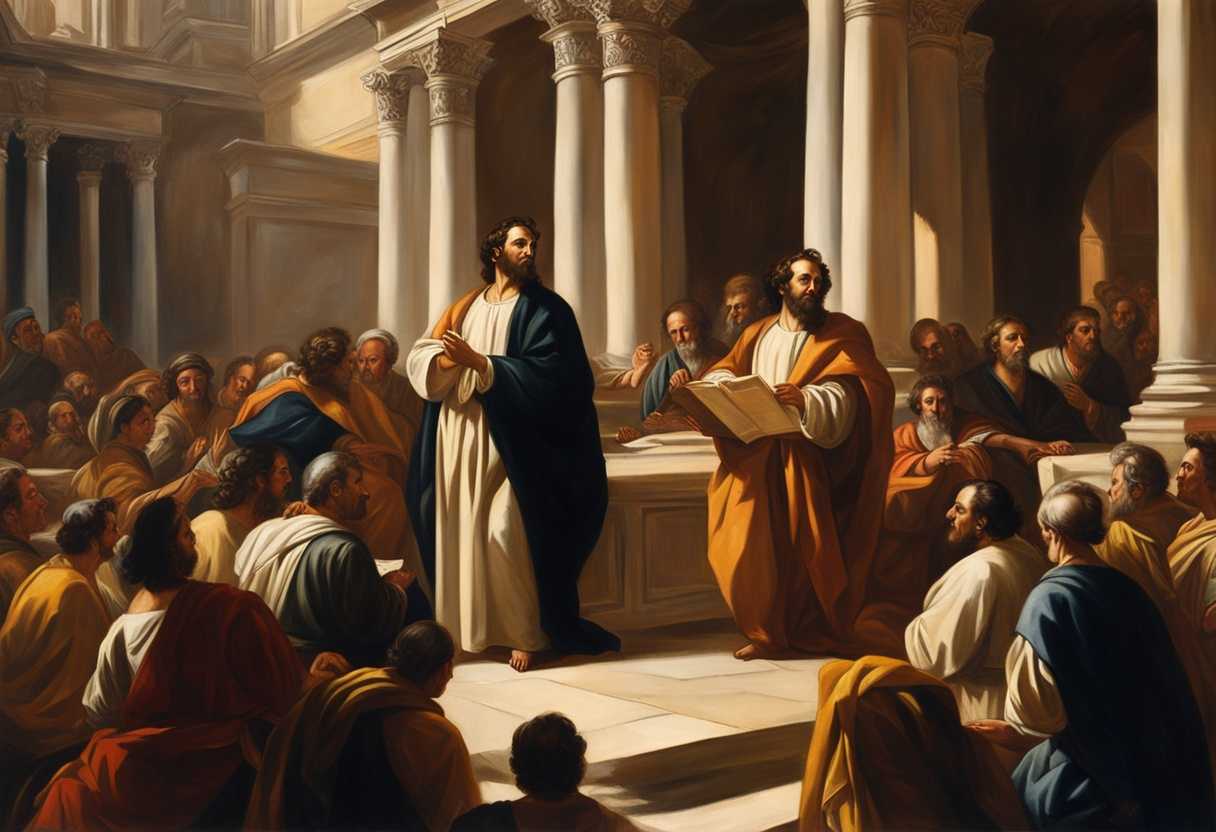
Scripture
1 But Saul, still breathing threats and murder against the disciples of the Lord, went to the high priest
2 and asked him for letters to the synagogues at Damascus, so that if he found any belonging to the Way, men or women, he might bring them bound to Jerusalem.
3 Now as he went on his way, he approached Damascus, and suddenly a light from heaven shone around him.
4 And falling to the ground, he heard a voice saying to him, “Saul, Saul, why are you persecuting me?”
5 And he said, “Who are you, Lord?” And he said, “I am Jesus, whom you are persecuting.
6 But rise and enter the city, and you will be told what you are to do.”
7 The men who were traveling with him stood speechless, hearing the voice but seeing no one.
8 Saul rose from the ground, and although his eyes were opened, he saw nothing. So they led him by the hand and brought him into Damascus.
9 And for three days he was without sight, and neither ate nor drank.
10 Now there was a disciple at Damascus named Ananias. The Lord said to him in a vision, “Ananias.” And he said, “Here I am, Lord.”
11 And the Lord said to him, “Rise and go to the street called Straight, and at the house of Judas look for a man of Tarsus named Saul, for behold, he is praying,
12 and he has seen in a vision a man named Ananias come in and lay his hands on him so that he might regain his sight.”
13 But Ananias answered, “Lord, I have heard from many about this man, how much evil he has done to your saints in Jerusalem.
14 And here he has authority from the chief priests to bind all who call on your name.”
15 But the Lord said to him, “Go, for he is a chosen instrument of mine to carry my name before the Gentiles and kings and the children of Israel.
16 For I will show him how much he must suffer for the sake of my name.
17 So Ananias departed and entered the house. And laying his hands on him he said, “Brother Saul, the Lord Jesus who appeared to you on the road by which you came has sent me so that you may regain your sight and be filled with the Holy Spirit.”
18 And immediately something like scales fell from his eyes, and he regained his sight. Then he rose and was baptized.
19 and taking food, he was strengthened.
Meaning of Paulus in the Bible
The broader meaning of Paulus, or the Apostle Paul, in the Bible represents the transformative power of faith and the inclusive nature of the Gospel. Initially a fervent persecutor of Christians, Saul experienced a profound conversion on the road to Damascus, where he encountered the risen Christ (Acts 9:1-19). This pivotal moment underscores a central theme of Christian theology: redemption and the capacity for personal transformation. Paul’s letters, particularly to the Galatians (Galatians 2:20) and the Romans (Romans 1:16), articulate the essence of faith in Christ as the means by which believers are justified and brought into relationship with God—a radical departure from the law-centric Judaism of his time.
Moreover, Paul’s ministry exemplifies the call to spread the message of Jesus beyond cultural and ethnic boundaries. His teachings emphasize that “there is neither Jew nor Gentile, neither slave nor free, nor is there male and female, for you are all one in Christ Jesus” (Galatians 3:28). This inclusivity highlights the universal nature of the Christian message and echoes the Great Commission (Matthew 28:19), where Jesus commands his followers to make disciples of all nations. Thus, Paulus not only symbolizes the potential for individual change but also the mission of the Church to reach out and embrace all of humanity, fostering unity and grace through faith in Christ.
In addition to his transformative personal journey, Paulus embodies the profound theological implications of grace and the role of faith in the life of a believer. His epistles delve deeply into the concept of salvation not as a result of human effort but as a divine gift—this is particularly evident in his exhortations regarding the nature of grace in letters such as Ephesians and Corinthians. Here, Paul underscores that it is through Christ’s atoning sacrifice that individuals receive unmerited favor, which inherently disrupts traditional notions of meritocracy prevalent in both Roman and Jewish contexts. This doctrine of grace not only shapes individual believers but also lays the groundwork for establishing communities that reflect God’s love and forgiveness.
Paul’s outreach to various communities further reflects his understanding of the Church as a body made up of diverse members united in Christ. His letters often address specific issues faced by different congregations, highlighting the importance of maintaining unity and harmony despite cultural differences or doctrinal disputes. The metaphor of the Church as the Body of Christ, found in 1 Corinthians, encapsulates this vision, illustrating how every believer, regardless of their background or status, plays a vital role in the overall function and health of the Christian community. Thus, Paulus’s teachings encourage believers to embrace their unique contributions while fostering a spirit of cooperation and love, ultimately culminating in the larger mission of witnessing to the transformative power of the Gospel in a fractured world.
Transformation and Redemption
The name Paulus, or Paul, signifies a profound transformation and redemption narrative within the biblical context. Originally known as Saul, he was a fervent persecutor of Christians before experiencing a dramatic conversion on the road to Damascus. This change from a zealous adversary of the faith to one of its most ardent advocates illustrates the theme of redemption that permeates the New Testament. Paul’s life serves as a testament to the belief that no one is beyond the reach of God’s grace, emphasizing the transformative power of faith.
Mission and Evangelism
Paulus also embodies the spirit of mission and evangelism in the early Christian church. As an apostle, he undertook extensive missionary journeys, spreading the message of Jesus Christ to both Jews and Gentiles. His letters, which form a significant portion of the New Testament, address various communities and issues, providing theological insights and practical guidance. This aspect of Paulus highlights the importance of outreach and the universal call to share the gospel, reflecting the early church’s commitment to expanding its reach beyond cultural and geographical boundaries.
Unity and Inclusivity
Another broader meaning of Paulus in the Bible relates to the themes of unity and inclusivity within the Christian community. Paul’s teachings often emphasized the breaking down of barriers between different groups, advocating for a faith that transcends ethnic, social, and gender divisions. His writings encourage believers to embrace diversity within the body of Christ, promoting a vision of unity that reflects the inclusive nature of the gospel. This aspect of Paulus underscores the call for Christians to foster a sense of belonging and acceptance among all believers, regardless of their backgrounds.
How to Embrace Apostolic Mission for Spiritual Growth
Embracing the apostolic mission is a transformative journey that invites us to step beyond our comfort zones and actively engage with the world around us. As you seek to grow spiritually, consider how the early apostles lived out their faith with boldness and purpose, sharing the message of Christ through their actions and words. Start by cultivating a heart of service—look for opportunities to help those in need, whether through your local church or community initiatives. Prayer is essential; ask God to guide you in your mission and to open your eyes to the needs of others. Remember, it’s not just about preaching but also about living out the love of Christ in everyday interactions. As you take these steps, you’ll find that your faith deepens, your understanding of God’s love expands, and you become a beacon of hope and grace in a world that desperately needs it. Embrace this mission with joy, knowing that every small act of kindness can ripple out to create significant change.
Bible References to the Meaning of Paulus:
Acts 13:1-12: Now there were in the church at Antioch prophets and teachers, Barnabas, Simeon who was called Niger, Lucius of Cyrene, Manaen a lifelong friend of Herod the tetrarch, and Saul.
2 While they were worshiping the Lord and fasting, the Holy Spirit said, “Set apart for me Barnabas and Saul for the work to which I have called them.”
3 Then after fasting and praying they laid their hands on them and sent them off.
4 So, being sent out by the Holy Spirit, they went down to Seleucia, and from there they sailed to Cyprus.
5 When they arrived at Salamis, they proclaimed the word of God in the synagogues of the Jews. And they had John to assist them.
6 When they had gone through the whole island as far as Paphos, they came upon a certain magician, a Jewish false prophet named Bar-Jesus.
7 He was with the proconsul, Sergius Paulus, a man of intelligence, who summoned Barnabas and Saul and sought to hear the word of God.
8 But Elymas the magician (for that is the meaning of his name) opposed them, seeking to turn the proconsul away from the faith.
9 But Saul, who was also called Paul, filled with the Holy Spirit, looked intently at him
10 and said, “You son of the devil, you enemy of all righteousness, full of all deceit and villainy, will you not stop making crooked the straight paths of the Lord?
11 And now, behold, the hand of the Lord is upon you, and you will be blind and unable to see the sun for a time.” So immediately mist and darkness fell upon him, and he went about seeking people to lead him by the hand.
12 Then the proconsul believed, when he saw what had occurred, for he was astonished at the teaching of the Lord.
Acts 22:3-21: 3 “I am a Jew, born in Tarsus in Cilicia, but brought up in this city, educated at the feet of Gamaliel according to the strict manner of the law of our fathers, being zealous for God as all of you are this day.
4 I persecuted this Way to the death, binding and delivering to prison both men and women,
5 As the high priest and the whole council of elders can bear me witness. From them I received letters to the brothers, and I journeyed toward Damascus to take those also who were there and bring them in bonds to Jerusalem to be punished.
6 “As I was on my way and drew near to Damascus, about noon a great light from heaven suddenly shone around me.
7 And I fell to the ground and heard a voice saying to me, ‘Saul, Saul, why are you persecuting me?’
8 And I answered, ‘Who are you, Lord?’ And he said to me, ‘I am Jesus of Nazareth, whom you are persecuting.’
9 Now those who were with me saw the light but did not understand the voice of the one who was speaking to me.
10 And I said, ‘What shall I do, Lord?’ And the Lord said to me, ‘Rise, and go into Damascus, and there you will be told all that is appointed for you to do.’
11 And since I could not see because of the brightness of that light, I was led by the hand by those who were with me, and came into Damascus.
And one Ananias, a devout man according to the law, well spoken of by all the Jews who lived there,
And when the blood of Stephen your witness was being shed, I myself was standing by and approving and watching over the garments of those who killed him.
And he said, ‘The God of our fathers appointed you to know his will, to see the Righteous One and to hear a voice from his mouth;
15 For you will be a witness for him to everyone of what you have seen and heard.
And now why do you wait? Rise and be baptized and wash away your sins, calling on his name.
When I had returned to Jerusalem and was praying in the temple, I fell into a trance.
And saw him saying to me, ‘Make haste and get out of Jerusalem quickly, because they will not accept your testimony about me.’
19 And I said, ‘Lord, they themselves know that in one synagogue after another I imprisoned and beat those who believed in you.
20 And when the blood of Stephen your witness was being shed, I myself was standing by and approving and watching over the garments of those who killed him.’
And he said to me, ‘Go, for I will send you far away to the Gentiles.’”
Acts 26:9-18: 9 “I myself was convinced that I ought to do many things in opposing the name of Jesus of Nazareth.
10 And I did so in Jerusalem. I not only locked up many of the saints in prison after receiving authority from the chief priests, but when they were put to death I cast my vote against them.
11 And I punished them often in all the synagogues and tried to make them blaspheme, and in raging fury against them I persecuted them even to foreign cities.
12 “In this connection I journeyed to Damascus with the authority and commission of the chief priests.”
13 At midday, O king, I saw on the way a light from heaven, brighter than the sun, that shone around me and those who journeyed with me.
And when we had all fallen to the ground, I heard a voice saying to me in the Hebrew language, ‘Saul, Saul, why are you persecuting me? It is hard for you to kick against the goads.’
15 And I said, ‘Who are you, Lord?’ And the Lord said, ‘I am Jesus whom you are persecuting.
16 But rise and stand upon your feet, for I have appeared to you for this purpose, to appoint you as a servant and witness to the things in which you have seen me and to those in which I will appear to you,
17 delivering you from your people and from the Gentiles—to whom I am sending you to open their eyes, so that they may turn from darkness to light and from the power of Satan to God, that they may receive forgiveness of sins and a place among those who are sanctified by faith in me.’
18 to open their eyes, so that they may turn from darkness to light and from the power of Satan to God, that they may receive forgiveness of sins and a place among those who are sanctified by faith in me.’
Romans 1:1-17: 1 Paul, a servant of Christ Jesus, called to be an apostle, set apart for the gospel of God,
2 which he promised beforehand through his prophets in the holy Scriptures,
3 concerning his Son, who was descended from David according to the flesh
4 and was declared to be the Son of God in power according to the Spirit of holiness by his resurrection from the dead, Jesus Christ our Lord,
5 through whom we have received grace and apostleship to bring about the obedience of faith for the sake of his name among all the nations,
6 including you who are called to belong to Jesus Christ,
7 To all those in Rome who are loved by God and called to be saints: Grace to you and peace from God our Father and the Lord Jesus Christ.
8 First, I thank my God through Jesus Christ for all of you, because your faith is proclaimed in all the world.
For God is my witness, whom I serve with my spirit in the gospel of his Son, that without ceasing I mention you always in my prayers,
10 always in my prayers, asking that somehow by God’s will I may now at last succeed in coming to you.
11 For I long to see you, that I may impart to you some spiritual gift to strengthen you—
12 that is, that we may be mutually encouraged by each other’s faith, both yours and mine.
I do not want you to be unaware, brothers, that I have often intended to come to you (but thus far have been prevented), in order that I may reap some harvest among you as well as among the rest of the Gentiles.
14 I am under obligation both to Greeks and to barbarians, both to the wise and to the foolish.
15 So I am eager to preach the gospel to you also who are in Rome.
16 For I am not ashamed of the gospel, for it is the power of God for salvation to everyone who believes, to the Jew first and also to the Greek.
17 For in it the righteousness of God is revealed from faith for faith, as it is written, “The righteous shall live by faith.”
1 Corinthians 1:1-17: 1 Paul, called by the will of God to be an apostle of Christ Jesus, and our brother Sosthenes,
2 To the church of God that is in Corinth, to those sanctified in Christ Jesus, called to be saints together with all those who in every place call upon the name of our Lord Jesus Christ, both their Lord and ours:
3 Grace to you and peace from God our Father and the Lord Jesus Christ.
4 I give thanks to my God always for you because of the grace of God that was given you in Christ Jesus,
5 that in every way you were enriched in him in all speech and all knowledge—
6 even as the testimony about Christ was confirmed among you—
7 so that you are not lacking in any gift, as you wait for the revealing of our Lord Jesus Christ,
8 who will sustain you to the end, guiltless in the day of our Lord Jesus Christ.
9 God is faithful, by whom you were called into the fellowship of his Son, Jesus Christ our Lord.
10 I appeal to you, brothers, by the name of our Lord Jesus Christ, that all of you agree, and that there be no divisions among you, but that you be united in the same mind and the same judgment.
11 For it has been reported to me by Chloe’s people that there is quarreling among you, my brothers.
12 What I mean is that each one of you says, “I follow Paul,” or “I follow Apollos,” or “I follow Cephas,” or “I follow Christ.”
13 Is Christ divided? Was Paul crucified for you? Or were you baptized in the name of Paul?
14 I thank God that I baptized none of you except Crispus and Gaius,
15 so that no one may say that you were baptized in my name.
16 (I did baptize also the household of Stephanas. Beyond that, I do not know whether I baptized anyone else.)
17 For Christ did not send me to baptize but to preach the gospel, and not with words of eloquent wisdom, lest the cross of Christ be emptied of its power.
2 Corinthians 11:16-33: 16 I repeat, let no one think me foolish. But even if you do, accept me as a fool, so that I too may boast a little.
17 What I am saying with this boastful confidence, I say not as the Lord would, but as a fool.
18 Since many boast according to the flesh, I too will boast.
19 For you gladly bear with fools, being wise yourselves.
20 For you bear it if someone makes slaves of you, or devours you, or takes advantage of you, or puts on airs, or strikes you in the face.
21 To my shame, I must say, we were too weak for that!
22 Are they Hebrews? So am I. Are they Israelites? So am I. Are they offspring of Abraham? So am I.
23 Are they servants of Christ? I am a better one—I am talking like a madman—with far greater labors, far more imprisonments, with countless beatings, and often near death.
24 Five times I received at the hands of the Jews the forty lashes less one.
25 Three times I was beaten with rods. Once I was stoned. Three times I was shipwrecked; a night and a day I was adrift at sea;
26 on frequent journeys, in danger from rivers, danger from robbers, danger from my own people, danger from Gentiles, danger in the city, danger in the wilderness, danger at sea, danger from false brothers;
27 in toil and hardship, through many a sleepless night, in hunger and thirst, often without food, in cold and exposure.
28 And, apart from other things, there is the daily pressure on me of my anxiety for all the churches.
29 Who is weak, and I am not weak? Who is made to fall, and I am not indignant?
30 If I must boast, I will boast of the things that show my weakness.
31 The God and Father of the Lord Jesus, he who is blessed forever, knows that I am not lying.
32 In Damascus, the governor under King Aretas was guarding the city of Damascus in order to seize me.
33 but I was let down in a basket through a window in the wall and escaped his hands.
Galatians 1:11-24: 11 For I would have you know, brothers, that the gospel that was preached by me is not man’s gospel.
12 For I did not receive it from any man, nor was I taught it, but I received it through a revelation of Jesus Christ.
For you have heard of my former life in Judaism, how I persecuted the church of God violently and tried to destroy it.
14 And I was advancing in Judaism beyond many of my own age among my people, so extremely zealous was I for the traditions of my fathers.
15 But when he who had set me apart before I was born, and who called me by his grace,
16 to reveal his Son in me so that I might preach him among the Gentiles, I did not immediately consult with anyone;
17 nor did I go up to Jerusalem to those who were apostles before me, but I went away into Arabia, and returned again to Damascus.
18 Then after three years I went up to Jerusalem to visit Cephas and remained with him fifteen days.
19 But I saw none of the other apostles except James the Lord’s brother.
20 (In what I am writing to you, before God, I do not lie!)
21 Then I went into the regions of Syria and Cilicia.
22 And I was still unknown in person to the churches of Judea that are in Christ.
23 They only were hearing it said, “He who used to persecute us is now preaching the faith he once tried to destroy.”
24 And they glorified God because of me.
Philippians 3:4-14: 4 though I myself have reason for confidence in the flesh also. If anyone else thinks he has reason for confidence in the flesh, I have more:
5 circumcised on the eighth day, of the people of Israel, of the tribe of Benjamin, a Hebrew of Hebrews; as to the law, a Pharisee;
6 as to zeal, a persecutor of the church; as to righteousness under the law, blameless.
7 But whatever gain I had, I counted as loss for the sake of Christ.
8 Indeed, I count everything as loss because of the surpassing worth of knowing Christ Jesus my Lord.
9 and be found in him, not having a righteousness of my own that comes from the law, but that which comes through faith in Christ, the righteousness from God that depends on faith—
10 that I may know him and the power of his resurrection, and may share his sufferings, becoming like him in his death,
11 that by any means possible I may attain the resurrection from the dead.
12 Not that I have already obtained this or am already perfect, but I press on to make it my own, because Christ Jesus has made me his own.
13 Brothers, I do not consider that I have made it my own. But one thing I do: forgetting what lies behind and straining forward to what lies ahead,
14 I press on toward the goal for the prize of the upward call of God in Christ Jesus.
1 Timothy 1:12-17: 12 I thank him who has given me strength, Christ Jesus our Lord, because he judged me faithful, appointing me to his service,
13 though formerly I was a blasphemer, persecutor, and insolent opponent. But I received mercy because I had acted ignorantly in unbelief.
14 and the grace of our Lord overflowed for me with the faith and love that are in Christ Jesus.
15 The saying is trustworthy and deserving of full acceptance, that Christ Jesus came into the world to save sinners, of whom I am the foremost.
16 But I received mercy for this reason, that in me, as the foremost, Jesus Christ might display his perfect patience as an example to those who were to believe in him for eternal life.
17 To the King of the ages, immortal, invisible, the only God, be honor and glory forever and ever. Amen.

Reverend Ogunlade is a seasoned Church Minister with over three decades of experience in guiding and nurturing congregations. With profound wisdom and a serene approach, Reverend Ogunlade has carried out various pastoral duties, including delivering uplifting sermons, conducting religious ceremonies, and offering sage counsel to individuals seeking spiritual guidance. Their commitment to fostering harmony and righteousness within their community is exemplified through their compassionate nature, making them a beloved and trusted figure among the congregation.