
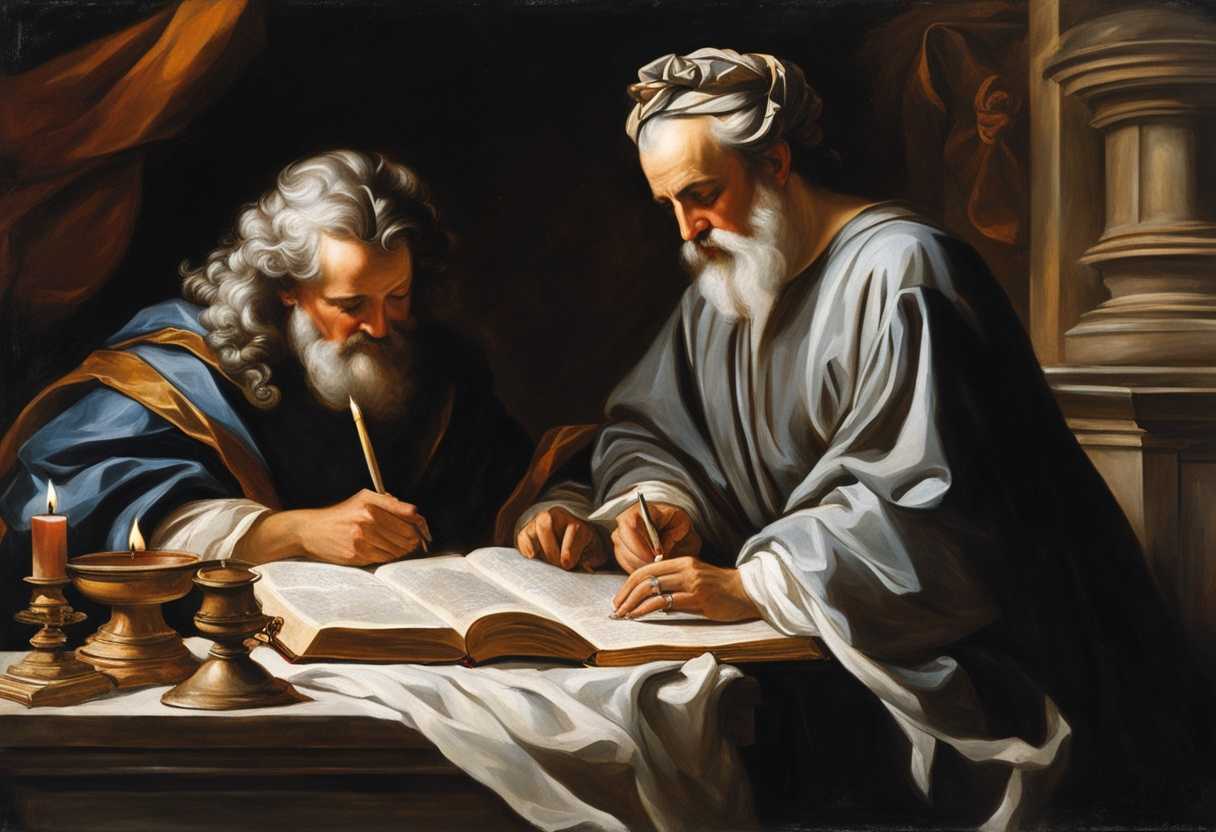
In the King James Version (KJV) of the Bible, “scribes” refer to individuals who were skilled in writing and interpreting the Law, often serving as teachers, legal experts, and clerks in ancient Israelite society. They played a significant role in preserving and transmitting Scripture, as well as in religious and legal matters (e.g., Ezra 7:6).
Scripture
28 And when Jesus finished these sayings, the crowds were astonished at his teaching,
29 for he was teaching them as one who had authority, and not as their scribes.
Meaning of “Scribes” in KJV Bible
In the King James Version (KJV) of the Bible, “scribes” emerged as pivotal figures in the religious and socio-political landscape of ancient Israel. Often associated with the Pharisees, these scribes were custodians of the Law, tasked with the meticulous writing, copying, and interpreting of the Scriptures (Ezra 7:6). Their authority stemmed from their expertise in the Mosaic Law and their ability to teach its principles to the populace, as seen in passages like Matthew 23:2-3, where Jesus acknowledges their position in teaching but criticizes their hypocritical practices. This dual role of the scribe as both a teacher and an enforcer rendered them influential, albeit contentious, figures in society.
The significance of scribes extends beyond mere administration; they represent a bridge between the ancient traditions of Israel and the evolving understanding of faith and practice. Their writings and interpretations shaped communal worship and legal practices, often embedding human tradition alongside divine law (Mark 7:7). Moreover, their interactions with Jesus highlight the tension between established religious authority and emerging theological insights. In the New Testament, scribes are depicted as opponents of Christ, challenging His authority and teachings (Luke 5:21). Thus, scribes embody both the preservation of sacred texts and the critique of rigid legalism, illustrating the dynamic interplay of law, grace, and the transformative nature of divine revelation throughout biblical history.
Scribes are further mentioned in various contexts throughout the Bible, where their roles and implications in society are explored more deeply. In the Gospels, they frequently appear as representatives of religious authority, embodying the weight of tradition while simultaneously resisting the radical teachings of Jesus. For instance, as religious scholars, scribes engaged in theological disputes, interpreting the law and determining its applications for daily life. Their commitment to text and tradition positioned them as crucial figures, responsible for preserving the cultural and spiritual heritage of the Jewish people, yet they also faced criticism for their rigid adherence to the letter of the law rather than its spirit.
Moreover, the role of scribes can be seen as evolving through the prophetic literature. Old Testament passages indicate that scribes not only documented religious mandates but also participated in the prophetic dialogue of their time. They were sometimes key figures in the restoration efforts during and after the exile, involved in reciting and affirming the covenantal laws to a people longing for identity and reestablishment of their community. Their function helped sustain the religious life of Israel, bridging the gap between past experiences and present needs. The tension between their authoritative status and the burgeoning new perspectives brought forth by prophetic voices ultimately highlights the multifaceted nature of the scribe’s contributions, intertwining concerns for faith, interpretation, and the societal repercussions of their work in the sacred narrative.
The Role of Scribes in Jewish Society
Scribes in the KJV Bible were not merely writers; they held a significant position within Jewish society as scholars and interpreters of the Law. Their primary responsibility was to copy and preserve sacred texts, ensuring the accurate transmission of religious teachings. This role extended beyond mere transcription; they were also tasked with interpreting the Scriptures, providing guidance on legal and moral issues, and teaching the Law to the people. As such, they were seen as custodians of the faith, playing a crucial role in maintaining the religious and cultural identity of the Jewish community.
Scribes as Authorities on the Law
In the biblical context, scribes were often associated with the Pharisees and were regarded as authorities on the Mosaic Law. Their expertise in the Scriptures allowed them to engage in theological debates and provide authoritative interpretations that shaped religious practices. This authority, however, sometimes led to conflicts with Jesus, who challenged their interpretations and the legalistic approach they often took. The portrayal of scribes in the New Testament highlights the tension between traditional religious authority and the new teachings brought forth by Jesus, emphasizing the need for a deeper understanding of the spirit of the Law rather than mere adherence to its letter.
Scribes as Symbols of Religious Hypocrisy
Throughout the KJV Bible, scribes are often depicted as symbols of religious hypocrisy. While they were knowledgeable about the Scriptures, their actions sometimes contradicted the very teachings they espoused. This duality serves as a cautionary tale about the dangers of intellectualism divorced from genuine faith and practice. The criticisms directed at the scribes reflect a broader theme in the Bible regarding the importance of authenticity in one’s relationship with God, urging believers to embody the principles of the faith rather than merely professing them through knowledge or tradition.
How to Live Authentically as a Better Christian
Living authentically as a Christian means embracing your true self while aligning your actions with your faith. It starts with a deep, personal relationship with God—spending time in prayer and scripture to understand His will for your life. Be honest about your struggles and doubts; remember that even the most faithful believers faced challenges. Surround yourself with a supportive community that encourages vulnerability and growth, allowing you to share your journey without fear of judgment. Practice love and kindness in your daily interactions, reflecting Christ’s teachings in both big and small ways. Ultimately, authenticity is about being true to who God created you to be, allowing His light to shine through your unique personality and experiences. Embrace your imperfections, knowing that God uses them to shape you into a better version of yourself, and let that authenticity inspire others on their own faith journeys.
Bible References to “Scribes” in KJV:
Matthew 23:1-12: 1 Then Jesus said to the crowds and to his disciples,
2 “The scribes and the Pharisees sit on Moses’ seat,
3 so do and observe whatever they tell you, but not the works they do. For they preach, but do not practice.
4 They tie up heavy burdens, hard to bear, and lay them on people’s shoulders, but they themselves are not willing to move them with their finger.
5 They do all their deeds to be seen by others. For they make their phylacteries broad and their fringes long,
6 and they love the place of honor at feasts and the best seats in the synagogues,
7 and greetings in the marketplaces and being called rabbi by others.
8 But you are not to be called rabbi, for you have one teacher, and you are all brothers.
9 And call no man your father on earth, for you have one Father, who is in heaven.
10 Neither be called instructors, for you have one instructor, the Christ.
11 The greatest among you shall be your servant.
12 Whoever exalts himself will be humbled, and whoever humbles himself will be exalted.
Mark 2:6-12: 6 But some of the scribes were sitting there, questioning in their hearts,
7 “Why does this man speak like that? He is blaspheming! Who can forgive sins but God alone?”
8 And immediately Jesus, perceiving in his spirit that they thus questioned within themselves, said to them, “Why do you question these things in your hearts?
9 Which is easier, to say to the paralytic, ‘Your sins are forgiven,’ or to say, ‘Rise, take up your bed and walk’?
10 But that you may know that the Son of Man has authority on earth to forgive sins”—he said to the paralytic—
11 “I say to you, rise, pick up your bed, and go home.”
12 And he rose and immediately picked up his bed and went out before them all, so that they were all amazed and glorified God, saying, “We never saw anything like this!”
Mark 12:28-34: 28 And one of the scribes came up and heard them disputing with one another, and seeing that he answered them well, asked him, “Which commandment is the most important of all?”
29 Jesus answered, “The most important is, ‘Hear, O Israel: The Lord our God, the Lord is one.
30 And you shall love the Lord your God with all your heart and with all your soul and with all your mind and with all your strength.
31 The second is this: ‘You shall love your neighbor as yourself.’ There is no other commandment greater than these.”
32 And the scribe said to him, “You are right, Teacher. You have truly said that he is one, and there is no other besides him.
33 And to love him with all the heart and with all the understanding and with all the strength, and to love one’s neighbor as oneself, is much more than all whole burnt offerings and sacrifices.”
34 And when Jesus saw that he answered wisely, he said to him, “You are not far from the kingdom of God.” And after that no one dared to ask him any more questions.
Luke 5:17-26: 17 On one of those days, as he was teaching, Pharisees and teachers of the law were sitting there, who had come from every village of Galilee and Judea and from Jerusalem. And the power of the Lord was with him to heal.
18 And behold, some men were bringing on a bed a man who was paralyzed, and they were seeking to bring him in and lay him before Jesus,
19 But finding no way to bring him in, because of the crowd, they went up on the roof and let him down with his bed through the tiles into the midst before Jesus.
20 And when he saw their faith, he said, “Man, your sins are forgiven you.”
21 And the scribes and the Pharisees began to question, saying, “Who is this who speaks blasphemies? Who can forgive sins but God alone?”
22 But Jesus, aware of their thoughts, answered and said to them, “Why are you reasoning in your hearts?
23 Which is easier, to say, ‘Your sins are forgiven you,’ or to say, ‘Rise and walk’?
24 But that you may know that the Son of Man has authority on earth to forgive sins”—he said to the man who was paralyzed—“I say to you, rise, pick up your bed and go home.”
25 And immediately he rose up before them and picked up what he had been lying on and went home, glorifying God.
26 And amazement seized them all, and they glorified God and were filled with awe, saying, “We have seen extraordinary things today.”
Luke 11:45-54: 45 One of the lawyers answered him, “Teacher, in saying these things you insult us also.”
46 And he said, “Woe to you lawyers also! For you load people with burdens hard to bear, and you yourselves do not touch the burdens with one of your fingers.
47 Woe to you! For you build the tombs of the prophets whom your fathers killed.
48 So you are witnesses and you consent to the deeds of your fathers, for they killed them, and you build their tombs.
49 Therefore also the Wisdom of God said, ‘I will send them prophets and apostles, some of whom they will kill and persecute,’
50 so that the blood of all the prophets, shed from the foundation of the world, may be charged against this generation,
51 from the blood of Abel to the blood of Zechariah, who perished between the altar and the sanctuary. Yes, I tell you, it will be required of this generation.
52 Woe to you lawyers! For you have taken away the key of knowledge. You did not enter yourselves, and you hindered those who were entering.”
53 As he went away from there, the scribes and the Pharisees began to press him hard and to provoke him to speak about many things,
54 lying in wait for him, to catch him in something he might say.
Luke 20:45-47: 45 And in the hearing of all the people he said to his disciples,
46 “Beware of the scribes, who like to walk around in long robes, and love greetings in the marketplaces and the best seats in the synagogues and the places of honor at feasts,”
47 who devour widows’ houses and for a pretense make long prayers. They will receive the greater condemnation.
John 8:1-11: 1 but Jesus went to the Mount of Olives.
2 Early in the morning he came again to the temple. All the people came to him, and he sat down and taught them.
3 The scribes and the Pharisees brought a woman who had been caught in adultery, and placing her in the midst.
4 they said to him, “Teacher, this woman has been caught in the act of adultery.
5 Now in the Law, Moses commanded us to stone such women. So what do you say?”
6 This they said to test him, that they might have some charge to bring against him. Jesus bent down and wrote with his finger on the ground.
7 And as they continued to ask him, he stood up and said to them, “Let him who is without sin among you be the first to throw a stone at her.”
8 And once more he bent down and wrote on the ground.
9 But when they heard it, they went away one by one, beginning with the older ones, and Jesus was left alone with the woman standing before him.
10 Jesus stood up and said to her, “Woman, where are they? Has no one condemned you?”
11 She said, “No one, Lord.” And Jesus said, “Neither do I condemn you; go, and from now on sin no more.”
Acts 4:5-12: 5 On the next day their rulers and elders and scribes gathered together in Jerusalem,
6 with Annas the high priest and Caiaphas and John and Alexander, and all who were of the high-priestly family.
7 And when they had set them in the midst, they inquired, “By what power or by what name did you do this?”
8 Then Peter, filled with the Holy Spirit, said to them, “Rulers of the people and elders,
9 if we are being examined today concerning a good deed done to a crippled man, by what means this man has been healed,
10 let it be known to all of you and to all the people of Israel that by the name of Jesus Christ of Nazareth, whom you crucified, whom God raised from the dead—by him this man is standing before you well.
11 This Jesus is the stone that was rejected by you, the builders, which has become the cornerstone.
12 And there is salvation in no one else, for there is no other name under heaven given among men by which we must be saved.
Acts 6:8-15: 8 And Stephen, full of grace and power, was doing great wonders and signs among the people.
9 But some of those who belonged to the synagogue of the Freedmen (as it was called), and of the Cyrenians, and of the Alexandrians, and of those from Cilicia and Asia, rose up and disputed with Stephen.
10 But they could not withstand the wisdom and the Spirit with which he was speaking.
11 Then they secretly instigated men who said, “We have heard him speak blasphemous words against Moses and God.”
12 And they stirred up the people and the elders and the scribes, and they came upon him and seized him and brought him before the council.
13 and they set up false witnesses who said, “This man never ceases to speak words against this holy place and the law,
And they set up false witnesses who said, “This man never ceases to speak words against this holy place and the law, for we have heard him say that this Jesus of Nazareth will destroy this place and will change the customs that Moses delivered to us.”
15 And gazing at him, all who sat in the council saw that his face was like the face of an angel.
Acts 23:6-9: 6 Now when Paul perceived that one part were Sadducees and the other Pharisees, he cried out in the council, “Brothers, I am a Pharisee, a son of Pharisees. It is with respect to the hope and the resurrection of the dead that I am on trial.”
7 And when he had said this, a dissension arose between the Pharisees and the Sadducees, and the assembly was divided.
8 For the Sadducees say that there is no resurrection, nor angel, nor spirit, but the Pharisees acknowledge them all.
9 Then a great clamor arose, and some of the scribes of the Pharisees’ party stood up and contended sharply, “We find nothing wrong in this man. What if a spirit or an angel spoke to him?”

Reverend Ogunlade is a seasoned Church Minister with over three decades of experience in guiding and nurturing congregations. With profound wisdom and a serene approach, Reverend Ogunlade has carried out various pastoral duties, including delivering uplifting sermons, conducting religious ceremonies, and offering sage counsel to individuals seeking spiritual guidance. Their commitment to fostering harmony and righteousness within their community is exemplified through their compassionate nature, making them a beloved and trusted figure among the congregation.