
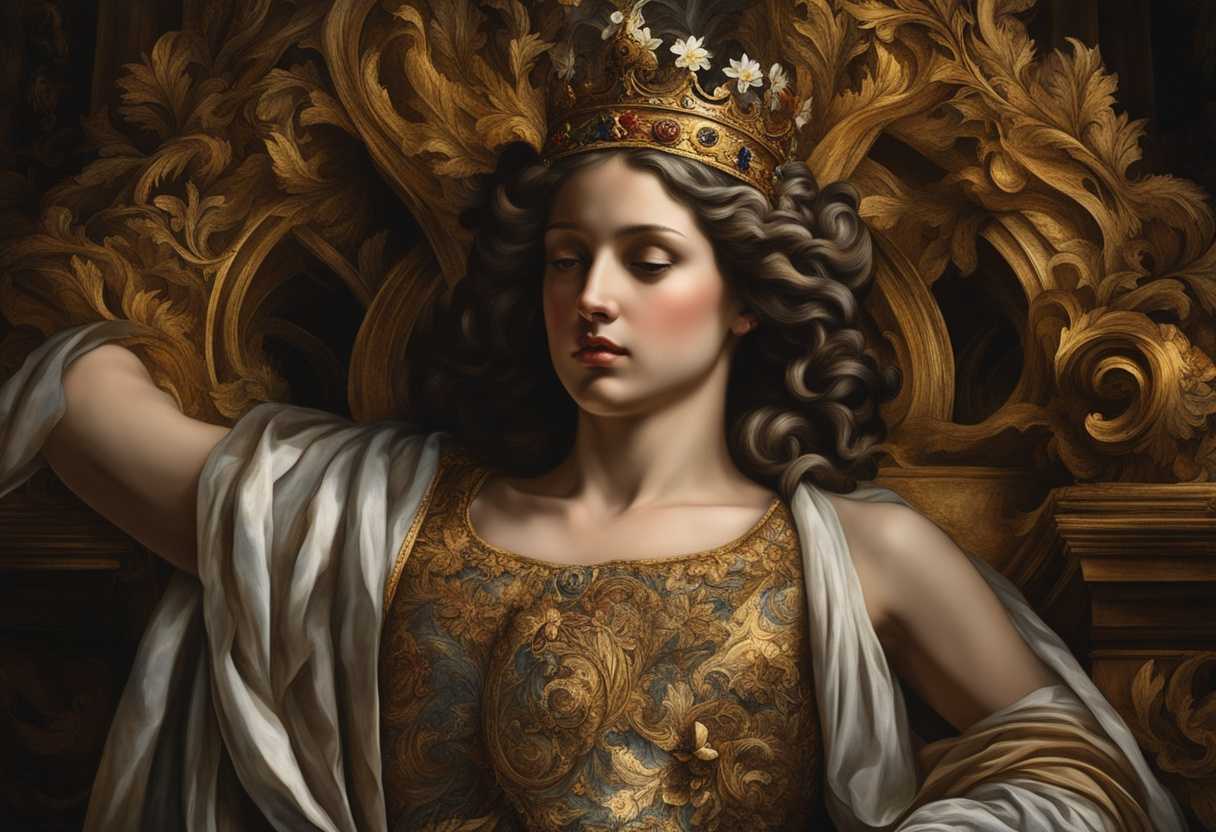
The name Stephanie does not appear in the Bible; however, it is derived from the Greek name “Stephanos,” meaning “crown” or “garland.” In biblical context, the term often symbolizes victory and honor, as referenced in passages like 1 Corinthians 9:25, where Paul discusses receiving an imperishable crown for faithfulness.
Scripture
1 Now in these days when the disciples were increasing in number, a complaint by the Hellenists arose against the Hebrews because their widows were being neglected in the daily distribution.
2 And the twelve summoned the full number of the disciples and said, “It is not right that we should give up preaching the word of God to serve tables.
3 Therefore, brothers, pick out from among you seven men of good repute, full of the Spirit and of wisdom, whom we will appoint to this duty.
4 But we will devote ourselves to prayer and to the ministry of the word.”
5 And what they said pleased the whole gathering, and they chose Stephen, a man full of faith and of the Holy Spirit, and Philip, and Prochorus, and Nicanor, and Timon, and Parmenas, and Nicolaus, a proselyte of Antioch.
6 They set before the apostles, and when they had prayed, they laid their hands on them.
7 And the word of God continued to increase, and the number of the disciples multiplied greatly in Jerusalem, and a great many of the priests became obedient to the faith.
8 And Stephen, full of grace and power, was doing great wonders and signs among the people.
9 But some of those who belonged to the synagogue of the Freedmen (as it was called), and of the Cyrenians, and of the Alexandrians, and of those from Cilicia and Asia, rose up and disputed with Stephen.
10 But they could not withstand the wisdom and the Spirit with which he was speaking.
11 Then they secretly instigated men who said, “We have heard him speak blasphemous words against Moses and God.”
12 And they stirred up the people and the elders and the scribes, and they came upon him and seized him and brought him before the council.
13 and they set up false witnesses who said, “This man never ceases to speak words against this holy place and the law,
And they set up false witnesses who said, “This man never ceases to speak words against this holy place and the law, for we have heard him say that this Jesus of Nazareth will destroy this place and will change the customs that Moses delivered to us.”
15 And gazing at him, all who sat in the council saw that his face was like the face of an angel.
Biblical Meaning of the Name Stephanie
While the name “Stephanie” itself is not mentioned in the Bible, its Greek origin “Stephanos,” meaning “crown” or “garland,” carries significant symbolic weight within biblical teachings. In the context of scripture, the “crown” often represents achievement, victory, and the rewards of faithful living. For example, in 1 Corinthians 9:25, the Apostle Paul speaks of athletes competing for a perishable crown, emphasizing that believers strive for an imperishable crown through their perseverance in faith. This metaphor encourages Christians to live disciplined lives, focusing not on temporary rewards but on eternal significance.
The broader meaning behind the concept of a crown resonates through various biblical passages. In 2 Timothy 4:8, Paul expresses hope for a “crown of righteousness,” which the Lord will award to all who have loved His appearing. This notion highlights that the sacrifices made in the service of God will result in eternal rewards and honor. Thus, while “Stephanie” may not directly appear in scripture, its roots tie individuals to the vital themes of victory, honor, and the divine rewards awaiting faithful believers. In this light, names like Stephanie can serve as daily reminders of the spiritual journey toward righteousness and the ultimate crown of life promised in James 1:12. The name Stephanie offers a deeper reflection when considering its Greek roots and the theological implications of “Stephanos.” In the biblical narrative, crowns symbolize not just physical or earthly rewards, but also divine favor and moral virtue. In Revelation 2:10, believers are urged not to fear persecution, for they will receive the “crown of life” as a reward for their faithfulness. This notion affirms that enduring hardship for the sake of Christ leads to ultimate victory, correlating with the essence of the name Stephanie as representative of triumph and honor.
Moreover, in the context of leadership and servanthood, the concept of a crown can be paralleled with the responsibilities of those who lead others in faith. In Philippians 4:1, Paul refers to the Philippians as his “joy and crown,” depicting the bond between a leader and their congregation. This relationship mirrors the sense of honor and affection embedded in the name Stephanie, suggesting that individuals bearing this name may be seen as catalysts of spiritual growth and encouragement to those around them. Just as crowns signify the culmination of faith and the representation of achievements in serving God, the name Stephanie encapsulates the hope of leading a righteous life worthy of divine reward.
The Significance of “Crown” in Biblical Context
The name Stephanie is derived from the Greek word “stephanos,” which means “crown.” In biblical terms, a crown often symbolizes victory, honor, and reward. This concept is prevalent in the New Testament, where believers are promised crowns for their faithfulness and perseverance. Thus, the name Stephanie can be seen as a reminder of the spiritual rewards that await those who remain steadfast in their faith.
The Role of Women in the Early Church
In the early Christian community, women played significant roles, often serving as leaders and supporters of the faith. The name Stephanie, while not directly mentioned in the Bible, can represent the contributions of women like Phoebe, Priscilla, and others who were instrumental in spreading the Gospel. This highlights the importance of female figures in the biblical narrative and their impact on the growth of the early church.
The Call to Perseverance
The name Stephanie can also evoke the idea of perseverance in the face of trials. Just as a crown is awarded to those who endure challenges, the name serves as a metaphor for the Christian journey, encouraging believers to remain faithful despite difficulties. This theme of perseverance is central to many biblical teachings, emphasizing the importance of maintaining one’s faith and commitment to God throughout life’s challenges.
How to Embrace Humility as a Better Christian
Embracing humility as a Christian is a transformative journey that begins with recognizing our own limitations and the grace that God extends to us daily. It’s about understanding that we are all flawed and in need of His mercy, which can help us let go of pride and the need to be right all the time. Start by reflecting on Philippians 2:3-4, which encourages us to consider others better than ourselves and to look out for their interests. This mindset shift can be practiced in small, everyday interactions—whether it’s listening more than speaking, offering help without expecting anything in return, or simply acknowledging when we’re wrong. Remember, humility doesn’t mean thinking less of ourselves, but rather thinking of ourselves less. As you cultivate this attitude, you’ll find that it not only deepens your relationship with God but also enriches your connections with others, allowing you to embody the love and grace that Christ exemplified.
Bible References to the Name Stephanie:
Acts 7:1-60: 1 And the high priest said, “Are these things so?”
2 And Stephen said: “Brothers and fathers, hear me. The God of glory appeared to our father Abraham when he was in Mesopotamia, before he lived in Haran,
3 and said to him, ‘Go out from your land and from your kindred and go into the land that I will show you.’
4 Then he went out from the land of the Chaldeans and lived in Haran. And after his father died, God removed him from there into this land in which you are now living.
5 Yet he gave him no inheritance in it, not even a foot’s length, but promised to give it to him as a possession and to his offspring after him, though he had no child.
6 And God spoke to this effect—that his offspring would be sojourners in a land belonging to others, who would enslave them and afflict them four hundred years.
7 And I will judge the nation that they serve, said God, and after that they shall come out and worship me in this place.
8 And he gave him the covenant of circumcision. And so Abraham became the father of Isaac, and circumcised him on the eighth day, and Isaac became the father of Jacob, and Jacob of the twelve patriarchs.
9 “And the patriarchs, jealous of Joseph, sold him into Egypt; but God was with him”
10 and rescued him out of all his afflictions and gave him favor and wisdom before Pharaoh, king of Egypt, who made him ruler over Egypt and over all his household.
11 Now there came a famine throughout all Egypt and Canaan, and great affliction, and our fathers could find no food.
12 But when Jacob heard that there was grain in Egypt, he sent out our fathers on their first visit.
13 And on the second visit Joseph made himself known to his brothers, and Joseph’s family became known to Pharaoh.
14 And Joseph sent and summoned Jacob his father and all his kindred, seventy-five persons in all.
15 And Jacob went down into Egypt, and he died, he and our fathers,
16 And they were carried back to Shechem and laid in the tomb that Abraham had bought for a sum of silver from the sons of Hamor in Shechem.
17 “But as the time of the promise drew near, which God had granted to Abraham, the people increased and multiplied in Egypt”
18 until there arose over Egypt another king who did not know Joseph.
19 He dealt shrewdly with our race and forced our fathers to expose their infants, so that they would not be kept alive.
20 At this time Moses was born; and he was beautiful in God’s sight. And he was brought up for three months in his father’s house.
21 and when he was exposed, Pharaoh’s daughter adopted him and brought him up as her own son.
22 And Moses was instructed in all the wisdom of the Egyptians, and he was mighty in his words and deeds.
23 “When he was forty years old, it came into his heart to visit his brothers, the children of Israel.”
24 And seeing one of them being wronged, he defended the oppressed man and avenged him by striking down the Egyptian.
25 He supposed that his brothers would understand that God was giving them salvation by his hand, but they did not understand.
26 And on the following day he appeared to them as they were quarreling and tried to reconcile them, saying, ‘Men, you are brothers. Why do you wrong each other?’
27 But the man who was wronging his neighbor thrust him aside, saying, ‘Who made you a ruler and a judge over us?
28 ‘Do you want to kill me as you killed the Egyptian yesterday?’
29 At this retort Moses fled and became an exile in the land of Midian, where he became the father of two sons.
30 “Now when forty years had passed, an angel appeared to him in the wilderness of Mount Sinai, in a flame of fire in a bush.”
31 When Moses saw it, he marveled at the sight, and as he drew near to look, there came the voice of the Lord:
32 ‘I am the God of your fathers, the God of Abraham and of Isaac and of Jacob.’ And Moses trembled and did not dare to look.
33 Then the Lord said to him, ‘Take off the sandals from your feet, for the place where you are standing is holy ground.
34 I have surely seen the affliction of my people who are in Egypt, and have heard their groaning, and I have come down to deliver them. And now come, I will send you to Egypt.’”
35 “This Moses, whom they rejected, saying, ‘Who made you a ruler and a judge?’—this man God sent as both ruler and redeemer by the hand of the angel who appeared to him in the bush.
36 This man led them out, performing wonders and signs in Egypt and at the Red Sea and in the wilderness for forty years.
37 This is the Moses who said to the Israelites, ‘God will raise up for you a prophet like me from your brothers.’
38 This is the one who was in the congregation in the wilderness with the angel who spoke to him at Mount Sinai, and with our fathers. He received living oracles to give to us.
39 Our fathers refused to obey him, but thrust him aside, and in their hearts they turned to Egypt,
40 saying to Aaron, ‘Make for us gods who will go before us. As for this Moses who led us out from the land of Egypt, we do not know what has become of him.’
41 And they made a calf in those days, and offered a sacrifice to the idol and were rejoicing in the works of their hands.
42 But God turned away and gave them over to worship the host of heaven, as it is written in the book of the prophets: “Did you bring to me slain beasts and sacrifices, during the forty years in the wilderness, O house of Israel?
43 You took up the tent of Moloch
and the star of your god Rephan,
the images that you made to worship;
and I will send you into exile beyond Babylon.’
44 “Our fathers had the tent of witness in the wilderness, just as he who spoke to Moses directed him to make it, according to the pattern that he had seen.”
45 Our fathers in turn brought it in with Joshua when they dispossessed the nations that God drove out before our fathers. So it was until the days of David,
46 who found favor in the sight of God and asked to find a dwelling place for the God of Jacob.
47 But it was Solomon who built a house for him.
48 Yet the Most High does not dwell in houses made by hands, as the prophet says,
49 “‘Heaven is my throne,
and the earth is my footstool.
What kind of house will you build for me, says the Lord,
or what is the place of my rest?
51 “You stiff-necked people, uncircumcised in heart and ears, you always resist the Holy Spirit. As your fathers did, so do you.”
51 “You stiff-necked people, uncircumcised in heart and ears, you always resist the Holy Spirit. As your fathers did, so do you.”
Which of the prophets did your fathers not persecute? And they killed those who announced beforehand the coming of the Righteous One, whom you have now betrayed and murdered,
You who received the law as delivered by angels and did not keep it.
54 Now when they heard these things they were enraged, and they ground their teeth at him.
55 But he, full of the Holy Spirit, gazed into heaven and saw the glory of God, and Jesus standing at the right hand of God.
56 And he said, “Behold, I see the heavens opened, and the Son of Man standing at the right hand of God.”
57 But they cried out with a loud voice and stopped their ears and rushed together at him.
58 Then they cast him out of the city and stoned him. And the witnesses laid down their garments at the feet of a young man named Saul.
59 And as they were stoning Stephen, he called out, “Lord Jesus, receive my spirit.”
60 Then falling to his knees he cried out with a loud voice, “Lord, do not hold this sin against them.” And when he had said this, he fell asleep.
Acts 8:1-3: 1 And Saul approved of his execution. And there arose on that day a great persecution against the church in Jerusalem, and they were all scattered throughout the regions of Judea and Samaria, except the apostles.
2 Devout men buried Stephen and made great lamentation over him.
3 But Saul was ravaging the church, and entering house after house, he dragged off men and women and committed them to prison.
1 Corinthians 1:1-9: 1 Paul, called by the will of God to be an apostle of Christ Jesus, and our brother Sosthenes,
2 To the church of God that is in Corinth, to those sanctified in Christ Jesus, called to be saints together with all those who in every place call upon the name of our Lord Jesus Christ, both their Lord and ours:
3 Grace to you and peace from God our Father and the Lord Jesus Christ.
4 I give thanks to my God always for you because of the grace of God that was given you in Christ Jesus,
5 that in every way you were enriched in him in all speech and all knowledge—
6 even as the testimony about Christ was confirmed among you—
7 so that you are not lacking in any gift, as you wait for the revealing of our Lord Jesus Christ,
8 who will sustain you to the end, guiltless in the day of our Lord Jesus Christ.
9 God is faithful, by whom you were called into the fellowship of his Son, Jesus Christ our Lord.
1 Corinthians 16:13-18: 13 Be watchful, stand firm in the faith, act like men, be strong.
14 Let all that you do be done in love.
15 Now I urge you, brothers—you know that the household of Stephanas were the first converts in Achaia, and that they have devoted themselves to the service of the saints—
16 be subject to such as these, and to every fellow worker and laborer.
17 I rejoice at the coming of Stephanas and Fortunatus and Achaicus, because they have made up for your absence,
18 for they refreshed my spirit as well as yours. So give recognition to such men.
2 Corinthians 1:12-14: 12 For our boast is this, the testimony of our conscience, that we behaved in the world with simplicity and godly sincerity, not by earthly wisdom but by the grace of God, and supremely so toward you.
13 For we are not writing to you anything other than what you read and understand, and I hope you will fully understand—
14 just as you did partially acknowledge us—that on the day of our Lord Jesus you will boast of us as we will boast of you.
2 Corinthians 8:16-24: 16 But thanks be to God, who put into the heart of Titus the same earnest care I have for you.
17 For he not only accepted our appeal, but being himself very earnest he is going to you of his own accord.
18 With him we are sending the brother who is famous among all the churches for his preaching of the gospel.
19 And not only that, but he has been appointed by the churches to travel with us as we carry out this act of grace that is being ministered by us, for the glory of the Lord himself and to show our good will.
20 We take this course so that no one should blame us about this generous gift that is being administered by us,
21 for we aim at what is honorable not only in the Lord’s sight but also in the sight of man.
22 And with them we are sending our brother whom we have often tested and found earnest in many matters, but who is now more earnest than ever because of his great confidence in you.
23 As for Titus, he is my partner and fellow worker for your benefit. And as for our brothers, they are messengers of the churches, the glory of Christ.
24 So give proof before the churches of your love and of our boasting about you to these men.
Philippians 2:19-30: 19 I hope in the Lord Jesus to send Timothy to you soon, so that I too may be cheered by news of you.
20 For I have no one like him, who will be genuinely concerned for your welfare.
21 For they all seek their own interests, not those of Jesus Christ.
22 But you know Timothy’s proven worth, how as a son with a father he has served with me in the gospel.
23 I hope therefore to send him just as soon as I see how it will go with me,
24 and I trust in the Lord that shortly I myself will come also.
25 I have thought it necessary to send to you Epaphroditus my brother and fellow worker and fellow soldier, and your messenger and minister to my need,
26 for he has been longing for you all and has been distressed because you heard that he was ill.
27 Indeed he was ill, near to death. But God had mercy on him, and not only on him but on me also, lest I should have sorrow upon sorrow.
28 I am the more eager to send him, therefore, that you may rejoice at seeing him again, and that I may be less anxious.
29 So receive him in the Lord with all joy, and honor such men,
30 because he nearly died for the work of Christ, risking his life to complete what was lacking in your service to me.
1 Thessalonians 3:1-10: Therefore when we could bear it no longer, we were willing to be left behind at Athens alone,
2 and we sent Timothy, our brother and God’s coworker in the gospel of Christ, to establish and exhort you in your faith,
3 that no one be moved by these afflictions. For you yourselves know that we are destined for this.
4 For when we were with you, we kept telling you beforehand that we were to suffer affliction, just as it has come to pass, and just as you know.
5 For this reason, when I could bear it no longer, I sent to learn about your faith, for fear that somehow the tempter had tempted you and our labor would be in vain.
6 But now that Timothy has come to us from you, and has brought us the good news of your faith and love and reported that you always remember us kindly and long to see us, as we long to see you—
7 for this reason, brothers, in all our distress and affliction we have been comforted about you through your faith.
8 For now we live, if you are standing fast in the Lord.
9 For what thanksgiving can we return to God for you, for all the joy that we feel for your sake before our God,
10 as we pray most earnestly night and day that we may see you face to face and supply what is lacking in your faith?
2 Timothy 4:1-8: 1 I charge you in the presence of God and of Christ Jesus, who is to judge the living and the dead, and by his appearing and his kingdom:
2 preach the word; be ready in season and out of season; reprove, rebuke, and exhort, with complete patience and teaching.
3 For the time is coming when people will not endure sound teaching, but having itching ears they will accumulate for themselves teachers to suit their own passions,
4 and will turn away from listening to the truth and wander off into myths.
5 As for you, always be sober-minded, endure suffering, do the work of an evangelist, fulfill your ministry.
6 For I am already being poured out as a drink offering, and the time of my departure has come.
7 I have fought the good fight, I have finished the race, I have kept the faith.
8 Henceforth there is laid up for me the crown of righteousness, which the Lord, the righteous judge, will award to me on that day, and not only to me but also to all who have loved his appearing.

Reverend Ogunlade is a seasoned Church Minister with over three decades of experience in guiding and nurturing congregations. With profound wisdom and a serene approach, Reverend Ogunlade has carried out various pastoral duties, including delivering uplifting sermons, conducting religious ceremonies, and offering sage counsel to individuals seeking spiritual guidance. Their commitment to fostering harmony and righteousness within their community is exemplified through their compassionate nature, making them a beloved and trusted figure among the congregation.