
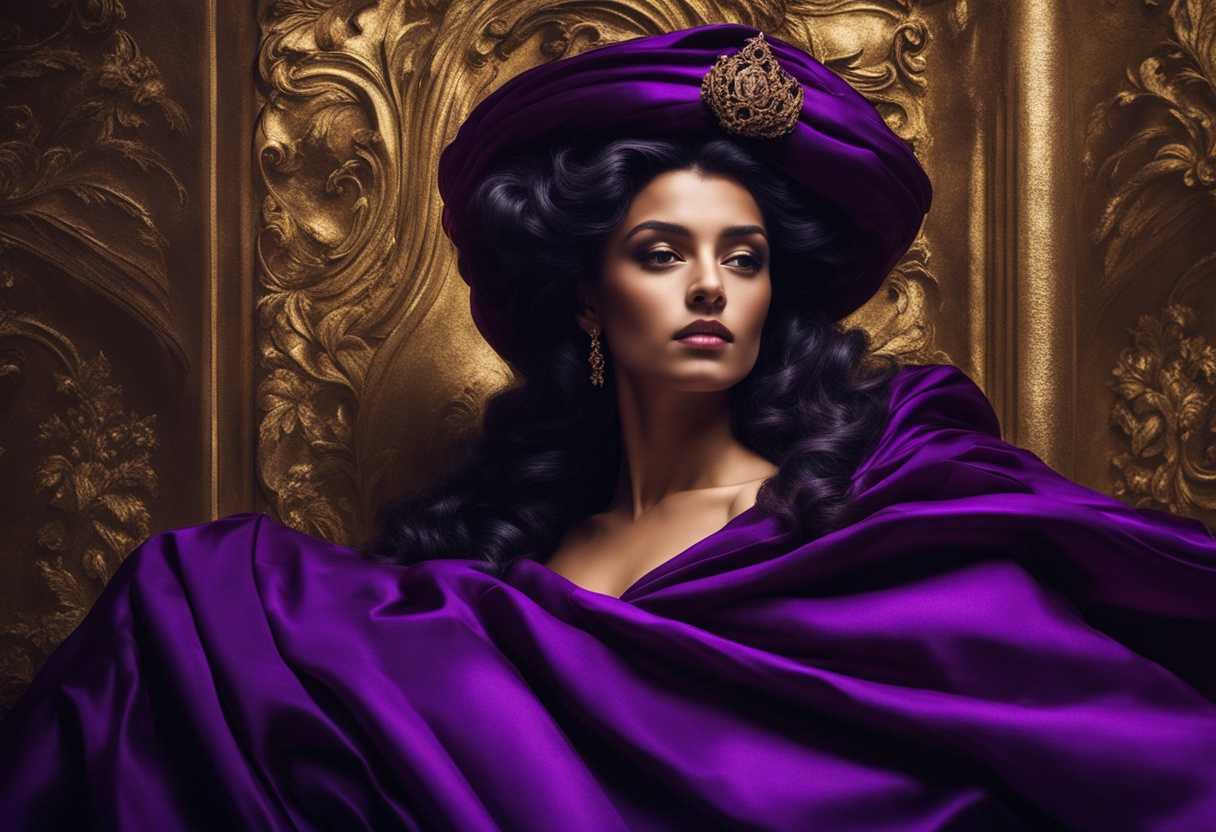
In the Bible, purple cloth symbolizes wealth, royalty, and nobility, often associated with kings and the elite. For example, in the Book of Esther, purple is used to signify royal authority, and in the New Testament, the robe of Jesus during his crucifixion was purple, emphasizing his status as the King of the Jews.
Scripture
1 The Lord said to Moses,
2 “Speak to the people of Israel, that they take for me a contribution. From every man whose heart moves him you shall receive the contribution for me.
3 This is the contribution that you shall receive from them: gold, silver, and bronze,
4 blue and purple and scarlet yarns and fine twined linen, goats’ hair,
5 rams’ skins dyed red, and goatskins, acacia wood,
6 oil for the light, spices for the anointing oil and for the fragrant incense,
7 onyx stones, and stones for setting, for the ephod and for the breastpiece.
8 And let them make me a sanctuary, that I may dwell in their midst.
9 Exactly as I show you concerning the pattern of the tabernacle, and of all its furniture, so you shall make it.
Significance of Purple Cloth in the Bible
In biblical tradition, the color purple is deeply entwined with themes of royalty, wealth, and divine authority. Its significance is notably highlighted in the Book of Esther, where Queen Esther adorns herself in royal garments, including purple, to signify her exalted position and to convey the gravitas of her mission to save her people (Esther 5:1). This connection to royalty continues into the New Testament, where Jesus is mocked before his crucifixion by being dressed in a purple robe, which serves as a poignant irony since he is indeed the prophesied King of the Jews (Mark 15:17). The purple cloth, in this context, amplifies not only the recognition of his kingship but also the juxtaposition of his suffering and sacrificial death against the expectations of earthly power.
Moreover, purple was a costly dye, traditionally reserved for the wealthy elite, which further emphasizes its association with nobility and significance. For instance, in the Book of Revelation, the clothing of the wealthy city of Tyre is described as purple, underscoring their luxurious lifestyle and spiritual downfall (Revelation 18:12). This duality of purple as a symbol can convey both the splendor associated with earthly riches and the higher divine calling that transcends material wealth. Thus, purple cloth, throughout the scriptures, serves as both a literal and metaphorical representation of authority, the clash between worldly power and spiritual humility, and ultimately, the overarching narrative of redemption through Christ’s kingship.
The prominence of purple cloth in biblical references extends beyond royal vestments and markers of wealth, often intertwining with themes of divine calling and the transcendence of human authority. In the construction of the Tabernacle, for instance, purple was part of the intricate designs and materials used to create sacred spaces meant for worship (Exodus 26:1). The use of purple in the fabric of the curtains and garments of the priests serves to illustrate the intersection of the heavenly realm with the earthly, signifying the holiness of God’s dwelling among His people. This reinforces the theme that while God is king over all, the divine presence is accessible through the symbols of kingship and priesthood, embodied in the richness of the purple hue.
Furthermore, Paul’s letters reflect on the significance of purple in the context of early Christian communities, particularly in the mention of Lydia, a seller of purple cloth (Acts 16:14). Lydia’s occupation not only speaks to her economic status but also indicates her role in the spread of the Gospel as one of the first converts in Philippi. By wearing and selling purple garments, she was situated at the nexus of commerce and faith, embodying how those of high status could contribute to the burgeoning Christian movement. Her story illustrates that divine purpose can intertwine with personal vocation, reinforcing the idea that the significance of purple is multilayered – representing not just wealth and royalty but also a vehicle for the realization of God’s plans through individuals who bridge the gap between social status and spiritual mission. Thus, the color purple resonates with a broader narrative of God’s providence, the calling of the faithful, and the transformative power of the Gospel across all levels of society.
Symbol of Royalty and Authority
In biblical times, purple cloth was often associated with royalty and high status. The color purple was expensive to produce, derived from rare mollusks, making it a symbol of wealth and power. This association highlights the divine authority of God and the kingship of Christ, as well as the calling of believers to live as heirs in His kingdom.
Representation of Sacrifice and Suffering
Purple cloth also carries connotations of sacrifice and suffering. In various contexts, it can symbolize the trials and tribulations faced by those in positions of authority or leadership. This duality reflects the biblical theme of suffering leading to glory, as seen in the life of Jesus, who wore a purple robe during His mockery before crucifixion, signifying both His kingship and the suffering He endured for humanity.
Connection to Spiritual Richness
Beyond its physical attributes, purple cloth can represent spiritual richness and the depth of faith. It serves as a reminder of the richness of God’s grace and the beauty of a life transformed by faith. The use of purple in religious contexts, such as in the garments of priests, signifies the call to holiness and the pursuit of a deeper relationship with God, encouraging believers to seek the richness of spiritual life.
How to Embrace Humility and Service in Faith
Embracing humility and service in your faith journey is a beautiful way to reflect Christ’s love in the world. Start by recognizing that true humility isn’t thinking less of yourself, but rather thinking of yourself less; it’s about shifting your focus from your own needs to the needs of others. Consider volunteering your time or talents in your community, whether it’s helping at a local shelter or simply being there for a friend in need. Remember, Jesus washed the feet of His disciples, demonstrating that no act of service is too small or beneath us. As you practice humility, you’ll find that it opens your heart to deeper connections with others and a more profound understanding of God’s grace in your life. Let each act of service be a reminder that we are all part of a greater purpose, and in serving others, we truly serve Him.
Bible References to Purple Cloth Significance:
Exodus 26:1-6: 1 “Moreover, you shall make the tabernacle with ten curtains of fine twined linen and blue and purple and scarlet yarns; you shall make them with cherubim skillfully worked into them.
2 The length of each curtain shall be twenty-eight cubits, and the breadth of each curtain four cubits; all the curtains shall be the same size.
3 Five curtains shall be coupled to one another, and the other five curtains shall be coupled to one another.
4 And you shall make loops of blue on the edge of the outermost curtain in the first set.
5 And you shall make fifty loops on the edge of the curtain that is outermost in one set, and fifty loops on the edge of the curtain that is outermost in the second set.
6 And you shall make fifty clasps of gold, and couple the curtains one to the other with the clasps, so that the tabernacle may be a single whole.
Exodus 28:1-5: 1 “Then bring near to you Aaron your brother, and his sons with him, from among the people of Israel, to serve me as priests—Aaron and Aaron’s sons, Nadab and Abihu, Eleazar and Ithamar.”
2 And you shall make holy garments for Aaron your brother, for glory and for beauty.
3 You shall speak to all the skillful, whom I have filled with a spirit of skill, that they make Aaron’s garments to consecrate him for my priesthood.
4 These are the garments that they shall make: a breastpiece, an ephod, a robe, a coat of checker work, a turban, and a sash. They shall make holy garments for Aaron your brother and his sons to serve me as priests.
5 They shall take the gold, blue and purple and scarlet yarns, and fine twined linen.
Exodus 35:4-19: 4 Moses said to all the congregation of the people of Israel, “This is the thing that the Lord has commanded.
5 Take from among you a contribution to the Lord. Whoever is of a generous heart, let him bring the Lord’s contribution: gold, silver, and bronze;
6 And they received from Moses all the contribution that the people of Israel had brought for doing the work on the sanctuary. They still kept bringing him freewill offerings every morning,
7 And the ram skins dyed red, and the fine leather, and the acacia wood,
8 and oil for the light, and spices for the anointing oil, and for the fragrant incense,
9 skilled women spun with their hands, and brought what they had spun in blue and purple and scarlet yarns and fine twined linen.
10 “Let every skillful craftsman among you come and make all that the Lord has commanded:
11 the tabernacle, its tent and its covering, its hooks and its frames, its bars, its pillars, and its bases;
12 the finely worked garments for ministering in the Holy Place, the holy garments for Aaron the priest, and the garments of his sons, for their service as priests.”
13 the table with its poles and all its utensils, and the bread of the Presence;
14 the lampstand also for the light, with its utensils and its lamps, and the oil for the light,
15 And the altar of incense, with its poles, and the anointing oil and the fragrant incense, and the screen for the entrance of the tent;
16 And the altar of burnt offering with all its utensils and the basin and its stand.
17 the hangings of the court, its pillars, and its bases, and the screen for the gate of the court,
18 the pegs of the tabernacle and the pegs of the court, and their cords;
19 the finely worked garments for ministering in the Holy Place, the holy garments for Aaron the priest, and the garments of his sons, for their service as priests.”
Exodus 36:8-13: 8 And all the craftsmen among the workmen made the tabernacle with ten curtains. They were made of fine twined linen and blue and purple and scarlet yarns, with cherubim skillfully worked.
9 The length of each curtain was twenty-eight cubits, and the breadth of each curtain four cubits. All the curtains were the same size.
10 And he coupled five curtains to one another, and the other five curtains he coupled to one another.
11 And he made loops of blue on the edge of the outermost curtain in the first set.
12 And for the east side the hangings were fifty cubits.
13 And he made fifty clasps of gold, and coupled the curtains one to the other with clasps. So the tabernacle was a single whole.
Exodus 39:1-5: 1 From the blue and purple and scarlet yarns they made finely woven garments, for ministering in the Holy Place. They made the holy garments for Aaron, as the Lord had commanded Moses.
2 And he made the ephod of gold, blue and purple and scarlet yarns, and fine twined linen.
3 They hammered out gold leaf, and he cut it into threads to work into the blue and purple and the scarlet yarns, and into the fine twined linen, in skilled design.
4 They made for the ephod attaching shoulder pieces, joined to it at its two edges.
5 And the skillfully woven band on it was of one piece with it and made like it, of gold, blue and purple and scarlet yarns, and fine twined linen, as the Lord had commanded Moses.
Judges 8:22-26: 22 Then the men of Israel said to Gideon, “Rule over us, you and your son and your grandson also, for you have saved us from the hand of Midian.”
23 Gideon said to them, “I will not rule over you, and my son will not rule over you; the Lord will rule over you.”
24 And Gideon said to them, “Let me make a request of you: every one of you give me the earrings from his spoil.” For they had golden earrings, because they were Ishmaelites.
25 And they said, “We will willingly give them.” And they spread a cloak, and every man threw in it the earrings of his spoil.
26 And the weight of the golden earrings that he requested was 1,700 shekels of gold, besides the crescent ornaments and the pendants and the purple garments worn by the kings of Midian, and besides the collars that were around the necks of their camels.
Esther 8:15-17: 15 Then Mordecai went out from the presence of the king in royal robes of blue and white, with a great golden crown and a robe of fine linen and purple, and the city of Susa shouted and rejoiced.
16 The Jews had light and gladness and joy and honor.
17 In every province and in every city, wherever the king’s command and his edict reached, there was gladness and joy among the Jews, a feast and a holiday. And many from the peoples of the country declared themselves Jews, for fear of the Jews had fallen on them.
Proverbs 31:21-22: 21 She is not afraid of snow for her household,
for all her household are clothed in scarlet.
22 She makes bed coverings for herself;
her clothing is fine linen and purple.
Jeremiah 10:8-9: 8 They are both stupid and foolish; the instruction of idols is but wood!
9 Beaten silver is brought from Tarshish,
and gold from Uphaz.
Ezekiel 27:7-16: 7 Your sail was of fine embroidered linen from Egypt so that it became your own sail.
8 The inhabitants of Sidon and Arvad were your rowers; your skilled men, O Tyre, were in you; they were your pilots.
9 The elders of Gebal and its skilled men were in you, caulking your seams; all the ships of the sea with their mariners were in you to barter for your wares.
10 “Persia and Lud and Put were in your army as your men of war. They hung the shield and helmet in you; they gave you splendor.”
11 The men of Arvad and Helech were on your walls all around, and men of Gamad were in your towers. They hung their shields on your walls all around; they have made perfect your beauty.
12 “Tarshish did business with you because of your great wealth of every kind; silver, iron, tin, and lead they exchanged for your wares.
13 Javan, Tubal, and Meshech traded with you. They exchanged human beings and vessels of bronze for your merchandise.
14 “Beth-togarmah exchanged for your wares horses, war horses, and mules.
15 The men of Dedan traded with you. Many coastlands were your own special markets; they brought you in payment ivory tusks and ebony.
16 Syria did business with you because of the abundance of your goods; they exchanged for your wares emeralds, purple, embroidered work, fine linen, coral, and ruby.
Daniel 5:7-16: 7 The king called loudly to bring in the enchanters, the Chaldeans, and the astrologers. The king declared to the wise men of Babylon, “Whoever reads this writing, and shows me its interpretation, shall be clothed with purple and have a chain of gold around his neck and shall be the third ruler in the kingdom.”
8 Then all the king’s wise men came in, but they could not read the writing or make known to the king the interpretation.
9 Then King Belshazzar was greatly alarmed, and his color changed, and his lords were perplexed.
10 The queen, because of the words of the king and his lords, came into the banqueting hall, and the queen declared, “O king, live forever! Let not your thoughts alarm you or your color change.
11 There is a man in your kingdom in whom is the spirit of the holy gods. In the days of your father, light and understanding and wisdom like the wisdom of the gods were found in him, and King Nebuchadnezzar, your father—your father the king—made him chief of the magicians, enchanters, Chaldeans, and astrologers,
12 because an excellent spirit, knowledge, and understanding to interpret dreams, explain riddles, and solve problems were found in this Daniel, whom the king named Belteshazzar. Now let Daniel be called, and he will show the interpretation.”
13 Then Daniel was brought in before the king. The king answered and said to Daniel, “You are that Daniel, one of the exiles of Judah, whom the king my father brought from Judah.
14 I have heard of you that the spirit of the gods is in you, and that light and understanding and excellent wisdom are found in you.
15 And now the wise men, the enchanters, have been brought in before me to read this writing and make known to me its interpretation, but they could not show the interpretation of the matter.
16 And I have heard of you, that you can give interpretations and solve problems. Now if you can read the writing and make known to me its interpretation, you shall be clothed in purple and have a chain of gold around your neck and shall be the third ruler in the kingdom.
Luke 16:19-31: 19 “There was a rich man who was clothed in purple and fine linen and who feasted sumptuously every day.
20 And at his gate was laid a poor man named Lazarus, covered with sores,
21 who desired to be fed with what fell from the rich man’s table. Moreover, even the dogs came and licked his sores.
22 The poor man died and was carried by the angels to Abraham’s side. The rich man also died and was buried.
23 and in Hades, being in torment, he lifted up his eyes and saw Abraham far off and Lazarus at his side.
24 And he called out, ‘Father Abraham, have mercy on me, and send Lazarus to dip the end of his finger in water and cool my tongue, for I am in anguish in this flame.’
25 But Abraham said, ‘Child, remember that you in your lifetime received your good things, and Lazarus in like manner bad things; but now he is comforted here, and you are in anguish.
26 And besides all this, between us and you a great chasm has been fixed, in order that those who would pass from here to you may not be able, and none may cross from there to us.’
27 And he said, ‘Then I beg you, father, to send him to my father’s house—
28 for I have five brothers—so that he may warn them, lest they also come into this place of torment.’
Abraham said to him, ‘They have Moses and the Prophets; let them hear them.’
30 And he said, ‘No, father Abraham, but if someone goes to them from the dead, they will repent.’
31 He said to him, ‘If they do not hear Moses and the Prophets, neither will they be convinced if someone should rise from the dead.’
John 19:1-5: 1 Then Pilate took Jesus and flogged him.
2 And the soldiers twisted together a crown of thorns and put it on his head and arrayed him in a purple robe.
3 They came up to him, saying, “Hail, King of the Jews!” and struck him with their hands.
4 Pilate went out again and said to them, “See, I am bringing him out to you that you may know that I find no guilt in him.”
5 So Jesus came out, wearing the crown of thorns and the purple robe. Pilate said to them, “Behold the man!”
Acts 16:11-15: 11 So, setting sail from Troas, we made a direct voyage to Samothrace, and the following day to Neapolis,
12 and from there to Philippi, which is a leading city of the district of Macedonia and a Roman colony. We remained in this city some days.
13 And on the Sabbath day we went outside the gate to the riverside, where we supposed there was a place of prayer, and we sat down and spoke to the women who had come together.
14 One who heard us was a woman named Lydia, from the city of Thyatira, a seller of purple goods, who was a worshiper of God. The Lord opened her heart to pay attention to what was said by Paul.
15 And after she was baptized, and her household as well, she urged us, saying, “If you have judged me to be faithful to the Lord, come to my house and stay.” And she prevailed upon us.
Revelation 17:1-5: 1 Then one of the seven angels who had the seven bowls came and said to me, “Come, I will show you the judgment of the great prostitute who is seated on many waters,
2 with whom the kings of the earth have committed sexual immorality, and with the wine of whose sexual immorality the dwellers on earth have become drunk.”
3 And he carried me away in the Spirit into a wilderness, and I saw a woman sitting on a scarlet beast that was full of blasphemous names, and it had seven heads and ten horns.
4 The woman was arrayed in purple and scarlet, and adorned with gold and jewels and pearls, holding in her hand a golden cup full of abominations and the impurities of her sexual immorality.
5 And on her forehead was written a name of mystery: “Babylon the great, mother of prostitutes and of earth’s abominations.”
Revelation 18:11-16: 11 And the merchants of the earth weep and mourn for her, since no one buys their cargo anymore,
12 cargo of gold, silver, jewels, pearls, fine linen, purple cloth, silk, scarlet cloth, all kinds of scented wood, all kinds of articles of ivory, all kinds of articles of costly wood, bronze, iron and marble,
13 cinnamon, spice, incense, myrrh, frankincense, wine, oil, fine flour, wheat, cattle and sheep, horses and chariots, and slaves, that is, human souls.
14 The fruit for which your soul longed
has gone from you,
and all your delicacies and your splendors
are lost to you,
never to be found again!
15 The merchants of these wares, who gained wealth from her, will stand far off, in fear of her torment, weeping and mourning aloud,
16 “Alas, alas, for the great city that was clothed in fine linen, in purple and scarlet, adorned with gold, with jewels, and with pearls!”

Rev. François Dupont is a dedicated church minister with a wealth of experience in serving spiritual communities. With a calm and serene demeanor, he has been devoted to sharing the message of love, compassion, and tolerance for over two decades. Through his thoughtful sermons, compassionate counseling, and unwavering support, Rev. Dupont has touched the lives of countless individuals, allowing them to find solace and strength during difficult times. His serene presence and deep understanding of the human condition make him a trusted guide for those seeking spiritual nourishment and guidance.