
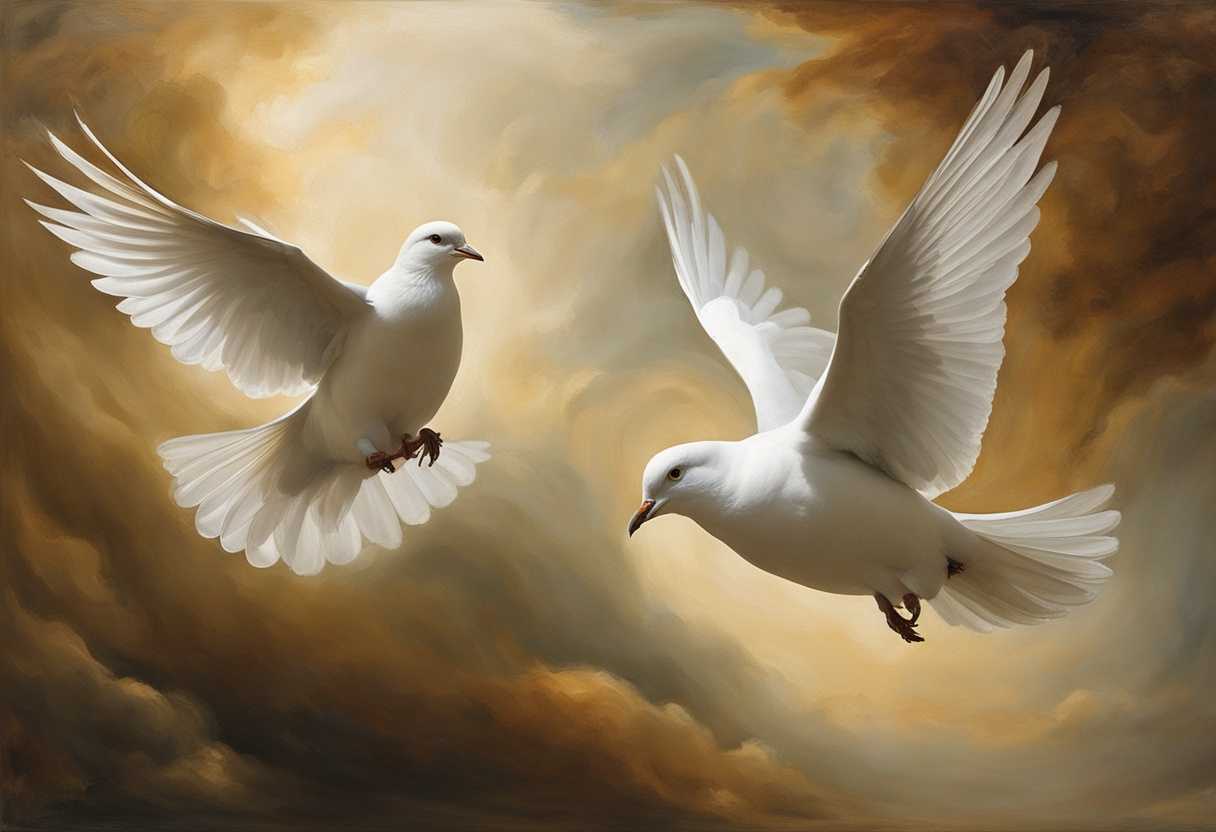
In the Bible, two doves often symbolize peace and the presence of the Holy Spirit. For example, in the story of Jesus’ baptism, the Spirit descends like a dove, indicating divine approval and peace (Matthew 3:16). Additionally, doves were used in sacrificial offerings, representing innocence and atonement (Leviticus 12:6-8).
Scripture
8 Then he sent forth a dove from him, to see if the waters had subsided from the face of the ground.
9 But the dove found no place to set her foot, and she returned to him to the ark, for the waters were still on the face of the whole earth. So he put out his hand and took her and brought her into the ark with him.
10 He waited another seven days, and again he sent forth the dove out of the ark.
11 And the dove came back to him in the evening, and behold, in her mouth was a freshly plucked olive leaf. So Noah knew that the waters had subsided from the earth.
12 And he waited yet another seven days and sent forth the dove, and she did not return to him anymore.
Symbolism of Two Doves in Scripture
The symbolism of two doves in the Bible encapsulates profound themes of peace, purity, and divine presence. One of the most notable instances occurs during the baptism of Jesus, as outlined in Matthew 3:16, where the Spirit of God descends like a dove, signifying both divine approval and the onset of Jesus’ ministry. This imagery suggests not only the peaceful and gentle nature of the Holy Spirit but also the embodiment of the promise of God’s presence among humanity. The dual imagery of doves can also be interpreted through the lens of unity and harmony, as doves are social creatures that live in pairs, symbolizing relational fidelity and companionship, reflective of the relationship between the believer and God.
Moreover, the use of doves in sacrificial offerings, particularly as outlined in Leviticus 12:6-8, where two young doves or pigeons were prescribed for purification rites, further emphasizes their role as symbols of innocence and atonement. The doves represented a means for the faithful to approach God, offering their humility and seeking peace with the Divine. This sacrificial connection underscores the importance of repentance and reconciliation. Thus, the dual symbolism of the dove encapsulates both the peace that comes from divine approval and the grace found in atonement, reinforcing themes of spiritual renewal and the intimate relationship between God and humanity. Together, these elements illustrate the multifaceted significance of doves in biblical context, resonating with believers as a reminder of God’s comforting presence and the call to live in peace.
In addition to their significance during moments of divine approval and atonement, two doves can symbolize fidelity and love, particularly in the context of relationships and marriages. The nature of doves as monogamous birds that often bond in pairs serves as a metaphor for the covenantal and steadfast love that is intended between spouses. This imagery is echoed in the Song of Solomon, where the beloved is compared to a dove, suggesting purity and beauty in loving relationships. Such associations highlight not only the importance of mutual commitment but also the divine design of love that fosters unity and joy among partners.
Furthermore, the representation of doves as messengers plays a crucial role in various biblical narratives. For instance, in the story of Noah’s Ark, a dove is sent out to find dry land after the flood, ultimately returning with an olive branch, which signifies restoration and hope for a new beginning. The return of the dove embodies the promise of God’s covenant with creation to never again destroy the earth by flood, reinforcing the themes of renewal and divine faithfulness. Thus, the dual image of the dove, appearing in situations of relationship and renewal, illustrates the overarching themes of commitment, hope, and the presence of peace in both human connections and divine promises, encouraging believers to foster harmonious relations and trust in God’s restorative plan.
Purity and Innocence
In biblical symbolism, doves are often associated with purity and innocence. The image of two doves can represent the duality of these qualities, emphasizing the importance of maintaining a pure heart and spirit. This symbolism is particularly relevant in the context of offerings and sacrifices, where doves were used as a means of atonement and purification. The presence of two doves can signify a complete and sincere commitment to seeking forgiveness and living a life aligned with divine principles.
Peace and Harmony
Doves are universally recognized as symbols of peace, and the depiction of two doves can further enhance this meaning. The pairing of doves suggests a harmonious relationship, whether between individuals, communities, or humanity and the divine. This symbolism reflects the biblical call for reconciliation and unity, encouraging believers to foster peace in their relationships and to seek harmony in a world often marked by conflict and division. The image of two doves can serve as a reminder of the importance of working together towards a common good and embodying the peace that comes from faith.
Divine Presence and Guidance
In various biblical narratives, doves are also seen as messengers of God, symbolizing divine presence and guidance. The imagery of two doves can represent the dual aspects of divine communication—God’s guidance through the Holy Spirit and the call for believers to be receptive to that guidance. This symbolism encourages individuals to remain open to spiritual insights and to seek direction in their lives, trusting in the divine presence that leads them toward righteousness and truth. The pairing of doves can thus signify the importance of both receiving and sharing divine wisdom in one’s journey of faith.
How to Cultivate Peace and Experience Divine Presence
Cultivating peace and experiencing the divine presence in our lives is a journey that requires intentionality and openness to God’s grace. Start by creating a quiet space in your daily routine—whether through prayer, meditation, or simply sitting in silence, allowing yourself to be still before the Lord. As you do this, invite the Holy Spirit to fill your heart with peace that surpasses all understanding (Philippians 4:7). Engage with Scripture, letting the words wash over you and remind you of God’s promises. Surround yourself with a community of believers who uplift and encourage you, as fellowship can be a powerful source of peace. Finally, practice gratitude; acknowledging the blessings in your life can shift your focus from anxiety to appreciation, drawing you closer to the divine presence that is always with you. Remember, peace is not the absence of trouble but the presence of Christ in the midst of it.
Bible References to Two Doves Symbolism:
Leviticus 12:6-8: 6 “And when the days of her purifying are completed, whether for a son or for a daughter, she shall bring to the priest at the entrance of the tent of meeting a lamb a year old for a burnt offering, and a pigeon or a turtledove for a sin offering,”
7 who shall offer it before the Lord and make atonement for her. Then she shall be clean from the flow of her blood. This is the law for her who bears a child, whether male or female.
8 And if she cannot afford a lamb, then she shall take two turtledoves or two pigeons, one for a burnt offering and the other for a sin offering. And the priest shall make atonement for her, and she shall be clean.”
Leviticus 14:4-7: 4 the priest shall command them to take for him who is to be cleansed two live clean birds and cedarwood and scarlet yarn and hyssop.
5 And the priest shall command them to kill one of the birds in an earthenware vessel over fresh water.
6 As for the living bird, he shall take it together with the cedarwood and the scarlet yarn and the hyssop, and dip them and the living bird in the blood of the bird that was killed over the fresh water.
7 And he shall sprinkle it seven times on him who is to be cleansed of the leprous disease. Then he shall pronounce him clean and shall let the living bird go into the open field.
Leviticus 14:49-53: 49 And he shall take for the cleansing of the house two small birds, cedarwood, scarlet yarn, and hyssop.
50 and shall kill one of the birds in an earthenware vessel over fresh water.
51 And he shall take the cedarwood and the hyssop and the scarlet yarn, along with the live bird, and dip them in the blood of the bird that was killed and in the fresh water, and sprinkle the house seven times.
52 and he shall cleanse the house with the blood of the bird and with the fresh water and with the live bird and with the cedarwood and hyssop and scarlet yarn.
53 “But the priest shall examine the disease on the skin of the body, and if the hair in the diseased area has turned white and the disease appears to be deeper than the skin of the body, it is a case of leprous disease. When the priest has examined him, he shall pronounce him unclean.”
Luke 2:22-24: 22 And when the time came for their purification according to the Law of Moses, they brought him up to Jerusalem to present him to the Lord.
23 (as it is written in the Law of the Lord, “Every male who first opens the womb shall be called holy to the Lord”)
24 and to offer a sacrifice according to what is said in the Law of the Lord, “a pair of turtledoves, or two young pigeons.”
Song of Solomon 2:12-14: 12 The flowers appear on the earth, the time of singing has come, and the voice of the turtle dove is heard in our land.
13 The fig tree ripens its figs, and the vines are in blossom; they give forth fragrance. Arise, my love, my beautiful one, and come away.
14 O my dove, in the clefts of the rock, in the secret places of the cliff, let me see your face, let me hear your voice, for your voice is sweet, and your face is lovely.
Matthew 3:16-17: 16 And when Jesus was baptized, immediately he went up from the water, and behold, the heavens were opened to him, and he saw the Spirit of God descending like a dove and coming to rest on him;
17 and behold, a voice from heaven said, “This is my beloved Son, with whom I am well pleased.”
Mark 1:9-11: 9 In those days Jesus came from Nazareth of Galilee and was baptized by John in the Jordan.
10 And when he came up out of the water, immediately he saw the heavens being torn open and the Spirit descending on him like a dove.
11 And a voice came from heaven, “You are my beloved Son; with you I am well pleased.”
John 1:32-34: 32 And John bore witness: “I saw the Spirit descend from heaven like a dove, and it remained on him.
33 I myself did not know him, but he who sent me to baptize with water said to me, ‘He on whom you see the Spirit descend and remain, this is he who baptizes with the Holy Spirit.’
34 And I have seen and have borne witness that this is the Son of God.”

Reverend Ogunlade is a seasoned Church Minister with over three decades of experience in guiding and nurturing congregations. With profound wisdom and a serene approach, Reverend Ogunlade has carried out various pastoral duties, including delivering uplifting sermons, conducting religious ceremonies, and offering sage counsel to individuals seeking spiritual guidance. Their commitment to fostering harmony and righteousness within their community is exemplified through their compassionate nature, making them a beloved and trusted figure among the congregation.