
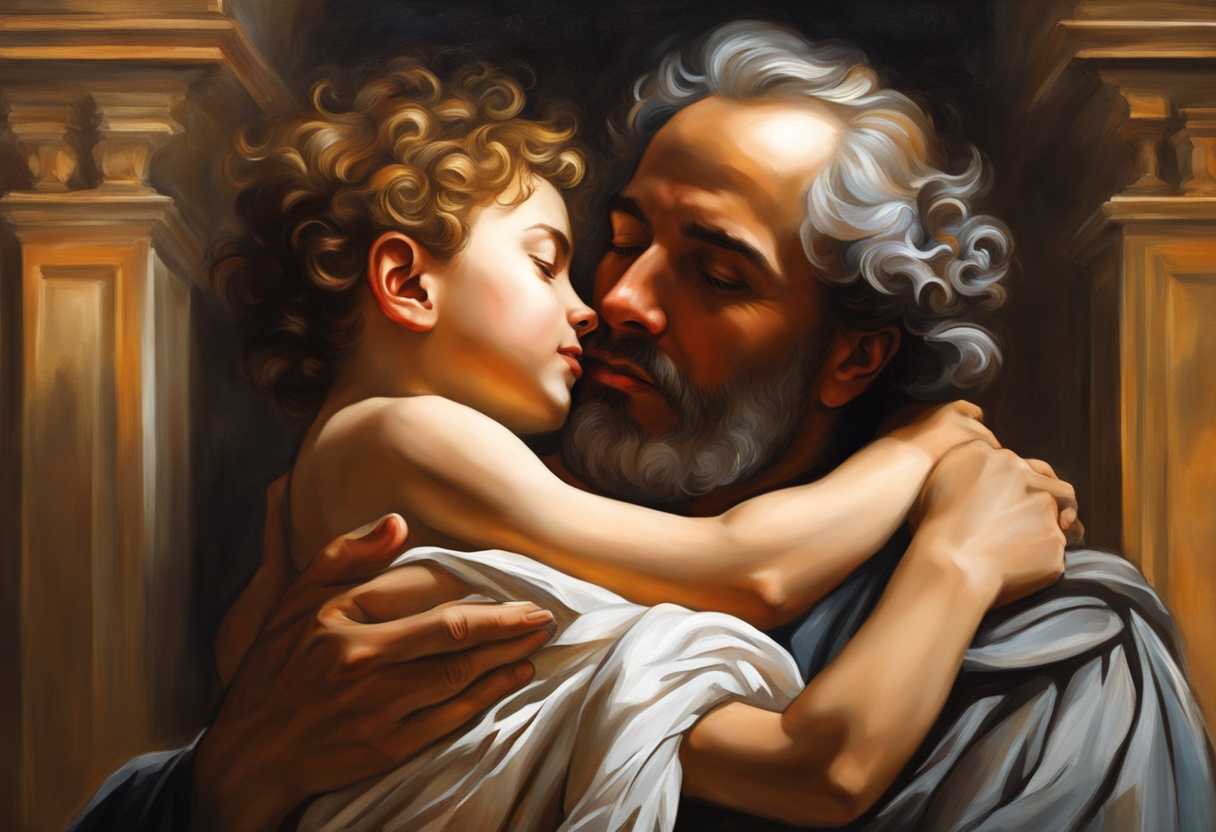
The Prodigal Son, found in Luke 15:11-32, represents themes of repentance, forgiveness, and the unconditional love of God. The parable illustrates how even those who stray away can return and be welcomed back with grace, emphasizing the joy in redemption.
Scripture
11 And he said, “There was a man who had two sons.
12 And the younger of them said to his father, ‘Father, give me the share of property that is coming to me.’ And he divided his property between them.
13 Not many days later, the younger son gathered all he had and took a journey into a far country, and there he squandered his property in reckless living.
14 And when he had spent everything, a severe famine arose in that country, and he began to be in need.
And he went and hired himself out to one of the citizens of that country, who sent him into his fields to feed pigs.
16 And he was longing to be fed with the pods that the pigs ate, and no one gave him anything.
17 “But when he came to himself, he said, ‘How many of my father’s hired servants have more than enough bread, but I perish here with hunger!
18 I will arise and go to my father, and I will say to him, “Father, I have sinned against heaven and before you.
19 I am no longer worthy to be called your son.
20 And he arose and came to his father. But while he was still a long way off, his father saw him and felt compassion, and ran and embraced him and kissed him.
21 And the son said to him, ‘Father, I have sinned against heaven and before you. I am no longer worthy to be called your son.’
22 But the father said to his servants, ‘Bring quickly the best robe, and put it on him, and put a ring on his hand, and shoes on his feet.
23 And bring the fattened calf and kill it, and let us eat and celebrate.
24 For this my son was dead, and is alive again; he was lost, and is found.’ And they began to celebrate.
25 “Now his older son was in the field, and as he came and drew near to the house, he heard music and dancing.”
26 And he called one of the servants and asked what these things meant.
27 And he said to him, ‘Your brother has come, and your father has killed the fattened calf, because he has received him back safe and sound.’
28 But he was angry and refused to go in. His father came out and entreated him.
29 but he answered his father, ‘Look, these many years I have served you, and I never disobeyed your command, yet you never gave me a young goat, that I might celebrate with my friends.
30 But when this son of yours came, who has devoured your property with prostitutes, you killed the fattened calf for him!’
31 And he said to him, ‘Son, you are always with me, and all that is mine is yours.
32 It was fitting to celebrate and be glad, for this your brother was dead, and is alive; he was lost, and is found.’”
Meaning of the Prodigal Son
The Parable of the Prodigal Son, as recounted in Luke 15:11-32, is a powerful illustration of themes such as repentance, forgiveness, and the overwhelming nature of God’s love. The narrative begins with the younger son demanding his inheritance prematurely, symbolizing a rejection of familial and divine authority (Luke 15:12). His subsequent squandering of resources in a distant land serves as a metaphor for sin and separation from God—a universal human experience. When the son finds himself destitute and desires to return, it reflects a genuine repentance and recognition of his shortcomings, underscoring the importance of humility as depicted in James 4:10, “Humble yourselves before the Lord, and he will lift you up.”
Upon the son’s return, the father’s reaction—running to him, embracing him, and celebrating his return—demonstrates the unconditional love and mercy of God (Luke 15:20-24). The contrast between the father’s joy and the older son’s resentment emphasizes how God’s grace is extended even to those who may feel deserving of it. This parable ultimately teaches that no one is beyond redemption and that God rejoices over every sinner who repents, as stated in Luke 15:10, “There is rejoicing in the presence of the angels of God over one sinner who repents.” The profound message reflects not just a personal journey towards forgiveness but also a broader theological understanding of the nature of God’s everlasting compassion towards humanity, reinforcing the call for believers to embody the same grace in their interactions with others.
The theme of reconciliation and restoration found in the Parable of the Prodigal Son resonates throughout the biblical narrative, highlighting the relational aspects of God’s interaction with humanity. The familial dynamics showcased in the parable might remind readers of the covenantal relationships seen in the Old Testament, particularly in the stories of Israel’s repeated unfaithfulness and eventual return to God. The narrative arc of Israel, from rebellion to exile and back to restoration, mirrors the prodigal’s journey, indicating a divine pattern of grace that is consistent throughout scripture. Such patterns reveal the heart of God as a steadfast and forgiving Father, yearning for the return of His children.
Furthermore, the notion of celebrating redemption extends into the teachings of Jesus, where acts of love and acceptance are central commitments of followers of Christ. This theme is echoed in the New Testament, where believers are called to reflect Christ’s love through acts of compassion and reconciliation among themselves. The call to forgive others as God forgives encapsulates the essence of the parable, urging Christians to embrace even those who have strayed, drawing them back into fellowship. This challenge not only highlights the necessity of community in the process of restoration but also calls upon believers to actively participate in the transformative work of grace that God performs in the lives of individuals. The celebration of redemption, both in heaven and within faith communities, serves to affirm the value of each person’s journey and the joy that comes from returning to the family of faith.
The Nature of Forgiveness and Redemption
The story of the Prodigal Son illustrates the profound nature of forgiveness and the possibility of redemption. It emphasizes that no matter how far one strays or how many mistakes one makes, there is always an opportunity for reconciliation. This narrative serves as a reminder that divine love is unconditional and that individuals can return to a state of grace, regardless of their past actions.
The Journey of Self-Discovery
The Prodigal Son’s journey is also a metaphor for self-discovery and personal growth. His experiences in a foreign land, marked by hardship and regret, lead him to a deeper understanding of himself and his values. This aspect of the story highlights the importance of recognizing one’s own shortcomings and the transformative power of humility and introspection.
The Dynamics of Family Relationships
The parable also explores the complexities of family relationships, particularly the themes of jealousy, acceptance, and unconditional love. The contrasting reactions of the father and the elder brother reveal the different ways individuals respond to forgiveness and grace. This dynamic encourages reflection on how familial bonds can be strained by resentment and how love can ultimately heal those rifts.
How to Embrace Forgiveness and Cultivate Grace in Life
Embracing forgiveness and cultivating grace in our lives is a transformative journey that reflects the heart of Christ. It begins with recognizing that we, too, are recipients of God’s boundless grace, which empowers us to extend that same grace to others. When someone wrongs us, it’s easy to hold onto resentment, but remember that forgiveness is not about excusing the behavior; it’s about freeing ourselves from the burden of anger and bitterness. Start by praying for the strength to forgive, and ask God to soften your heart. Reflect on the times you’ve needed forgiveness and how it felt to receive it. As you practice letting go of grudges, you’ll find that grace becomes a natural response in your interactions, allowing you to approach others with compassion and understanding. This journey may not always be easy, but with each step, you’ll find a deeper connection to God and a more profound peace within yourself.
Bible References to the Prodigal Son’s Meaning:

Reverend Ogunlade is a seasoned Church Minister with over three decades of experience in guiding and nurturing congregations. With profound wisdom and a serene approach, Reverend Ogunlade has carried out various pastoral duties, including delivering uplifting sermons, conducting religious ceremonies, and offering sage counsel to individuals seeking spiritual guidance. Their commitment to fostering harmony and righteousness within their community is exemplified through their compassionate nature, making them a beloved and trusted figure among the congregation.