
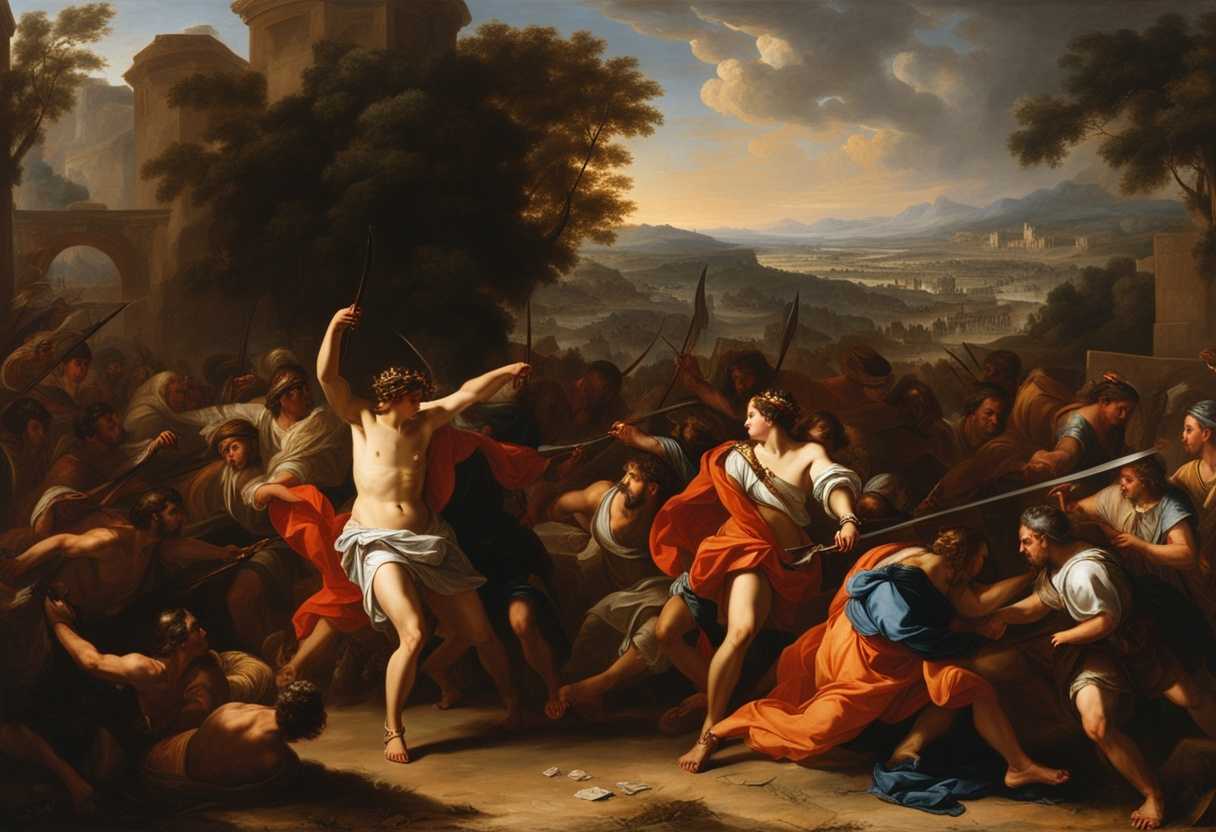
Keilah is a city mentioned in the Bible located in the territory of Judah. It is noted in 1 Samuel 23:1-5, where David defends it against the Philistines and seeks refuge there.
Scripture
6 When Abiathar the son of Ahimelech had fled to David to Keilah, he had come down with an ephod in his hand.
2 Therefore David inquired of the Lord, “Shall I go and attack these Philistines?” And the Lord said to David, “Go and attack the Philistines and save Keilah.”
3 But David’s men said to him, “Behold, we are afraid here in Judah; how much more then if we go to Keilah against the armies of the Philistines?”
4 Once again David inquired of the Lord, and the Lord answered him, “Go down to Keilah, for I am going to give the Philistines into your hand.”
5 So David and his men went to Keilah and fought with the Philistines and brought away their livestock and struck them with a great blow. So David saved the inhabitants of Keilah.
6 When Abiathar the son of Ahimelech had fled to David to Keilah, he had come down with an ephod in his hand.
7 Now it was told Saul that David had come to Keilah. And Saul said, “God has given him into my hand, for he has shut himself in by entering a town that has gates and bars.”
8 And Saul summoned all the people to war, to go down to Keilah, to besiege David and his men.
9 David knew that Saul was plotting harm against him. And he said to Abiathar the priest, “Bring the ephod here.”
10 And David said, “O Lord, the God of Israel, your servant has surely heard that Saul seeks to come to Keilah, to destroy the city on my account.
11 Will the men of Keilah surrender me into his hand? Will Saul come down, as your servant has heard? O Lord, the God of Israel, please tell your servant.” And the Lord said, “He will come down.”
Then David said, “Will the men of Keilah surrender me and my men into the hand of Saul?” And the Lord said, “They will surrender you.”
13 Then David and his men, who were about six hundred, arose and departed from Keilah, and they went wherever they could go. When Saul was told that David had escaped from Keilah, he gave up the expedition.
Location of Keilah in the Bible
The location of Keilah in the Bible carries significant theological and historical meaning, particularly in the context of David’s early leadership and the socio-political dynamics of Israel at that time. In 1 Samuel 23:1-5, we see David being informed that the Philistines were attacking Keilah and plundering the threshing floors. He consults the Lord and, after receiving divine guidance, takes action to rescue the city. This event not only underscores David’s character as a protector and leader but also highlights the role of divine guidance in his decision-making process. The urgent plea for help from Keilah represents the fragility of Israel’s territorial integrity during the Philistine incursions, illustrating the pressure that the Israelites faced from their rivals.
Additionally, the mention of Keilah encapsulates themes of refuge and community resistance against oppression. When David arrives, he is not just fighting for survival but is creating a stronghold of unity and faithfulness among the people of Israel. In 1 Samuel 23:5, after David successfully rescues Keilah, it serves as a reminder of God’s providence and the calling for Israel to stand against its enemies. The city symbolizes a microcosm of Israel’s struggle, reflecting broader themes of protection, divine intervention, and the establishment of a covenant community during tumultuous times. Through this narrative, Keilah emerges as an emblem of hope and resilience, affirming the importance of divine guidance in navigating conflict and fostering communal solidarity within Israel’s journey.
Keilah is further mentioned in 1 Samuel 30, showcasing its relevance in David’s life beyond the initial rescue. In this later narrative, David and his men return to find Ziklag, their own stronghold, devastated by the Amalekites. The geographical location of Keilah is of interest as it hints at the strategic significance of the city in the region—acting as a refuge for both David’s men and other displaced people at the time. Keilah’s positioning could be interpreted as a vital means of providing shelter and security during a period marked by instability and conflict, aligning with David’s evolving role as a leader amid constant threats from adversaries. This setting reinforces the strategic military importance of Keilah not just as a city, but as part of the broader landscape in the power struggles during the transition of Israel from a coalition of tribes to a unified monarchy.
Moreover, the mention of Keilah illustrates the intricate relationships between cities in the region, especially concerning loyalties and allegiances during turmoil. The city’s fate and interactions with neighboring entities, such as the Philistines and Amalekites, reflect the ongoing struggle for power and territorial claims in ancient Israel. Additionally, the references to Keilah in later texts, although less frequent, prompt considerations of the city’s symbolic role in the narrative of Israel’s identity and divine favor. The memory of Keilah as a location of refuge and resilience continues to resonate throughout biblical literature, serving as a testament to the themes of survival and God’s unwavering support for His people amidst worldly challenges. These narratives collectively feed into the theological discourse around divine providence and community, further enriching the biblical understanding of geography in the spiritual and historical context of Israel.
Strategic Military Importance
The location of Keilah serves as a significant military stronghold in the biblical narrative. Positioned in the territory of Judah, it was a fortified city that provided a strategic advantage for David during his time of conflict with Saul. The city’s geographical placement allowed for effective defense against enemy forces and served as a refuge for those seeking safety. This highlights the importance of geography in biblical warfare and the tactical decisions made by leaders based on the locations of cities.
Symbol of Divine Guidance
Keilah also represents a place where divine guidance is sought and received. David’s decision to go to Keilah was influenced by his inquiry of God, demonstrating the importance of seeking divine direction in times of uncertainty. This reflects a broader theme in the Bible where locations are not just physical spaces but also places of spiritual significance, where individuals can connect with God and receive clarity on their paths.
Community and Refuge
The city of Keilah symbolizes community and refuge for those in distress. As a city that provided shelter for David and his followers, it illustrates the role of cities in the biblical context as places of gathering and support. This aspect emphasizes the importance of community in the biblical narrative, where individuals come together for protection, sustenance, and shared purpose, reinforcing the idea that faith and fellowship are vital in times of adversity.
How to Seek Sanctuary and Uphold Faith in Challenges
In times of challenge, seeking sanctuary in your faith can be a profound source of strength and comfort. I encourage you to carve out moments of solitude where you can immerse yourself in prayer and scripture, allowing God’s word to wash over you and provide clarity. Remember, even Jesus sought refuge in prayer during His trials, demonstrating that it’s okay to lean into your faith when the storms of life rage. Surround yourself with a community of believers who can uplift and support you, sharing in both your burdens and joys. Embrace the practice of gratitude, reflecting on the blessings in your life, no matter how small, as this can shift your perspective and reinforce your faith. Trust that God is with you in every challenge, guiding you toward growth and resilience, and hold onto the promise that He will never leave you nor forsake you.
Bible References to the Location of Keilah:
1 Samuel 23:14-15: 14 And David remained in the strongholds in the wilderness, in the hill country of the wilderness of Ziph. And Saul sought him every day, but God did not give him into his hand.
15 David saw that Saul had come out to seek his life. David was in the wilderness of Ziph at Horesh.
1 Samuel 23:16-18: 16 And Jonathan, Saul’s son, rose and went to David at Horesh, and strengthened his hand in God.
17 And he said to him, “Do not fear, for the hand of Saul my father shall not find you. You shall be king over Israel, and I shall be next to you. Saul my father also knows this.”
18 And the two of them made a covenant before the Lord. David remained at Horesh, and Jonathan went home.
1 Samuel 23:19-20: Then the Ziphites went up to Saul at Gibeah, saying, “Is not David hiding among us in the strongholds at Horesh, on the hill of Hachilah, which is south of Jeshimon?”
20 Now come down, O king, according to all your heart’s desire to come down, and our part shall be to surrender him into the king’s hand.”
1 Samuel 23:21-23: 21 And Saul said, “May you be blessed by the Lord, for you have had compassion on me.
22 Please, go, make sure yet again. Know and see the place where his foot is, and who has seen him there, for it is told me that he is very cunning.
23 See therefore and take note of all the lurking places where he hides, and come back to me with sure information. Then I will go with you. And if he is in the land, I will search him out among all the thousands of Judah.”
1 Samuel 23:24-28: 24 And they arose and went to Ziph ahead of Saul. Now David and his men were in the wilderness of Maon, in the Arabah to the south of Jeshimon.
25 And Saul and his men went to seek him. And David was told, so he went down to the rock and lived in the wilderness of Maon. And when Saul heard that, he pursued after David in the wilderness of Maon.
26 And Saul went on one side of the mountain, and David and his men on the other side of the mountain. And David was hurrying to get away from Saul. As Saul and his men were closing in on David and his men to capture them,
27 But a messenger came to Saul, saying, “Hurry and come, for the Philistines have made a raid against the land.”
28 So Saul returned from pursuing after David and went against the Philistines. Therefore that place was called the Rock of Escape.
1 Samuel 23:29: 29 And David went up from there and lived in the strongholds of Engedi.
Nehemiah 3:17-18: 17 After him the Levites repaired, Rehum the son of Bani. Next to him Hashabiah, ruler of half the district of Keilah, repaired for his district.
18 After him their brothers repaired Bavvai the son of Henadad, ruler of half the district of Keilah.
Nehemiah 3:19-20: 19 Next to him Ezer the son of Jeshua, ruler of Mizpah, repaired another section opposite the ascent to the armory at the buttress.
20 After him Baruch the son of Zabbai repaired another section, from the buttress to the door of the house of Eliashib the high priest.
Nehemiah 3:21-22: 21 After him Meremoth the son of Uriah, son of Hakkoz repaired another section, from the door of the house of Eliashib to the end of the house of Eliashib.
22 And after him the priests, the men of the surrounding area,
Nehemiah 3:23-24: 23 After them Benjamin and Hasshub repaired opposite their house. After them Azariah the son of Maaseiah, son of Ananiah, repaired beside his own house.
24 After him Binnui the son of Henadad repaired another section, from the house of Azariah to the buttress.
Nehemiah 3:25-27: 25 Palal the son of Uzai repaired opposite the buttress and the tower projecting from the upper house of the king at the court of the guard.
26 and the temple servants living on Ophel repaired to a point opposite the Water Gate on the east and the projecting tower.
27 After them the Tekoites repaired another section opposite the great projecting tower as far as the wall of Ophel.

Reverend Ogunlade is a seasoned Church Minister with over three decades of experience in guiding and nurturing congregations. With profound wisdom and a serene approach, Reverend Ogunlade has carried out various pastoral duties, including delivering uplifting sermons, conducting religious ceremonies, and offering sage counsel to individuals seeking spiritual guidance. Their commitment to fostering harmony and righteousness within their community is exemplified through their compassionate nature, making them a beloved and trusted figure among the congregation.