
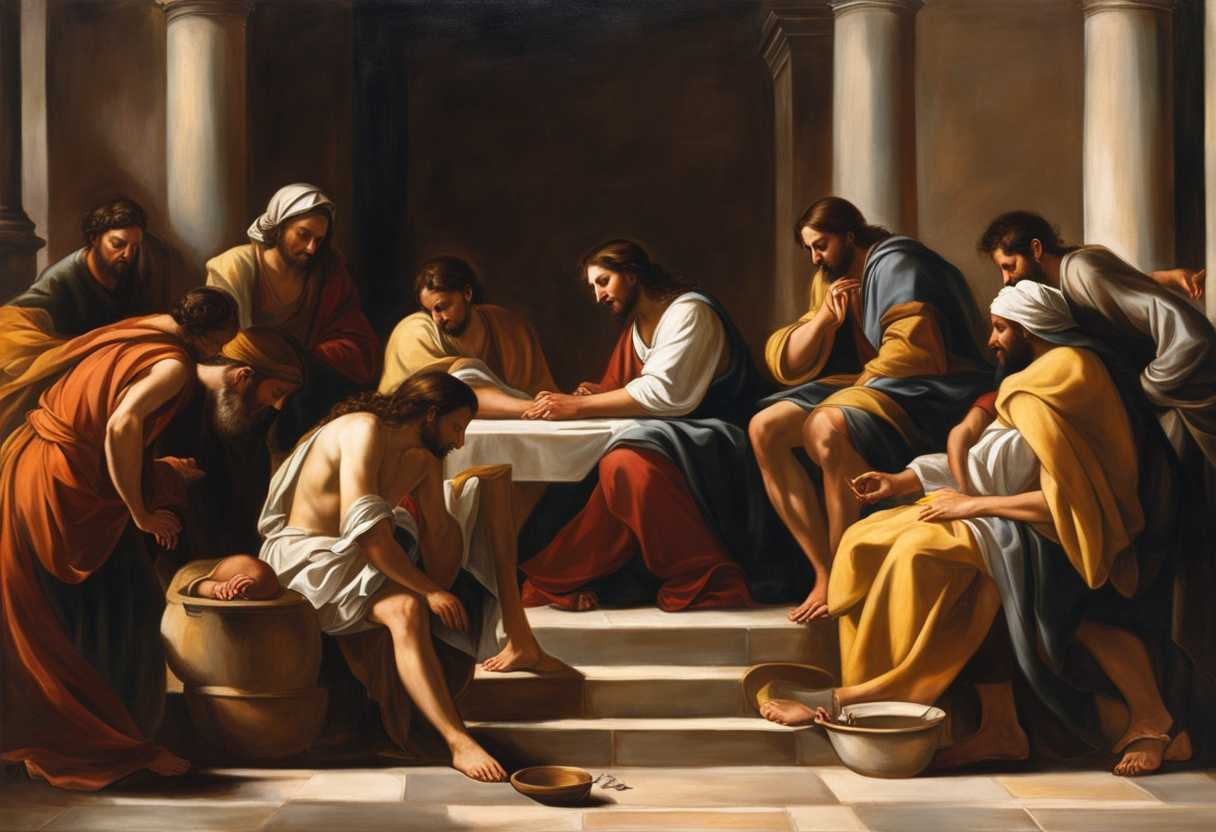
Washing feet in the Bible symbolizes humility and servitude, reflecting the act of Jesus washing His disciples’ feet as a demonstration of love and a call to serve one another (John 13:1-17). It signifies the importance of selflessness and caring for others in a community of faith.
Scripture
1 Now before the Feast of the Passover, when Jesus knew that his hour had come to depart out of this world to the Father, having loved his own who were in the world, he loved them to the end.
2 During supper, when the devil had already put it into the heart of Judas Iscariot, Simon’s son, to betray him,
3 Jesus, knowing that the Father had given all things into his hands, and that he had come from God and was going back to God,
4 rose from supper. He laid aside his outer garments, and taking a towel, tied it around his waist.
5 Then he poured water into a basin and began to wash the disciples’ feet and to wipe them with the towel that was wrapped around him.
6 He came to Simon Peter, who said to him, “Lord, do you wash my feet?”
7 Jesus answered him, “What I am doing you do not understand now, but afterward you will understand.”
8 Peter said to him, “You shall never wash my feet.” Jesus answered him, “If I do not wash you, you have no share with me.”
9 Simon Peter said to him, “Lord, not my feet only but also my hands and my head!”
10 Jesus said to him, “The one who has bathed does not need to wash, except for his feet, but is completely clean. And you are clean, but not every one of you.”
11 For he knew who was to betray him; that was why he said, “Not all of you are clean.”
12 When he had washed their feet and put on his outer garments and resumed his place, he said to them, “Do you understand what I have done to you?
13 You call me Teacher and Lord, and you are right, for so I am.
14 If I then, your Lord and Teacher, have washed your feet, you also ought to wash one another’s feet.
15 For I have given you an example, that you also should do just as I have done to you.
16 Truly, truly, I say to you, a servant is not greater than his master, nor is a messenger greater than the one who sent him.
17 If you know these things, blessed are you if you do them.
Biblical Significance of Washing Feet
The act of washing feet in the Bible extends beyond mere hygiene; it carries profound theological and ethical implications. In John 13:1-17, during the Last Supper, Jesus stoops to wash His disciples’ feet, a task typically reserved for the lowliest servant. This act serves as a powerful illustration of His love and humility, encapsulating the essence of His mission on earth. By performing this humble service, Jesus not only prepares His disciples for His imminent sacrifice but also redefines greatness in a Kingdom context—declaring that true leaders are those who serve others. He explicitly commands them in verse 15, “I have set you an example that you should do as I have done for you,” thereby inviting His followers to emulate His example of selfless love and service.
In a broader context, the meaning of foot-washing resonates deeply within the Christian community, emphasizing the call to serve one another in love and humility. It echoes throughout the New Testament, particularly in passages like Philippians 2:3-4, where believers are urged to “do nothing out of selfish ambition or vain conceit, but in humility consider others better than yourselves.” The metaphor of washing feet transcends the physical act, representing spiritual cleansing and accountability within the body of Christ (Ephesians 5:25-27). By engaging in acts of service and humility, believers embody the transformative love of Christ, nurturing a community marked by grace, unity, and sacrificial love. As such, foot-washing becomes a lasting emblem of a faith lived out through action, reminding the church to prioritize love and service as foundational tenets of Christian discipleship.
Beyond its immediate context, the symbolism of foot-washing is woven throughout the biblical narrative, highlighting themes of purification and service. In ancient Israel, washing feet was a common practice to remove the dust and grime accumulated during travel, symbolizing not only physical cleanliness but also spiritual readiness and a relationship with God. This ritual can be viewed through the lens of other ceremonial cleansings found in the Old Testament, such as the washing of hands or the purifying rituals outlined in Levitical law. Such acts underscored the importance of being ritually clean before entering sacred spaces, thereby emphasizing a broader call for believers to seek holiness and act righteously in their daily lives.
Additionally, foot-washing has implications for communal relationships within the early church. In the letters of Paul, for instance, various exhortations encourage mutual support and the bearing of one another’s burdens (Galatians 6:2). These teachings align with the ethos of foot-washing, which symbolizes both the need for humility and the importance of serving one another in practical ways. The early Christian community adopted a holistic understanding of service that encompassed both physical acts of care, like foot-washing, and spiritual nurturing. Thus, the act serves not only as a model for personal behavior but also fosters an atmosphere of support and unity among believers, reiterating that true fellowship in Christ is marked by an unwavering commitment to love, humility, and self-sacrifice. Through such interpretations, foot-washing embodies a commitment to walking the transformative path of servanthood that defines the very essence of being a follower of Christ.
Humility and Servanthood
Washing feet in the Bible symbolizes the profound humility and servanthood that believers are called to embody. In ancient times, foot washing was a common practice, especially in the context of hospitality, as people traveled on dusty roads wearing sandals. By performing this act, individuals demonstrated their willingness to serve others, putting aside their own status or comfort. This act of humility reflects the broader biblical principle that true greatness in the eyes of God is found in serving others selflessly.
Cleansing and Renewal
The act of washing feet also carries a deeper meaning of cleansing and renewal. In a spiritual context, it represents the need for believers to be cleansed from sin and impurities. Just as physical washing removes dirt, the metaphorical washing of feet signifies the process of repentance and the restoration of one’s relationship with God. This theme of cleansing is prevalent throughout the Bible, emphasizing the importance of spiritual renewal and the transformative power of grace.
Community and Fellowship
Washing feet serves as a powerful symbol of community and fellowship among believers. It illustrates the call to love and support one another within the body of Christ. By engaging in acts of service, such as foot washing, individuals foster a sense of unity and belonging. This practice encourages believers to look beyond their own needs and to actively participate in the lives of others, reinforcing the idea that the Christian faith is not just a personal journey but a communal experience rooted in love and mutual care.
How to Embrace Humility and Serve Like Christ
Embracing humility and serving like Christ is a transformative journey that begins with a heart open to self-reflection and a willingness to put others before ourselves. Jesus, the ultimate example of humility, washed the feet of His disciples, demonstrating that true greatness lies in serving rather than being served. To cultivate this spirit, start by practicing gratitude—acknowledge the blessings in your life and recognize that they are not solely your own doing. Engage in acts of service, whether big or small, and do so with a joyful heart, remembering that every act of kindness reflects Christ’s love. Surround yourself with a community that encourages humility, and be open to learning from others, regardless of their status. As you step into the shoes of a servant, you’ll find that humility not only deepens your relationship with God but also enriches your connections with those around you, allowing you to shine His light in a world that desperately needs it.
Bible References to Washing Feet:
1 Timothy 5:9-10: 9 Let a widow be enrolled if she is not less than sixty years of age, having been the wife of one husband,
10 and having a reputation for good works: if she has brought up children, has shown hospitality, has washed the feet of the saints, has cared for the afflicted, and has devoted herself to every good work.
Luke 7:36-50: 36 One of the Pharisees asked him to eat with him, and he went into the Pharisee’s house and reclined at table.
37 And behold, a woman of the city, who was a sinner, when she learned that he was reclining at table in the Pharisee’s house, brought an alabaster flask of ointment,
38 and standing behind him at his feet, weeping, she began to wet his feet with her tears and wiped them with the hair of her head and kissed his feet and anointed them with the ointment.
39 Now when the Pharisee who had invited him saw this, he said to himself, “If this man were a prophet, he would have known who and what sort of woman this is who is touching him, for she is a sinner.”
40 And Jesus answering said to him, “Simon, I have something to say to you.” And he answered, “Say it, Teacher.”
41 “A certain moneylender had two debtors. One owed five hundred denarii, and the other fifty.
42 When they could not pay, he cancelled the debt of both. Now which of them will love him more?”
43 Simon answered, “The one, I suppose, for whom he cancelled the larger debt.” And he said to him, “You have judged rightly.”
44 Then turning toward the woman he said to Simon, “Do you see this woman? I entered your house; you gave me no water for my feet, but she has wet my feet with her tears and wiped them with her hair.
45 You gave me no kiss, but from the time I came in she has not ceased to kiss my feet.
46 You did not anoint my head with oil, but she has anointed my feet with ointment.
47 Therefore I tell you, her sins, which are many, are forgiven—for she loved much. But he who is forgiven little, loves little.
48 And he said to her, “Your sins are forgiven.”
49 Then those who were at table with him began to say among themselves, “Who is this, who even forgives sins?”
50 And he said to the woman, “Your faith has saved you; go in peace.”
Genesis 18:1-8: 1 And the Lord appeared to him by the oaks of Mamre, as he sat at the door of his tent in the heat of the day.
2 He lifted up his eyes and looked, and behold, three men were standing in front of him. When he saw them, he ran from the tent door to meet them and bowed himself to the earth.
3 “My lord, if I have found favor in your sight, do not pass by your servant.”
4 Let a little water be brought, and wash your feet, and rest yourselves under the tree,
5 And I will bring a morsel of bread, that you may refresh yourselves, and after that you may pass on—since you have come to your servant.” So they said, “Do as you have said.”
6 And Abraham went quickly into the tent to Sarah and said, “Quick! Three seahs of fine flour! Knead it, and make cakes.”
7 And Abraham ran to the herd and took a calf, tender and good, and gave it to a young man, who prepared it quickly.
8 He took curds and milk and the calf that he had prepared, and set it before them. And he stood by them under the tree while they ate.
Exodus 30:17-21: 17 The Lord said to Moses,
18 “You shall also make a basin of bronze, with its stand of bronze, for washing. You shall put it between the tent of meeting and the altar, and you shall put water in it,”
19 With it you shall anoint the tent of meeting and the ark of the testimony,
20 When they go into the tent of meeting, or when they come near the altar to minister, to burn a food offering to the Lord, they shall wash with water, so that they may not die.
21 So they shall wash their hands and their feet, so that they may not die. It shall be a statute forever to them, even to him and to his offspring throughout their generations.”
1 Samuel 25:40-42: 40 When the servants of David came to Abigail at Carmel, they said to her, “David has sent us to you to take you to him as his wife.”
41 And she rose and bowed with her face to the ground and said, “Behold, your handmaid is a servant to wash the feet of the servants of my lord.”
42 And Abigail hurried and rose and mounted a donkey, and her five young women attended her. She followed the messengers of David and became his wife.
Matthew 15:1-20: 1 Then Pharisees and scribes came to Jesus from Jerusalem and said,
2 “Why do your disciples break the tradition of the elders? For they do not wash their hands when they eat.”
3 He answered them, “And why do you break the commandment of God for the sake of your tradition?
4 For God commanded, ‘Honor your father and your mother,’ and, ‘Whoever reviles father or mother must surely die.’
5 But you say, ‘Whoever tells his father or his mother, “Whatever you would have gained from me is a gift for God”—
6 he need not honor his father. So for the sake of your tradition you have made void the word of God.
7 You hypocrites! Well did Isaiah prophesy of you, when he said:
8 “‘This people honors me with their lips,
but their heart is far from me;
9 in vain do they worship me, teaching as doctrines the commandments of men.
10 And he called the people to him and said to them, “Hear and understand:
11 it is not what goes into the mouth that defiles a person, but what comes out of the mouth; this defiles a person.
12 Then the disciples came and said to him, “Do you know that the Pharisees were offended when they heard this saying?”
13 He answered, “Every plant that my heavenly Father has not planted will be rooted up.
14 Let them alone; they are blind guides. And if the blind lead the blind, both will fall into a pit.
15 But Peter said to him, “Explain the parable to us.”
16 And he said, “Are you also still without understanding?
17 Do you not see that whatever goes into the mouth passes into the stomach and is expelled?
18 But what comes out of the mouth proceeds from the heart, and this defiles a person.
19 For out of the heart come evil thoughts, murder, adultery, sexual immorality, theft, false witness, slander.
20 These are what defile a person. But to eat with unwashed hands does not defile anyone.”
Mark 7:1-23: 1 Now when the Pharisees gathered to him, with some of the scribes who had come from Jerusalem,
2 they saw that some of his disciples ate with hands that were defiled, that is, unwashed.
3 (For the Pharisees and all the Jews do not eat unless they wash their hands properly, holding to the tradition of the elders,
4 and when they come from the marketplace, they do not eat unless they wash. And there are many other traditions that they observe, such as the washing of cups and pots and copper vessels and dining couches.
5 And the Pharisees and the scribes asked him, “Why do your disciples not walk according to the tradition of the elders, but eat with defiled hands?”
6 And he said to them, “Well did Isaiah prophesy of you hypocrites, as it is written, “‘This people honors me with their lips, but their heart is far from me;
7 in vain do they worship me, teaching as doctrines the commandments of men.
8 You leave the commandment of God and hold to the tradition of men.
9 And he said to them, “You have a fine way of rejecting the commandment of God in order to establish your tradition!
10 For Moses said, ‘Honor your father and your mother’; and, ‘Whoever reviles father or mother must surely die.’
11 But you say, ‘If a man tells his father or his mother, “Whatever you would have gained from me is Corban”’ (that is, given to God)—
12 then you no longer permit him to do anything for his father or mother,
13 thus making void the word of God by your tradition that you have handed down. And many such things you do.”
14 And he called the people to him again and said to them, “Hear me, all of you, and understand:
15 There is nothing outside a person that by going into him can defile him, but the things that come out of a person are what defile him.
16 If anyone has ears to hear, let him hear.”
17 And when he had entered the house and left the people, his disciples asked him about the parable.
18 And he said to them, “Then are you also without understanding? Do you not see that whatever goes into a person from outside cannot defile him,
19 since it enters not his heart but his stomach, and is expelled?” (Thus he declared all foods clean.)
20 And he said, “What comes out of a person is what defiles him.
21 For from within, out of the heart of man, come evil thoughts, sexual immorality, theft, murder, adultery,
22 coveting, wickedness, deceit, sensuality, envy, slander, pride, foolishness.
23 All these evil things come from within, and they defile a person.”
John 12:1-8: 1 Six days before the Passover, Jesus therefore came to Bethany, where Lazarus was, whom Jesus had raised from the dead.
2 So they gave a dinner for him there. Martha served, and Lazarus was one of those reclining with him at table.
3 Mary therefore took a pound of expensive ointment made from pure nard, and anointed the feet of Jesus and wiped his feet with her hair. The house was filled with the fragrance of the perfume.
4 But Judas Iscariot, one of his disciples (he who was about to betray him), said,
5 “Why was this ointment not sold for three hundred denarii and given to the poor?”
6 He said this, not because he cared about the poor, but because he was a thief, and having charge of the moneybag he used to help himself to what was put into it.
7 Jesus said, “Leave her alone, so that she may keep it for the day of my burial.”
8 For the poor you always have with you, but you do not always have me.”
Acts 16:11-15: 11 So, setting sail from Troas, we made a direct voyage to Samothrace, and the following day to Neapolis,
12 and from there to Philippi, which is a leading city of the district of Macedonia and a Roman colony. We remained in this city some days.
13 And on the Sabbath day we went outside the gate to the riverside, where we supposed there was a place of prayer, and we sat down and spoke to the women who had come together.
14 One who heard us was a woman named Lydia, from the city of Thyatira, a seller of purple goods, who was a worshiper of God. The Lord opened her heart to pay attention to what was said by Paul.
15 And after she was baptized, and her household as well, she urged us, saying, “If you have judged me to be faithful to the Lord, come to my house and stay.” And she prevailed upon us.

Reverend Michael Johnson is an experienced Church Minister with a profound expertise in spirituality and guidance. With a serene presence and a compassionate heart, he has faithfully served his congregation for over 20 years, leading them on a spiritual journey towards inner peace and enlightenment. Reverend Johnson’s extensive knowledge of religious philosophies and profound understanding of human nature have made him a trusted confidant and mentor to many, as he seamlessly weaves his profound wisdom into life teachings. Reverend Johnson’s calming demeanor and empathetic nature continue to uplift and heal souls, nurturing a sense of unity and tranquility within his community.