
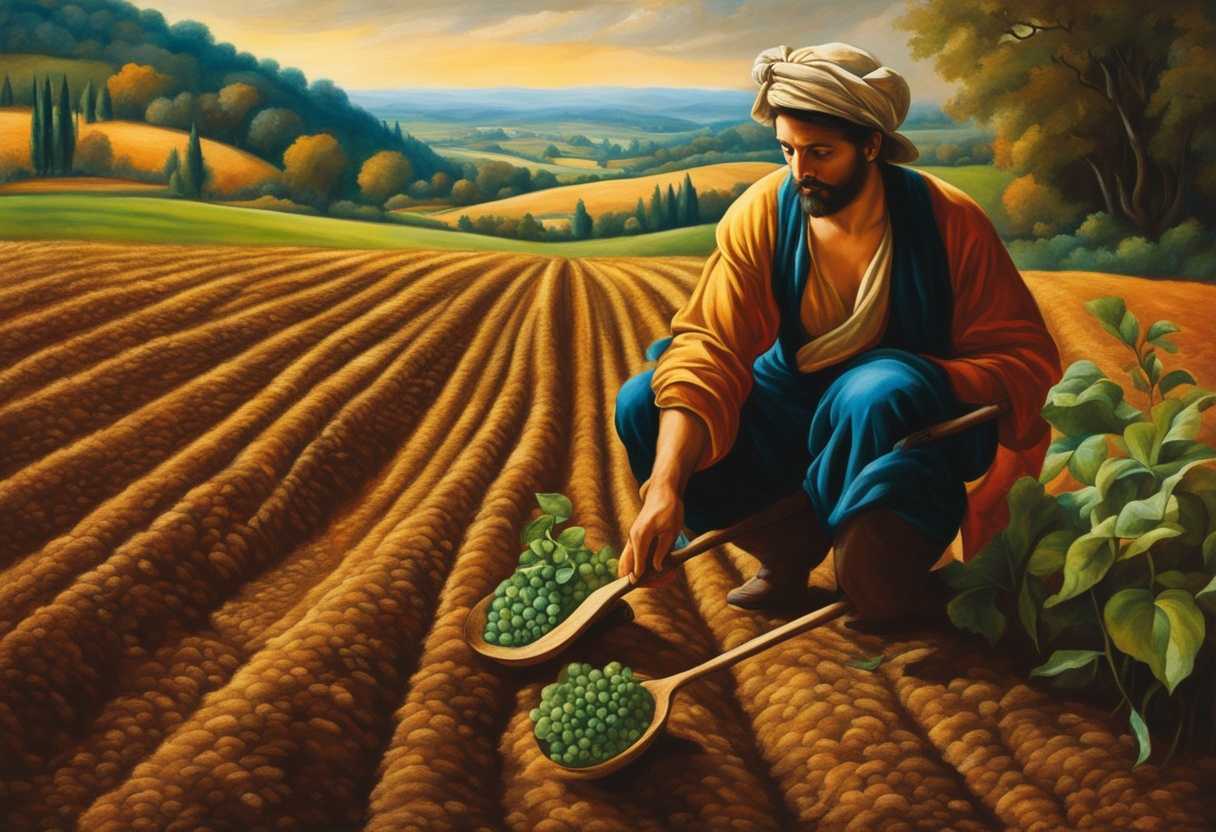
In the Bible, sowing often symbolizes the act of planting spiritual truths or teachings, while seeds represent the potential for growth and transformation in one’s faith or actions (e.g., Galatians 6:7-8). The Parable of the Sower (Matthew 13:1-23) illustrates how different types of soil (hearts) receive the seed (word of God), impacting their spiritual fruitfulness.
Scripture
22 While the earth remains, seedtime and harvest, cold and heat, summer and winter, day and night, shall not cease.
Biblical Significance of Sowing and Seeds
The Biblical concept of sowing and seeds intricately intertwines with themes of faith, spiritual growth, and divine purpose. In Galatians 6:7-8, the idea of sowing what one reaps underscores a moral and spiritual law: “A man reaps what he sows.” This verse highlights that the actions and intentions we cultivate influence the spiritual harvest we ultimately experience, suggesting that righteous deeds and faithfulness yield eternal life, while sowing to the flesh leads to corruption. This principle invites believers to be mindful of how they invest their lives—fostering a life punctuated by service, kindness, and adherence to God’s will.
Moreover, the Parable of the Sower in Matthew 13:1-23 further elaborates on this theme by illustrating how the reception of God’s word varies based on the condition of one’s heart—likened to different types of soil. The seeds that fall on the path, rocky places, thorny ground, and good soil symbolize how individuals respond to Biblical teachings. While some seeds fail to thrive due to external or internal obstacles, others flourish, producing an abundant harvest. This parable emphasizes that spiritual growth requires a receptive heart, diligent nurturing of faith, and an environment where God’s truth can take root. Thus, sowing and seeds not only pertain to the individual believer’s journey but also serve as a metaphor for the expansive nature of God’s kingdom, illustrating how transformative faith can bear fruit within various contexts and lives.
The Biblical imagery of sowing and seeds extends to the overarching theme of generational impact and the establishment of God’s kingdom on earth. In the Old Testament, the concept of sowing is often linked with the promise of inheritance—a seed not only represents the potential for growth and abundance but also the continuation of God’s covenant across generations. For instance, the promise made to Abraham included the assurance that his descendants would be as numerous as the stars in the sky, emphasizing that faith is sown not just for personal gain but for the legacy of faith to permeate families and nations. This illustrates the principle that nurturing one’s faith can have far-reaching implications, rippling through both present and future generations.
Additionally, the metaphor of seeds is captured in the teachings of Jesus, where He emphasizes the transformative power of even the smallest seeds, like the mustard seed, which grows into a mighty tree. This idea conveys the notion that faith, no matter how small, can lead to significant outcomes when nurtured appropriately. It highlights that in the economy of God’s kingdom, the seemingly insignificant acts of love, compassion, and obedience have the potential to yield an extraordinary harvest beyond what one might imagine. Thus, the act of sowing extends beyond mere actions; it embodies a lifestyle of faith that invites the Lord to cultivate in us an enduring legacy of righteousness, love, and influence that contributes to the flourishing of His kingdom on earth.
The Principle of Reaping What You Sow
In the Bible, the act of sowing seeds often symbolizes the principle of reaping what you sow. This concept emphasizes that the actions and choices individuals make will ultimately yield corresponding results, whether positive or negative. It serves as a reminder that one’s behavior, whether virtuous or sinful, will have consequences that manifest in life. This principle encourages individuals to be mindful of their actions, as they will eventually bear fruit in their lives.
Spiritual Growth and Transformation
Sowing and seeds also represent the process of spiritual growth and transformation. Just as seeds must be planted, nurtured, and cultivated to grow into fruitful plants, individuals must engage in spiritual practices, such as prayer, study, and community, to develop their faith. This metaphor illustrates the journey of believers as they grow in their relationship with God, emphasizing that spiritual maturity requires time, effort, and the right conditions for growth.
The Kingdom of God
Another broader meaning of sowing and seeds in the Bible relates to the expansion of the Kingdom of God. The act of sowing can be seen as the spreading of the Gospel and the message of Christ, which is likened to seeds being scattered across different soils. This imagery highlights the idea that the Kingdom of God grows through the faithful sharing of God’s word, and that the reception of this message varies among individuals, leading to different levels of spiritual fruitfulness. This underscores the importance of evangelism and the transformative power of faith in the lives of believers and their communities.
How to Nurture Your Faith for a Flourishing Life
Nurturing your faith is like tending to a garden; it requires intention, patience, and a willingness to cultivate the right conditions for growth. Start by immersing yourself in Scripture, allowing the Word to speak to your heart and guide your actions. Prayer is your lifeline—make it a daily practice, not just a ritual, but a heartfelt conversation with God where you share your joys, struggles, and desires. Surround yourself with a community of believers who uplift and challenge you, as fellowship can provide the support and encouragement we all need on our journey. Remember to serve others, for in giving, we often find our own faith deepening. Lastly, take moments of silence to reflect and listen; sometimes, the most profound growth happens in the stillness. By nurturing your faith in these ways, you’ll find that your life flourishes in ways you never imagined, rooted in love, hope, and purpose.
Bible References to Sowing and Seeds:
Matthew 13:3-9: 3 And he told them many things in parables, saying: “A sower went out to sow.
4 And as he sowed, some seeds fell along the path, and the birds came and devoured them.
5 Other seeds fell on rocky ground, where they did not have much soil, and immediately they sprang up, since they had no depth of soil,
6 But when the sun rose, they were scorched, and since they had no root, they withered away.
7 Other seeds fell among thorns, and the thorns grew up and choked them.
8 Other seeds fell on good soil and produced grain, some a hundredfold, some sixty, some thirty.
9 He who has ears, let him hear.
Mark 4:26-29: 26 And he said, “The kingdom of God is as if a man should scatter seed on the ground.
27 He sleeps and rises night and day, and the seed sprouts and grows; he knows not how.
28 The earth produces by itself, first the blade, then the ear, then the full grain in the ear.
29 But when the grain is ripe, at once he puts in the sickle, because the harvest has come.
Luke 8:11-15: 11 Now the parable is this: The seed is the word of God.
12 The ones along the path are those who have heard; then the devil comes and takes away the word from their hearts, so that they may not believe and be saved.
13 And the ones on the rock are those who, when they hear the word, receive it with joy. But these have no root; they believe for a while, and in time of testing fall away.
14 And as for what fell among the thorns, they are those who hear, but as they go on their way they are choked by the cares and riches and pleasures of life, and their fruit does not mature.
15 As for that in the good soil, they are those who, hearing the word, hold it fast in an honest and good heart, and bear fruit with patience.
2 Corinthians 9:6-10: 6 The point is this: whoever sows sparingly will also reap sparingly, and whoever sows bountifully will also reap bountifully.
7 Each one must give as he has decided in his heart, not reluctantly or under compulsion, for God loves a cheerful giver.
8 And God is able to make all grace abound to you, so that having all sufficiency in all things at all times, you may abound in every good work.
8 And God is able to make all grace abound to you, so that having all sufficiency in all things at all times, you may abound in every good work.
10 He who supplies seed to the sower and bread for food will supply and multiply your seed for sowing and increase the harvest of your righteousness.
Galatians 6:7-9: 7 Do not be deceived: God is not mocked, for whatever one sows, that will he also reap.
8 For the one who sows to his own flesh will from the flesh reap corruption, but the one who sows to the Spirit will from the Spirit reap eternal life.
9 And let us not grow weary of doing good, for in due season we will reap, if we do not give up.
Hosea 10:12-12: 12 Sow for yourselves righteousness; reap steadfast love; break up your fallow ground, for it is the time to seek the Lord, that he may come and rain righteousness upon you.
Ecclesiastes 11:6-6: 6 In the morning sow your seed, and at evening withhold not your hand, for you do not know which will prosper, this or that, or whether both alike will be good.
Isaiah 55:10-11: 10 “For as the rain and the snow come down from heaven and do not return there but water the earth, making it bring forth and sprout, giving seed to the sower and bread to the eater,”
11 so shall my word be that goes out from my mouth; it shall not return to me empty, but it shall accomplish that which I purpose, and shall succeed in the thing for which I sent it.
James 3:18-18: 18 And a harvest of righteousness is sown in peace by those who make peace.
Psalm 126:5-6: 5 Those who sow in tears shall reap with shouts of joy!
6 He who goes out weeping, bearing the seed for sowing, shall come home with shouts of joy, bringing his sheaves with him.
Proverbs 11:18-18: 18 The wicked earns deceptive wages, but one who sows righteousness gets a sure reward.
1 Corinthians 3:6-9: 6 I planted, Apollos watered, but God gave the growth.
7 So neither he who plants nor he who waters is anything, but only God who gives the growth.
8 He who plants and he who waters are one, and each will receive his wages according to his labor.
9 For we are God’s fellow workers. You are God’s field, God’s building.
Matthew 13:24-30: 24 He put another parable before them, saying, “The kingdom of heaven may be compared to a man who sowed good seed in his field,
25 but while his men were sleeping, his enemy came and sowed weeds among the wheat and went away.
26 But when the plants sprouted and bore grain, then the weeds appeared also.
27 And the servants of the master of the house came and said to him, ‘Master, did you not sow good seed in your field? How then does it have weeds?’
28 He said to them, ‘An enemy has done this.’ So the servants said to him, ‘Then do you want us to go and gather them?’
29 But he said, ‘No, lest in gathering the weeds you root up the wheat along with them.
30 Let both grow together until the harvest, and at harvest time I will tell the reapers, “Gather the weeds first and bind them in bundles to be burned, but gather the wheat into my barn.”
John 12:24-25: 24 Truly, truly, I say to you, unless a grain of wheat falls into the earth and dies, it remains alone; but if it dies, it bears much fruit.
25 Whoever loves his life loses it, and whoever hates his life in this world will keep it for eternal life.

Reverend Michael Johnson is an experienced Church Minister with a profound expertise in spirituality and guidance. With a serene presence and a compassionate heart, he has faithfully served his congregation for over 20 years, leading them on a spiritual journey towards inner peace and enlightenment. Reverend Johnson’s extensive knowledge of religious philosophies and profound understanding of human nature have made him a trusted confidant and mentor to many, as he seamlessly weaves his profound wisdom into life teachings. Reverend Johnson’s calming demeanor and empathetic nature continue to uplift and heal souls, nurturing a sense of unity and tranquility within his community.