
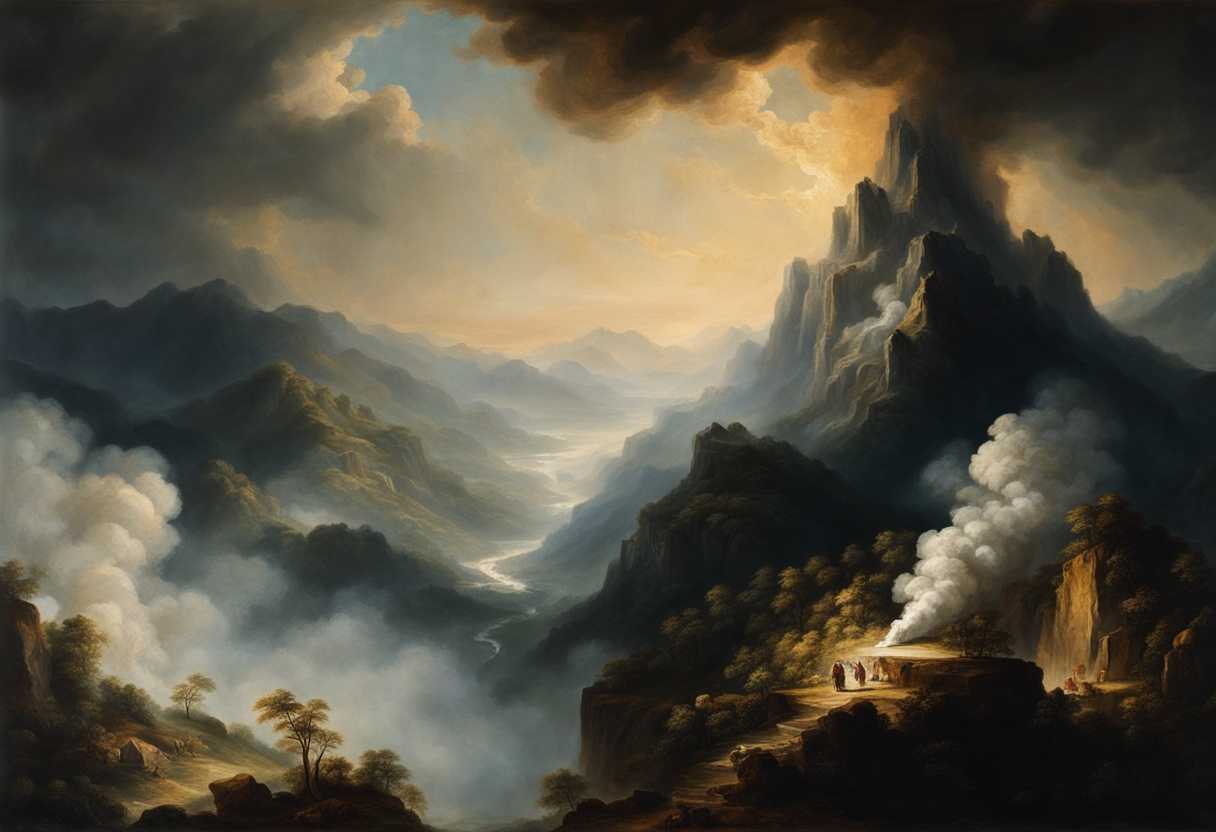
In the Bible, smoke often symbolizes the presence of God, divine judgment, or destruction. For example, in Exodus 19:18, smoke represents God’s presence on Mount Sinai, while in Revelation 9:2, smoke signifies chaos and judgment.
Scripture
16 On the morning of the third day there were thunders and lightnings and a thick cloud on the mountain and a very loud trumpet blast, so that all the people in the camp trembled.
17 Then Moses brought the people out of the camp to meet God, and they took their stand at the foot of the mountain.
18 Now Mount Sinai was wrapped in smoke because the Lord had descended on it in fire. The smoke of it went up like the smoke of a kiln, and the whole mountain trembled greatly.
19 As the sound of the trumpet grew louder and louder, Moses spoke, and God answered him in thunder.
Biblical Significance of Smoke
In the Bible, smoke serves as a profound symbol that encompasses both the divine and the catastrophic. In Exodus 19:18, the manifestation of smoke on Mount Sinai signifies the holiness and majesty of God’s presence as He descends to deliver the Law. The thick smoke and the rumblings indicate not just physical phenomena but also the fear and awe that accompany an encounter with the divine. This notion is further reinforced in Isaiah 6:4, where the smoke in the temple represents the glory of the Lord, filling the space and demonstrating His overwhelming power.
Conversely, smoke also embodies themes of destruction and divine judgment. In Revelation 9:2, smoke is depicted as rising from the abyss, heralding chaos and the ensuing tribulations of the end times. This imagery indicates a judgment meant for the unrepentant, confirming that smoke often symbolizes the judgment of God. The duality of smoke in these contexts highlights the complexity of God’s character—His invitation to draw near in holiness and His readiness to judge in righteousness. Together, these verses illustrate that smoke is a multifaceted symbol within the biblical narrative, linking the divine presence with the reality of judgment and chaos in the world.
Continuing the theme of smoke’s significance, it is important to recognize its role in representing purification and sacrifice. Throughout the Old Testament, the act of burning offerings produces smoke that ascends to God, symbolizing the people’s devotion and the purification of their sins. For instance, the smoke rising from the altar during sacrifices reflects not only the acceptance of the offering by God but also serves as an aesthetic manifestation of repentance and atonement. This divine acceptance is crucial, as it illustrates the intended relationship between the worshippers and their Creator, where the smoke serves as a tangible connection during sacred rites.
Additionally, smoke can signify the presence and activity of God in moments of guidance and protection. In the form of a pillar of smoke during the exodus of the Israelites, it acted as a divine guide through the wilderness, shielding them from the attacks of their enemies and leading them toward the Promised Land. The smoke not only represents God’s protective nature but also his continual guidance throughout their journey, suggesting that even in times of uncertainty, His presence provides assurance and direction. Through these layers of meaning, smoke in scripture conveys a rich theological narrative that encompasses themes of purification, sacrifice, guidance, and the ever-present tension between divine mercy and judgment.
Divine Presence and Glory
In the Bible, smoke often symbolizes the presence and glory of God. It serves as a physical manifestation of the divine, indicating that God is near or actively involved in a situation. This connection between smoke and the divine presence highlights the awe and reverence that should accompany encounters with the sacred. The appearance of smoke can evoke a sense of mystery and majesty, reminding believers of the transcendence of God and the holiness that surrounds Him.
Judgment and Destruction
Smoke is also associated with judgment and destruction in biblical narratives. It frequently appears in contexts where divine judgment is executed, serving as a sign of God’s wrath or the consequences of sin. The imagery of smoke rising from destruction can symbolize the end of something that was once alive or flourishing, illustrating the seriousness of divine retribution. This aspect of smoke serves as a warning to humanity about the consequences of turning away from God and the importance of repentance.
Transformation and Purification
Another significant meaning of smoke in the Bible relates to transformation and purification. Smoke can represent the process of refining or purifying, as seen in the imagery of offerings and sacrifices. The rising smoke from burnt offerings symbolizes the acceptance of these gifts by God and the purification of the worshiper. This transformative aspect of smoke underscores the themes of redemption and the possibility of renewal, emphasizing that through divine intervention, individuals can be cleansed and restored.
How to Embrace Divine Guidance for Spiritual Growth
Embracing divine guidance for spiritual growth is a beautiful journey that invites us to open our hearts and minds to the whispers of God in our daily lives. Start by cultivating a habit of prayer and meditation, creating sacred space where you can listen for His voice amidst the noise of the world. As you read Scripture, allow the words to resonate deeply within you, seeking understanding and application in your own life. Surround yourself with a community of believers who can encourage and challenge you, sharing insights and experiences that illuminate your path. Remember, divine guidance often comes in unexpected ways—through a kind word, a moment of stillness, or even a challenge that pushes you to grow. Trust that God is always present, gently nudging you toward a deeper relationship with Him, and be open to the transformative power of His love as you navigate your spiritual journey.
Bible References to the Significance of Smoke:
Leviticus 16:12-13: 12 And he shall take a censer full of coals of fire from the altar before the Lord, and two handfuls of sweet incense beaten small, and he shall bring it inside the veil
13 and put the incense on the fire before the Lord, that the cloud of the incense may cover the mercy seat that is over the testimony, so that he does not die.
1 Kings 8:10-11: 10 And when the priests came out of the Holy Place, a cloud filled the house of the Lord,
11 so that the priests could not stand to minister because of the cloud, for the glory of the Lord filled the house of the Lord.
Psalm 18:7-9: 7 Then the earth reeled and rocked; the foundations also of the mountains trembled and quaked, because he was angry.
8 Smoke went up from his nostrils, and devouring fire from his mouth; glowing coals flamed forth from him.
9 He bowed the heavens and came down; thick darkness was under his feet.
Isaiah 6:3-4: 3 And one called to another and said: “Holy, holy, holy is the Lord of hosts; the whole earth is full of his glory!”
4 And the foundations of the thresholds shook at the voice of him who called, and the house was filled with smoke.
Isaiah 14:30-31: 30 The firstborn of the poor will graze,
and the needy will lie down in safety;
but I will kill your root with famine,
and your remnant it will slay.
31 Wail, O gate; cry out, O city; melt in fear, O Philistia, all of you! For smoke comes out of the north, and there is no straggler in his ranks.
Isaiah 34:9-10: 9 And the streams of Edom shall be turned into pitch,
and her soil into sulfur;
her land shall become burning pitch.
10 Night and day it shall not be quenched; its smoke shall go up forever. From generation to generation it shall lie waste; none shall pass through it forever and ever.
Joel 2:30-31: 30 “And I will show wonders in the heavens and on the earth, blood and fire and columns of smoke.”
31 The sun shall be turned to darkness, and the moon to blood, before the great and awesome day of the Lord comes.
Revelation 8:3-5: 3 And another angel came and stood at the altar with a golden censer, and he was given much incense to offer with the prayers of all the saints on the golden altar before the throne,
4 And the smoke of the incense, with the prayers of the saints, rose before God from the hand of the angel.
5 Then the angel took the censer and filled it with fire from the altar and threw it on the earth, and there were peals of thunder, rumblings, flashes of lightning, and an earthquake.
Revelation 9:1-3: 1 And the fifth angel blew his trumpet, and I saw a star fallen from heaven to earth, and he was given the key to the shaft of the bottomless pit.
2 He opened the shaft of the bottomless pit, and from the shaft rose smoke like the smoke of a great furnace, and the sun and the air were darkened with the smoke from the shaft.
3 Then from the smoke came locusts on the earth, and they were given power like the power of scorpions of the earth.
Revelation 15:7-8: 7 And one of the four living creatures gave to the seven angels seven golden bowls full of the wrath of God who lives forever and ever,
8 and the sanctuary was filled with smoke from the glory of God and from his power, and no one could enter the sanctuary until the seven plagues of the seven angels were finished.
Revelation 19:2-3: 2 for his judgments are true and just; for he has judged the great prostitute who corrupted the earth with her immorality, and has avenged on her the blood of his servants.”
3 Once more they cried out, “Hallelujah! The smoke from her goes up forever and ever.”

Reverend Ogunlade is a seasoned Church Minister with over three decades of experience in guiding and nurturing congregations. With profound wisdom and a serene approach, Reverend Ogunlade has carried out various pastoral duties, including delivering uplifting sermons, conducting religious ceremonies, and offering sage counsel to individuals seeking spiritual guidance. Their commitment to fostering harmony and righteousness within their community is exemplified through their compassionate nature, making them a beloved and trusted figure among the congregation.