
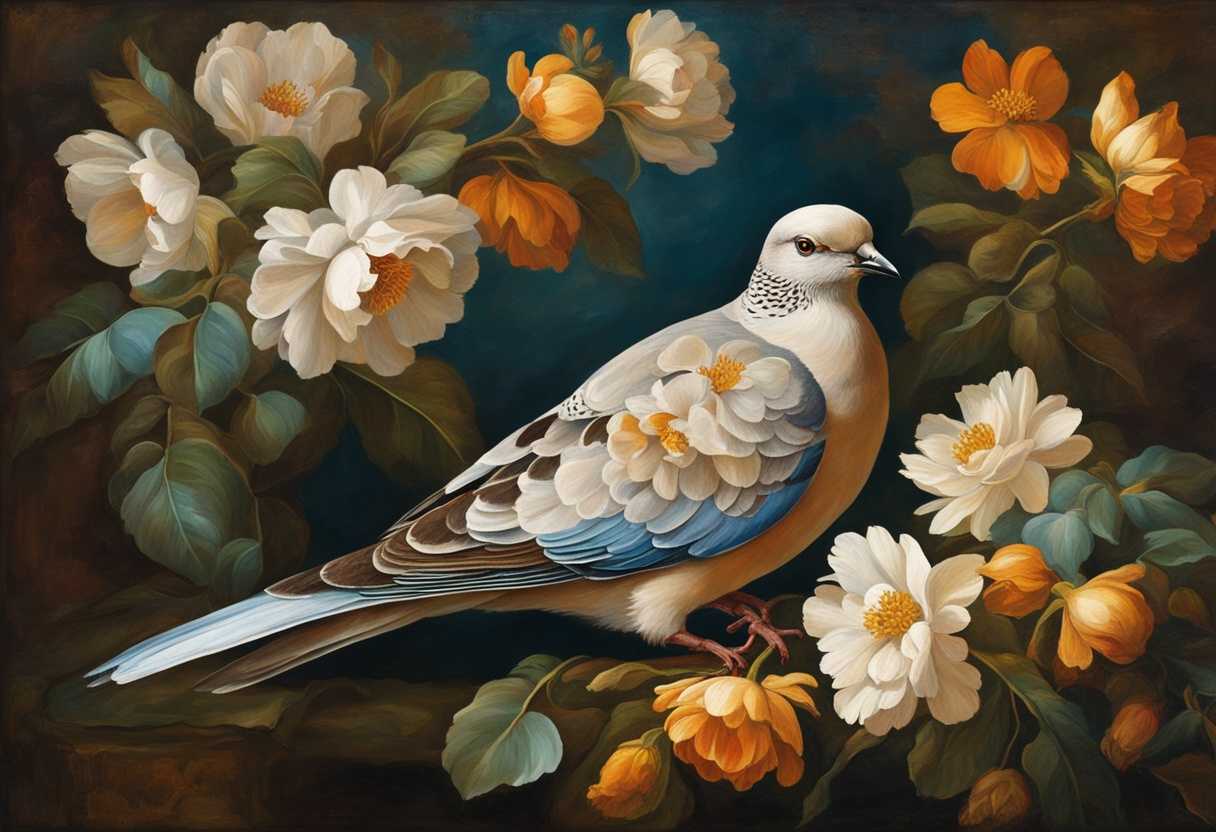
In the Bible, the turtledove is often associated with purity and sacrifice; it was used in rituals for atonement and as an offering by those who could not afford larger animals (Leviticus 12:6-8). Additionally, in the Song of Solomon, the turtledove symbolizes love and beauty, reflecting a sense of longing and connection (Song of Solomon 2:12).
Scripture
14 “If his offering to the Lord is a burnt offering of birds, then he shall bring his offering of turtledoves or pigeons.”
15 And the priest shall bring it to the altar and wring off its head and burn it on the altar. Its blood shall be drained out on the side of the altar.
16 And he shall remove its crop with its contents and cast it beside the altar on the east side, in the place for ashes.
17 It shall be a statute forever throughout your generations, in all your dwelling places, that you eat neither fat nor blood.
Significance of Turtledove in the Bible
The turtledove in the Bible carries rich symbolism that transcends mere physical representation, embodying themes of purity, sacrifice, love, and renewal. In Leviticus 12:6-8, the turtledove served as a vital component of the purification ritual for women after childbirth, highlighting its association with inner purity and spiritual cleansing. The use of turtledoves as offerings for those who could not afford larger sacrifices underscores a broader theological theme of accessibility and mercy in God’s covenantal relationship with His people. This further reflects the biblical principle that heart and intent matter more than material wealth, allowing all to approach God in humility and repentance.
Moreover, the turtledove holds a poignant place in the Song of Solomon, which celebrates love and desire, suggesting the deep connection between lovers, much like that between God and His people. In Song of Solomon 2:12, the call of the turtledove signals the arrival of spring and the symbolic renewal of life and hope. This duality of the turtledove—as a symbol of both sacrificial love and romantic yearning—embodies the complexity of relationships in the biblical narrative, illustrating how sacrifice is intertwined with love and purity. Therefore, the turtledove represents not just a ritualistic element but a profound reminder of God’s love that invites believers to reflect on their own relational dynamics with Him and with others.
In addition to its symbolic presence in rituals and poetry, the turtledove is often interpreted as a metaphor for peace and reconciliation within biblical narratives. In the context of sacrificial practices, the turtledove’s gentle nature and mild demeanor paint a portrait of the kind of spirit one should embody while approaching God—humble and contrite. The acceptance of the turtledove as a viable offering for those facing economic hardships emphasizes God’s recognition of human limitations and His provision for spiritual access regardless of socio-economic status. This aligns with the larger biblical narrative where God invites the marginalized to partake in fellowship and worship, signifying an inclusive approach to faith that transcends socioeconomic barriers.
Furthermore, the imagery of the turtledove extends into the New Testament, particularly during the presentation of Jesus at the Temple. Mary and Joseph’s offering of two turtledoves or pigeons, as mentioned in the Gospel, aligns with the established tradition of sacrificial offerings for those unable to afford a lamb. This act not only highlights the humility of Jesus’ entrance into the world but also reinforces the foundational principle of God’s grace—wherein the least among us are acknowledged and uplifted within His plan. The turtledove, therefore, becomes emblematic of divine love manifesting in unexpected places and people, encouraging believers to recognize the sacredness in simplicity and the profound ways in which God works through the humble offerings of His creation. In a world often defined by competition and excess, the turtledove calls us back to the essence of faith rooted in love, compassion, and community.
Symbol of Purity and Innocence
The turtledove is often associated with purity and innocence in biblical texts. Its gentle nature and soft cooing are seen as representations of peace and tranquility. This symbolism extends to the idea of sacrifice, where the turtledove is used as an offering for atonement, reflecting the need for purity in the presence of God. The choice of this bird for offerings signifies a humble approach to worship, emphasizing that even the least among us can seek reconciliation with the divine.
Emblem of Love and Fidelity
In biblical literature, the turtledove is also a symbol of love and fidelity. Its monogamous nature, where it typically mates for life, makes it a fitting representation of enduring love and commitment. This aspect is often highlighted in poetic and romantic contexts, where the turtledove serves as a metaphor for the deep bonds between partners. The imagery of the turtledove in love poetry underscores the beauty of loyalty and the sacredness of marital relationships, reflecting God’s design for love and companionship.
Representation of the Holy Spirit
The turtledove is sometimes interpreted as a representation of the Holy Spirit in biblical narratives. Its gentle demeanor and ability to soar high in the sky evoke the qualities of the Spirit, which is often associated with peace, comfort, and divine presence. This connection is particularly significant in the context of baptism and anointing, where the descent of the Spirit is likened to a dove. This imagery reinforces the idea of divine guidance and the transformative power of the Holy Spirit in the lives of believers.
How to Embrace Purity and Sacrifice in Faith
Embracing purity and sacrifice in your faith journey is a deeply personal and transformative process that requires intentionality and grace. Start by reflecting on what purity means in your life—it’s not just about avoiding sin, but cultivating a heart that seeks after God’s righteousness. This can involve setting boundaries in your relationships, being mindful of the media you consume, and engaging in practices that draw you closer to Christ, like prayer and scripture reading. Sacrifice, on the other hand, often means letting go of your own desires and comforts for the sake of serving others and honoring God. It might look like volunteering your time, giving generously, or simply being present for someone in need. Remember, it’s not about perfection but about progress; lean into God’s strength and allow His love to guide you as you strive to live a life that reflects His purity and selflessness. In doing so, you’ll find that your faith deepens and your heart becomes more aligned with His.
Bible References to Turtledove Significance:
Leviticus 5:7-10: 7 “But if he cannot afford a lamb, then he shall bring to the Lord as his compensation for the sin that he has committed two turtledoves or two pigeons, one for a sin offering and the other for a burnt offering.
8 And he shall bring them to the priest, who shall offer first the one for the sin offering. He shall wring its head from its neck but shall not sever it completely,
9 And he shall sprinkle some of the blood of the sin offering on the side of the altar, while the rest of the blood shall be drained out at the base of the altar; it is a sin offering.
10 Then he shall offer the second for a burnt offering according to the rule. And the priest shall make atonement for him for the sin that he has committed, and he shall be forgiven.
Leviticus 12:6-8: 6 “And when the days of her purifying are completed, whether for a son or for a daughter, she shall bring to the priest at the entrance of the tent of meeting a lamb a year old for a burnt offering, and a pigeon or a turtledove for a sin offering,”
7 who shall offer it before the Lord and make atonement for her. Then she shall be clean from the flow of her blood. This is the law for her who bears a child, whether male or female.
8 And if she cannot afford a lamb, then she shall take two turtledoves or two pigeons, one for a burnt offering and the other for a sin offering. And the priest shall make atonement for her, and she shall be clean.”
Leviticus 14:22-32: 22 And two turtledoves or two pigeons, whichever he can afford, one shall be a sin offering and the other a burnt offering.
23 And on the eighth day he shall bring them for his cleansing to the priest, to the entrance of the tent of meeting, before the Lord.
24 And the priest shall take the lamb of the guilt offering and the log of oil, and the priest shall wave them for a wave offering before the Lord.
25 And he shall kill the lamb of the guilt offering. And the priest shall take some of the blood of the guilt offering and put it on the lobe of the right ear of him who is to be cleansed, and on the thumb of his right hand and on the big toe of his right foot.
26 And the priest shall take one male lamb and offer it for a guilt offering, along with the log of oil, and wave them for a wave offering before the Lord.
27 And if he is poor and cannot afford so much, then he shall take one male lamb for a guilt offering to be waved, to make atonement for him, and a tenth of an ephah of fine flour mixed with oil for a grain offering, and a log of oil;
28 And the priest shall put some of the oil that is in his hand on the lobe of the right ear of him who is to be cleansed and on the thumb of his right hand and on the big toe of his right foot, in the place where the blood of the guilt offering was put.
29 And the rest of the oil that is in the priest’s hand he shall put on the head of the one to be cleansed. Then the priest shall make atonement for him before the Lord.
30 And he shall offer, of the turtle-doves or pigeons, such as he can afford,
31 And if the priest makes the anointed one, who is to be cleansed, stand before the Lord, and the priest shall take from the log of oil and shall pour it into the palm of his own left hand
32 This is the law for him in whom is a case of leprous disease, who cannot afford the offerings for his cleansing.”
Leviticus 15:14-15: 14 And on the eighth day he shall take two turtledoves or two pigeons and come before the Lord to the entrance of the tent of meeting and give them to the priest.
15 And the priest shall offer them, one for a sin offering and the other for a burnt offering. And the priest shall make atonement for him before the Lord for his discharge.
Numbers 6:10-12: 10 And on the eighth day he shall bring two turtledoves or two pigeons to the priest to the entrance of the tent of meeting.
11 And the priest shall offer one for a sin offering and the other for a burnt offering, and make atonement for him, because he sinned by reason of the dead body. And he shall consecrate his head that same day,
12 And he shall separate himself to the Lord for the days of his separation and bring a male lamb a year old for a guilt offering. But the previous days shall be void, because his separation was defiled.
Luke 2:22-24: 22 And when the time came for their purification according to the Law of Moses, they brought him up to Jerusalem to present him to the Lord.
23 (as it is written in the Law of the Lord, “Every male who first opens the womb shall be called holy to the Lord”)
24 and to offer a sacrifice according to what is said in the Law of the Lord, “a pair of turtledoves, or two young pigeons.”
Song of Solomon 2:12-13: 12 The flowers appear on the earth, the time of singing has come, and the voice of the turtle dove is heard in our land.
13 The fig tree ripens its figs, and the vines are in blossom; they give forth fragrance. Arise, my love, my beautiful one, and come away.
Jeremiah 8:7-9: 7 Even the stork in the heavens knows her times,
and the turtledove, swallow, and crane
keep the time of their coming,
but my people know not
the rules of the Lord.
8 How can you say, ‘We are wise, and the law of the Lord is with us’? But behold, the lying pen of the scribes has made it into a lie.
9 The wise men shall be put to shame; they shall be dismayed and taken; behold, they have rejected the word of the Lord, so what wisdom is in them?
Genesis 15:9-11: 9 He said to him, “Bring me a heifer three years old, a female goat three years old, a ram three years old, a turtledove, and a young pigeon.”
10 And he brought him all these, cut them in half, and laid each half over against the other. But he did not cut the birds in half.
11 And when birds of prey came down on the carcasses, Abram drove them away.

Rev. François Dupont is a dedicated church minister with a wealth of experience in serving spiritual communities. With a calm and serene demeanor, he has been devoted to sharing the message of love, compassion, and tolerance for over two decades. Through his thoughtful sermons, compassionate counseling, and unwavering support, Rev. Dupont has touched the lives of countless individuals, allowing them to find solace and strength during difficult times. His serene presence and deep understanding of the human condition make him a trusted guide for those seeking spiritual nourishment and guidance.