
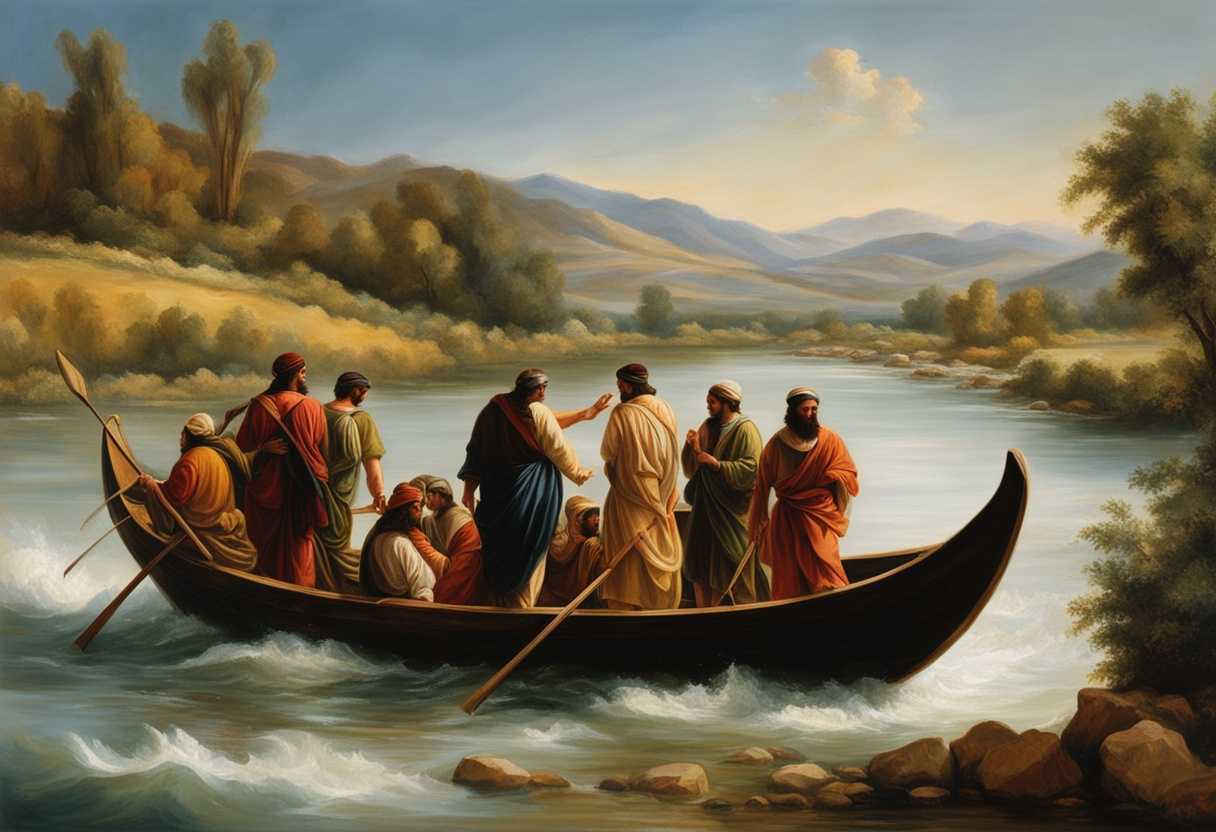
In the Bible, “cross over” often refers to the act of passing from one side to another, symbolizing a transition or change, such as the Israelites crossing the Jordan River into the Promised Land (Joshua 3:14-17). It can also signify a spiritual journey or commitment to follow God, as seen in the invitation to leave behind the old ways of life.
Scripture
1 Now the Lord said to Abram, “Go from your country and your kindred and your father’s house to the land that I will show you.
2 And I will make of you a great nation, and I will bless you and make your name great, so that you will be a blessing.
3 I will bless those who bless you, and him who dishonors you I will curse, and in you all the families of the earth shall be blessed.”
4 So Abram went, as the Lord had told him, and Lot went with him. Abram was seventy-five years old when he departed from Haran.
5 Abram took Sarai his wife, and Lot his brother’s son, and all their possessions that they had gathered, and the people that they had acquired in Haran, and they set out to go to the land of Canaan.
6 Abram passed through the land to the place at Shechem, to the oak of Moreh. At that time the Canaanites were in the land.
7 Then the Lord appeared to Abram and said, “To your offspring I will give this land.” So he built there an altar to the Lord, who had appeared to him.
8 From there he moved to the hill country on the east of Bethel and pitched his tent, with Bethel on the west and Ai on the east. And there he built an altar to the Lord and called upon the name of the Lord.
9 And Abram journeyed on, still going toward the Negeb.
Meaning of “Cross Over” in the Bible
The concept of “crossing over” in the Bible resonates deeply with themes of transition, transformation, and divine promise. One of the most prominent examples is found in Joshua 3:14-17, where the Israelites, led by Joshua, cross the Jordan River to enter the Promised Land. This event not only represents a literal geographical transition but also embodies a significant spiritual milestone for the Israelites, as they move from a state of wandering and uncertainty into a land that symbolizes God’s fulfillment of His covenant with them. The act of crossing over, therefore, signifies leaving behind a life of struggle and entering a phase of promise and rest, illustrating God’s guidance and faithfulness in the journeys of His people.
Furthermore, the idea of crossing over can also reflect the spiritual commitment inherent in the Christian faith. In the New Testament, Jesus calls believers to “cross over” from death to life, emphasizing a transformative journey of faith. In John 5:24, He states, “Truly, truly, I say to you, whoever hears my word and believes him who sent me has eternal life. He does not come into judgment, but has passed from death to life.” Here, crossing over becomes a metaphor for the believer’s transition from a life bound by sin and separation from God to one of redemption and eternal life. This broader interpretation invites individuals to consider their own journeys of faith, encouraging them to leave behind worldly affiliations and embrace the new life that faith in Christ offers—a theme that resonates throughout the New Testament as believers are called to be transformed and renewed in their commitments to God.
The motif of “crossing over” also appears prominently in the prophetic texts, where it often signifies pivotal moments in the collective life of God’s people. Ezekiel, for example, speaks of the restoration and reunification of Israel, envisioning a time when the divided kingdoms will cross over to become one nation under God’s sovereignty (Ezekiel 37:21-22). This crossing over represents not just a physical merging but a profound spiritual healing and the renewal of the covenant relationship between God and His people. It underscores the hope that God brings through reconciliation and unity, illustrating how crossing over is not merely a transition through space but a movement toward restored identity and purpose ordained by God.
Moreover, the New Testament echoes this transformational concept through the idea of “crossing over” into a new covenant reality, where believers are empowered by the Holy Spirit. Galatians 3:26-28 reflects this idea by emphasizing that through faith in Christ, believers transcend societal barriers and distinctions, participating in a new identity as children of God. This signifies a deeper spiritual crossing over—one where former identities, influences, and limitations are left behind in favor of an inclusive community rooted in love and grace. Thus, the theme of crossing over encompasses both individual journeys of faith and the collective movement toward unity, empowerment, and fulfillment of God’s promises throughout Scripture.
Transition to New Beginnings
In the biblical context, “cross over” often signifies a transition from one state of existence to another, marking the beginning of a new journey or phase in life. This can be seen as a metaphor for spiritual rebirth or transformation, where individuals leave behind their old ways and embrace a new path guided by faith. This theme of crossing over is prevalent in various narratives, symbolizing the hope and promise of what lies ahead when one steps out in faith.
Deliverance and Salvation
The act of crossing over can also represent deliverance and salvation. It embodies the idea of moving from a place of bondage or despair to one of freedom and hope. This concept is deeply rooted in the biblical narrative, where crossing over often signifies God’s intervention and the fulfillment of His promises. It serves as a reminder of the divine assistance available to believers as they navigate life’s challenges, emphasizing the importance of trust in God’s plan for deliverance.
Spiritual Journey and Growth
Additionally, “cross over” can be interpreted as a metaphor for the spiritual journey and growth that believers experience throughout their lives. It reflects the ongoing process of moving from spiritual immaturity to maturity, as individuals seek to deepen their relationship with God. This journey often involves overcoming obstacles, learning lessons, and gaining wisdom, ultimately leading to a closer alignment with God’s will and purpose. The concept encourages believers to embrace the journey of faith, recognizing that each crossing over is an opportunity for growth and transformation.
How to Embrace Faith for a Better Christian Journey
Embracing faith is a deeply personal journey that can transform your life and deepen your relationship with God. Start by cultivating a daily practice of prayer and reflection, allowing yourself to be open to His guidance and love. Dive into the Scriptures, not just as ancient texts, but as living words that speak to your current struggles and joys. Surround yourself with a community of believers who can support and challenge you, fostering an environment where you can grow together in faith. Remember, it’s okay to have doubts; they can lead to deeper understanding and a more authentic faith. As you navigate your journey, be intentional about serving others, as acts of kindness and compassion can illuminate your path and bring you closer to Christ. Embrace each moment as an opportunity to learn and grow, trusting that God is with you every step of the way.
Bible References to “Cross Over” Meaning:
Exodus 14:21-31: 21 Then Moses stretched out his hand over the sea, and the Lord drove the sea back by a strong east wind all night and made the sea dry land, and the waters were divided.
22 And the people of Israel went into the midst of the sea on dry ground, the waters being a wall to them on their right hand and on their left.
23 The Egyptians pursued and went in after them into the midst of the sea, all Pharaoh’s horses, his chariots, and his horsemen.
24 And in the morning watch the Lord in the pillar of fire and of cloud looked down on the Egyptian forces and threw the Egyptian forces into a panic,
25 He clogged their chariot wheels so that they drove heavily. And the Egyptians said, “Let us flee from before Israel, for the Lord fights for them against the Egyptians.”
26 Then the Lord said to Moses, “Stretch out your hand over the sea, that the water may come back upon the Egyptians, upon their chariots, and upon their horsemen.”
27 So Moses stretched out his hand over the sea, and the sea returned to its normal course when the morning appeared.
28 The waters returned and covered the chariots and the horsemen; of all the host of Pharaoh that had followed them into the sea, not one of them remained.
29 But the people of Israel walked on dry ground through the sea, the waters being a wall to them on their right hand and on their left.
30 Thus the Lord saved Israel that day from the hand of the Egyptians, and Israel saw the Egyptians dead on the seashore.
31 Israel saw the great power that the Lord used against the Egyptians, so the people feared the Lord, and they believed in the Lord and in his servant Moses.
Joshua 3:14-17: 14 So when the people set out from their tents to pass over the Jordan with the priests bearing the ark of the covenant before the people,
15 and as soon as those bearing the ark had come as far as the Jordan, and the feet of the priests bearing the ark were dipped in the brink of the water (now the Jordan overflows all its banks throughout the time of harvest),
16 the waters coming down from above stood and rose up in a heap very far away, at Adam, the city that is beside Zarethan, and those flowing down toward the Sea of the Arabah, the Salt Sea, were completely cut off. And the people passed over opposite Jericho.
17 And the priests who bore the ark of the covenant of the Lord stood firmly on dry ground in the midst of the Jordan, and all Israel was passing over on dry ground until all the nation finished passing over the Jordan.
2 Kings 2:8-14: 8 Then Elijah took his cloak and rolled it up and struck the water, and the water was parted to the one side and to the other, till the two of them could go over on dry ground.
9 When they had crossed, Elijah said to Elisha, “Ask what I shall do for you, before I am taken from you.” And Elisha said, “Please let there be a double portion of your spirit on me.”
10 And he said, “You have asked a hard thing; yet, if you see me as I am being taken from you, it shall be so for you, but if you do not see me, it shall not be so.”
11 And as they still went on and talked, behold, chariots of fire and horses of fire separated the two of them. And Elijah went up by a whirlwind into heaven.
12 And Elisha saw it and he cried, “My father, my father! The chariots of Israel and its horsemen!” And he saw him no more. Then he took hold of his own clothes and tore them in two pieces.
13 He picked up the cloak of Elijah that had fallen from him and went back and stood on the bank of the Jordan.
14 Then he took the cloak of Elijah that had fallen from him and struck the water, saying, “Where is the Lord, the God of Elijah?” And when he had struck the water, the water was parted to the one side and to the other, and Elisha went over.
Isaiah 43:1-2: 1 But now thus says the Lord, he who created you, O Jacob, he who formed you, O Israel: “Fear not, for I have redeemed you; I have called you by name, you are mine.
2 When you pass through the waters, I will be with you; and through the rivers, they shall not overwhelm you; when you walk through fire you shall not be burned, and the flame shall not consume you.
John 5:24-25: 24 Truly, truly, I say to you, whoever hears my word and believes him who sent me has eternal life. He does not come into judgment, but has passed from death to life.
25 “Truly, truly, I say to you, an hour is coming, and is now here, when the dead will hear the voice of the Son of God, and those who hear will live.
John 6:47-51: 47 Truly, truly, I say to you, whoever believes has eternal life.
48 I am the bread of life.
49 Your fathers ate the manna in the wilderness, and they died.
50 This is the bread that comes down from heaven, so that one may eat of it and not die.
51 I am the living bread that came down from heaven. If anyone eats of this bread, he will live forever. And the bread that I will give for the life of the world is my flesh.
Romans 6:3-4: 3 Do you not know that all of us who have been baptized into Christ Jesus were baptized into his death?
4 We were buried therefore with him by baptism into death, in order that, just as Christ was raised from the dead by the glory of the Father, we too might walk in newness of life.
1 Corinthians 10:1-4: 1 For I do not want you to be unaware, brothers, that our fathers were all under the cloud, and all passed through the sea,
2 and all were baptized into Moses in the cloud and in the sea,
3 and all ate the same spiritual food,
4 and all drank the same spiritual drink. For they drank from the spiritual Rock that followed them, and the Rock was Christ.
Hebrews 11:29-31: 29 By faith the people crossed the Red Sea as on dry land, but the Egyptians, when they attempted to do the same, were drowned.
30 By faith the walls of Jericho fell down after they had been encircled for seven days.
31 By faith Rahab the prostitute did not perish with those who were disobedient, because she had given a friendly welcome to the spies.

Reverend Michael Johnson is an experienced Church Minister with a profound expertise in spirituality and guidance. With a serene presence and a compassionate heart, he has faithfully served his congregation for over 20 years, leading them on a spiritual journey towards inner peace and enlightenment. Reverend Johnson’s extensive knowledge of religious philosophies and profound understanding of human nature have made him a trusted confidant and mentor to many, as he seamlessly weaves his profound wisdom into life teachings. Reverend Johnson’s calming demeanor and empathetic nature continue to uplift and heal souls, nurturing a sense of unity and tranquility within his community.