
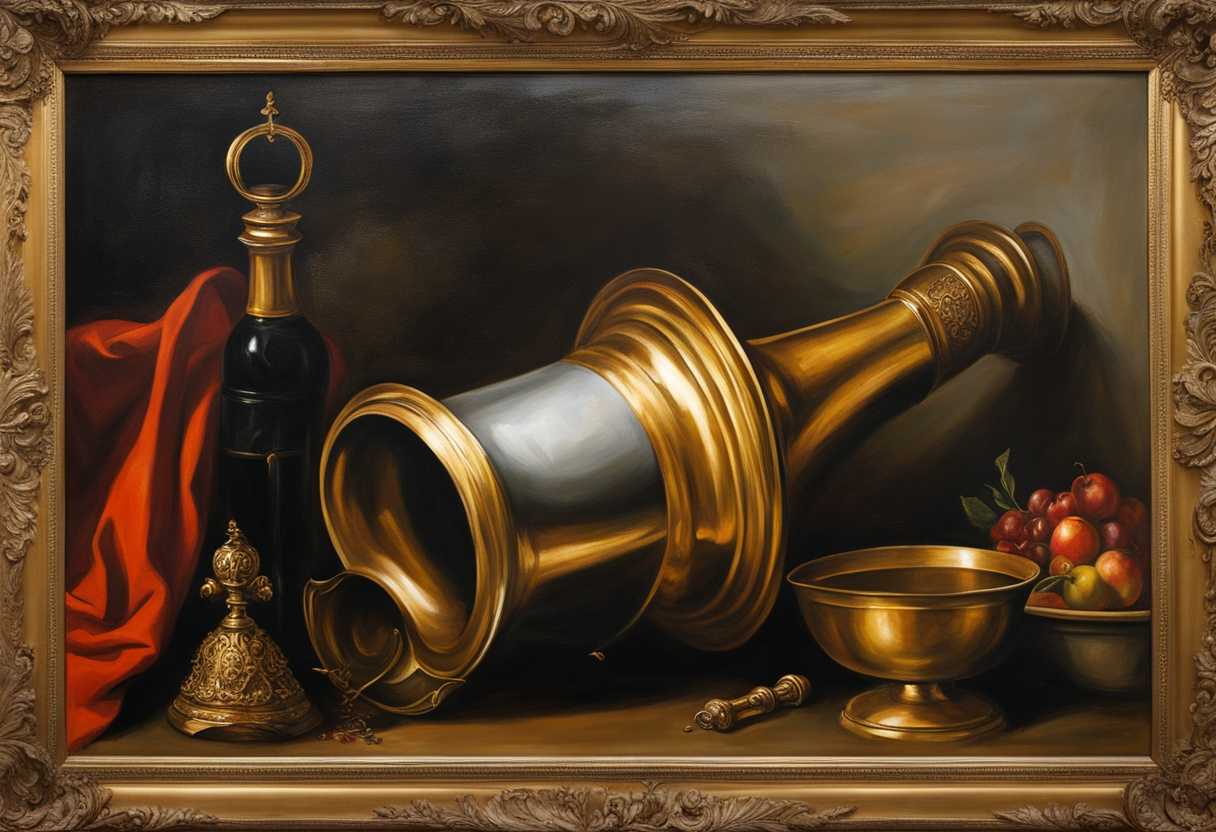
In the Bible, the “horn of oil” symbolizes strength and authority, often used for anointing kings, prophets, and priests. It represents God’s empowerment and the setting apart of individuals for holy purposes, as seen in instances like the anointing of David by Samuel (1 Samuel 16:13).
Scripture
16 The Lord said to Samuel, “How long will you grieve over Saul, since I have rejected him from being king over Israel? Fill your horn with oil, and go. I will send you to Jesse the Bethlehemite, for I have provided for myself a king among his sons.”
2 And Samuel said, “How can I go? If Saul hears it, he will kill me.” And the Lord said, “Take a heifer with you and say, ‘I have come to sacrifice to the Lord.’
3 Invite Jesse to the sacrifice, and I will show you what you shall do. And you shall anoint for me him whom I declare to you.”
4 Samuel did what the Lord commanded and came to Bethlehem.
5 And he said, “Peaceably; I have come to sacrifice to the Lord. Consecrate yourselves, and come with me to the sacrifice.” And he consecrated Jesse and his sons and invited them to the sacrifice.
6 When they came, he looked on Eliab and thought, “Surely the Lord’s anointed is before him.”
7 But the Lord said to Samuel, “Do not look on his appearance or on the height of his stature, because I have rejected him. For the Lord sees not as man sees: man looks on the outward appearance, but the Lord looks on the heart.”
8 Then Jesse called Abinadab and made him pass before Samuel. And he said, “Neither has the Lord chosen this one.”
9 Then Jesse made Shammah pass by. And he said, “Neither has the Lord chosen this one.”
10 Thus Jesse made seven of his sons pass before Samuel. And Samuel said to Jesse, “The Lord has not chosen these.”
11 Then Samuel said to Jesse, “Are all your sons here?” And he said, “There remains yet the youngest, but behold, he is keeping the sheep.” And Samuel said to Jesse, “Send and get him, for we will not sit down till he comes here.”
12 And he sent and brought him in. Now he was ruddy and had beautiful eyes and was handsome. And the Lord said, “Arise, anoint him, for this is he.”
13 Then Samuel took the horn of oil and anointed him in the midst of his brothers. And the Spirit of the Lord rushed upon David from that day forward. And Samuel rose up and went to Ramah.
Meaning of Horn of Oil in the Bible
The “horn of oil” in the Bible serves as a powerful symbol of divine authority and the empowerment bestowed by God’s Spirit. Its use in anointing ceremonies signifies the commissioning of individuals for specific roles within God’s covenant community. For instance, in 1 Samuel 16:13, when Samuel anoints David with the horn of oil, it marks David as God’s chosen king, infusing him with the strength and wisdom needed to lead Israel. This anointing not only sets David apart for leadership but also demonstrates God’s active choice and endorsement, establishing a tangible connection between the anointed and the divine.
Moreover, the imagery of the horn itself—being a projecting, robust form—evokes themes of power and prominence. In biblical tradition, horns were often associated with strength and victory (as seen in Psalm 18:2 and Psalm 92:10), reinforcing the idea that those anointed with oil carry God’s authority and are equipped to fulfill their roles. This anointing oil also foreshadows the ultimate anointing of Jesus Christ, who is referred to as the Messiah, meaning “the Anointed One” (Luke 4:18). Thus, the horn of oil encapsulates a rich theological significance, embodying God’s empowerment, the seriousness of the calling, and the transformative impact of divine selection throughout the narrative of the Scriptures.
The significance of the “horn of oil” extends beyond individual anointings to embody themes of restoration and consecration for the community. In various moments throughout the biblical text, anointing with oil signifies not only personal empowerment but also the collective hope for the nation of Israel. For instance, during the establishment of the priesthood in Exodus, anointing with oil sets apart the priests, marking them as intermediaries between God and the people. This collective anointing represents the sanctification of the entire community as they join in covenant relationship with the Divine. The horn, as a vessel for the oil, exemplifies the outpouring of God’s grace upon His chosen leaders and, by extension, upon the community they serve.
Additionally, the horn of oil serves as a metaphor for God’s provision and sustenance during times of distress or exile. In contexts of loss or fragmentation, the idea of anointing with oil evokes a sense of renewal and hope. The prophets often utilized this imagery to remind the people of God’s enduring relationship with them, even in their wanderings. Anointing signifies re-establishment and restoration—much needed in times of national crisis. This theme intricately weaves through the tapestry of Scripture, ultimately encouraging believers to recognize that they are part of a larger narrative of divine love, commissioning, and grace that extends through generations and culminates in the anointing of the Messiah, embodying hope for all of humanity.
Symbol of Anointing and Empowerment
The horn of oil in the Bible serves as a powerful symbol of anointing, representing the divine empowerment bestowed upon individuals chosen for specific roles, such as kings, priests, and prophets. The act of anointing with oil signifies the setting apart of a person for God’s service, marking them as equipped with the Holy Spirit to fulfill their God-given purpose. This practice illustrates the belief that God’s presence and authority are conferred through the anointing, enabling the individual to lead and serve effectively.
Representation of God’s Favor and Blessing
In biblical contexts, the horn of oil also signifies God’s favor and blessing upon a person or a community. The use of oil, particularly from a horn, conveys a sense of abundance and richness, symbolizing the overflowing blessings that come from a relationship with God. This imagery reflects the idea that those anointed with oil are recipients of God’s grace, protection, and guidance, reinforcing the notion that divine favor is essential for success and prosperity in life.
Connection to the Holy Spirit
The horn of oil is often associated with the Holy Spirit, emphasizing the transformative power of God’s presence in the lives of believers. The anointing oil represents the Holy Spirit’s work in empowering individuals to carry out God’s mission and to live in accordance with His will. This connection highlights the importance of spiritual anointing in the life of a believer, as it signifies not only the presence of God but also the call to act in faith and obedience, guided by the Spirit’s leading.
How to Embrace Spiritual Growth as a Christian
Embracing spiritual growth as a Christian is a beautiful journey that requires intentionality and openness to God’s guidance. Start by immersing yourself in Scripture, allowing the Word to shape your thoughts and actions; consider setting aside time each day for prayer and reflection, inviting the Holy Spirit to illuminate your understanding. Surround yourself with a community of believers who can encourage and challenge you, as fellowship is vital for growth. Don’t shy away from serving others, as acts of kindness and love not only reflect Christ’s heart but also deepen your own faith. Remember, spiritual growth is not a race but a lifelong process; be patient with yourself, celebrate small victories, and trust that God is at work in you, molding you into the person He created you to be.
Bible References to Horn of Oil:
1 Kings 1:32-40: 32 King David said, “Call to me Zadok the priest, Nathan the prophet, and Benaiah the son of Jehoiada.” So they came before the king.
33 The king also said to them, “Take with you the servants of your lord and have Solomon my son ride on my own mule, and bring him down to Gihon.
34 There let Zadok the priest and Nathan the prophet anoint him king over Israel. Then blow the trumpet and say, ‘Long live King Solomon!’
35 Then you shall come up after him, and he shall come and sit on my throne, for he shall be king in my place.
36 Benaiah the son of Jehoiada answered the king, “Amen! May the Lord, the God of my lord the king, say so.
37 As the Lord has been with my lord the king, even so may he be with Solomon, and make his throne greater than the throne of my lord King David.”
38 So Zadok the priest, Nathan the prophet, and Benaiah the son of Jehoiada, and the Cherethites and the Pelethites went down and had Solomon ride on King David’s mule and brought him to Gihon.
39 Zadok the priest took the horn of oil from the tent and anointed Solomon. Then they blew the trumpet, and all the people said, “Long live King Solomon!”
40 And all the people went up after him, playing on pipes, and rejoicing with great joy, so that the earth was split by their noise.
1 Samuel 10:1-8: 1 Then Samuel took a flask of oil and poured it on his head and kissed him and said, “Has not the Lord anointed you to be prince over his people Israel? And you shall reign over the people of the Lord and you will save them from the hand of their surrounding enemies. And this shall be the sign to you that the Lord has anointed you to be prince over his heritage.
2 When you depart from me today, you will meet two men by Rachel’s tomb in the territory of Benjamin at Zelzah, and they will say to you, ‘The donkeys that you went to seek are found, and now your father has ceased to care about the donkeys and is anxious about you, saying, “What shall I do about my son?”‘
3 Then you shall go on from there farther and come to the oak of Tabor. Three men going up to God at Bethel will meet you there, one carrying three young goats, another carrying three loaves of bread, and another carrying a skin of wine.
4 And they will greet you and give you two loaves of bread, which you shall accept from their hand.
5 After that you shall come to Gibeath-elohim, where there is a garrison of the Philistines. And there, as soon as you come to the city, you will meet a group of prophets coming down from the high place with harp, tambourine, flute, and lyre before them, prophesying.
6 Then the Spirit of the Lord will rush upon you, and you will prophesy with them and be turned into another man.
7 And let it be, when these signs come to you, that you do as occasion demands, for God is with you.
8 Then go down before me to Gilgal. And behold, I am coming down to you to offer burnt offerings and to sacrifice peace offerings. Seven days you shall wait, until I come to you and show you what you shall do.”
Exodus 30:22-33: 22 The Lord said to Moses,
23 “Take the finest spices: of liquid myrrh 500 shekels, and of sweet-smelling cinnamon half as much, that is, 250, and 250 of aromatic cane,”
24 and cassia, and onycha, and galbanum, sweet spices with pure frankincense (of each shall there be an equal part),
25 And you shall make of these a sacred anointing oil blended as by the perfumer; it shall be a holy anointing oil.
26 With it you shall anoint the tent of meeting and the ark of the testimony,
27 And the table and all its utensils, and the lampstand and its utensils, and the altar of incense,
28 and the altar of burnt offering with all its utensils and the basin and its stand,
29 You shall consecrate them, that they may be most holy. Whatever touches them will become holy.
30 You shall anoint Aaron and his sons, and consecrate them, that they may serve me as priests.
31 And you shall say to the people of Israel, ‘This shall be my holy anointing oil throughout your generations.
32 It shall not be poured on the body of an ordinary person, and you shall make no other like it in composition. It is holy, and it shall be holy to you.
33 Whoever compounds any like it or whoever puts any of it on an outsider shall be cut off from his people.
1 Kings 19:15-16: 15 And the Lord said to him, “Go, return on your way to the wilderness of Damascus. And when you arrive, you shall anoint Hazael to be king over Syria.
16 And Jehu the son of Nimshi you shall anoint to be king over Israel, and Elisha the son of Shaphat of Abel-meholah you shall anoint to be prophet in your place.
Psalm 89:19-24: 19 Of old you spoke in a vision to your godly one and said: “I have granted help to one who is mighty; I have exalted one chosen from the people.
20 I have found David, my servant; with my holy oil I have anointed him.
21 With whom my hand shall be established; my arm also shall strengthen him.
22 The enemy shall not outwit him; the wicked shall not humble him.
23 I will crush his foes before him and strike down those who hate him.
24 My faithfulness and my steadfast love shall be with him, and in my name shall his horn be exalted.

Reverend Ogunlade is a seasoned Church Minister with over three decades of experience in guiding and nurturing congregations. With profound wisdom and a serene approach, Reverend Ogunlade has carried out various pastoral duties, including delivering uplifting sermons, conducting religious ceremonies, and offering sage counsel to individuals seeking spiritual guidance. Their commitment to fostering harmony and righteousness within their community is exemplified through their compassionate nature, making them a beloved and trusted figure among the congregation.