
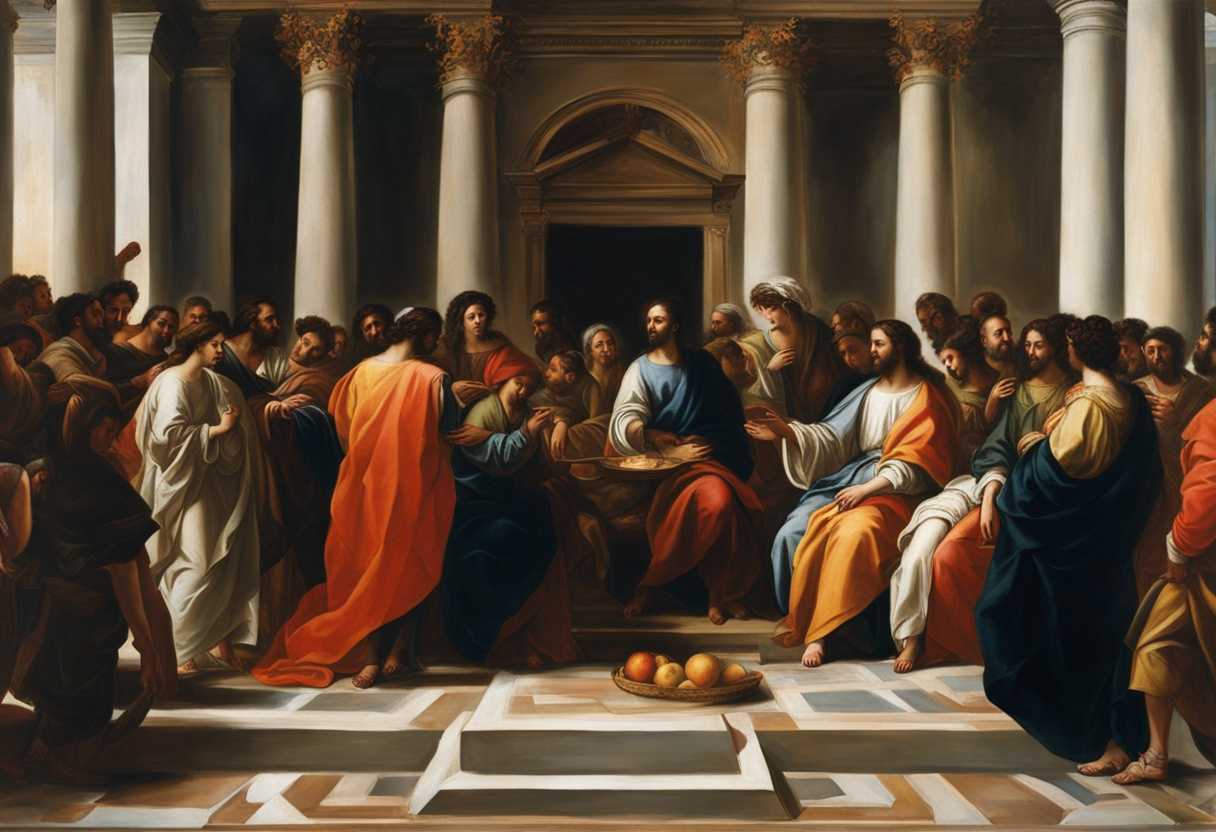
Luke: Life Of Jesus, Teachings, Miracles
The Gospel of Luke, written sometime between 70 and 85 CE, is one of the earliest accounts of the life and ministry of Jesus Christ. Traditionally attributed to Luke, a Greek physician and companion of the apostle Paul, this gospel offers a unique perspective on the events.
The gospel was likely composed in the bustling city of Antioch, a major hub of early Christianity located in modern-day Turkey. As the third-largest city in the Roman Empire, Antioch was a diverse, cosmopolitan metropolis, home to a significant Jewish population as well as a growing community of gentile converts to Christianity. The city’s strategic location and exposure to various cultures and belief systems shaped the author’s worldview and approach.
During the time of Roman rule, with Emperor Domitian reigning over the vast empire, the Gospel of Luke was written. Judea, the region where much of Jesus’ ministry took place, was under the control of the Roman governor and client king, creating a complex and often tense relationship between the occupying forces and the local Jewish population.
The people encountered in the Gospel of Luke represent a diverse cross-section of ancient Mediterranean society, from the devout Jewish followers of Jesus to the marginalized and outcasts. The author paints a vivid picture of the social and religious landscape of the time, emphasizing the inclusiveness of Jesus’ message, particularly towards the poor, the sick, and the socially ostracized.
The significance of the Gospel of Luke lies in its unique perspective and theological emphasis. As a Gentile convert, the author bridges the Jewish roots of Christianity with its growing appeal to the broader Greco-Roman world. The focus on Jesus’ compassion, his concern for the marginalized, and the universality of his message have made the Gospel of Luke a cherished and influential text within the Christian tradition.
The Author of Luke
Luke, the author of the Gospel of Luke and the Acts of the Apostles, is believed to have been a Gentile physician and a close companion of the apostle Paul. His background as a physician suggests that he was educated, detail-oriented, and equipped with the skills necessary to carefully investigate and document the events surrounding Jesus’ ministry and the early church. He brought a unique perspective to his writings as a Gentile, emphasizing themes of universal salvation and the inclusion of all people in God’s plan of redemption.
Luke’s motivation for writing his gospel and the book of Acts was to provide an orderly and accurate account of the life, teachings, death, and resurrection of Jesus Christ, as well as the spread of the gospel and the growth of the early Christian church. He sought to reassure his readers of the credibility and reliability of the Christian faith, both in terms of the historical events that took place and the theological significance of those events for believers. Despite facing persecution and opposition, Luke’s commitment to preserving the story of Jesus and the early church remained unwavering, driven by a deep sense of faith and devotion to his Christian community.
Overview of Luke
The Gospel of Luke, the third book in the New Testament, was written by Luke, a companion of the Apostle Paul. Addressed to a man named Theophilus, the gospel aims to provide an orderly account of the life, ministry, death, and resurrection of Jesus Christ.
The narrative can be divided into several key sections. It starts with the birth narratives of John the Baptist and Jesus, including the Annunciation, the Visitation, and the birth of Jesus in Bethlehem. This emphasizes the fulfillment of Old Testament prophecies regarding the Messiah. The second section focuses on Jesus’ ministry, highlighting His teachings, miracles, and interactions with various individuals, such as the parables of the Good Samaritan, the Prodigal Son, and the Pharisee and the Tax Collector.
The third section centers on Jesus’ journey to Jerusalem, where He ultimately faces crucifixion and resurrection. This includes the Last Supper, Jesus’ arrest, trial, crucifixion, and resurrection. The book concludes with Jesus’ ascension into heaven and the commissioning of His disciples to spread the Gospel to all nations.
Throughout the Gospel of Luke, there is a strong emphasis on Jesus’ compassion for the marginalized and outcasts of society, such as the poor, sinners, and Samaritans. This is seen in stories like the healing of the leper and the parable of the Good Samaritan. Luke also highlights the importance of prayer, as seen in Jesus’ teachings on prayer and His own prayer life.
The Gospel of Luke is significant in the context of Christianity, providing a detailed and comprehensive account of the life and teachings of Jesus Christ. It emphasizes Jesus’ mission to seek and save the lost and His offer of salvation to all people, regardless of their social status or background. The book also underscores the themes of repentance, forgiveness, and the coming of the Kingdom of God, serving as a foundational text for understanding the person and work of Jesus Christ and His call to discipleship for all believers.
Key themes of Luke
Luke is about Compassion
At the heart of the book of Luke is the theme of compassion. Throughout the gospel, Jesus is portrayed as a compassionate and merciful figure, showing love and care for all people, regardless of their background or status. In Luke 7:13, Jesus is moved with compassion for a widow who has lost her only son, and he raises the young man from the dead. Similarly, in Luke 15:20, the parable of the prodigal son illustrates the father’s compassion and forgiveness towards his wayward child. Jesus’s teachings on loving one’s enemies and helping those in need further emphasize the importance of compassion in the Christian life (Luke 6:27-36). The book of Luke challenges readers to embody the same spirit of compassion and kindness that Jesus exemplified during his ministry on earth.
Luke is about Forgiveness
For in the book of Luke, forgiveness is a central theme that is emphasized throughout the teachings of Jesus. In Luke 6:37, Jesus instructs his followers to forgive others, and they will be forgiven in return. This idea is further illustrated in the parable of the Prodigal Son in Luke 15:11-32, where a father forgives his wayward son upon his return. Jesus also demonstrates the power of forgiveness on the cross when he asks God to forgive those who crucified him in Luke 23:34. Through these examples, Luke highlights the importance of forgiveness in the Christian faith, showing that it is not only a commandment but also a way to experience God’s mercy and grace.
Luke is about Humility
Luke emphasizes the theme of humility throughout his gospel. In Luke 14:11, Jesus teaches that those who exalt themselves will be humbled, but those who humble themselves will be exalted. This idea is further reinforced in Luke 18:14 when Jesus tells the parable of the Pharisee and the tax collector, highlighting the importance of humility in prayer. Additionally, in Luke 9:48, Jesus teaches his disciples that the one who is least among them is the greatest. Luke portrays Jesus as a humble servant who came to serve rather than to be served, as seen in Luke 22:27. The book of Luke teaches us the value of humility in our relationships with others and in our walk with God.
Luke is about Social justice
The theme of social justice is prominent in the book of Luke, as Jesus consistently shows compassion and care for the marginalized and oppressed in society. In Luke 4:18-19, Jesus declares his mission to bring good news to the poor, freedom to the prisoners, and release to the oppressed. Throughout the gospel, Jesus interacts with those on the fringes of society, such as tax collectors, sinners, and Samaritans, demonstrating God’s love and inclusivity. The parable of the Good Samaritan in Luke 10:25-37 exemplifies the call to show mercy and compassion to all, regardless of social status or background. Jesus challenges societal norms by uplifting the downtrodden and advocating for justice and equality. As followers of Christ, we are called to emulate his example by standing up for the marginalized and working towards a more just and equitable world.
Important Verses in Luke:
Luke 1:26-38: 26 And in the sixth month the angel Gabriel was sent from God unto a city of Galilee, named Nazareth,
27 To a virgin espoused to a man whose name was Joseph, of the house of David; and the virgin’s name was Mary.
And the angel came in unto her, and said, Hail, thou that art highly favoured, the Lord is with thee: blessed art thou among women.
29 And when she saw him, she was troubled at his saying, and cast in her mind what manner of salutation this should be.
30 And the angel said unto her, Fear not, Mary: for thou hast found favour with God.
31 And, behold, thou shalt conceive in thy womb, and bring forth a son, and shalt call his name Jesus.
32 He shall be great, and shall be called the Son of the Highest: and the Lord God shall give unto him the throne of his father David.
33 And he shall reign over the house of Jacob for ever; and of his kingdom there shall be no end.
34 Then said Mary unto the angel, How shall this be, seeing I know not a man?
35 And the angel answered and said unto her, The Holy Ghost shall come upon thee, and the power of the Highest shall overshadow thee: therefore also that holy thing which shall be born of thee shall be called the Son of God.
36 And, behold, thy cousin Elisabeth, she hath also conceived a son in her old age: and this is the sixth month with her, who was called barren.
For with God nothing shall be impossible.
38 And Mary said, Behold the handmaid of the Lord; be it unto me according to thy word. And the angel departed from her.
Luke 2:1-7: 2 And it came to pass in those days, that there went out a decree from Caesar Augustus, that all the world should be taxed.
2 (And this taxing was first made when Cyrenius was governor of Syria.)
3 And all went to be taxed, every one into his own city.
4 And Joseph also went up from Galilee, out of the city of Nazareth, into Judaea, unto the city of David, which is called Bethlehem; (because he was of the house and lineage of David:)
5 To be taxed with Mary his espoused wife, being great with child.
6 And so it was, that, while they were there, the days were accomplished that she should be delivered.
7 And she brought forth her firstborn son, and wrapped him in swaddling clothes, and laid him in a manger; because there was no room for them in the inn.
Luke 2:8-14: 8 And there were in the same country shepherds abiding in the field, keeping watch over their flock by night.
9 And, lo, the angel of the Lord came upon them, and the glory of the Lord shone round about them: and they were sore afraid.
10 And the angel said unto them, Fear not: for, behold, I bring you good tidings of great joy, which shall be to all people.
11 For unto you is born this day in the city of David a Saviour, which is Christ the Lord.
12 And this shall be a sign unto you; Ye shall find the babe wrapped in swaddling clothes, lying in a manger.
13 And suddenly there was with the angel a multitude of the heavenly host praising God, and saying,
14 Glory to God in the highest, and on earth peace, good will toward men.
Luke 2:40: 40 And the child grew, and waxed strong in spirit, filled with wisdom: and the grace of God was upon him.
Luke 4:18-19: 18 The Spirit of the Lord is upon me, because he hath anointed me to preach the gospel to the poor; he hath sent me to heal the brokenhearted, to preach deliverance to the captives, and recovering of sight to the blind, to set at liberty them that are bruised,
19 To preach the acceptable year of the Lord.
Luke 6:27-28: 27 But I say unto you which hear, Love your enemies, do good to them which hate you,
28 Bless them that curse you, and pray for them which despitefully use you.
Luke 10:25-37: 25 And, behold, a certain lawyer stood up, and tempted him, saying, Master, what shall I do to inherit eternal life?
26 He said unto him, What is written in the law? how readest thou?
27 And he answering said, Thou shalt love the Lord thy God with all thy heart, and with all thy soul, and with all thy strength, and with all thy mind; and thy neighbour as thyself.
28 And he said unto him, Thou hast answered right: this do, and thou shalt live.
29 But he, willing to justify himself, said unto Jesus, And who is my neighbour?
30 And Jesus answering said, A certain man went down from Jerusalem to Jericho, and fell among thieves, which stripped him of his raiment, and wounded him, and departed, leaving him half dead.
31 And by chance there came down a certain priest that way: and when he saw him, he passed by on the other side.
32 And likewise a Levite, when he was at the place, came and looked on him, and passed by on the other side.
33 But a certain Samaritan, as he journeyed, came where he was: and when he saw him, he had compassion on him,
34 And went to him, and bound up his wounds, pouring in oil and wine, and set him on his own beast, and brought him to an inn, and took care of him.
35 And on the morrow when he departed, he took out two pence, and gave them to the host, and said unto him, Take care of him; and whatsoever thou spendest more, when I come again, I will repay thee.
36 Which now of these three, thinkest thou, was neighbour unto him that fell among the thieves?
37 And he said, He that shewed mercy on him. Then said Jesus unto him, Go, and do thou likewise.
Luke 11:9-10: 9 And I say unto you, Ask, and it shall be given you; seek, and ye shall find; knock, and it shall be opened unto you.
10 For every one that asketh receiveth; and he that seeketh findeth; and to him that knocketh it shall be opened.
Luke 15:11-32: 11 And he said, A certain man had two sons:
12 And the younger of them said to his father, Father, give me the portion of goods that falleth to me. And he divided unto them his living.
13 And not many days after the younger son gathered all together, and took his journey into a far country, and there wasted his substance with riotous living.
14 And when he had spent all, there arose a mighty famine in that land; and he began to be in want.
15 And he went and joined himself to a citizen of that country; and he sent him into his fields to feed swine.
16 And he would fain have filled his belly with the husks that the swine did eat: and no man gave unto him.
17 And when he came to himself, he said, How many hired servants of my father’s have bread enough and to spare, and I perish with hunger!
18 I will arise and go to my father, and will say unto him, Father, I have sinned against heaven, and before thee.
19 And am no more worthy to be called thy son: make me as one of thy hired servants.
20 And he arose, and came to his father. But when he was yet a great way off, his father saw him, and had compassion, and ran, and fell on his neck, and kissed him.
21 And the son said unto him, Father, I have sinned against heaven, and in thy sight, and am no more worthy to be called thy son.
22 But the father said to his servants, Bring forth the best robe, and put it on him; and put a ring on his hand, and shoes on his feet:
23 And bring hither the fatted calf, and kill it; and let us eat, and be merry:
24 For this my son was dead, and is alive again; he was lost, and is found. And they began to be merry.
25 Now his elder son was in the field: and as he came and drew nigh to the house, he heard musick and dancing.
26 And he called one of the servants, and asked what these things meant.
27 And he said unto him, Thy brother is come; and thy father hath killed the fatted calf, because he hath received him safe and sound.
28 And he was angry, and would not go in: therefore came his father out, and intreated him.
29 And he answering said to his father, Lo, these many years do I serve thee, neither transgressed I at any time thy commandment: and yet thou never gavest me a kid, that I might make merry with my friends:
30 But as soon as this thy son was come, which hath devoured thy living with harlots, thou hast killed for him the fatted calf.
31 And he said unto him, Son, thou art ever with me, and all that I have is thine.
32 It was meet that we should make merry, and be glad: for this thy brother was dead, and is alive again; and was lost, and is found.
Luke 23:34: 34 Then said Jesus, Father, forgive them; for they know not what they do.
Luke 24:1-6: 1 Now upon the first day of the week, very early in the morning, they came unto the sepulchre, bringing the spices which they had prepared, and certain others with them.
2 And they found the stone rolled away from the sepulchre.
3 And they entered in, and found not the body of the Lord Jesus.
4 And it came to pass, as they were much perplexed thereabout, behold, two men stood by them in shining garments:
5 And as they were afraid, and bowed down their faces to the earth, they said unto them, Why seek ye the living among the dead?
6 He is not here, but is risen: remember how he spake unto you when he was yet in Galilee,

Reverend Michael Johnson is an experienced Church Minister with a profound expertise in spirituality and guidance. With a serene presence and a compassionate heart, he has faithfully served his congregation for over 20 years, leading them on a spiritual journey towards inner peace and enlightenment. Reverend Johnson’s extensive knowledge of religious philosophies and profound understanding of human nature have made him a trusted confidant and mentor to many, as he seamlessly weaves his profound wisdom into life teachings. Reverend Johnson’s calming demeanor and empathetic nature continue to uplift and heal souls, nurturing a sense of unity and tranquility within his community.