
In the Bible, a tax collector is often viewed as a sinner or outcast due to their association with the Roman authorities and their practice of extorting money from their own people (Luke 18:10-14). They are depicted as needing repentance and grace, exemplified in stories such as that of Zacchaeus, who was transformed by his encounter with Jesus (Luke 19:1-10).
Scripture
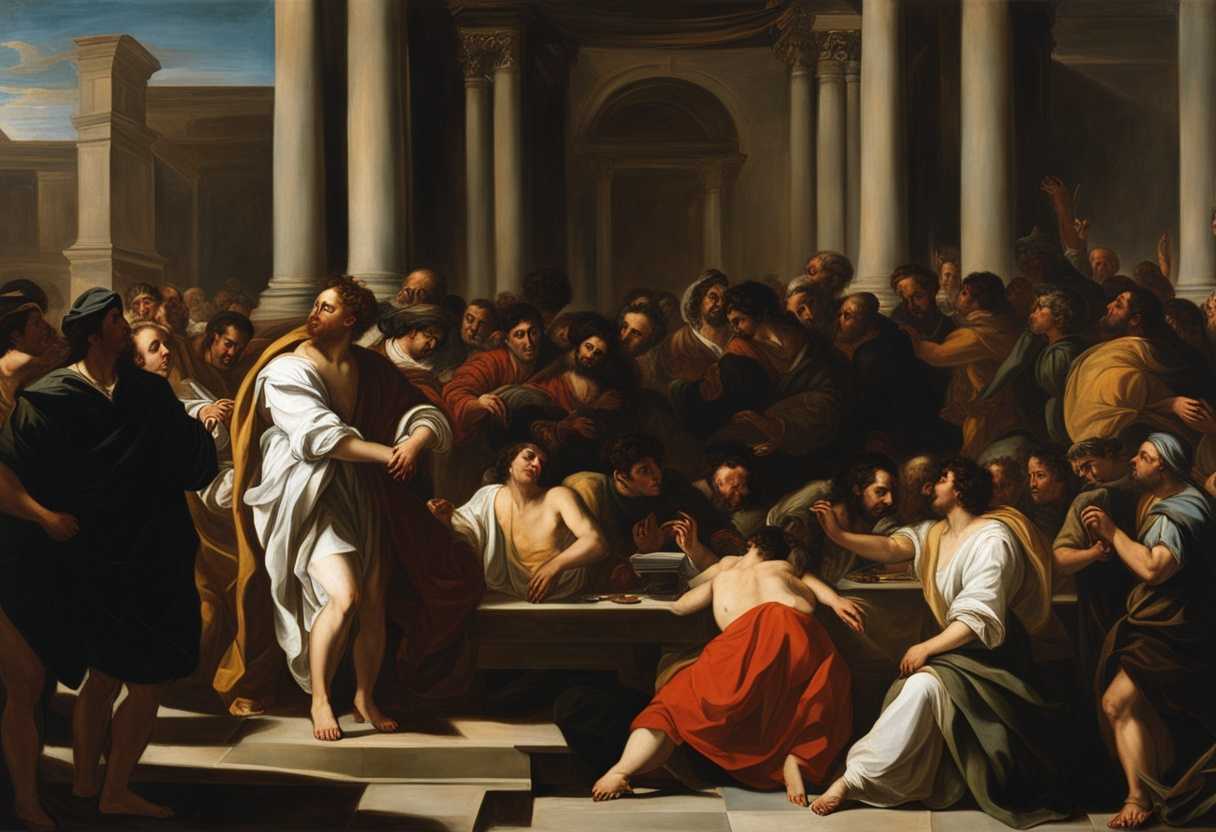
9 As Jesus passed on from there, he saw a man called Matthew sitting at the tax booth, and he said to him, “Follow me.” And he rose and followed him.
10 And as Jesus reclined at table in the house, behold, many tax collectors and sinners came and were reclining with Jesus and his disciples.
11 And when the Pharisees saw this, they said to his disciples, “Why does your teacher eat with tax collectors and sinners?”
12 But when he heard it, he said, “Those who are well have no need of a physician, but those who are sick.
13 Go and learn what this means: ‘I desire mercy, and not sacrifice.’ For I came not to call the righteous, but sinners.”
Biblical Significance of Tax Collectors
In the biblical context, tax collectors symbolized moral and social outcasts, largely due to their collaboration with the Roman oppressors and the corruption often associated with tax collection. This view is prevalent in passages such as Luke 18:10-14, where Jesus discusses the contrasting attitudes of a Pharisee and a tax collector in prayer. The Pharisee, representing the religious elite, boasts of his righteous deeds, while the tax collector, humbled and aware of his sinfulness, pleads for mercy, underscoring the theme of humility and the accessibility of God’s grace, regardless of societal status.
The transformation of individuals like Zacchaeus, as recorded in Luke 19:1-10, further illustrates the potential for redemption that exists for those marginalized by society. Zacchaeus, upon realizing his wrongdoings, repents and commits to restitution, showing that even the most despised individuals can experience grace through faith in Christ. This narrative not only highlights the inclusivity of Jesus’ ministry but also challenges societal norms, suggesting that God’s love extends beyond conventional boundaries. The tax collector, therefore, serves as a poignant reminder of the need for humility and the universal availability of God’s mercy, emphasizing that all are called to repentance and restoration, regardless of their past.
Throughout the New Testament, tax collectors serve as powerful symbols of God’s transformative mercy and the radical inclusivity of Jesus’ message. In Matthew 9:9-13, the calling of Matthew, a tax collector, showcases how Jesus not only associates with those deemed unacceptable by society but actively invites them into His inner circle. This act of choosing Matthew as one of His disciples illustrates the breaking down of barriers that separate the righteous from the sinners. Jesus’ declaration that He came to call not the righteous, but sinners, embodies His mission to reach out to those on the fringes of society, emphasizing that God’s kingdom is open to all who seek redemption.
Moreover, the narrative of the tax collector reinforces the concept of societal rejection and the potential for new beginnings through repentance. In the context of the Gospel, tax collectors were often seen as thieves who exploited their own people for personal gain through overtaxation. However, their presence in the ministry of Jesus signals a radical shift in understanding morality and acceptance within the kingdom of God. This theme continues through other encounters, such as the invitation for tax collectors to embrace a life of discipleship, signifying that God’s grace is not dependent on one’s social standing or past actions. The overarching message is clear: no one is beyond the reach of divine forgiveness, and even those most despised by society can become agents of change and messengers of the Gospel.
Symbol of Social Outcasts
In biblical times, tax collectors were often viewed as social outcasts due to their association with the Roman authorities and their reputation for dishonesty. They were seen as traitors by their fellow Jews, as they collected taxes for an occupying power. This status highlights the broader theme of societal rejection and the transformative power of acceptance and redemption, as Jesus often reached out to those marginalized by society.
Representation of Greed and Corruption
Tax collectors in the Bible frequently symbolize greed and corruption. Their role in collecting taxes often led to exploitation, as many would overcharge to line their own pockets. This portrayal serves as a cautionary tale about the dangers of materialism and the moral pitfalls associated with wealth accumulation, emphasizing the need for integrity and ethical behavior in financial dealings.
Emblem of Redemption and Grace
Despite their negative connotations, tax collectors also serve as powerful symbols of redemption and grace in the biblical narrative. Their encounters with Jesus illustrate the possibility of transformation and forgiveness, demonstrating that no one is beyond the reach of divine mercy. This theme underscores the message that repentance and faith can lead to a new life, regardless of past actions or societal labels.
How to Embrace Christlike Values for Growth in Faith
Embracing Christlike values is a transformative journey that can deeply enrich your faith and daily life. Start by immersing yourself in the Gospels, where you’ll find the essence of Christ’s teachings—love, compassion, humility, and forgiveness. Reflect on how these values manifest in your interactions with others; strive to show kindness even in challenging situations, and practice forgiveness, remembering that we are all imperfect beings in need of grace. Surround yourself with a community that encourages spiritual growth, whether through church, study groups, or service projects, as fellowship can inspire and challenge you to live out these values authentically. Finally, make prayer a cornerstone of your daily routine, asking for guidance and strength to embody Christ’s love in every aspect of your life. As you intentionally cultivate these values, you’ll find that your faith deepens, and your heart opens wider to the beauty of God’s love.
Bible References to Tax Collectors’ Significance:
Matthew 18:15-17: 15 “If your brother sins against you, go and tell him his fault, between you and him alone. If he listens to you, you have gained your brother.”
16 But if he does not listen, take one or two others along with you, that every charge may be established by the evidence of two or three witnesses.
17 If he refuses to listen to them, tell it to the church. And if he refuses to listen even to the church, let him be to you as a Gentile and a tax collector.
Matthew 21:28-32: 28 “What do you think? A man had two sons. And he went to the first and said, ‘Son, go and work in the vineyard today.’
29 And he answered, ‘I will not,’ but afterward he changed his mind and went.
30 And he went to the other son and said the same. And he answered, ‘I go, sir,’ but did not go.
31 Which of the two did the will of his father?” They said, “The first.” Jesus said to them, “Truly, I say to you, the tax collectors and the prostitutes go into the kingdom of God before you.
32 For John came to you in the way of righteousness, and you did not believe him, but the tax collectors and the prostitutes believed him. And even when you saw it, you did not afterward change your minds and believe him.
Mark 2:13-17: 13 He went out again beside the sea, and all the crowd was coming to him, and he was teaching them.
14 And as he passed by, he saw Levi the son of Alphaeus sitting at the tax booth, and he said to him, “Follow me.” And he rose and followed him.
15 And as he reclined at table in his house, many tax collectors and sinners were reclining with Jesus and his disciples, for there were many who followed him.
16 And the scribes of the Pharisees, when they saw that he was eating with sinners and tax collectors, said to his disciples, “Why does he eat with tax collectors and sinners?”
17 And when Jesus heard it, he said to them, “Those who are well have no need of a physician, but those who are sick. I came not to call the righteous, but sinners.”
Luke 3:12-13: 12 Tax collectors also came to be baptized and said to him, “Teacher, what shall we do?”
13 And he said to them, “Collect no more than you are authorized to do.”
Luke 5:27-32: 27 After this he went out and saw a tax collector named Levi, sitting at the tax booth. And he said to him, “Follow me.”
28 And he left everything, and rose and followed him.
29 And Levi made him a great feast in his house, and there was a large company of tax collectors and others reclining at table with them.
30 And the Pharisees and their scribes grumbled at his disciples, saying, “Why do you eat and drink with tax collectors and sinners?”
31 And Jesus answered them, “Those who are well have no need of a physician, but those who are sick.
32 I have not come to call the righteous but sinners to repentance.
Luke 7:29-35: 29 (When all the people heard this, and the tax collectors too, they declared God just, having been baptized with the baptism of John,).
30 but the Pharisees and the lawyers rejected the purpose of God for themselves, not having been baptized by him.
31 “To what then shall I compare the people of this generation, and what are they like?
32 They are like children sitting in the marketplace and calling to one another, “We played the flute for you, and you did not dance; we sang a dirge, and you did not weep.”
33 For John the Baptist has come eating no bread and drinking no wine, and you say, ‘He has a demon.’
34 The Son of Man has come eating and drinking, and you say, ‘Look at him! A glutton and a drunkard, a friend of tax collectors and sinners!’
35 Yet wisdom is justified by all her children.
Luke 15:1-7: 1 Now the tax collectors and sinners were all drawing near to hear him.
2 And the Pharisees and the scribes grumbled, saying, “This man receives sinners and eats with them.”
3 So he told them this parable:
4 “What man of you, having a hundred sheep, if he has lost one of them, does not leave the ninety-nine in the open country, and go after the one that is lost, until he finds it?”
5 And when he has found it, he lays it on his shoulders, rejoicing.
6 And when he comes home, he calls together his friends and his neighbors, saying to them, ‘Rejoice with me, for I have found my sheep that was lost.’
7 Just so, I tell you, there will be more joy in heaven over one sinner who repents than over ninety-nine righteous persons who need no repentance.
Luke 18:9-14: 9 He also told this parable to some who trusted in themselves that they were righteous, and treated others with contempt:
10 “Two men went up into the temple to pray, one a Pharisee and the other a tax collector.”
11 The Pharisee, standing by himself, prayed thus: ‘God, I thank you that I am not like other men, extortioners, unjust, adulterers, or even like this tax collector.
12 I fast twice a week; I give tithes of all that I get.’
13 But the tax collector, standing far off, would not even lift up his eyes to heaven, but beat his breast, saying, ‘God, be merciful to me, a sinner!’
14 I tell you, this man went down to his house justified, rather than the other. For everyone who exalts himself will be humbled, but the one who humbles himself will be exalted.”
Luke 19:1-10: 10 For the Son of Man came to seek and to save the lost.
2 And behold, there was a man named Zacchaeus. He was a chief tax collector and was rich.
3 And he was seeking to see who Jesus was, but on account of the crowd he could not, because he was small in stature.
4 So he ran on ahead and climbed up into a sycamore tree to see him, for he was about to pass that way.
5 And when Jesus came to the place, he looked up and said to him, “Zacchaeus, hurry and come down, for I must stay at your house today.”
6 So he hurried and came down and received him joyfully.
7 And when they saw it, they all grumbled, “He has gone in to be the guest of a man who is a sinner.”
8 And Zacchaeus stood and said to the Lord, “Behold, Lord, the half of my goods I give to the poor. And if I have defrauded anyone of anything, I restore it fourfold.”
10 For the Son of Man came to seek and to save the lost.
10 For the Son of Man came to seek and to save the lost.
Romans 13:6-7: 6 For because of this you also pay taxes, for the authorities are ministers of God, attending to this very thing.
7 Pay to all what is owed to them: taxes to whom taxes are owed, revenue to whom revenue is owed, respect to whom respect is owed, honor to whom honor is owed.

Rev. François Dupont is a dedicated church minister with a wealth of experience in serving spiritual communities. With a calm and serene demeanor, he has been devoted to sharing the message of love, compassion, and tolerance for over two decades. Through his thoughtful sermons, compassionate counseling, and unwavering support, Rev. Dupont has touched the lives of countless individuals, allowing them to find solace and strength during difficult times. His serene presence and deep understanding of the human condition make him a trusted guide for those seeking spiritual nourishment and guidance.