
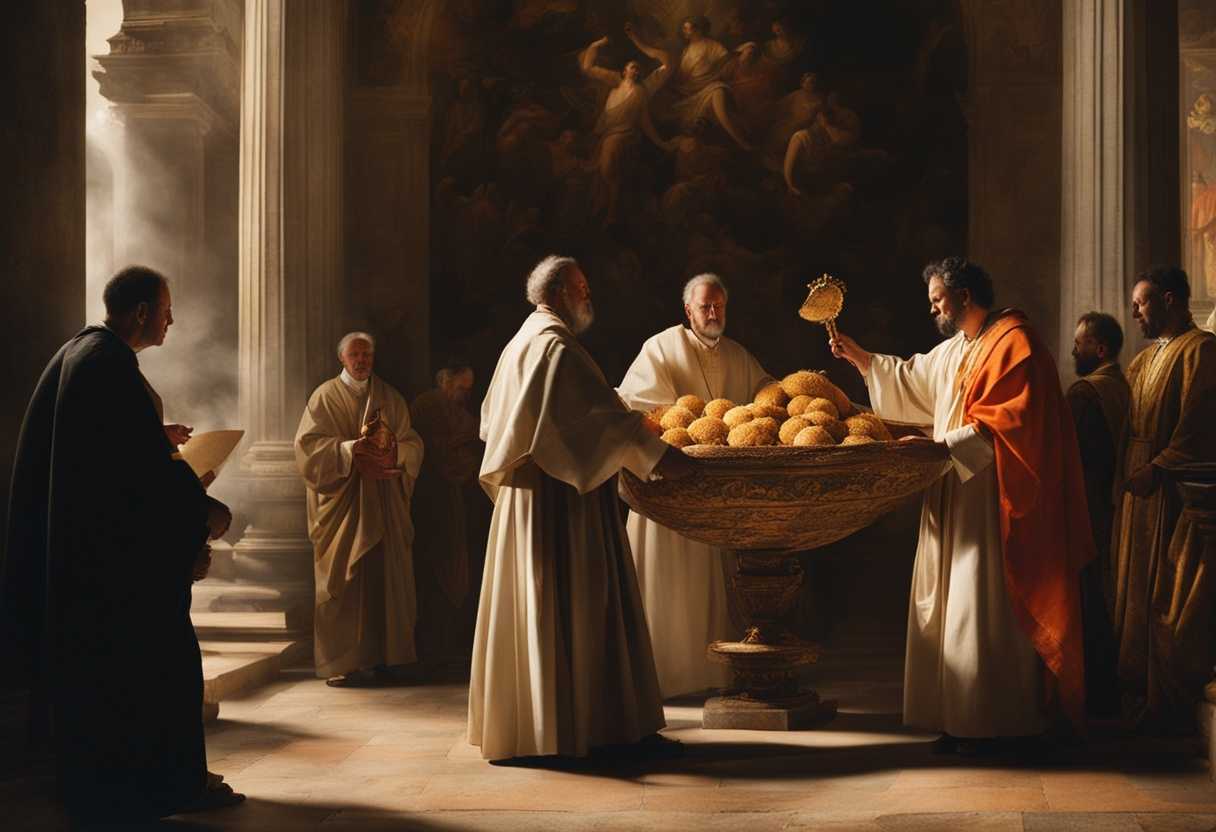
Heave offerings, as defined in the Bible, refer to a specific type of voluntary offering presented to God, often reserved for the priests or the sanctuary. In Exodus 29:27 and Leviticus 7:30, it is described as a portion of the sacrifices that is “heaved” or lifted up to signify dedication to God.
Scripture
27 And you shall consecrate the breast of the wave offering that is waved and the thigh of the priests’ portion that is contributed from the ram of ordination, from what was Aaron’s and his sons’.
28 It shall be for Aaron and his sons as a perpetual due from the people of Israel, for it is a contribution. It shall be a contribution from the people of Israel from their peace offerings, their contribution to the Lord.
Biblical Meaning of Heave Offerings
Heave offerings, or “terumah” in Hebrew, represent more than mere ritualistic practices; they embody the deeper theological principle of giving one’s best to God and recognizing His sovereignty over all aspects of life. In Exodus 29:27 and Leviticus 7:30, the act of “lifting” the heave offering signifies a dedication of these resources to divine service, reinforcing the acknowledgment that all provisions stem from God. This reflects a heart posture of gratitude and commitment, wherein the giver acknowledges that material blessings are not solely for personal gain but also for the sustenance of priestly ministry and the community’s spiritual life.
Throughout scripture, the concept of Heave offerings serves as a reminder that true worship involves the sacrifice of one’s time, talents, and treasures. In Numbers 18:8-11, the heave offerings are explicitly earmarked for priests as a means of supporting their livelihood and, by extension, ensuring that sacred duties are fulfilled. This highlights a communal responsibility among the Israelites to support their spiritual leaders while also strengthening their covenant relationship with God. Moreover, this principle of sacrificial giving finds resonance in the New Testament, as echoed in passages like 2 Corinthians 9:7, where believers are called to give not reluctantly or under compulsion, but cheerfully, illustrating that true heave offerings transcend the Old Testament practice to embody a life dedicated to God’s purposes and generosity.
Heave offerings reflect a profound understanding of stewardship that weaves through the tapestry of biblical teachings, establishing a framework for communal and individual responsibility toward the divine. In various instances throughout the Old Testament, the act of offering demonstrates the necessity of prioritizing God in all aspects of life, serving as an acknowledgment that what one possesses ultimately belongs to Him. The offering process emphasizes the importance of generous giving, which serves not only as a physical relinquishment of goods but as a spiritual exercise, fostering a mindset that recognizes divine providence. This perspective enables believers to cultivate a sense of trust in God’s provision, aligning their material resources with heavenly priorities.
As the concept of heave offerings transitions into the New Testament, it embodies a broader invitation to live sacrificially as an act of worship. Paul’s teachings encourage followers of Christ to view their lives as offerings, emphasizing that everything—be it time, skills, or blessings—should be viewed in the light of serving God and His kingdom. The early church exemplified this principle through their communal living and mutual support, illustrating how heave offerings extend beyond physical gifts to a lifestyle committed to generosity and service. Ultimately, this biblical principle underscores that heave offerings are not merely about what is given but reflect the heart’s intent, pushing believers to examine their motivations and cultivating a spirit of joyful generosity in all their endeavors.
Symbol of Dedication and Commitment
Heave offerings represent a tangible expression of dedication to God. By presenting a portion of their harvest or livestock, individuals demonstrate their commitment to the covenant relationship with God. This act of giving signifies that they recognize God’s sovereignty over their lives and resources, acknowledging that all they possess ultimately belongs to Him. The act of lifting or heaving the offering symbolizes the elevation of their devotion and the desire to honor God with their best.
Community and Support for the Priesthood
Heave offerings also serve a practical purpose in supporting the priesthood and the community. By contributing a portion of their goods, the faithful ensure that the priests, who dedicate their lives to spiritual service, are provided for. This communal aspect fosters a sense of unity and shared responsibility among the people, reinforcing the idea that worship and service to God are collective endeavors. It highlights the importance of supporting those who lead in spiritual matters and maintaining the functioning of the religious community.
Spiritual Significance of Generosity
The concept of heave offerings extends beyond mere ritual; it embodies the spiritual principle of generosity. By willingly giving a portion of their blessings, individuals cultivate a heart of generosity and gratitude. This practice encourages believers to reflect on their relationship with material possessions and to prioritize spiritual wealth over earthly treasures. The act of giving, especially in a manner that is joyful and voluntary, aligns with the biblical teaching that generosity is a reflection of one’s faith and trust in God’s provision.
How to Cultivate Sacrificial Devotion and Gratitude in Faith
Cultivating sacrificial devotion and gratitude in your faith journey is a deeply personal and transformative process that begins with a heart open to God’s love and grace. Start by reflecting on the ultimate sacrifice Jesus made for us, which can inspire you to give of yourself—whether that means your time, resources, or talents—to serve others and glorify God. Consider setting aside moments each day for gratitude, perhaps through journaling or prayer, where you acknowledge the blessings in your life, even amidst challenges. This practice not only shifts your focus from what you lack to what you have but also deepens your appreciation for God’s provision. Engage in acts of service, no matter how small, as these can be powerful expressions of your devotion. Remember, it’s in the little sacrifices—like lending a listening ear or offering a helping hand—that we often find the most profound connections to our faith and to one another. As you embrace this journey, let your heart be filled with gratitude, allowing it to overflow into every aspect of your life, transforming not just your relationship with God, but also with those around you.
Bible References to Heave Offerings:
Leviticus 7:14-15: 14 And of it he shall offer one from each offering, as a food offering to the Lord.
15 And the flesh of the sacrifice of his peace offerings for thanksgiving shall be eaten on the day of his offering.
Leviticus 7:32-34: 32 And the right thigh you shall give to the priest as a contribution from the sacrifice of your peace offerings.
33 Whoever among the sons of Aaron offers the blood of the peace offerings and the fat shall have the right thigh for a portion.
34 For the breast that is waved and the thigh that is contributed I have taken from the people of Israel, out of the sacrifices of their peace offerings, and have given them to Aaron the priest and to his sons, as a perpetual due from the people of Israel.
Leviticus 10:14-15: 14 But the breast that is waved and the thigh that is contributed you shall eat in a clean place, you and your sons and your daughters with you, for they are given as your due and your sons’ due from the sacrifices of the peace offerings of the people of Israel.
15 The thigh that is contributed and the breast that is waved they shall bring with the food offerings of the fat pieces to wave for a wave offering before the Lord, and it shall be yours and your sons’ with you as a due forever, as the Lord has commanded.”
Numbers 15:19-21: 19 You shall offer a cake of the first of your dough as a contribution; like a contribution from the threshing floor, so shall you present it.
20 You shall eat it in a holy place, because it is your due and your sons’ due, from the Lord’s food offerings, for so I am commanded.
21 Of the first of your dough you shall present a loaf as a contribution; like a contribution from the threshing floor, so shall you present it.
Numbers 18:8-11: 8 Then the Lord spoke to Aaron, “Behold, I have given you charge of the contributions made to me, all the consecrated things of the people of Israel. I have given them to you as a portion and to your sons as a perpetual due.
9 This shall be yours of the most holy things, reserved from the fire: every offering of theirs, every grain offering of theirs and every sin offering of theirs and every guilt offering of theirs, which they render to me, shall be most holy to you and to your sons.
10 You shall eat it in a holy place, because it is your due and your sons’ due, from the Lord’s food offerings, for so I am commanded.
11 This also is yours: the contribution of their gift, all the wave offerings of the people of Israel. I have given them to you, and to your sons and daughters with you, as a perpetual due. Everyone who is clean in your house may eat it.
Numbers 18:24-29: 24 For the tithe of the people of Israel, which they present as a contribution to the Lord, I have given to the Levites for an inheritance. Therefore I have said of them that they shall have no inheritance among the people of Israel.”
25 Then the Lord spoke to Moses, saying,
26 “Moreover, you shall speak and say to the Levites, ‘When you take from the people of Israel the tithe that I have given you from them for your inheritance, then you shall present a contribution from it to the Lord, a tithe of the tithe.
27 And this your contribution shall be counted to you as though it were the grain of the threshing floor, and as the fullness of the winepress.
28 So you shall also present a contribution to the Lord from all your tithes, which you receive from the people of Israel. And from it you shall give the Lord’s contribution to Aaron the priest.
29 Out of all the gifts to you, you shall present every contribution due to the Lord; from each its best part is to be dedicated.’
Deuteronomy 12:6-7: 6 And there you shall bring your burnt offerings and your sacrifices, your tithes and the contribution that you present, your vow offerings, your freewill offerings, and the firstborn of your herd and of your flock.
7 And there you shall eat before the Lord your God, and you shall rejoice, you and your households, in all that you undertake, in which the Lord your God has blessed you.
Deuteronomy 12:17-19: 17 You may not eat within your towns the tithe of your grain or of your wine or of your oil, or the firstborn of your herd or of your flock, or any of your vow offerings that you vow, or your freewill offerings or the contribution that you present,
18 but you shall eat them before the Lord your God in the place that the Lord your God will choose, you and your son and your daughter, your male servant and your female servant, and the Levite who is within your towns. And you shall rejoice before the Lord your God in all that you undertake.
19 Take care that you do not neglect the Levite as long as you live in your land.
Deuteronomy 18:3-5: 3 And this shall be the priests’ due from the people, from those offering a sacrifice, whether an ox or a sheep: they shall give to the priest the shoulder and the two cheeks and the stomach.
4 The firstfruits of your grain, of your wine and of your oil, and the first fleece of your sheep, you shall give him.
5 For the Lord your God has chosen him out of all your tribes to stand and minister in the name of the Lord, him and his sons for all time.
Ezekiel 44:29-30: 29 They shall eat the grain offering, the sin offering, and the guilt offering, and every devoted thing in Israel shall be theirs.
30 And the first of all the firstfruits of all kinds, and every offering of all kinds from all your offerings, shall belong to the priests. You shall also give to the priests the first of your dough, that a blessing may rest on your house.

Reverend Michael Johnson is an experienced Church Minister with a profound expertise in spirituality and guidance. With a serene presence and a compassionate heart, he has faithfully served his congregation for over 20 years, leading them on a spiritual journey towards inner peace and enlightenment. Reverend Johnson’s extensive knowledge of religious philosophies and profound understanding of human nature have made him a trusted confidant and mentor to many, as he seamlessly weaves his profound wisdom into life teachings. Reverend Johnson’s calming demeanor and empathetic nature continue to uplift and heal souls, nurturing a sense of unity and tranquility within his community.