
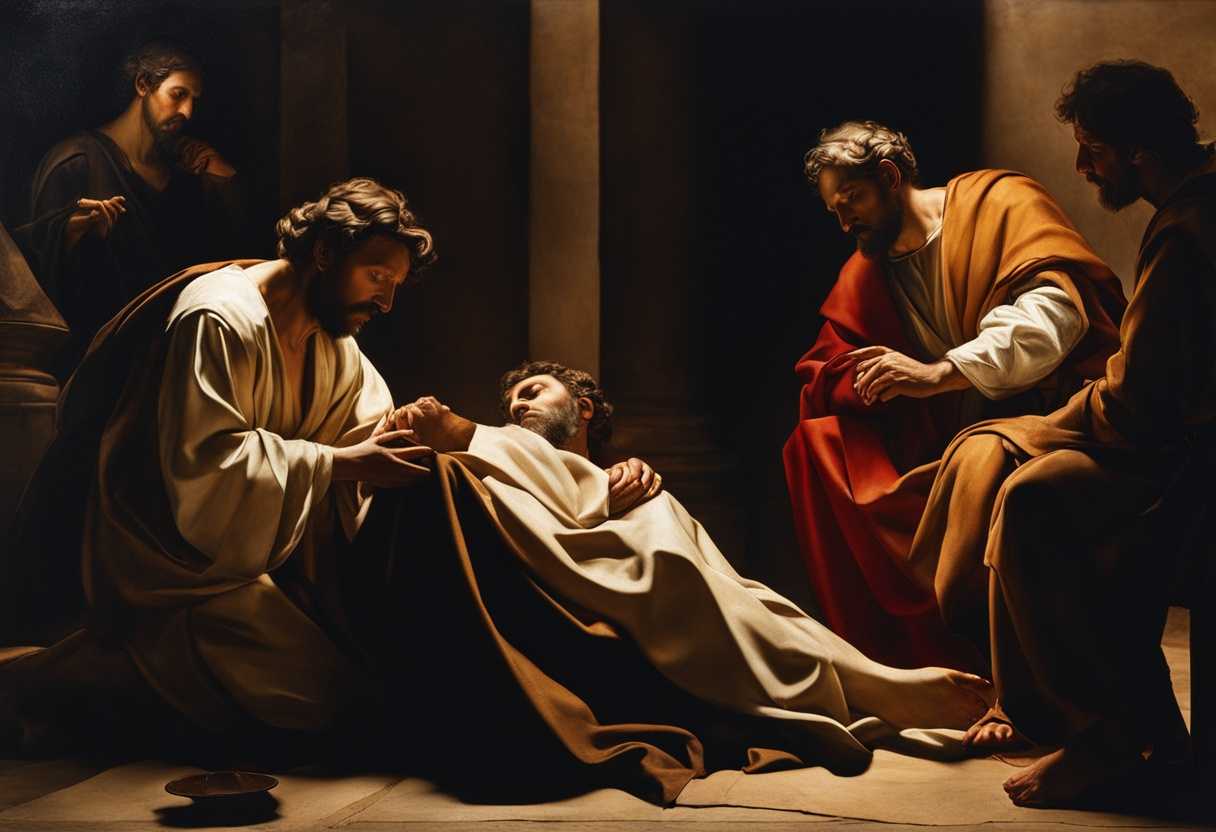
“Doubting Thomas” refers to the Apostle Thomas, who expressed skepticism about Jesus’ resurrection until he saw the wounds of Christ himself (John 20:24-29). This term has come to symbolize someone who is skeptical or requires physical proof before believing something.
Scripture
24 Now Thomas, one of the twelve, called the Twin, was not with them when Jesus came.
25 So the other disciples told him, “We have seen the Lord.” But he said to them, “Unless I see in his hands the mark of the nails, and place my finger into the mark of the nails, and place my hand into his side, I will never believe.”
26 Eight days later, his disciples were inside again, and Thomas was with them. Although the doors were locked, Jesus came and stood among them and said, “Peace be with you.”
27 Then he said to Thomas, “Put your finger here, and see my hands; and put out your hand, and place it in my side. Do not disbelieve, but believe.”
28 Thomas answered him, “My Lord and my God!”
29 Jesus said to him, “Have you believed because you have seen me? Blessed are those who have not seen and yet have believed.”
Doubting Thomas: Biblical Significance Explained
The story of “Doubting Thomas” in John 20:24-29 highlights a profound theological and psychological exploration of faith and belief. After the resurrection of Jesus, Thomas, one of the twelve disciples, finds it difficult to accept the testimony of his fellow apostles who claimed that the Lord had risen from the dead. In his insistence on wanting to see and touch the physical wounds of Jesus, Thomas embodies a universal human struggle with doubt, especially in the face of extraordinary claims. Jesus’ response to Thomas—”Blessed are those who have not seen and yet have believed” (John 20:29)—serves both as a critique of Thomas’s skepticism and an affirmation of those who find faith in the absence of tangible proof.
The broader meaning of this incident speaks to the nature of belief in the Christian faith. It suggests that faith is often challenged by doubt but also signifies growth and maturity in one’s spiritual journey. The encounters of Thomas with the risen Christ underline the importance of personal experience in one’s faith; while Thomas required physical evidence to believe, the experience ultimately transformed him into a devoted disciple who would later spread the message of the Gospel, suggesting that doubt can lead to deeper understanding and commitment. Furthermore, this account resonates with the prophetic words from Hebrews 11:1, “Now faith is confidence in what we hope for and assurance about what we do not see.” Thus, Thomas’s story invites believers to grapple with their uncertainties while encouraging them to seek understanding and deeper faith, highlighting that doubt can coexist with belief, ultimately leading to a more profound spiritual revelation.
The portrayal of Thomas as a “Doubter” raises important questions about the nature of faith itself and the journey toward belief. Throughout biblical narratives, doubt is presented not merely as a flaw but as a vital aspect of the faith experience. For example, the story of Gideon (Judges 6-7) recounts how this leader asked for signs from God to affirm his calling, reflecting a similar quest for assurance amid uncertainty. This interplay of doubt and faith underscores a recurring theme in scripture where individuals, rather than being chastised for their skepticism, are often invited into deeper conversation with God. Such interactions emphasize that doubt can serve as a catalyst for a more authentic relationship with the divine, where individuals wrestle with their own beliefs and ultimately emerge with renewed strength in their faith.
Moreover, Thomas’s story resonates with the struggles faced by many believers throughout history, including the prophets and early Christians who confronted doubts in their own lives. The importance of community in addressing these doubts is evident as well, as it was the collective witness of the apostles that initially spurred his skepticism and subsequent transformation. This dynamic suggests that fellowship and openness about one’s struggles can foster an environment where individuals can navigate their uncertainties, ultimately leading to a more robust faith. Thus, the legacy of Thomas invites believers to embrace their doubts as legitimate experiences on their spiritual journeys, encouraging them not only to seek answers but also to trust in the process of faith development that can arise from moments of questioning.
The Nature of Faith and Doubt
The story of Doubting Thomas illustrates the complex relationship between faith and doubt. It highlights that doubt is a natural part of the human experience, especially when faced with extraordinary claims or events. This narrative encourages believers to confront their uncertainties and seek deeper understanding, suggesting that questioning can lead to a more profound faith rather than a rejection of it.
The Importance of Personal Experience
Doubting Thomas emphasizes the significance of personal experience in the journey of faith. Thomas’s desire for tangible proof reflects a broader human need for evidence and assurance. This story suggests that personal encounters with the divine can strengthen belief, and that faith is often deepened through individual experiences rather than solely through communal or secondhand accounts.
The Role of Community in Faith Development
The account of Doubting Thomas also underscores the role of community in nurturing faith. Thomas’s initial skepticism contrasts with the collective belief of the other disciples, illustrating how community can provide support and encouragement in times of doubt. This narrative serves as a reminder that faith can be cultivated through shared experiences and the testimonies of others, fostering a sense of belonging and collective growth in spiritual understanding.
How to Embrace Faith While Navigating Skepticism in Christianity
Navigating skepticism while embracing faith can feel like walking a tightrope, but it’s a journey that can deepen your relationship with God. Start by acknowledging your doubts; they are not a sign of weakness but an opportunity for growth. Engage with scripture, prayer, and community to seek understanding and clarity. Remember, even the disciples had moments of doubt, yet they were still called to follow Jesus. Surround yourself with fellow believers who can share their experiences and insights, creating a safe space for open dialogue. Embrace the mystery of faith, knowing that it’s okay not to have all the answers. Trust that God is big enough to handle your questions, and allow your skepticism to lead you to a more profound, authentic faith.
Bible References to Doubting Thomas:
Matthew 28:16-17: 16 Now the eleven disciples went to Galilee, to the mountain to which Jesus had directed them.
17 And when they saw him they worshiped him, but some doubted.
Mark 16:9-14: 9 [[Now when he rose early on the first day of the week, he appeared first to Mary Magdalene, from whom he had cast out seven demons.]]
10 She went and told those who had been with him, as they mourned and wept.
11 But when they heard that he was alive and had been seen by her, they would not believe it.
12 After these things he appeared in another form to two of them, as they were walking into the country.
13 And they went back and told the rest, but they did not believe them.
14 Afterward he appeared to the eleven themselves as they were reclining at table, and he rebuked them for their unbelief and hardness of heart, because they had not believed those who saw him after he had risen.
Luke 24:36-43: 36 As they were talking about these things, Jesus himself stood among them, and said to them, “Peace to you!”
37 But they were startled and frightened and thought they saw a spirit.
38 And he said to them, “Why are you troubled, and why do doubts arise in your hearts?
39 See my hands and my feet, that it is I myself. Touch me, and see. For a spirit does not have flesh and bones as you see that I have.”
40 And when he had said this, he showed them his hands and his feet.
41 And while they still disbelieved for joy and were marveling, he said to them, “Have you anything here to eat?”
42 They gave him a piece of broiled fish,
43 and he took it and ate before them.
John 14:5-7: 5 Thomas said to him, “Lord, we do not know where you are going. How can we know the way?”
6 Jesus said to him, “I am the way, and the truth, and the life. No one comes to the Father except through me.
7 If you had known me, you would have known my Father also. From now on you do know him and have seen him.
John 11:14-16: 14 Then Jesus told them plainly, “Lazarus has died,
15 and for your sake I am glad that I was not there, so that you may believe. But let us go to him.
16 So Thomas, called the Twin, said to his fellow disciples, “Let us also go, that we may die with him.”
Acts 1:1-3: 1 In the first book, O Theophilus, I have dealt with all that Jesus began to do and teach,
2 until the day when he was taken up, after he had given commands through the Holy Spirit to the apostles whom he had chosen.
3 He presented himself alive to them after his suffering by many proofs, appearing to them during forty days and speaking about the kingdom of God.

Reverend Ogunlade is a seasoned Church Minister with over three decades of experience in guiding and nurturing congregations. With profound wisdom and a serene approach, Reverend Ogunlade has carried out various pastoral duties, including delivering uplifting sermons, conducting religious ceremonies, and offering sage counsel to individuals seeking spiritual guidance. Their commitment to fostering harmony and righteousness within their community is exemplified through their compassionate nature, making them a beloved and trusted figure among the congregation.