
John 20:24-29 is about the doubt of Thomas and Jesus’ response to him, emphasizing the importance of faith even without seeing physical evidence.
24 Now Thomas, one of the twelve, called the Twin, was not with them when Jesus came.
25 So the other disciples told him, “We have seen the Lord.” But he said to them, “Unless I see in his hands the mark of the nails, and place my finger into the mark of the nails, and place my hand into his side, I will never believe.”
26 Eight days later, his disciples were inside again, and Thomas was with them. Although the doors were locked, Jesus came and stood among them and said, “Peace be with you.”
27 Then he said to Thomas, “Put your finger here, and see my hands; and put out your hand, and place it in my side. Do not disbelieve, but believe.”
28 Thomas answered him, “My Lord and my God!”
29 Jesus said to him, “Have you believed because you have seen me? Blessed are those who have not seen and yet have believed.”
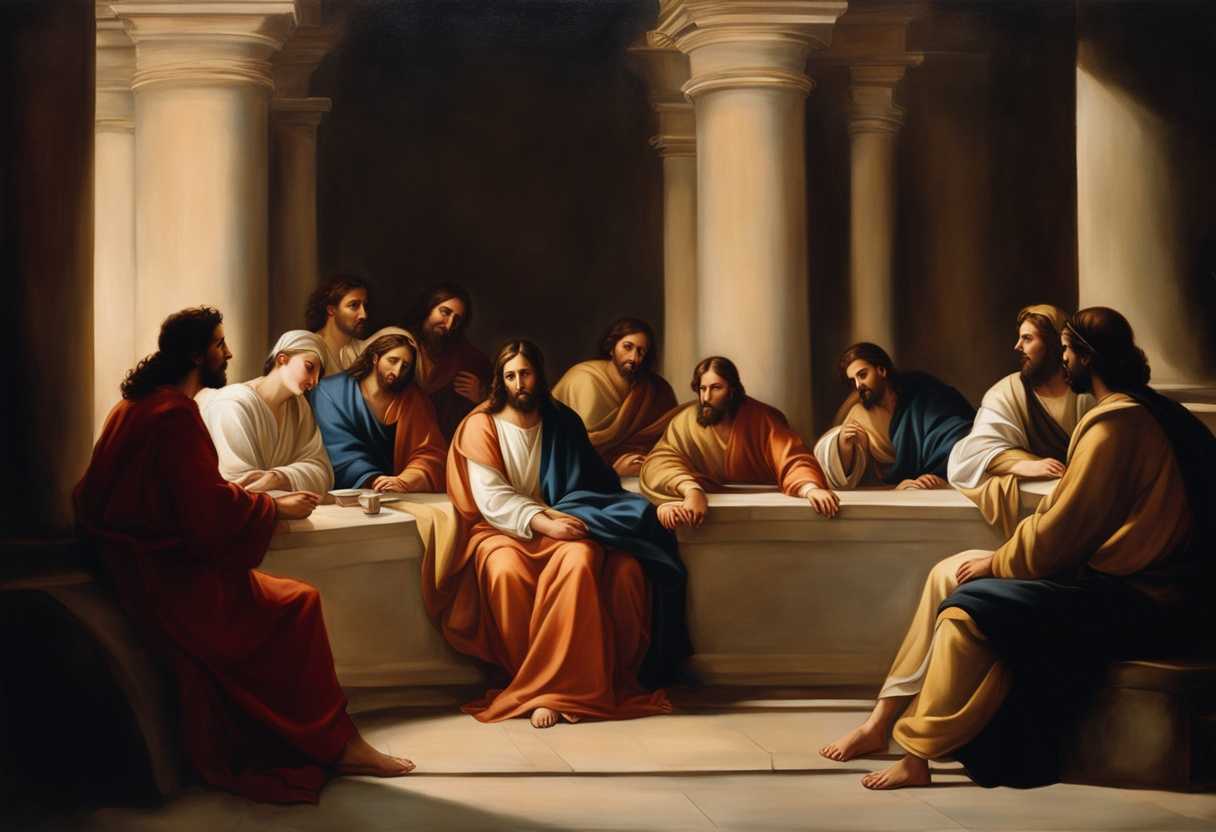
Setting the Scene for John 20:24-29
The scene in John chapter 20:24-29 takes place in a room where the disciples had gathered after the resurrection of Jesus. The disciples were still reeling from the events of the crucifixion and the reports of Jesus being alive. However, Thomas, one of the disciples, was not present when Jesus first appeared to them. Thomas expressed doubt and insisted that he needed to see and touch the wounds of Jesus to believe in his resurrection.
The disciples were gathered in fear and uncertainty, locked in the room for safety. Suddenly, Jesus appeared among them, despite the locked doors, and greeted them with peace. He then turned to Thomas and invited him to touch his wounds, addressing his doubt directly. Overwhelmed with emotion and conviction, Thomas declared, “My Lord and my God!” in a powerful moment of realization and faith. This encounter solidified the disciples’ belief in the resurrection and the divinity of Jesus.
The room where this scene unfolded was likely dimly lit, with the disciples huddled together in a mix of fear, confusion, and hope. The atmosphere would have been tense and charged with emotion as they grappled with the miraculous events they were witnessing. Jesus’ sudden appearance would have brought a sense of awe and wonder, transforming their fear into joy and belief. The room itself would have been simple, perhaps with a few scattered belongings and a table where they had gathered, now the backdrop for a profound moment of faith and revelation.
What is John 20:24-29 about?
The disciple named Thomas is referred to as “Doubting Thomas” in this verse. Thomas struggled to believe in Jesus’ resurrection until he physically saw Jesus’ wounds from the crucifixion. Despite his initial doubts, Thomas’s faith was ultimately strengthened through this encounter. This story highlights the importance of experiencing faith firsthand and being open to belief even in the face of doubts.
Have you ever doubted something until you witnessed it with your own eyes? Thomas’s journey from skepticism to belief serves as a powerful reminder that sometimes we need tangible evidence to strengthen our faith. It also teaches us the value of being open to new experiences and perspectives, even if they challenge our current beliefs. This verse ultimately encourages us to trust in what we cannot see and to remain open to the possibility of faith, even in moments of doubt.
Understanding what John 20:24-29 really means
In John 20:24-29, we encounter the familiar narrative of Thomas, a disciple who grappled with doubt regarding Jesus’ resurrection. Thomas’s insistence on physical proof before believing serves as a poignant reminder of our innate inclination to seek tangible evidence in matters of faith. His words, “Unless I see the nail marks in his hands and put my finger where the nails were, and put my hand into his side, I will not believe,” echo the sentiments of many who struggle with faith in the unseen. This skepticism is not uncommon, as doubt often creeps into our hearts, prompting us to question what we cannot perceive with our senses.
However, Jesus’ response to Thomas, “Stop doubting and believe,” gently redirects the focus from empirical evidence to unwavering faith. This call to trust in the unseen underscores the essence of faith – a confident assurance in what is hoped for and a conviction about what is not seen, as Hebrews 11:1 beautifully articulates. It challenges us to transcend our reliance on physical proof and instead anchor our beliefs in the promises of Christ, living not by sight but by faith, as 2 Corinthians 5:7 emphasizes.
Moreover, Jesus’s declaration, “Blessed are those who have not seen and yet have believed,” extends a profound blessing to all future believers who would come to faith without the privilege of witnessing Christ’s physical presence. This statement highlights the value and commendation of faith that transcends the need for visible confirmation. It beckons us to embrace a faith that surpasses the limitations of our senses and rests securely on the foundation of God’s truth.
In today’s world, characterized by skepticism and a thirst for empirical validation, the story of Thomas resonates deeply. Many individuals grapple with doubts and uncertainties, yearning for tangible proof of the divine. Yet, this passage serves as a beacon of hope, encouraging believers to trust in the unseen, to hold fast to the promises of Christ even when they seem intangible. It reassures us that faith, though unseen, is a blessed and commendable path, leading us to a deeper relationship with our Savior.
Consider a child learning to ride a bike, hesitant to let go of the training wheels out of fear of falling. The parent’s reassurance to trust in their guidance mirrors Jesus’s call to Thomas and to us – to release our doubts and embrace faith wholeheartedly. Just as the child experiences the exhilaration of riding freely once they let go, believers find true joy and peace in surrendering their doubts and placing unwavering trust in Christ’s promises.
In conclusion, the account of Thomas serves as a poignant reminder of the transformative power of faith. It challenges us to move beyond doubt, to relinquish our need for visible proof, and to embrace a belief that transcends the physical realm. By aligning our hearts with the blessed ranks of those who believe without seeing, we embark on a journey of faith and trust in God’s unfailing word, experiencing the fullness of life that comes from walking in unwavering faith.
What must we see to believe?
To believe, one must see and touch the evidence before them. Doubt may linger until physical proof is presented. Yet, blessed are those who have not seen and still believe in the unseen. The depth of faith lies not in what our eyes can perceive, but in the conviction of the heart. Through belief in the unseen, true faith blossoms and grows stronger.
Thomas required tangible proof to believe, but Jesus showed him that faith goes beyond what the eyes can see. When doubts are dispelled, a profound realization emerges – faith is not dependent on physical proof but on spiritual understanding. The journey of faith involves a transformation where the unseen becomes more real and powerful than what is visible to the naked eye. Belief without seeing ultimately testifies to the strength of one’s faith.
Application
Think about how you trust a work project will come together or believe in your family’s love without seeing it every moment. Thomas had doubts but found faith in the end. This is your chance to face your own doubts head-on and trust in something greater. Strengthen your belief in the unseen and find truth in Christ’s words. Will you take this step to deepen your faith in the risen Savior today?

Reverend Michael Johnson is an experienced Church Minister with a profound expertise in spirituality and guidance. With a serene presence and a compassionate heart, he has faithfully served his congregation for over 20 years, leading them on a spiritual journey towards inner peace and enlightenment. Reverend Johnson’s extensive knowledge of religious philosophies and profound understanding of human nature have made him a trusted confidant and mentor to many, as he seamlessly weaves his profound wisdom into life teachings. Reverend Johnson’s calming demeanor and empathetic nature continue to uplift and heal souls, nurturing a sense of unity and tranquility within his community.