
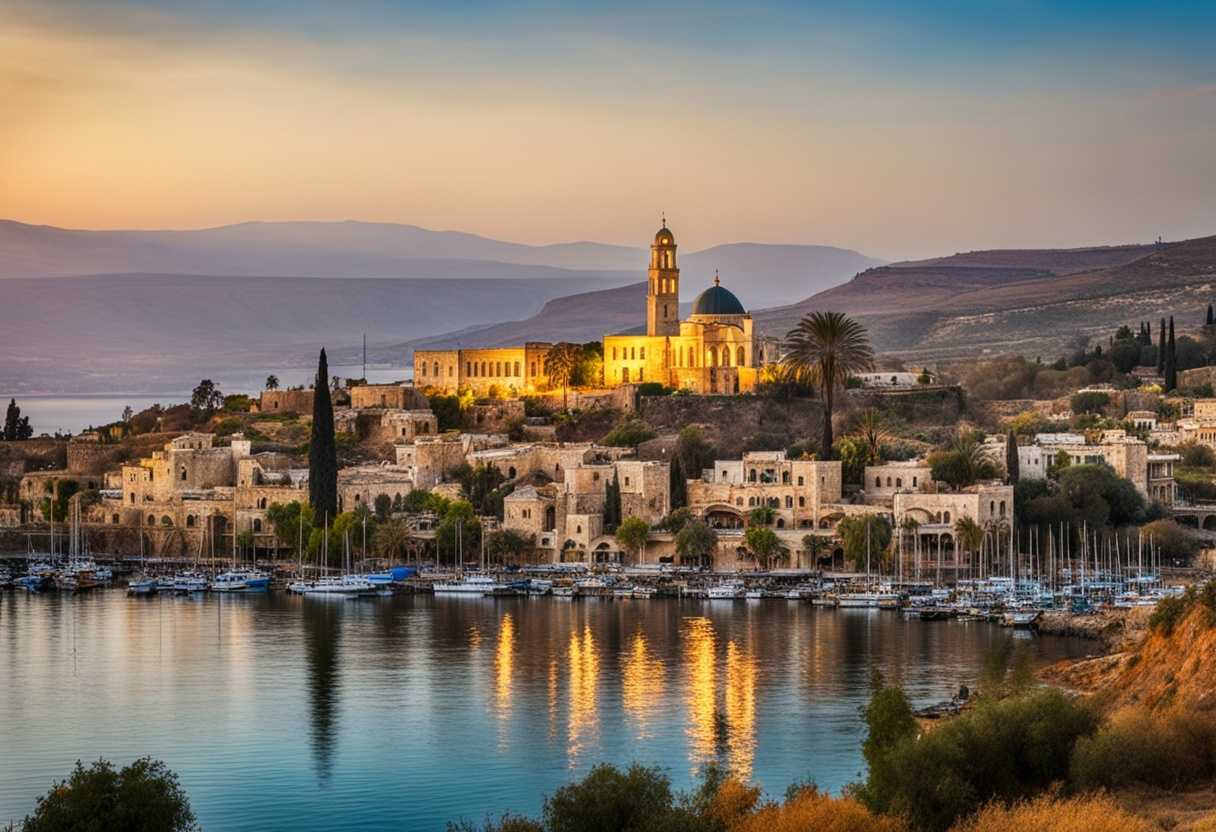
Tiberias is a city mentioned in the New Testament, notably as a location near the Sea of Galilee (John 6:1). It was known as a center of Jewish learning and culture during the time of Jesus, reflecting the intersection of Jewish and Roman influences in the region.
Scripture
1 After this Jesus went away to the other side of the Sea of Galilee, which is the Sea of Tiberias.
2 And a large crowd was following him, because they saw the signs that he was doing on the sick.
3 And Jesus went up on the mountain, and there he sat down with his disciples.
4 Now the Passover, the feast of the Jews, was at hand.
5 Lifting up his eyes, then, and seeing that a large crowd was coming toward him, Jesus said to Philip, “Where are we to buy bread, so that these people may eat?”
6 He said this to test him, for he himself knew what he would do.
7 Philip answered him, “Two hundred denarii worth of bread would not be enough for each of them to get a little.”
8 One of his disciples, Andrew, Simon Peter’s brother, said to him,
9 “There is a boy here who has five barley loaves and two fish, but what are they for so many?”
10 Jesus said, “Have the people sit down.” Now there was much grass in the place. So the men sat down, about five thousand in number.
11 Jesus then took the loaves, and when he had given thanks, he distributed them to those who were seated. So also the fish, as much as they wanted.
12 And when they had eaten their fill, he told his disciples, “Gather up the leftover fragments, that nothing may be lost.”
13 So they gathered them up and filled twelve baskets with fragments from the five barley loaves left by those who had eaten.
14 When the people saw the sign that he had done, they said, “This is indeed the Prophet who is to come into the world!”
15 Perceiving then that they were about to come and take him by force to make him king, Jesus withdrew again to the mountain by himself.
16 When evening came, his disciples went down to the sea,
17 got into a boat, and started across the sea to Capernaum.
18 The sea became rough because a strong wind was blowing.
19 When they had rowed about three or four miles, they saw Jesus walking on the sea and coming near the boat, and they were frightened.
20 But he said to them, “It is I; do not be afraid.”
21 Then they were glad to take him into the boat, and immediately the boat was at the land to which they were going.
22 On the next day the crowd that remained on the other side of the sea saw that there had been only one boat there, and that Jesus had not entered the boat with his disciples, but that his disciples had gone away alone.
23 Other boats from Tiberias came near the place where they had eaten the bread after the Lord had given thanks.
Meaning of Tiberias in the Bible
Tiberias, a city located on the western shore of the Sea of Galilee, embodies the intricate tapestry of cultural and religious exchange during the time of Jesus. Established by Herod Antipas and named after Emperor Tiberius, the city represents the Roman influence on Jewish life, which often created tensions reflected in the New Testament narratives. In John 6:1, Tiberias serves as a geographical marker, illustrating the region’s significance in the ministry of Jesus, who performed many miracles there. This context highlights the juxtaposition between the emerging Christian movement and the prevailing Roman culture, underscoring how the locale influenced the spread of Jesus’ teachings among diverse populations.
Furthermore, Tiberias became more influential in Jewish scholarship post-biblically, as the Talmud mentions it as a center of learning. This backdrop illustrates how the teachings of Jesus and the early Christian community emerged amidst complex socio-political dynamics. The very name “Tiberias” evokes a sense of transition, as the early church navigated shifting paradigms of belief and practice in the face of dominant Roman authority. The interplay of Hellenistic and Jewish thought in Tiberias not only set the stage for Jesus’ ministry but also foretold the broader cultural exchanges that would inform early Christianity, suggesting that locations like Tiberias were not merely geographical points but pivotal arenas of theological and cultural dialogue (John 6:1; Matthew 4:13).
Additionally, Tiberias stands as an important reference in the context of early Christian communities’ interaction with their Jewish heritage. The city, established in the first century CE, not only served as a significant urban center but also became a symbolic representation of the growing divide between Judaism and the new Christian sect. The presence of a Roman name and affiliations linked Tiberias to imperial rule, and its role as a hub for trade and travel further positioned it as a crossroads of faiths. This environment allowed for diverse influences, shaping the theological discourse of the time.
Scholarly works following the biblical era highlight Tiberias as a crucial site for the development of rabbinic Judaism, particularly after the destruction of the Second Temple in 70 CE. The city flourished during the time of the Amoraim, where significant Jewish legal and ethical teachings were compiled, particularly in the Talmud. As Christianity began to flourish, the scholarly activities in Tiberias provided fertile ground for debates that would influence both Jewish and early Christian thought. The later rabbinic literature often reflects on the tensions and divergences of these communities while navigating their complex identity within a Roman-dominated landscape, reinforcing Tiberias as a symbol of both conflict and coexistence in a transformative period for both faiths.
Historical Significance
Tiberias, a city located on the western shore of the Sea of Galilee, holds historical importance in the biblical narrative. Founded by Herod Antipas in honor of the Roman Emperor Tiberius, the city represents the intersection of Jewish and Roman cultures during the time of Jesus. Its establishment reflects the political dynamics of the era, showcasing how Roman influence permeated Jewish life. This context is crucial for understanding the socio-political environment in which Jesus and his followers operated.
Symbol of Transition
In the biblical context, Tiberias can also be seen as a symbol of transition. The city emerged as a center of Jewish life and scholarship after the destruction of the Second Temple in 70 CE. It became a hub for the compilation of the Talmud, representing a shift from the Temple-centric worship to a more community-oriented practice of faith. This transition highlights the resilience of the Jewish people and their ability to adapt to changing circumstances, which is a recurring theme in the Bible.
Spiritual Reflection
Tiberias is often associated with the themes of healing and miracles, particularly due to its proximity to the Sea of Galilee, where many of Jesus’ miracles took place. The city serves as a reminder of the transformative power of faith and the presence of divine intervention in everyday life. It invites reflection on the spiritual journeys of individuals and communities, emphasizing the importance of seeking solace and healing in times of distress.
How to Embrace Historical Insights for Spiritual Growth
Embracing historical insights can profoundly enrich your spiritual journey as a Christian, allowing you to connect more deeply with the faith’s roots and the lives of those who have walked this path before you. Start by exploring the context in which the Bible was written—understanding the cultural, political, and social dynamics of ancient times can illuminate the messages and teachings of Scripture in ways that resonate with your own life today. Consider reading works by early church fathers or engaging with historical commentaries that shed light on the interpretations and practices of early Christians. This not only deepens your understanding but also fosters a sense of continuity with the broader Christian community throughout the ages. As you reflect on these insights, let them inspire you to live out your faith with the same passion and commitment that characterized those who came before you, reminding you that you are part of a rich tapestry of believers striving to embody Christ’s love in the world.
Bible References to Tiberias Meaning:
John 21:1-14: 1 After this Jesus revealed himself again to the disciples by the Sea of Tiberias, and he revealed himself in this way.
2 Simon Peter, Thomas (called the Twin), Nathanael of Cana in Galilee, the sons of Zebedee, and two others of his disciples were together.
3 Simon Peter said to them, “I am going fishing.” They said to him, “We will go with you.” So they went out and got into the boat, but that night they caught nothing.
4 Just as day was breaking, Jesus stood on the shore; yet the disciples did not know that it was Jesus.
5 Jesus said to them, “Children, do you have any fish?” They answered him, “No.”
6 He said to them, “Cast the net on the right side of the boat, and you will find some.” So they cast it, and now they were not able to haul it in, because of the quantity of fish.
7 That disciple whom Jesus loved therefore said to Peter, “It is the Lord!” When Simon Peter heard that it was the Lord, he put on his outer garment, for he was stripped for work, and threw himself into the sea.
8 The other disciples came in the boat, dragging the net full of fish, for they were not far from the land, but about a hundred yards off.
9 When they got out on land, they saw a charcoal fire in place, with fish laid out on it, and bread.
10 Jesus said to them, “Bring some of the fish that you have just caught.”
11 So Simon Peter went aboard and hauled the net ashore, full of large fish, 153 of them. And although there were so many, the net was not torn.
12 Jesus said to them, “Come and have breakfast.” Now none of the disciples dared ask him, “Who are you?” They knew it was the Lord.
13 Jesus came and took the bread and gave it to them, and so with the fish.
14 This was now the third time that Jesus was revealed to the disciples after he was raised from the dead.

Rev. François Dupont is a dedicated church minister with a wealth of experience in serving spiritual communities. With a calm and serene demeanor, he has been devoted to sharing the message of love, compassion, and tolerance for over two decades. Through his thoughtful sermons, compassionate counseling, and unwavering support, Rev. Dupont has touched the lives of countless individuals, allowing them to find solace and strength during difficult times. His serene presence and deep understanding of the human condition make him a trusted guide for those seeking spiritual nourishment and guidance.