
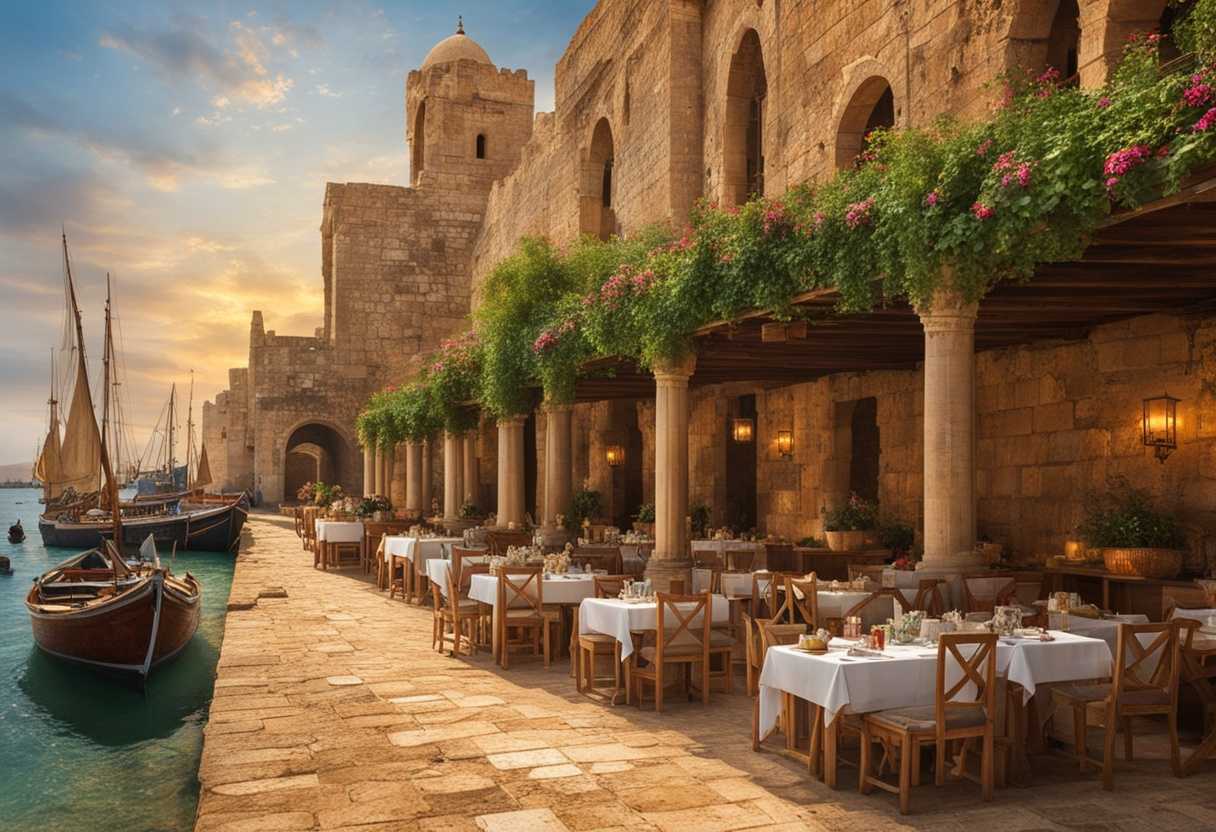
Zidon, also known as Sidon, is an ancient city mentioned in the Bible, often associated with the Phoenicians and regarded as a center of trade and idolatry. It is located in modern-day Lebanon and is referenced in various biblical passages, notably in relation to the cities of Tyre and the lineage of the Canaanites.
Scripture
15 Canaan fathered Sidon his firstborn and Heth,
16 the Jebusites, the Amorites, the Girgashites,
17 the Hivites, the Arkites, the Sinites,
18 the Arvadite, the Zemarite, and the Hamathite. Afterward the clans of the Canaanites spread abroad.
19 And the territory of the Canaanites extended from Sidon in the direction of Gerar as far as Gaza, and in the direction of Sodom, Gomorrah, Admah, and Zeboiim, as far as Lasha.
Meaning of Zidon in the Bible
Zidon, or Sidon, holds a significant place in the biblical narrative as a symbol of both prosperity and spiritual decline. Situated on the coast of modern-day Lebanon, Zidon was a prominent Phoenician city known for its commerce, particularly in purple dye and glass, making it integral to ancient trade networks. This economic status is mentioned in several biblical texts, where it is often juxtaposed with moral and spiritual admonitions. For example, in Ezekiel 27:8-9, Zidon is praised for its skilled craftsmen and merchant ships, yet this prosperity is interwoven with a call for accountability, highlighting the city’s eventual downfall due to idolatry and immorality.
Moreover, Zidon serves as a representation of the wider struggle between the Israelites and surrounding nations filled with pagan practices. In Joshua 11:8 and Judges 1:31, the conquest of Canaan is marked by the failure to fully subdue regions like Zidon, indicating a lingering influence of Canaanite worship, which ultimately challenged the Israelite faith. Jesus notably references the city in Matthew 11:21, where he condemns the cities of Israel for their unbelief, contrasting them with the people of Zidon, who would have repented had they witnessed the miracles performed by Him. Thus, the significance of Zidon transcends its geographical location, embodying themes of trade, cultural exchange, spiritual failure, and the quest for true faith amid worldly distractions.
In addition to its economic significance, Zidon is also highlighted in the accounts of the Israelite monarchy, illustrating the complex relationships between the Israelites and surrounding nations. The city is notably associated with the royal marriage of King Ahab to Jezebel, a Sidonian princess. This union brought Baal worship into Israel, leading to widespread idolatry and moral corruption among the people (1 Kings 16:31-32). The infusion of Sidonian influence through this marriage exemplifies how Zidon not only represents material wealth but also spiritual peril, as the practices of its people infiltrated Israelite society, prompting prophetic confrontations and calls for repentance, notably from Elijah.
Zidon also serves as a literary backdrop in prophetic literature, where it is often mentioned in the context of judgment and restoration. The city features in prophecies that encompass the broader Mediterranean context, linking its fate with that of other nations. Prophets like Isaiah and Jeremiah reference Sidon primarily to emphasize the consequences of pride, arrogance, and abandonment of the true God. These prophetic pronouncements reflect the belief that Zidon, despite its historical and commercial prominence, would ultimately face divine judgment for its idolatrous practices and moral failures. Thus, Zidon becomes a symbol not only of cultural and economic richness but also of the spiritual challenges and divine accountability that are pivotal themes throughout the biblical narrative.
Historical Significance of Zidon
Zidon, also known as Sidon, was one of the oldest cities in the ancient Near East and a prominent Phoenician city-state. Its historical significance lies in its role as a major center for trade and commerce in the Mediterranean region. The city was known for its skilled artisans, particularly in the production of purple dye and glass, which were highly valued in the ancient world. This economic prowess contributed to the cultural and political influence of the Phoenicians, who were known for their seafaring and trading capabilities.
Symbol of Idolatry and Moral Decline
In the biblical narrative, Zidon is often associated with idolatry and the worship of Baal and Asherah, which were prevalent among the Phoenician people. This association serves as a symbol of moral decline and the dangers of turning away from the worship of the God of Israel. The references to Zidon in the context of idolatry highlight the challenges faced by the Israelites in maintaining their faith amidst surrounding cultures that practiced polytheism and engaged in morally questionable practices.
Geopolitical Context
Zidon also represents the geopolitical dynamics of the ancient world, particularly the interactions between Israel and its neighboring nations. The city was often mentioned in relation to conflicts and alliances, illustrating the complex relationships between the Israelites and the Phoenicians. This context underscores the broader themes of territorial disputes, cultural exchanges, and the impact of foreign influence on the spiritual and social life of the Israelite people.
How to Embrace Heritage for Spiritual Growth and Understanding
Embracing your heritage can be a profound way to deepen your spiritual growth and understanding as a Christian. Our backgrounds, traditions, and cultural narratives shape who we are and how we relate to God and others. Take time to explore the stories of your ancestors, the faith practices they held dear, and the values they instilled in you. This exploration can lead to a richer appreciation of the diverse ways God has worked throughout history and in different communities. Engage with your heritage by incorporating meaningful rituals, music, or prayers into your spiritual life, allowing them to enrich your relationship with God. Remember, as you honor your roots, you also connect with the broader tapestry of faith that spans generations, reminding you that you are part of a larger story of redemption and grace. Embrace this journey with an open heart, and you may find that it not only strengthens your faith but also fosters a deeper sense of belonging within the body of Christ.
Bible References to the Meaning of Zidon:
Joshua 11:8-9: 8 And the Lord gave them into the hand of Israel, who struck them and chased them as far as Great Sidon and Misrephoth-maim, and eastward as far as the Valley of Mizpeh. And they struck them until he left none remaining.
9 And Joshua did to them just as the Lord said to him: he hamstrung their horses and burned their chariots with fire.
Judges 10:6-7: 6 The people of Israel again did what was evil in the sight of the Lord and served the Baals and the Ashtaroth, the gods of Syria, the gods of Sidon, the gods of Moab, the gods of the Ammonites, and the gods of the Philistines. And they forsook the Lord and did not serve him.
7 So the anger of the Lord was kindled against Israel, and he sold them into the hand of the Philistines and into the hand of the Ammonites,
1 Kings 5:1-6: 5 Now Hiram king of Tyre sent his servants to Solomon when he heard that they had anointed him king in place of his father, for Hiram always loved David.
2 And Solomon sent word to Hiram,
3 “You know that David my father could not build a house for the name of the Lord his God because of the warfare with which his enemies surrounded him, until the Lord put them under the soles of his feet.”
4 But now the Lord my God has given me rest on every side. There is neither adversary nor misfortune.
5 And so I intend to build a house for the name of the Lord my God, as the Lord said to David my father, ‘Your son, whom I will set on your throne in your place, shall build the house for my name.’
6 Now therefore command that cedars of Lebanon be cut for me. And my servants will join your servants, and I will pay you for your servants such wages as you set, for you know that there is no one among us who knows how to cut timber like the Sidonians.
Isaiah 23:1-4: 1 The oracle concerning Tyre. Wail, O ships of Tarshish, for Tyre is laid waste, without house or harbor! From the land of Cyprus it is revealed to them.
2 Be still, O inhabitants of the coast; the merchants of Sidon, who cross the sea, have filled you.
3 And on many waters your revenue was the grain of Shihor, the harvest of the Nile was her revenue, and she became the marketplace of the nations.
4 Be ashamed, O Sidon, for the sea has spoken, the stronghold of the sea, saying: “I have neither labored nor given birth, I have neither reared young men nor brought up young women.”
Jeremiah 25:15-22: 15 Thus the Lord, the God of Israel, said to me: “Take from my hand this cup of the wine of wrath, and make all the nations to whom I send you drink it.
16 They shall drink and stagger and be crazed because of the sword that I am sending among them.
17 So I took the cup from the Lord’s hand, and made all the nations to whom the Lord sent me drink it:
18 Jerusalem and the cities of Judah, its kings and officials, to make them a desolation and a waste, a hissing and a curse, as at this day;
19 Pharaoh king of Egypt, his servants, his officials, all his people,
20 all the mixed tribes among all the kings of the land of Uz and all the kings of the land of the Philistines and Ashkelon and Gaza and Ekron and the remnant of Ashdod,
21 Edom, Moab, and the sons of Ammon,
22 all the kings of Tyre, all the kings of Sidon, and the kings of the coastland across the sea;
Ezekiel 28:20-24: 20 The word of the Lord came to me:
21 “Son of man, set your face against Sidon, and prophesy against her,”
22 And say, Thus says the Lord God: “Behold, I am against you, O Sidon, and I will manifest my glory in your midst. And they shall know that I am the Lord when I execute judgments in her and manifest my holiness in her;
23 For I will send pestilence into her, and blood into her streets; and the slain shall fall in her midst, by the sword that is against her on every side. Then they will know that I am the Lord.
24 “And for the house of Israel there shall be no more a brier to prick or a thorn to hurt them among all their neighbors who have treated them with contempt. Then they will know that I am the Lord God.”
Joel 3:4-8: 4 “What are you to me, O Tyre and Sidon, and all the regions of Philistia? Are you paying me back for something? If you are paying me back, I will return your payment on your own head swiftly and speedily.
5 Because you have taken my silver and my gold, and have carried my rich treasures into your temples,
6 You have sold the people of Judah and Jerusalem to the Greeks, removing them far from their own border.
7 Behold, I will stir them up from the place to which you have sold them, and I will return your payment on your own head.
8 I will sell your sons and your daughters into the hand of the people of Judah, and they will sell them to the Sabeans, to a nation far away, for the Lord has spoken.”
Zechariah 9:1-4: 9 Rejoice greatly, O daughter of Zion! Shout aloud, O daughter of Jerusalem! Behold, your king is coming to you; righteous and having salvation is he, humble and mounted on a donkey, on a colt, the foal of a donkey.
2 and on Hamath also, which borders on it, Tyre and Sidon, though they are very wise.
3 Tyre has built herself a rampart
and heaped up silver like dust,
and fine gold like the mud of the streets.
4 Behold, the Lord will strip her of her possessions and strike down her power on the sea, and she shall be devoured by fire.
Matthew 15:21-28: 21 And Jesus went away from there and withdrew to the district of Tyre and Sidon.
22 And behold, a Canaanite woman from that region came out and was crying, “Have mercy on me, O Lord, Son of David; my daughter is severely oppressed by a demon.”
23 But he did not answer her a word. And his disciples came and begged him, saying, “Send her away, for she is crying out after us.”
24 He answered, “I was sent only to the lost sheep of the house of Israel.”
25 But she came and knelt before him, saying, “Lord, help me.”
26 But he answered, “It is not right to take the children’s bread and throw it to the dogs.”
27 She said, “Yes, Lord, yet even the dogs eat the crumbs that fall from their masters’ table.”
28 Then Jesus answered her, “O woman, great is your faith! Be it done for you as you desire.” And her daughter was healed instantly.

Rev. François Dupont is a dedicated church minister with a wealth of experience in serving spiritual communities. With a calm and serene demeanor, he has been devoted to sharing the message of love, compassion, and tolerance for over two decades. Through his thoughtful sermons, compassionate counseling, and unwavering support, Rev. Dupont has touched the lives of countless individuals, allowing them to find solace and strength during difficult times. His serene presence and deep understanding of the human condition make him a trusted guide for those seeking spiritual nourishment and guidance.